Race

Podcast: Are sweaty men exercising at dawn (then praying) a New York Times story?

Podcast: Are sweaty men exercising at dawn (then praying) a New York Times story?

Anyone who watches advertisements during football games knows that American men are doing just great, these days.

There appear to be gazillions of racially diverse circles of thin men out there — roughly 30-50 years of age — who get together all the time in sports bars with loads of disposable income to spend on beer and mountains of chicken wings in a wide variety of flavors. Others travel all over the place in their rad sports vehicles or those pick-up trucks that are part troop-carriers, part luxury vehicles.

There are some rotund, middle-aged, often bald, White losers out there, of course, but their family members or lovers are still around to laugh at their misadventures.

Yes, this screed from an elderly guy (on a diet, even) is directly connected with this week’s “Crossroads” podcast (CLICK HERE to tune that in). This week’s program focused on a fine, fascinating New York Times piece by religion-beat pro Ruth Graham. The double-decker headline on this piece proclaimed:

For Suburban Texas Men, a Workout Craze With a Side of Faith

In Katy, outside Houston, many men have taken up F3, a no-frills fitness group where members push themselves physically but also bond emotionally.

I heard from several readers praising this story (and followed buzz on Twitter) and people kept saying: What inspired the Gray Lady to do a positive story about a bunch of evangelical men (one with a “Republic of Texas” tattoo) bonding through exercise, fellowship, service and prayer?

The first answer: The story was written by a veteran religion reporter, not someone off the political or strange cultures desk. The men talk, they tell their own stories. They are not walking straw men ready for a beating. By the way: It also looks like F3 groups, or at least the one in this feature, are pretty diverse in terms of race. Hold that thought.

I think the crucial statement is at the top of the article and it isn’t the lede. Here is the note from the editors:

We’re exploring how America defines itself one place at a time. In a Houston suburb, men have been flocking to a workout group that promises more than just a sweat session; together, they aim to ease male loneliness.

Note the touch of humility: “We’re exploring how America defines itself one place at a time (I added the bold type). The goal here is to let Americans outside describe their own lives, as opposed to the Times doing that for them?
Please respect our Commenting Policy

This just in! Southern Baptists are still very conservative on issues of marriage and sex!

This just in! Southern Baptists are still very conservative on issues of marriage and sex!

Let’s face it, it’s rather hard for a congregation to be “removed from fellowship” — that’s Baptist-ese for “kicked out” — from the Southern Baptist Convention.

After all, are we talking about ties being cut to the local association, a state convention (some states, for doctrinal reasons, have more than one) or the various programs linked to the national SBC? Then there are, for extra-conservative or extra-progressive congregations, alternative “fellowship” networks that have their own vague relationships with the larger SBC ship.

Finally, if a church is “removed from fellowship” and any or all of these levels of voluntary association, it may simply become an independent autonomous Baptist church, as opposed to an autonomous SBC church. Most local folks will never know the difference and independent, often nondenominational, congregations are the fastest growing sector of American religious life.

But if you dig into the Google search in my first paragraph, you will see that churches have been pushed out the exit door of SBC life for several reasons and that this is nothing new. However, it is true that these churches are being kicked out for reasons that many (not all) journalists may consider more worthy of coverage than others. Think “politics.”

Consider this summary material from a New York Times piece last year that ran with this headline: “Southern Baptists Expel 2 Churches Over Sex Abuse and 2 for L.G.B.T.Q. Inclusion.”

The Southern Baptist Convention is the nation’s largest Protestant denomination and has been increasingly divided in recent years over a variety of cultural and political issues, including racism, sexuality and white evangelicals’ embrace of former President Donald J. Trump. …

[A]n increasingly influential conservative wing of the denomination accuses those leaders of prioritizing “social justice” over biblical truth. They denounce the encroachment of “critical race theory” — an academic framework intended to capture the deep influence of racism — and accuse the S.B.C.’s national leadership of being out of step with the rank and file.

It’s pretty easy to spot the subjects that would leap into headlines, right?

There is, for example, nothing new about “progressive” Baptist congregations veering to the doctrinal left on issues linked to gender and sexuality.


Please respect our Commenting Policy

Ryan Burge at RNS: Thinking about the impact of political sermons, on left and right

Ryan Burge at RNS: Thinking about the impact of political sermons, on left and right

Hey churchgoers: How long has it been since you heard a political sermon?

Wait. We need to pause and discuss what a political sermon might sound like. For example, I think everyone would agree that an open endorsement of a political candidate from the pulpit would be “political.”

But what if a congregation or a denomination invited a political leader to speak in a worship service or some other event? This is something that happens on the political left and right. For generations, to name one example, Democrats have accepted warm, strategic invitations to speak — or perhaps simply exchange greetings — in African-American churches. It makes headlines when GOP leaders address major evangelical bodies (think Vice President Mike Pence and the Southern Baptist Convention).

More questions: What if a bishop or a preacher addresses issues that are clearly both doctrinal AND political, such as right-to-life concerns or threats to the environment? What about a conference focusing on ways religious groups can defend First Amendment rights, such as freedom of speech, freedom of association and freedom of religious practice? Is a liberal rally on abortion more “theocratic” than one organized by believers on the doctrinal right?

I ask these questions because of a piece GetReligion contributor Ryan Burge, he of the omnipresent charts and info on Twitter, wrote for Religion News Service. Here’s the newsy headline “When preachers get political, do they change minds? Preachers tend to risk political speech only when they know it will receive a warm reception.” The overture:

One of the most important and difficult questions among those who study religion and politics is just how important a pastor, rabbi, imam or other religious leader is when it comes to shaping the worldviews of their congregation. These figures get a weekly chance to dominate the attention of the people who come to listen to their sermons. They have a nearly unique opportunity to mold their congregants’ view of the theological, social and political world around them.

How often do pastors actually use that opportunity to speak out about the pressing issues of the day? Some new data gives us a look.

A Pew Research Center poll fielded in March of 2021 asked people if they had heard sermons that contained references to the fallout from the 2020 presidential election in the previous month. The survey asked about four topics specifically: the possibility that the 2020 election was rigged, former President Donald Trump’s inaccurate statements about election fraud, as well as support for or opposition to those who stormed the U.S. Capitol on Jan. 6, 2021.

That is certainly a rather Donald Trump-era dominated list, but that reflects several years of headlines. Meanwhile, it’s safe to say that President Joe Biden is in the White House, in large part, because of support from voters in Black churches during several primaries. But I digress.


Please respect our Commenting Policy

Podcast: Are Brigham Young sports controversies about sports, religion or politics?

Podcast: Are Brigham Young sports controversies about sports, religion or politics?

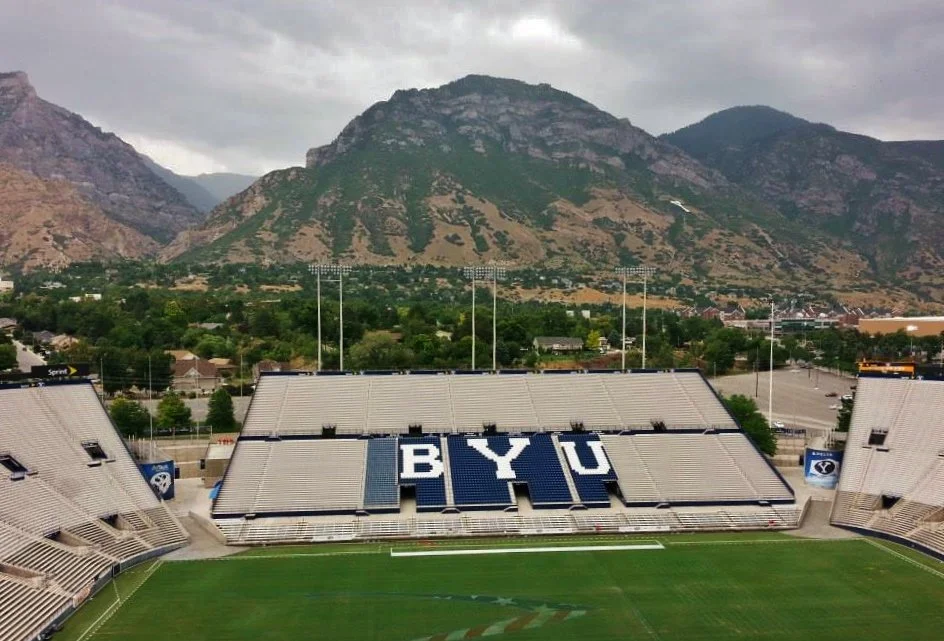
I have a journalism question, one that will require some time travel. Let’s flash back to the 2021 football game between the Brigham Young Cougars and the Baylor Bears, which was played in Waco, Texas, an interesting city known to many as “Jerusalem on the Brazos.”

After the first BYU score, a significant number of Baylor students are heard chanting “F*** the Mormons!” over and over. Or maybe, since we are talking about folks from a Baptist university, the chant is “Convert the Mormons!” The chant doesn’t focus on the “Cougars,” but on BYU’s obvious heritage with the Church of Jesus Christ of Latter-day Saints.

The chants were strong enough to be heard on broadcast media and, within minutes, there are clear audio recordings posted on social media.

My question, a which I asked during this week’s “Crossroads” podcast (CLICK HERE to tune that in): Would this nasty, crude event be considered a valid news story? In national coverage, would the religious ties of the two schools — soon to be rivals in the Big 12 — be discussed? In other words, would this be a religion-news story, as well as a sports story?

I think it’s pretty obvious that the answers would be “yes” and, again, “yes.”

This brings us, of course, to two BYU sports stories from recent weeks — one that received massive national coverage and the other that, well, didn’t get nearly as much ink. I think it’s valid to ask "Why?’ in both cases.

Before I share some links to coverage of the two stories, let’s pause and consider this related Religion News Service report: “Nearly 200 religious colleges deemed ‘unsafe’ for LGBTQ students by Campus Pride.” Here is the overture:

Dozens of religious universities across the country, including Seattle Pacific University in Washington and Brigham Young University in Utah, were listed as unsafe and discriminatory campuses for LGBTQ students by Campus Pride, a national organization advocating for inclusive colleges and universities.

Fewer than 10 of the 193 schools on the list released Thursday (Sept. 8), were not religiously affiliated or did not list a religious affiliation, according to Campus Pride.

The lengthy Campus Pride report on BYU opens with this statement (the shorter Baylor item appears here):

Brigham Young University has qualified for the Worst List because it has an established and well-documented history of anti-LGBTQ discrimination that endangers victims of sexual assault and has resulted in a call for it to not be included as a Big 12 school.

The key word, of course, is “endangers.”


Please respect our Commenting Policy

Question for journalists to mull: What will America's religious life look like in 50 years?

Question for journalists to mull: What will America's religious life look like in 50 years?

Scribes in the U.S. press snapped to attention last year when the Gallup Poll announced that as of 2020 less than half of Americans held religious memberships for the first time in its eight decades of asking the question. Only 47% of Americans said they belonged to a church, synagogue, mosque or other house of worship, a dramatic loss from the 70% as recently as 1999.

Now comes the Pew Research Center with a related pulse-pounder issued last week.

Pew figures that currently 64% of Americans (including children) identify as Christians in some sense, compared with 6% for other religions and a hefty 30% for “nones” and “nothing in particulars” — those without religious affiliation. Then we’re told that 50 years from now the Christian percentage may well fall to a modest 54% or even to a remarkable 35% in the worst-case scenario, while the non-religious population rises to somewhere between 34% and a slim majority of 52%.

Understandably, the Pew numbers became spot news for, among others, CBS, National Public Radio, the Washington Examiner and Washington Post, both newspapers in faith-focused Salt Lake City, USA Today, Britain’s The Guardian and a host of religious outlets.

This remains a good spot story for media that haven’t yet reported Pew’s basics. But even media that have reported the topline numbers could return to the theme with illustrative anecdotes and reactions from area religious leaders. And for sure journalists and religious analysts will want to give the full report some careful thought.

Pew emphasizes that its numbers are only “possibilities,” not “predictions of what will happen,” and comments that such a future would have “far-reaching consequences for politics, family life and civil society.” For example, also consider the multiple social science surveys that associate religious involvement with psychological and medical well-being and positive life outcomes for youths. Also, there is the impact of religious charity, not only effective huge organizations but private person-to-person interactions. Also, religions strengthen community in our “Bowling Alone” culture.

Pew calculated four future scenarios based largely upon the rates at which Americans may switch in or out of Christian identification and in or out of religious “none” status.


Please respect our Commenting Policy

Here's a solid religion information source for office, home libraries and (of course) newsrooms

Here's a solid religion information source for office, home libraries and (of course) newsrooms

Here are some interesting facts about war-ravaged Ukraine you might not have heard:

* The nation was 97% Christian in 1900, slumped to 60% when atheistic Soviet Communists held power, and has rebounded to 86%. But in one survey only 20% of Ukrainians said religion is “very important” for them.

* The Orthodox Church historically under the Moscow Patriarchate has 13.5 million members. But even before the current Russian invasion, the young rival Orthodox Church of the independent Kyiv Patriarchate had gained a bigger following of 16 million.

* Evangelical, Pentecostal and Charismatic Protestants, though a small minority, have so thrived since national independence in 1991 that Ukraine is known as Eastern Europe’s “Bible Belt.” Pentecostal believers who once survived in the underground church are now a force in civic affairs.

* Despite electing the first Jewish president, anti-Semitic incidents still occur.

* Regarding morals, “domestic violence is a massive problem,” especially in COVID-19 times, with complaints up 40% in the first half of 2020 compared with 2019.

Why mention these newsworthy pieces of information?

That’s a sampling of the sort of data about each of 233 countries you’ll find in the brand-new “Global Christianity: A Guide to the World’s Largest Religion from Afghanistan to Zimbabwe” (Zondervan Academic, $29.99 paperback). This valuable and inexpensive resource updates key information from the 2019 edition of the invaluable “World Christian Encyclopedia” (Edinburgh University Press, list price $270 with discounts online).

The new book’s editor is Gina Zurlo — https://ginazurlo.com; gzurlo@gordonconwell.edu) — co-editor of the “Encyclopedia” and co-director of the independent agency that produces it, the Center for the Study of Global Christianity at evangelical Gordon-Conwell Theological Seminary.


Please respect our Commenting Policy

Plug-In: Has Nashville become the 'new frontier' of today's religion news universe?

Plug-In: Has Nashville become the 'new frontier' of today's religion news universe?

Twenty years ago, I moved to Nashville, Tennessee, to work for The Associated Press.

I spent less than a year in Music City before transferring to Dallas, but oh, what a fun 11 months for a religion reporter (and country music fan).

I covered the fight over a proposed Tennessee lottery and a prayer service on the night the Iraq War began, but some of my favorite stories were less weighty:

A profile of a man who paid children $10 each to learn the Ten Commandments (until 15,000 “memorization affidavits” from across the nation flooded his mailbox after my story ran).

A feature on Gospel Music Week, when some of Nashville’s most popular bars and nightspots traded lying-and-cheating songs for hymns about prayer and redemption.

An interview with the 104-year-old widow of a famous Black traveling evangelist.

Blame Liam Adams, The Tennessean’s religion reporter, for this trip down memory lane.

In a fascinating deep dive published this week, Adams and his colleague Cole Villena delve into “Williamson County, the suburban ‘new frontier’ for American evangelical Christianity.”

“An already heavily Christian area is on track to become a capital of evangelicalism in the U.S.,” the story asserts, referring to the fast-growing county south of Nashville.

I pointed out to Adams on Twitter that my family lived in Williamson County — Spring Hill, to be precise — in our brief time in the Nashville area.

“All religion reporting roads lead through greater Nashville apparently,” chimed in Christianity Today’s Kate Shellnutt, herself a former Nashville resident.


Please respect our Commenting Policy

Podcast: Why are churches closing? There are many forces at work, but doctrine still matters

Podcast: Why are churches closing? There are many forces at work, but doctrine still matters

For years, there was a simple answer to the old question: Why do some churches grow, while others shrink?

You simply bought a copy of the 1972 book “Why Conservative Churches Are Growing: A Study in Sociology of Religion” by the late National Council of Churches leader Dean M. Kelley and that provided information answering lots (but not all) of the big questions. It was crucial that this groundbreaking book was written by a mainline Protestant insider, as opposed to a Southern Baptist or Assemblies of God leader.

Of course, everyone knew that some churches grew because of location, location, location. Also, there were always a few liberal churches that grew because of talented preachers or other strengths. Like I said: Kelley answered lots of church-decline questions, but not all of them.

What about 2022 in post-pandemic church life? For starters, many churches will never be post-pandemic — because many congregations (and maybe denominations or communions) were changed forever and we will see more evidence of that in the next few years.

All of this is an overture to this week’s “Crossroads” podcast (CLICK HERE to tune that in) which focuses on a must-read feature story by Godbeat veteran Bob Smietana. The headline at Religion News Service: “For a small Chicago church, closing down was an act of faith.” This was a personal, heartfelt story for Smietana, since this was a congregation that he once called home.

Like so many pastors around the United States, the Rev. Amanda Olson has kept one eye on the Bible and another on the evolving religious landscape.

She knew change was coming to the church in America.

Yet she hoped her congregation might be spared the worst of it.

“Everyone thinks that churches are going to close,” said Olson, the longtime pastor of Grace Evangelical Covenant Church on Chicago’s North Side. “But nobody thinks it is going to be their church.”


Please respect our Commenting Policy

Some trends in global Anglican Communion are starting to look rather Black and White

Some trends in global Anglican Communion are starting to look rather Black and White

There was nothing unusual about Nigerian Archbishop Henry Ndukuba leading the 2021 dedication rites for Holy Trinity Cathedral Church, which was packed with Nigerian Anglicans and a dozen or so bishops.

But this historic service was held in Houston and the cathedral is not part of the Diocese of Texas or the U.S. Episcopal Church. Some clergy at this Church of Nigeria North American Mission event were recognized as Anglicans by the Archbishop of Canterbury. Some were not.

This puzzle became more complicated recently during Lambeth 2022, which Nigeria boycotted, along with the churches of Uganda and Rwanda. Other Global South bishops, during Lambeth standoffs with Archbishop of Canterbury Justin Welby over the status of doctrines on marriage and sex, declined to receive Holy Communion with openly gay and lesbian bishops.

"There is a profound asymmetric quality to the Anglican Communion, where the voice of the bulk of its membership is either absent or muted," said the Rev. David Goodhew of St. Barnabas Church in Middlesborough, England. He is the author of a series of articles about African Anglicanism for Covenant, the weblog of The Living Church, an independent Anglican publication founded in 1878.

"If one adds up the number of bishops who didn't share Holy Communion at Lambeth … that is a very large number," he said. "I have been startled by the number of descriptions that said this Lambeth was a success. I don't know how one makes that claim when it would appear the bulk of the Anglican Communion's bishops couldn't come together to receive Communion. That looks like a disaster."

Bottom line: Global South Anglicans are experiencing a "volcano of growth" and remain "at loggerheads" with the shrinking churches of the United Kingdom, North America and other western nations. While most Global South bishops serve growing flocks -- roughly 75% of active worshipers in the 77-million-member Anglican Communion -- many western bishops lead what Goodhew called "micro-dioceses" with under 1,000 active members or "mini-dioceses" with fewer than 5,000.

The Church of Nigeria, meanwhile, claims 17 million members and the Center for Global Christianity at Gordon-Conwell Seminary, near Boston, estimates active participants at 22 million. The other churches skipping Lambeth 2022 were Uganda, with 10 million members, and Rwanda, with 1 million members.

The Church of England remains Anglicanism's power hub. It has 26 million members, but 2019 weekly attendance was about 679,000 -- before the COVID-19 crisis.


Please respect our Commenting Policy