
Daniel Pulliam
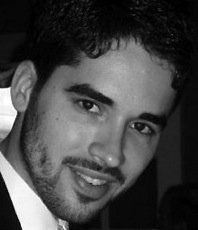
Greetings to the readers of GetReligion. As some of you may already know, Terry Mattingly and Doug LeBlanc have asked me to join this blog as one of its writers. I want to thank them for this opportunity and have been asked to say a few words about myself.
I am a 2004 graduate of Butler University in Indianapolis with a degree in journalism. From August 2004 to July 2007 I was a reporter in Washington, D.C., covering the administration of our nation's government for Government Executive. Past jobs/internships include stints at The Indianapolis Star, States News Service and The Roanoke Times.
In April 2007 I married my wife, Noelle.
As of August 2007 I started studying law at Indiana University School of Law in Indianapolis. I was raised in the Reformed Presbyterian Church, and I am currently attending a Presbyterian Church of America congregation in downtown Indianapolis. I do not know exactly where a law degree will take me, but I plan to continue in some form or another in journalism.
My career has been heavily focused on hard news and I have shied away from commentary, though I did stray into the Star's editorial department for a semester internship and wrote a weekly column for my school's student newspaper.
For GetReligion, Terry has asked me to help him write commentary about the nation's newspaper coverage of religion and foreign coverage of religion. You should be hearing from me about once a day. I use the Web heavily for my news needs (though I do subscribe to The Washington Post), and once I'm online, it's all just news to me, whether it's U.S.-based or foreign.
Since my day job no longer involves covering the Bush administration (quite a broad range of issues, from the Pentagon to technology), I will be avidly looking out for stories that deal with the U.S. government. For instance, stories dealing with the Air Force Academy's religious controversy will be areas in which I hope to provide extra insight.
I adhere to general journalistic principles, including full disclosure, thorough reporting, fair treatment of all subjects involved, the nature of the press as that of a fierce watchdog, utter care for the accuracy of facts and information and the eternal struggle for impartiality.
I hope to use this space, as it has been used so well in the past, to examine the work of journalists who write about religion, to see if it strives for the journalistic creed by which we work and attempt to hold people accountable when they make mistakes. In the tradition of this blog, I hope to praise as much as condemn. I also hope to find some way of deviating from the usual right versus left and traditional versus modern debates, which tend to permeate most religious discussions, by highlighting stories of individuals and how their personal religious experience has affected their lives.
As some of you know, my time as a regular contributor at GetReligion is coming to an end due to other commitments relating to my legal career. I hope to continue to contribute from time-to-time on various issues, however I know I will miss regularly contributing to the community in this space.
Religion ghosts float in and out of news stories, good stories as well as shallow, incomplete stories. Sometimes people see the ghosts and that’s a good thing.
An aftermath of the Iowa Supreme Court’s decision to require the state to allow same-sex couples to marry is reported by the The Des Moines Register as a major story with potentially significant implications when in fact it is not that significant of an issue. At least it’s not significant based on the facts buried in the story. Here, a magistrate, not a judge as the headline inaccurately proclaims, announced that he will no longer perform marriage ceremonies partially in response to the Supreme Court’s ruling.
There has been a slew of coverage of Miss California’s statements that she does not support gay marriage laws and her belief that her comments resulted in a missed chance at being crowned Miss USA. For a summary of the in depth, extensive coverage of the incident, and to make sure I don’t misconstrue any of the critical details of this factually sensitive story, here is a summary from the Associated Press:
One must really think through this article from the San Francisco Chronicle about some students, disciplined for praying in a college faculty’s office, being permitted to sue the college for violating their free speech rights. The story’s problem, and this may not be the newspaper’s fault, is that there seems to be little to no explanation for why the college attempted to punish the students in the first place.
Most news stories I have surveyed on President Obama’s speech Tuesday on the economy (among other things) have mentioned his use of the biblical metaphor of the nation’s economy being built on a rock, but few have gone beyond the message’s surface. (See here, here, here, here, here, and here.) For starters, none of the stories I read mentioned that President George W. Bush used a lot of religious metaphors and was at times criticized for using such language.
The one-year anniversary of the removal of 400-plus children from West Texas ranch operated by the Fundamentalist Church of Jesus Christ of Latter Day Saints is a tremendous reminder of the valuable asset newspapers are in providing substantive coverage of issues and events that require lengthy and rigorous review of records and in-depth investigation.
National Public Radio had an interesting interview a few days ago regarding the announcement of former Indianapolis Colts coach and Super Bowl champion Tony Dungy’s invitation to President Obama’s White House Office of Faith-Based and Neighborhood Partnerships. Yes, the invitation was officially announced (nice work Dan Gilgoff), and yes, Dungy declined that invitation for the stated reason of the time constraints of a retired NFL coach.
The Chicago Tribune‘s coverage of what appears to be a minor news story about a contract dispute between a national franchise (Dunkin’ Donuts) and a local franchisee deserves a mention of praise for its accuracy and relative depth on the tricky religious and legal angles. For starters, the reporter portrays the article’s primary subject precisely and in a way that conveys the information readers need to know:
The Arizona Republic‘s coverage of an alleged conflict between the Church of Jesus Christ of Latter-day Saints and its efforts to convert Latino Catholics troubles me in a number of ways. But before I get into my criticism, I think it’s worth saying at the top that just covering this issue is an excellent first step. The challenge faced by the reporter is that this is a massive issue that requires a close examination into a number of different areas that are sensitive, conflicting and anything but straightforward.
Sometimes the media amazes me with its ability to ignore the way religion influences people’s lives. Often the result is that religion is hinted at, suggested in an off-hand manner, or noted in an unintentionally ironic manner.
Houston Chronicle readers were introduced last week to the fact that a first generation Pakistani Muslim woman has values and preferences for a life mate that look an awful lot like a lot of Christian American women. She also faces a lot of the challenges all Americans face in general in finding a suitable life partner.