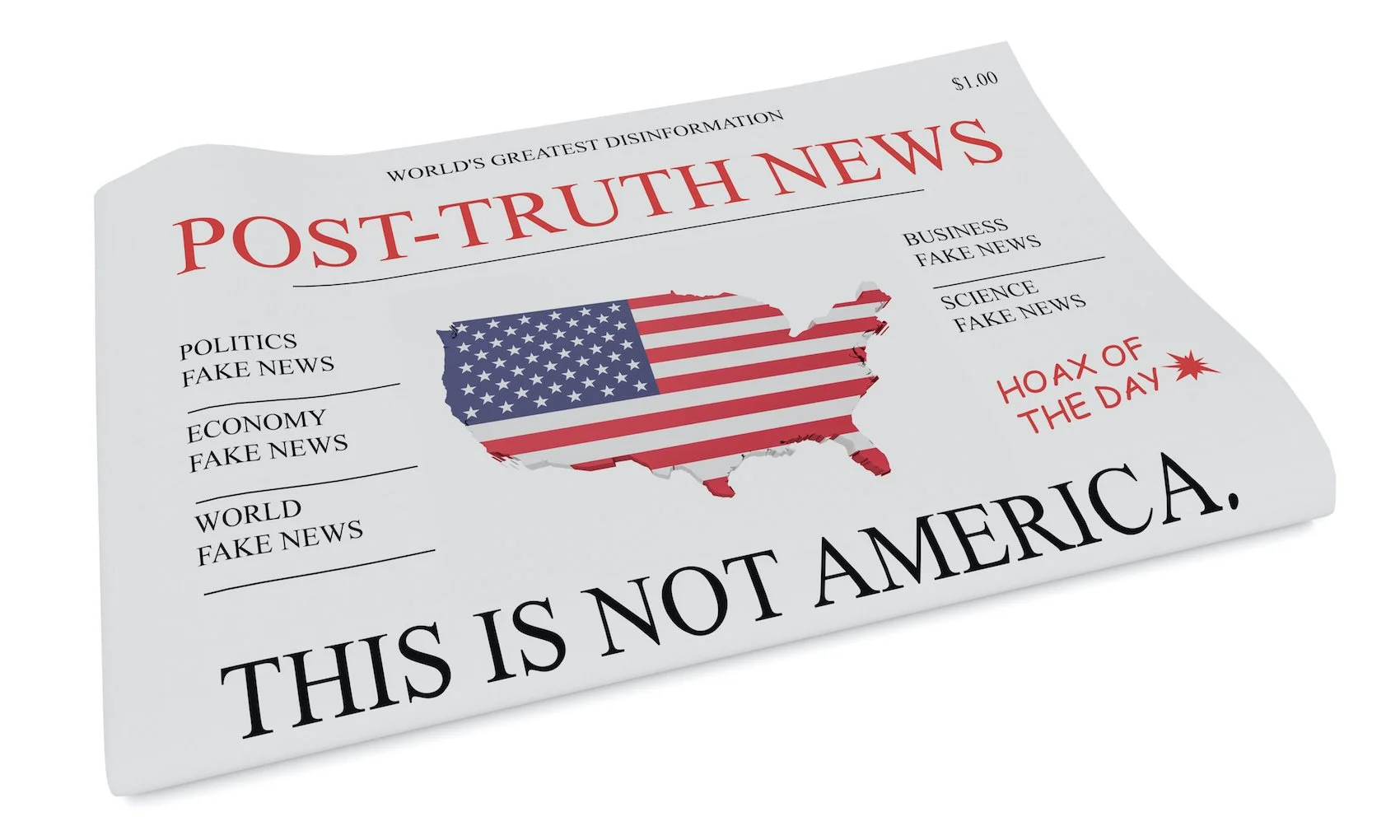
Podcast: Is 'post-truth America' a right-wing or a left-wing term? Please discuss

Podcast: Is 'post-truth America' a right-wing or a left-wing term? Please discuss

Please ponder this pair of true or false questions.

When religious, cultural and political liberals complained about Donald Trump promoting his own “alternative facts” for use in the mainstream press, did they have a valid point? Was it fair game for them to apply the academic term “post-truth” in this case?

When religious, cultural and political conservatives complained about Democrats and their Big Tech-Big Media allies burying coverage of the Hunter Biden laptop scandal, funders of Antifa, origin debates about COVID-19 and Jane’s Revenge attacks on churches and crisis-pregnancy centers, did they have a valid point? Was it fair game for them to apply the academic term “post-truth” in this case?

I would argue that the correct answer is “yes,” in both cases.

Debates about the meaning of the term “post-truth” were at the heart of this week’s “Crossroads” podcast (click here to tune that in). There was a logical reason for that, since Clemente Lisi and I were speakers in a March 10-11 conference in Washington, D.C., with this title: “Journalism in a Post-Truth World.” The conference was sponsored by Franciscan University of Steubenville and the Eternal Word Television Network.

The Franciscan University press release afterwards noted that the participants included journalists from the “National Catholic Register, The Washington Post, OSV News, Fox News, CNN, RealClearPolitics, The Catholic Herald, The Spectator, Washington Examiner, National Review, The Daily Signal, Catholic News Agency, The Daily Caller, and GetReligion.” Well, I had requested that I be identified as a columnist with the Universal press syndicate, but I wear several hats.

That’s a list that clearly leans to newsrooms on the cultural right, but with some solid mainstream voices as well. For example, I was on a panel about Catholic news coverage with the (in my eyes) legendary religion-beat pro Ann Rodgers, best known for several decades with the Pittsburgh Press and Pittsburgh Post-Gazette. Also, click here for a Lisi post at Religion Unplugged about his presentation.

It’s safe to say that someone was there from the National Catholic Reporter, because of this headline in that progressive Catholic publication: “EWTN-sponsored conference on journalism embraces right-wing 'post-truth' narrative.


Please respect our Commenting Policy

Florida evangelicals mull Trump vs. DeSantis and, #behold, AP finds some diversity!

Florida evangelicals mull Trump vs. DeSantis and, #behold, AP finds some diversity!

Brace yourselves, readers, because I am about to praise an Associated Press story about evangelical voters, Florida and the looming clash between Gov. Ron DeSantis and former President Donald Trump.

But before we go there, let’s review two GetReligion themes about these topics.

(1) During the primaries before the 2016 presidential election, a strong army of evangelical voters provided strategic support for Trump. But just as many evangelicals voted for other GOP candidates in a very, very large Republican field. In the general election, white evangelicals — faced with a choice between Trump and Democrat Hillary Clinton — voted overwhelmingly for Trump.

This created the “81% of evangelicals just love Trump” myth, which hid some crucial divisions inside the complex and diverse world of American evangelicalism.

(2) Trump reached the White House — quite literally — because of the crucial votes of Latino evangelicals and Pentecostal believers in Florida. The growing diversity in Latino voting remained a secret hidden in clear sight until press coverage linked to the 2020 and 2022 elections, including the rise of DeSantis, who is Catholic.

This brings us to the new AP report: “Trump vs. DeSantis: Florida pastors mull conservative issues.”

While it contains some familiar mainstream press language on moral and cultural issues — battles about parental rights and sex education are about “politics,” as opposed to beliefs or doctrines — it offers information and input from a strong set of insiders and experts. Also, there is a truly shocking summary statement about evangelicals in Florida. Hold that thought. Here is the overture:

DORAL, Florida (AP) — Several of Florida’s conservative faith leaders have the ear of two early frontrunners for the 2024 Republican presidential nomination — former President Donald Trump, who lives in Palm Beach, and Gov. Ron DeSantis.

The clergy’s top political priorities are thus likely to resonate in the national campaign for the religious vote, even as both men’s agendas are still being weighed from the pulpit.

The faith leaders’ key issues include education, especially about gender and sexuality, and immigration, a particularly relevant matter in Florida, which is a destination for hundreds of thousands of newcomers and home to politically powerful Latino diasporas.

Guess what? Latino clergy have a rather complex stance on immigration, one rather similar to the views I have heard from mainstream evangelicals for a long time.


Please respect our Commenting Policy

A Jewish book that Christian strategists (and reporters) should be reading right now

A Jewish book that Christian strategists (and reporters) should be reading right now

Much of organized Judaism in the U.S. is “crumbling” and destined to suffer even worse decline in coming years, contends Rabbi Danny Schiff in his new book “Judaism in a Digital Age: An Ancient Tradition Confronts a Transformative Era” (Palgrave Macmillan).

Christian strategists face much the same cultural upheaval and should pay attention to this examination, alongside Jews and religion-beat journalists. Echoes of the “Mainline” Protestant plight are especially noteworthy. And consider the stakes for Judaism when the United States has 70% of the world Jewish population.

Schiff, a scholar with the Jewish Federation of Greater Pittsburgh, focuses on the two branches that dominated U.S. Judaism over the past century. Reform Judaism is devoutly liberal, with broad individual choice on belief and practice. Conservative Judaism is more tradition-minded — but has lately floated in Reform’s direction. The book pays less notice to the faith’s growing third main branch, Orthodoxy, because it is relatively stable as it resists modern pressures.

Here’s the situation in a numerical nutshell: As of 1990, 73% of U.S. Jews identified with these two main non-Orthodox branches. By Pew Research Center’s major Jewish survey in 2020, their combined following was down to 54%, while 32% of Jews reported “no particular identity” in terms of religion. (The Orthodox were a 9% minority that will grow due to higher birth rates.)

For Schiff, the years around 1990 were the end of an era when “partial emancipation” from past social barriers and prejudice turned to “hyper-emancipation.” Antisemitism, though still existing, was extinct in polite society.

A related sign was the prevalence of intermarriage with non-Jews, once relatively rare. By the 2010-2020 decade, 72% of marriages by the non-Orthodox were with non-Jews. Inexorably, that lowered the odds that children would follow in Judaism as adults. Added problems were widespread divorce, less marriage and lower birth rates. Finally, “barriers to leaving Jewish life are virtually non-existent.”


Please respect our Commenting Policy

Who are America's most influential women in religion? Why do they get so little ink?

Who are America's most influential women in religion? Why do they get so little ink?

International Women’s Day last week led to — naturally — a lot of news features about the female half of the human race.

The Washington Post did a piece on women in Afghanistan (as did the New York Times); Agence France Presse wrote on women who work for the Roman Curia; the Jewish Telegraph Agency covered Orthodox women who get around their religion’s prohibition against women chanting Hebrew scriptures to mixed audiences.

I would have liked to have something more diverse and wider-ranging, such as a list of top women who exert influence not only within their own religions, but who have spoken to needs or issues in the general culture. In effect, they have transcended their faith groups.

In short, who are the most influential women in American religion?

Time magazine asked a similar question about evangelicals and the magazine’s list of America’s 25 most influential evangelicals is still referred to 18 years later. Most of those named were men; if there were women, they were paired with their husbands. The only two women who made the list on their own merits were televangelist Joyce Meyer and the late Diane Knippers, president of the Institute on Religion and Democracy.

I have spent much of my professional career profiling women in religion. The first time I put together such a list was in 2014 when I was so frustrated at how so many gifted evangelical women didn’t get near the top billing in the media that men do. In a post titled “Great Women Who Will Never Be Famous,” I wrote about Miriam Adeney, Nancy Pearcey, Robin Mazyck, Susan Wise Bauer, Sarah Zacharias Davis and Dale Hanson Bourke.

I’ve now updated that list to include other religions. I avoided women who got where they are because of their husbands. I am not denigrating their accomplishments, but simply focusing elsewhere.

I do realize that women in many traditions aren’t allowed into formal religious positions, which is why my list includes activists, bloggers and others who work outside regular boundaries.

It’s a sticky wicket, this list. Should one stick with women who have the largest numbers of books written, most news coverage or most impressive social media standings? How about lesser-known women who represent important constituencies?

For instance, many of you may not know Nailah Dean, 30, a black/Latina California lawyer and Muslim feminist who speaks out on what she calls the “Muslim marriage crisis.”


Please respect our Commenting Policy

Do the Math: Reporters use labels all the time, but religious life is more complex than that

Do the Math: Reporters use labels all the time, but religious life is more complex than that

Everything I do on social media is a trade-off.

That’s the nature of data visualization. You have to take an incredibly complex and often messy social world and distill it into a rather straightforward graph that the average person scrolling Twitter can understand in five seconds or less. Not an easy task.

One of the ways in which social scientists have tried to make the concept of age more palatable is through the use of generations — Boomers, Gen X, Millennials, etc. There have been several pieces published in the last few years that have exhorted social scientists to stop using these concepts because they mean very little from an empirical perspective.

One reason is that they are completely arbitrary. Born in December of 1979 — you are a Gen X. Born just one month later — you’re a Millennial. And consider the fact that you can be born in 1981 or 1995 and are part of the same generation. That’s just nonsensical the more you think about it.

One way around is to use five-year birth cohorts.

Instead of 15 or 20 year spans for generations, a birth cohort can be just those born between 1940 and 1945. This helps to further isolate the impact of age on religious trends. I’ve been making graphs using this cohort strategy for a while now and they can provide a lot of illumination about American religion and politics.


Please respect our Commenting Policy

Plug-In: At least six dead, plus unborn child, in Jehovah's Witnesses shooting In Germany

Plug-In: At least six dead, plus unborn child, in Jehovah's Witnesses shooting In Germany

Good morning, Weekend Plug-in readers!

Among the stories we’re following this week: A South Carolina church held a prayer vigil after two members of its community were abducted and killed by a Mexican drug cartel, as WPDE-TV’s Jenna Herazo reports.

Here in my home state of Oklahoma, voters trounced — somewhat surprisingly — a proposal to legalize recreational marijuana. Given the millions of dollars spent by the pro-marijuana side, a faith coalition leader who fought the initiative calls the outcome a “David beats Goliath” victory. I report that story at ReligionUnplugged.com.

Every weekend, Plug-in rounds up the best reads and top headlines in the world of faith.

We start this edition with tragic news out of Germany.

What to Know: The Big Story

Mass shooting at house of worship: “A former member of the Jehovah’s Witnesses shot dead six people at a hall belonging to the congregation in the German city of Hamburg before killing himself after police arrived, authorities said Friday. Police said an unborn baby also died, without clarifying whether the baby’s mother was among the dead. Eight people were wounded, four of them seriously.”

That’s the lede at this hour from The Associated Press’ Pietro de Cristofaro and Geir Moulson.

The shooting is “a rare kind of attack in a country where gun ownership is severely restricted,” the Wall Street Journal’s Georgi Kantchev notes.

More from the Journal:

The Jehovah’s Witnesses in Germany association said the community was “deeply saddened by the horrific attack on its members.” 

Jehovah’s Witnesses, a Christian denomination, have some 175,000 members in Germany, including 3,800 in the state of Hamburg, according to the organization. 

The attack took place around 9 p.m. on Thursday at a Jehovah’s Witnesses Kingdom Hall building in the northern part of the city after a service.

Motive emerging: Authorities are investigating the background of the shooting, according to news reports.


Please respect our Commenting Policy

Raquel Welch: The bombshell who became a quiet, sincere Presbyterian church lady

Raquel Welch: The bombshell who became a quiet, sincere Presbyterian church lady

The statuesque film legend didn't call attention to herself as she shared a pew with other conservative Presbyterians in their small church not far from Hollywood.

She was articulate when discussing theology and church matters and, from time to time, would offer advice on finances. She had learned a lot in the movie business.

Raquel Welch wasn't trying to hide, during the later decades of her life when she faithfully attended Calvary Presbyterian Church in Glendale, California. She was simply looking for people she could trust.

"She was careful. … She wasn't going to one of those 2,000-member churches where everyone would look at her. That wasn't her style," said the Rev. Christopher Neiswonger, who grew up in that congregation and attended nearby Fuller Theological Seminary. He now leads Graceview Associate Reformed Presbyterian Church in Southhaven, Mississippi.

"She also wasn't trying to stick her thumb in the eye of a Hollywood culture that she knew would denigrate this kind of faith commitment. … She was Raquel Welch, but she just wanted to be part of our church family."

Welch died on Feb. 15 at the age of 82, inspiring waves of tributes focusing on her iconic beauty in "Fantastic Voyage," "100 Rifles," "The Three Musketeers" and dozens of other movies and television programs. The legendary poster from "One Million Years B.C." framed her as a bombshell babe image for the ages.

In a Facebook tribute shared with other believers, Neiswonger called Welch a "wonderful lady and a fine Christian" whose "faith grew more powerful and practical with age. It's often true that the most important things become the most important to us as we've matured personally."

At the end of her 2010 memoir, "Raquel: Beyond the Cleavage," Welch described the hard questions she asked after the death of her mother, a faithful Presbyterian, and a sister's struggle with cancer. After decades away from church, Welch offered an "awkward inept prayer" to the "God of my childhood and, lo and behold, he was still there."


Please respect our Commenting Policy

Why do Southern Baptists and many like-minded Protestants still bar women pastors?

Why do Southern Baptists and many like-minded Protestants still bar women pastors?

THE QUESTION:

Why do Southern Baptists and like-minded Protestants bar women pastors?

THE RELIGION GUY’S ANSWER:

Why? Simple. Because they believe that’s what the Bible teaches.

But other conservative evangelical groups see female clergy as biblically proper, for example the Assemblies of God, Evangelical Covenant Church, Free Methodist Church and Salvation Army, along with many independent congregations.

The question is timely because the June 13-14 annual meeting of the Southern Baptist Convention, America’s largest Protestant denomination, will be a landmark on this. The gathering will decide whether to expel any congregation with a women pastor, thus affirming the SBC Executive Committee’s February expulsion of five such congregations.

Among them is one of the Baptists’ biggest and most influential, Saddleback Church in California, long led by popular author Rick Warren. (See this recent GetReligion post and podcast for more information: “Women in ministry remains a hot topic in SBC life, especially at the pulpit level.”)

Among Baptists, a local congregation ordains clergy, and the SBC upholds the total decision-making independence of each local congregation, so each is free to ordain women. However, the June meeting could establish a new nationwide policy that defines women’s ordination as such a doctrinal heresy that fellowship must be severed.

Across history, Christianity has largely been led by men, as with other world religions and with most societal institutions in most times and places, Protestants have been changing that.

In the U.S., a few U.S. Protestant women were ordained beginning in the 19th Century, including by evangelical churches. In the decades after World War Two, major “mainline” Protestant denominations ended their gender barriers. Women now make up 35% of the students at campuses in the Association of Theological Schools.

Though the SBC now anchors the men-only side in the ongoing debate among evangelicals, this was not always the case.


Please respect our Commenting Policy

Podcast: When is preaching a 'news' story? Ah, the temptation of ChatGPT sermons

Podcast: When is preaching a 'news' story? Ah, the temptation of ChatGPT sermons

When is preaching newsworthy?

News consumers of a certain age may remember this famous Associated Press headline: “Priest Told Children That Santa Claus Is Dead.

More recently, a Catholic priest in County Kerry made headlines around the world when he dared to preach a sermon defending centuries of Catholic teachings on abortion, marriage and sex — while reminding the faithful that the concept of “mortal sin” is serious business. His bishop was not amused.

Thus, controversial sermons are news, in part because editors don’t expects sermons to be controversial?

The act of preaching can also become “newsy” when it is linked to a trendy subject in modern life. That’s the equation: Old thing (preaching) gets hitched to hip new thing.

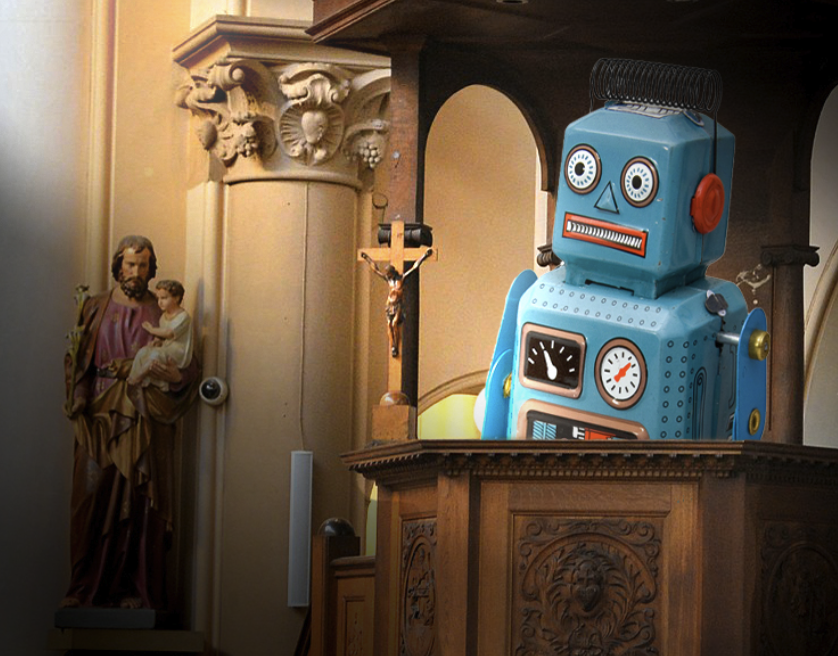
Right now, one of the hot topics in the public square is the rise of artificial intelligence and, to be specific, the ChatGPT website. Thus, this week’s “Crossroads” podcast (click here to tune that in) focused on several “newsy” angles of the recent Associated Press story that ran with the headline, “Pastors’ view: Sermons written by ChatGPT will have no soul.”

In a way, this whole AI preaching topic is linked to another “preaching that is news” trend that shows up every now and then — plagiarism in the pulpit. Overworked, stressed-out pastors have been known to cut a few corners and use material from other preachers, without letting the faithful know what they were doing. But that’s actually a very old story. See this On Religion column that starts with a case study from 1876.

During the podcast, I riffed on the whole issue that different kinds of technology can shape the content of communications in different ways. If ChatGPT sermons have a sense of “soul,” it would be a “soul” that is defined by the creator of the software and the tech platform.

This made me think back the early 1990s, when I was teaching at Denver Seminary and asking future pastors to think about the many ways that mass-media messages shape the lives of their flocks and, of course, the unchurched people around them (here is an essay on that seminary work).

During that time, I read an article — on paper, alas — about how the creation of studio microphones changed the content of American popular music, even at the level of lyrics in love songs.

Think about Frank Sinatra. As a young big-band singer, he belted out bold, strong, LOUD songs about commitment and romantic love that would never die. He had to be heard over that big band. But give Sinatra a microphone and, well, these songs turned into smooth, soft, seductive messages — urgent whispers of desire.

I wondered: How did microphones affect the style and theological content of preaching?


Please respect our Commenting Policy