Finding voices on both sides of Texas abortion debate? The Atlantic comes out on top

Finding voices on both sides of Texas abortion debate? The Atlantic comes out on top

In recent weeks, Texas has swung back and forth between prohibiting abortions after six weeks, then being forced bu judges to allow them, then managing to forbid them once again.

Currently, once the fetal heartbeat is detected, abortions are forbidden in the Lone Star state.

Meanwhile, journalists have gone full court press on the matter. There’s no surprise there. But did anyone strive to talk to women and men on both sides of this hot-button issue? Hold that thought.

Now, I don’t expect Hollywood ever to be balanced on the topic but a recent offering in The Hollywood Reporter on 12 abortion-positive movies was over the top, even for them.

It’s been 49 years since the two-part “Maude’s Dilemma” — written by future Golden Girls and Soap creator Susan Harris — premiered, but the choice faced by Bea Arthur’s title character, finding herself pregnant at 47, and the determination of Norman Lear’s show to discuss that choice in depth, and engage in a nuanced debate, would be provocative in an American broadcast sitcom today.

It’s still incredibly rare to find TV comedies dealing with actual abortions, though shows like Girls and Sex and the City used it as a conversation piece. Frequently, American television falls back on abortion being a thing characters talk about on-camera, do off-camera and then never speak of again..

Then comes the list:

“Dirty Dancinga clear and unapologetic argument for reproductive choice.” “Grandma,” which is “abortion as a regrettable but necessary option in many young women’s lives.” Or “Never Rarely Sometimes Always” about “a candid and clear-eyed contemplation of abortion as a choice arrived at not with hand-wringing but with sobering pragmatism.” Or “One Sings, the Other Doesn’t” about “love, whimsy, joyful bohemia and tenderness no less than healthy anger over injustice.”

You get the picture.


Please respect our Commenting Policy

Abortion-rights groups planning 'Hail Mary' efforts to block Texas law? #REALLY

Abortion-rights groups planning 'Hail Mary' efforts to block Texas law? #REALLY

Faithful followers of this website know that many, many of the news reports we critique are based on tips from readers.

These emails are important to me because, frankly, there is no way for us to follow as many media sources as our readers do, combined. This is especially true now that our team, due to finances, is smaller than it was for the previous decade or so.

From time to time, readers will react to something as simple as a horrible headline or a single rage-inducing phrase in a news report. There’s no way that I can respond to all of these, but here is a recent case that I think deserves a mention.

Read the top of this CNN piece (“The Justice Department's uphill battle against Texas' abortion ban“) and try to spot the issue that ticked off a reader:

In its lawsuit challenging Texas six-week abortion ban, the Justice Department is throwing a Hail Mary pass to get over the procedural stumbling blocks that have thwarted other attempts to block the ban in court.

The lawsuit, filed … in a federal court in Austin, relies on a novel strategy in seeking to halt enforcement of the ban, which was designed specifically with the goal of evading review of federal courts.

The arguments that the Justice Department is presenting on the merits -- that the law violates Supreme Court constitutional precedent on abortion rights -- are on solid ground. But the question is whether its lawsuit can get around the same procedural issues that doomed the earlier federal lawsuit brought by abortion clinics.

What’s the problem?


Please respect our Commenting Policy

Plug-In: Big winners, and some surprises, in Religion News Association's annual awards

Plug-In: Big winners, and some surprises, in Religion News Association's annual awards

For the second year in a row, the Religion News Association’s annual awards were presented in virtual fashion because of the COVID-19 pandemic.

Kudos once again to Jeff Diamant, RNA’s contest guru, for a fun and informative presentation of winners Thursday night. You can watch it all here.

For regular Weekend Plug-in readers, many of the first-place recipients’ names will be familiar, including the New York Times’ Elizabeth Dias, the Pittsburgh Post-Gazette’s Peter Smith, The Atlantic’s Emma Green, The Tennessean’s Holly Meyer and the Chattanooga Times Free Press’ Wyatt Massey. (By the way, Smith and Meyer now work for The Associated Press.)

But there were surprises, too, in some of the major categories.

Britta Lokting and Sam Adler-Bell of Jewish Currents won the Story of the Year prize for “Welcome to Lammville: How the Hasidic housing crisis led to the largest case of federal voter fraud in modern American history.”

Dan Stockman of the Global Sisters Report earned top honors for reporting at online-only outlets for a series on Catholic women. And Peter Clowney, John DeLore, Abigail Keel, Ash Sanders, Sarah Ventre and Amy Westervelt received the Gerald A. Renner Award for Excellence in Enterprise Religion Reporting for their podcast "Unfinished: Short Creek."

Congrats to ReligionUnplugged.com’s own honorees: Alexandra Radu took first place for a photo from Malaysia, and the “God and Guns” project by Paul Glader and Michael Ray Smith (with videos by Micah Danney) received third place both for Story of the Year and online-only reporting.

Check out the full list of winners here.


Please respect our Commenting Policy

What was the goal of Gov. Kathy Hochul's 'God gave us the vaccine' sermonette?

What was the goal of Gov. Kathy Hochul's 'God gave us the vaccine' sermonette?

In an age in which satire and news often overlap, it was hard to know what to make of this headline: "New York Atheists Claim Religious Exemption From Vaccine After Governor Claims That It's From God."

This was satire, care of the Babylon Bee website. But the barbed humor focused on real quotes from the governor of New York that raised eyebrows on the cultural left and right.

"We are not through this pandemic," said Gov. Kathy Hochul, at a New York City megachurch. "I prayed a lot to God during this time and you know what -- God did answer our prayers. He made the smartest men and women, the scientists, the doctors, the researchers -- he made them come up with a vaccine. That is from God to us and we must say, thank you, God. ...

"All of you, yes, I know you're vaccinated, you're the smart ones. But you know there's people out there who aren't listening to God. ... I need you to be my apostles. I need you to go out and talk about it and say, we owe this to each other. We love each other."

Clearly, the governor said, getting vaccinated was the best way to obey God in this crisis.

Writing at The Friendly Atheist website, Beth Stoneburner argued that this was not the kind of church-state sermonette that should trouble atheists and other secularists.

"Is it a speech that atheists will appreciate? Probably not," she noted. "But as far as a politician using the language of faith to reach an audience that desperately needs to get vaccinated -- but might not because other prominent Christians are feeding them lies -- it's arguably effective."

If this blast of God-talk from a Democrat "helps Christians get vaccinated when some of them might choose otherwise, then perhaps that outweighs any criticisms people may have of her speech," said Stoneburner.

At the same time, Hochul's explicitly Christian remarks on vaccines drew little or no news coverage, as opposed to the media firestorms that often greet faith-based statements by Republicans attempting to win the support of conservative Christians in similar settings.


Please respect our Commenting Policy

Crucial question in all those newsworthy abortion debates: When does life begin?

Crucial question in all those newsworthy abortion debates: When does life begin?

THE QUESTION:

When does life begin?

THE RELIGION GUY'S ANSWER:

Those four words are regularly posed in the current abortion debate, so let's scan the lines in pregnancy that have been drawn by experts — religious and secular — in the past.

Pre-scientific cultures spoke of "quickening," typically between 16 and 18 weeks, when the mother first feels the unborn child moving in her womb. A famous example involves the unborn John the Baptist in biblical Luke 1:41. Some ancient Jewish authorities in the Talmud, and Roman and Greek philosophers, supposed that the unborn child "formed" earlier, at 40 days.

Then there's "viability," when a fetus can live on its own outside the womb, typically reached around 23 or 24 weeks, or somewhat earlier or later in individual cases. The U.S. Supreme Court legalized abortion before that point in its 1973 Roe v. Wade decision, and after viability when there are risks to the mother's health, broadly defined.

The high Court on December 1 hears a case from Mississippi, which defied the Roe ruling and bars abortions after 15 weeks on grounds that the fetus experiences pain by then. A Missouri law, also under court challenge, puts a ban at eight weeks when "everything that is present in an adult human is now present in your baby," according to the American Pregnancy Association. The Court temporarily left in place a ban in Texas (likewise in 13 other states) after six weeks, when pulsations can be diagnosed at what eventually becomes the fully formed heart.

Many modern Christians believe that life begins at conception (sperm first meets egg) or implantation (fertilized egg attaches to the mother's womb) while some put the line a bit later at twinning (after which multiple pregnancies do not occur).

Note the brief filed last month in the Mississippi case by pro-choice religions including "mainline" Protestant churches, non-Orthodox Judaism, Unitarian Universalists and others. It says "numerous religious traditions posit that life begins at some point during pregnancy or even after a child is born."


Please respect our Commenting Policy

New podcast: Those Southern Baptist sex-abuse battles are not just about Southern Baptists

New podcast: Those Southern Baptist sex-abuse battles are not just about Southern Baptists

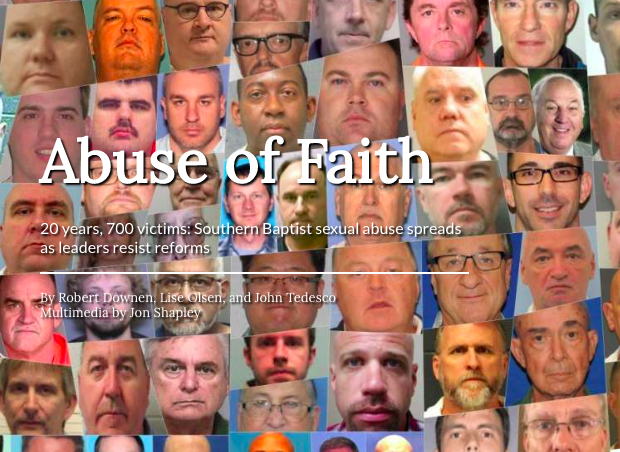
The Southern Baptist Convention’s ongoing fights about how to handle sexual-abuse claims against ministers and other church personnel and volunteers is a perfect example of the kind of story that drives newspaper editors crazy.

It’s big and complicated and it seems like something crazy or important (or both) happens every other day. But it also seems like it’s impossible to yank a big, dramatic headline out of this sprawling, complicated story.

The story never seems to end and the amount of background material needed — in story after story after story — makes it impossible to cover this stuff in tidy 500-word stories. But if a newsroom skips a few of the major developments, that makes it even harder to get back in the game and explain to readers what is happening. Oh, and did I mention that newsroom managers pretty much have to assign a reporter to this story full-time or near full-time? That’s expensive in this day and age. Obviously, this reporter has to have religion-beat experience and speak fluent Southern Baptist.

At the same time, in my experience, there will almost always be one or two editors who say (or think) something like this: “I know the SBC is huge and there are billions of dollars involved and we have lots of Southern Baptist churches (and maybe a college) in our news territory, but … I don’t ‘get’ why this story really matters to average readers. I mean, it’s not about sports or politics or something important (to me).”

As a Charlotte editor once told me, when I was poised to break a national-level SBC story in the early 1980s: Nobody reads this stuff but fanatics and every time you write about it we get too many letters to the editor.

This brings us to this week’s “Crossroads” podcast, which focuses on why the SBC’s struggles with sexual-abuse are important, and NOT just to Southern Baptists (click here to tune that in). The key is to identify major stories LINKED to sexual-abuse scandals that involve ethical, moral, legal and theological issues that can be seen in religious groups of all kinds (and many secular nonprofits and organizations as well). To illustrate this, let me tell you a story about an important evangelical counseling pioneer — the late Dr. Louis McBurney, founder of the Marble Retreat Center in Colorado.


Please respect our Commenting Policy

Pope's preferred airline goes bust: Alitalia's demise way more than a business story

Pope's preferred airline goes bust: Alitalia's demise way more than a business story

I have many fond memories of family trips to Italy that took place each summer during my childhood. Those summer pilgrimages to visit family and friends also included connecting with the place of my parents’ birth as well as seeing some of the country’s stories sites.

Visiting Vatican City for the first time in 1990 (when I was 14) remains one of the best memories. I would visit there again numerous times — including as a news reporter — in the decades that ensued.

Those New York-Rome trips involved flying with Alitalia, Italy’s national carrier. The airline — known for its nearly-impeccable safety record and sometimes appalling customer service — will officially close on Oct. 15. The announcement, made this past summer, marks the end of an era for an airline founded in 1946. it also marked the end of an era for my family, who were loyal to this brand to a fault.

Why is this a topic for GetReligion?

The airline’s demise and the start of a new one named ITA is a business story with a religion angle that too many news organizations ignored over the past few weeks. There was plenty of coverage regarding ITA buying new planes, potential layoffs and Italian government subsidies that kept the airline afloat for decades.

That religion angle? You see, my family and I weren’t the only loyal Alitalia customers over the years. The most famous has been the pope. It was in 1964, when Pope Paul VI traveled to Israel, when Alitalia became the pontiff’s official airline.

Alitalia put on plenty of miles under the papacy of now-St. Pope John Paul II, who visited 129 countries during his 27 years as head of the Roman Catholic church. The plane used by the pope — known in the press as “Shepherd One” as a way to compare it to the president’s “Air Force One” — continued to be used by Pope Benedict XVI and now Pope Francis. It’s also aboard these flights that the pope holds a news conference and always makes news.

Alitalia and the papacy will forever be intertwined.


Please respect our Commenting Policy

Keeping up: Ongoing 'woke' pronoun wars reach into the world of God-talk

Keeping up: Ongoing 'woke' pronoun wars reach into the world of God-talk

This Memo is a twofer, offering both a lively story theme to pursue plus an issue that is now affecting the work of every stylebook and copy editor in the American media.

An older campaign by feminists — including those working in the world of liturgy — sought to shun male pronouns, particularly when either gender is meant, in favor of plural they-them-their usage with singular antecedents. This increasingly common wording is of course grammatically incorrect given the structure of the English language, and can be confusing for readers.

That's now combined with the effort of transgender and "non-binary" advocates to suppress gender-specific adjectives by applying that same "singular they" along with newly crafted pronouns. A list of such neologisms recommended at the University of Wisconsin-Milwaukee, said to be non-exhaustive, covers ae, e, ey, fae, per, sie, tey, ve xe, ze and zie. So, for example, with "xe" the variants to parallel she-her-hers-herself are xem-xyr-xyrs-xemself.

As you would expect, references to God himself -- or is that "themself"? -- is now part of this debate.

Religion News Service ran a column last week from one of its regulars, Mark Silk, headlined "Why our preferred pronoun for God should be 'they'." He thinks calling God "they," not "he," and similar verbal tactics have become "imperative."

How would other progressives respond? His proposal was immediately publicized in a tweet from RNS's Catholic columnist, Jesuit Father Thomas Reese and the online comments began flowing.


Please respect our Commenting Policy

Lots of Latter-day Saints are going liberal? Washington Post story tries to make that case

Lots of Latter-day Saints are going liberal? Washington Post story tries to make that case

Back in late 2010, I began a seven-year stint of freelancing for the Washington Post’s Sunday magazine to help fill a gap in coverage of conservative religion. I wrote about Pentecostal serpent handlers, a female Jewish ambassador from Bahrain and the Orthodox Church of America’s rather controversial metropolitan, among other things.

Then sometime in 2017, a new editor came onboard and, after running my story on Paula White (which made quite a splash I might add), simply refused to respond to any more of my emails. “There goes in-depth religion coverage,” I thought, and turned to other markets.

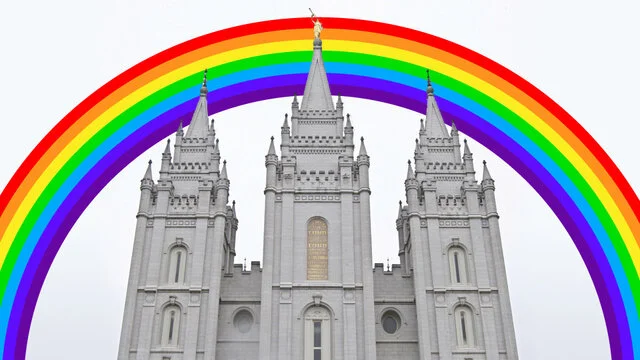
But lo and behold, the magazine just ran a piece about the Church of Jesus Christ of Latter-day Saints about a “battle for the future of Mormonism.”

Basically this article makes the case that the Mormons are veering left on gay issues. The reporter visits a very liberal congregation in Berkeley, Calif., and some conservatives in Rexburg, Idaho, considered a traditional Latter-day Saint bastion.

Not to my surprise, the reporter, in support of this thesis, only cites people in both locations who are gay or gay-friendly.

It felt like the reporter had a predetermined goal for the story that just needed the right quotes to scaffold it. Why? I see all the interviews going in one direction: Committed, serious believers who have come to the conclusion that many Mormons are secretly quite liberal. Here at GetReligion, we call this “Kellerism,” a nod to the teachings of a former New York Times editor.

Part of the story is based on an amazing — and inaccurate — assumption.

More so than in other conservative religious institutions, liberals — or at least those disaffected from conservatism — are making their presence known inside and on the perimeters of the church, provoking something of a Latter-day Saint identity crisis.


Please respect our Commenting Policy