Scriptures

Religious Left returns to RFRA: Washington Post explores a crucial Florida abortion showdown

Religious Left returns to RFRA: Washington Post explores a crucial Florida abortion showdown

For 18 years, GetReligion has argued that mainstream news organizations need to pay more attention to the Religious Left. Yes, I capitalized those words, just like the more familiar Religious Right.

The Religious Right has been at the heart of millions news stories (2,350,000 or so Google hits right now, with about 61,600 in current news). The Religious Left doesn’t get that much ink (322,000 in Google and 2,350 or so in Google News), in part — my theory — because most journalists prefer the word “moderate” when talking about believers in the small, but still media-powerful world of “mainline” religion.

But there is a church-state legal story unfolding in Florida that cries out for coverage of liberal believers — with an emphasis on the details of their doctrines and traditions, as opposed to politics. Doctrines are at the heart of a story that many journalists will be tempted to cover as more post-Roe v. Wade politics.

I suspect, if and when this story hits courts (even the U.S. Supreme Court), journalists will need to do their homework (#FINALLY) on the Religious Freedom Restoration Act of 1993. The big question: What does religious liberty (no “scare quotes”) look like from a Unitarian point of view? Hold that thought.

First, here is the headline on a long Washington Post feature: “Clerics sue over Florida abortion law, saying it violates religious freedom.” Here is the overture:

When the Rev. Laurie Hafner ministers to her Florida congregants about abortion, she looks to the founding values of the United Church of Christ, her lifelong denomination: religious freedom and freedom of thought. She taps into her reading of Genesis, which says “man became a living being” when God breathed “the breath of life” into Adam. She thinks of Jesus promising believers full and abundant life.

“I am pro-choice not in spite of my faith, but because of my faith,” Hafner says.

She is among seven Florida clergy members — two Christians, three Jews, one Unitarian Universalist and a Buddhist — who argue in separate lawsuits … that their ability to live and practice their religious faith is being violated by the state’s new, post-Roe abortion law. The law, which is one of the strictest in the country, making no exceptions for rape or incest, was signed in April by Gov. Ron DeSantis (R), in a Pentecostal church alongside antiabortion lawmakers such as the House speaker, who called life “a gift from God.”

The lawsuits are at the vanguard of a novel legal strategy arguing that new abortion restrictions violate Americans’ religious freedom, including that of clerics who advise pregnant people.


Please respect our Commenting Policy

Memory eternal, Ron Sider: An evangelical thinker caught in political crossfire for decades

Memory eternal, Ron Sider: An evangelical thinker caught in political crossfire for decades

It was the kind of Pope John Paul II quotation that was powerful and prophetic -- but hard to print on a political bumper sticker.

"America will remain a beacon of freedom for the world as long as it stands by those moral truths which are the very heart of its historical experience," he said, during his 1999 U.S. tour. "And so, America: If you want peace, work for justice. If you want justice, defend life. If you want life, embrace truth -- the truth revealed by God."

One American activist who paid close attention was Ronald J. Sider, a Mennonite theologian who was already several decades into a career built on asking Americans to ponder precisely that equation.

Politicians on left and right would cheer as John Paul attacked the modern world's "culture of death," said Sider. But, in private, Democrats and Republicans would groan.

"People on the left will love what he had to say about the death penalty and racism and caring for the poor," said Sider, when I reached him by telephone. "But many liberals are going to squirm because he ties these issues directly to traditional Christian teachings on abortion and euthanasia and family life. Meanwhile, some people on the right will squirm because the pope made it very clear that he links these pro-life issues to the death penalty and poverty, sickness, hunger and even the environment."

Sider added: "We live in an age of incredible relativism in this society and even in the church. We live in a land that seems to have lost its way."

These kinds of tensions defined Sider's own struggles as a hard-to-label political activist and ecumenical leader. He died on July 27 at the age of 82.

Christianity Today listed Sider's classic "Rich Christians in an Age of Hunger" as one of the 20th century's most influential religion books. The flagship evangelical magazine also ran this headline with a cover story about Sider's career -- "Unsettling Crusade: Why does this man irritate so many people?"


Please respect our Commenting Policy

What is 'Fundamentalism'? Name 666 or so examples from recent news coverage ...

What is 'Fundamentalism'? Name 666 or so examples from recent news coverage ...

THE QUESTION:

What is “Fundamentalism?”

THE RELIGION GUY’S ANSWER:

After the Presbyterian Church in America decided in June to depart from the National Association of Evangelicals, The Religion Guy wondered in print whether some “evangelicals” are becoming “fundamentalists.” That raises how to define these two similar and historically interrelated versions of conservative Protestantism.

Back in 2019, a New York Times Book Review item by a Harvard Divinity School teacher called Jehovah’s Witnesses “fundamentalists” several times. Well, Witnesses do share certain “fundamentalistic” traits with actual “fundamentalists,” but the label was mistaken because it ignored Witnesses’ beliefs.

If the Ivy League theological elite and such an influential newspaper don’t understand the definition, we have a problem.

Yes, “fundamentalist” can apply in a generic sense to any old group with a certain hard-core outlook. But in any religious context it should designate only a specific movement of orthodox Protestants, prominent especially in the United States. The religious F-word should be applied carefully because, as The Associated Press Stylebook correctly cautions, it has “to a large extent taken on pejorative connotations.”

So here is the Big Idea: The AP advises, “in general, do not use fundamentalist unless a group applies the word to itself.”

The Church of Jesus Christ of Latter-day Saints is irritated when offshoots that perpetuate its founding prophet Joseph Smith Jr’s polygamy doctrine are called “Mormon fundamentalists,” and now seeks to abolish its own “Mormon” nickname. Scholars of Islam similarly reject the common “Muslim fundamentalist” label for terrorists and political extremists.

Back to Protestants.


Please respect our Commenting Policy

This is sooooo New York Times? Cannibalism is hip, which raises zero religious questions

This is sooooo New York Times? Cannibalism is hip, which raises zero religious questions

While it isn’t conventional grammar, there are times when people use “New York Times” as descriptive phrase, rather than as a noun. Here’s a common example: “He is a New York Times Republican.” A variation would be, “He is a New York Times conservative columnist.”

From time to time, I have also received emails from readers pointing me toward a story with a description that reads something like this: “There are New York Times stories and there are New York Times stories, but this is a perfect NEW YORK TIMES story.” In other words, this particular story is a symbolic example of the worldview commonly found in America’s most influential newsroom.

If you follow social media, you know that quite a few people had that kind of reaction to a feature that ran the other day with this eye-grabbing double-decker headline:

A Taste for Cannibalism?

A spate of recent stomach-churning books, TV shows and films suggests we’ve never looked so delicious — to one another

As veteran GetReligionista Clemente Lisi put it, via email: “This story wouldn't pass what we at the NY Post used to call the ‘Cheerios test.’ That is, people don't want to read about this as they have breakfast, especially on a Sunday!”

As that headline suggests, this is one of those oh-so New York Times trend pieces about the sophisticated cultural tastes of sophisticated people living in sophisticated zip codes. The only question, with this kind of topic, is whether it appears first in the Times or on National Public Radio. Here is the overture:

An image came to Chelsea G. Summers: a boyfriend, accidentally on purpose hit by a car, some quick work with a corkscrew and his liver served Tuscan style, on toast.

That figment of her twisted imagination is what prompted Ms. Summers to write her novel, “A Certain Hunger,” about a restaurant critic with a taste for (male) human flesh.

Turns out, cannibalism has a time and a place. In the pages of some recent stomach-churning books, and on television and film screens, Ms. Summers and others suggest that that time is now.

The contents of this feature — think issues of omission, as well as commission — led me to a logical question, at least one that would be logical here at GetReligion: What does this influential cultural trend have to do with religion?

Very little, and that surprised me, since cannibalism and religion are often served on the same platter in certain cultures.


Please respect our Commenting Policy

Podcast: Anglicans in liberal West and conservative Global South face broken communion -- again

Podcast: Anglicans in liberal West and conservative Global South face broken communion -- again

This week’s “Crossroads” podcast was recorded (live on radio and then edited) this past Wednesday afternoon and it is already a bit out of date (CLICK HERE to tune that in).

You see, this episode was intended as a kind of “walk-up” feature about press issues at the 15th Lambeth Conference of Anglican bishops from around the world (July 26-Aug. 8) in Canterbury. At that point, there wasn’t much coverage to critique, other than some reports the Guardian, as in: “Justin Welby forced to allow Anglican bishops to reject statement on sexuality.” Since then, Religion News Service has released this: “Same-sex marriage sparks divisive debate at twice-delayed Lambeth Conference.”

As you can see, the coverage — so far — has been shaped by a familiar template in which decades of Anglican warfare is reduced to a rather political fight over homosexuality, as opposed to church doctrines about biblical authority and sex outside of traditional marriage.

The twist in this old, old story is that most of the heroes in the press coverage are White progressives from rich First World nations and the villains are People of Color from the Global South (think Africa and Asia). Does that framework sound familiar to many news consumers? Hold that thought.

The podcast argued that sexuality is the popular news hook for the Anglican wars, but that the doctrinal issues at stake run much deeper. Thus, I would like to place the unfolding Lambeth 2022 drama in the context of what your GetReligionistas have long called “Anglican timeline disease.

With that in mind, let’s flash back to 1992 — that’s three decades, for those keeping score. Here is the top of the 1999 “On Religion” column I wrote about this behind-the-scenes event: “The time for broken communion?” This is long, but essential:

It's been seven years since Bishop C. FitzSimons Allison faced the fact that some of his fellow bishops worship a different god than he does.

The symbolic moment came during an Episcopal House of Bishops meeting in Kanuga, N.C., as members met in small groups to discuss graceful ways to settle their differences on the Bible, worship and sex. The question for the day was: "Why are we dysfunctional?"

"I said the answer was simple — apostasy," said Allison, a dignified South Carolinian who has a doctorate in Anglican history from Oxford University. "Some of the other bishops looked at me and said, 'What are you talking about?'"


Please respect our Commenting Policy

AP visits a small circle of Dominicans in Greece -- a lovely story with some missing details

AP visits a small circle of Dominicans in Greece -- a lovely story with some missing details

Contrary to popular belief, there are more than a few GetReligion readers who haven’t given up on the mainstream press.

I know this because, every now and then, I will get emails that praise the same news story or feature. Often these missives come from readers who have been known to send me the URLs of news reports that contain errors or are radically unbalanced in how they approach covering complex issues.

In other words, these readers are reading the news and looking for “good” journalism — defined as work built on an old-liberal American Model of the Press approach seeking accuracy and some sense of balance (maybe even respect for diverse voice) when covering complex debates.

With all of this in mind, let’s look at a recent Associated Press report that several readers have written me to praise: “On Greece’s Santorini, 13 cloistered nuns pray for the world.” This is an unusually beautiful feature — the photography is stunning (please check that out) — written by Giovanna Dell'Orto, a journalism professor at the University of Minnesota who does freelance work for AP.

How did this piece come about, since it clearly involved a travel budget for in-depth religion work (rare in this thin-budget age), research time and a commitment to a detailed feature with strong photography? The credit line offers this: “Associated Press religion coverage receives support through the AP’s collaboration with The Conversation US, with funding from Lilly Endowment Inc.”

What is right with this piece? A regular reader noted, via email:

… I guess I submit this because a story that focuses so much on the joy of cloistered contemplatives is not what you expect to see in most newsfeeds. By letting the community speak for itself and by bringing nothing but honest curiosity to the story, look how even this short article opens a door on a whole other world. I'm reading "Desert Fathers: Sayings of the Early Christian Monks" at the moment, and this news story brought an ancient practice to vivid life.

I agree with all of that and, in this post, I will stress the positive — because it’s there.

At the same time, let me note that it was rather strange that this story focuses exclusively on “God” language and doesn’t contain a single reference to, well, Jesus (other than the name of one of the sisters). This is strange when writing about women religious whose Dominican vows joyfully declare them to be the Brides of Christ.


Please respect our Commenting Policy

Here's a soundbite for you: In the Bible, does St. Peter call women the 'weaker sex'?

Here's a soundbite for you: In the Bible, does St. Peter call women the 'weaker sex'?

THE QUESTION:

In the Bible, does St. Peter call women the “weaker sex”?

THE RELIGION GUY’S ANSWER:

Yes.

But why? What did that mean? What was he saying about women’s status in a culture far different from that of the 21st Century?

A preliminary point. Word limits do not allow adequate examination here of liberal scholars’ contention that St. Peter did not really write the two New Testament letters the texts attribute to him, or of the reasons conservatives are convinced that these are authentic words from the figure Catholicism uplifts as the first pope and all Christians revere as an apostle, founder and martyr. The following discussion will assume Peter was the author.

Jackson Wu, an evangelical theologian with the Global Training Network, raised the question about I Peter 3:7 in this June 29 blog item. The verse at issue reads “likewise you husbands, live considerately with your wives, bestowing honor on the woman as the weaker sex, since you are joint heirs of the grace of life. …”

That’s the Revised Standard Version translation. Using the ever-handy www.BibleGateway.com, you can quickly compare 60 other English renditions.

Others that say “weaker sex” are the Living Bible, a modern U.S. paraphrase; Expanded Bible, which includes alternate translations; and the original New Revised Standard Version, but not last year’s updated edition. Others say weaker “partner” and many have weaker “vessel,” which is the more exact translation of the original Greek. That’s important.

Peter’s letter is abundantly clear that women are not inferior spiritually, or morally, or of any lesser status than men in the eyes of God.


Please respect our Commenting Policy

Podcast: Are many Bible Belt military families losing faith in the U.S. armed services?

Podcast: Are many Bible Belt military families losing faith in the U.S. armed services?

On Feb. 1, 2004, GetReligion co-founder Doug Leblanc opened the digital doors here at GetReligion and our first post went live. The headline: “What we do, why we do it.

I tweaked that post a bit in 2019, but left the main point intact. The key was that GetReligion was going to try to spot what I called religion “ghosts” in hard-news stories in the mainstream press. What, precisely, was a religion “ghost”? I raise this issue once again because this week’s “Crossroads” podcast (CLICK HERE to tune that in) focused on a “ghost” question in a very important topic in the news. Hold that thought.

That first post opened with Americans sitting down to read their newspapers or watch television news.

They read stories that are important to their lives, yet they seem to catch fleeting glimpses of other characters or other plots between the lines. …

One minute they are there. The next they are gone. There are ghosts in there, hiding in the ink and the pixels. Something is missing in the basic facts or perhaps most of the key facts are there, yet some are twisted. Perhaps there are sins of omission, rather than commission.

A lot of these ghosts are, well, holy ghosts. They are facts and stories and faces linked to the power of religious faith. Now you see them. Now you don’t.

This brings us to a recent Associated Press report with this headline: “Army cuts force size amid unprecedented battle for recruits.” There are zero references to religion in this report, which is kind of the point.

Is there a religion “ghost” somewhere in this story? Here are some crucial paragraphs:

With just two and a half months to go in the fiscal year, the Army has achieved just 50% of its recruiting goal of 60,000 soldiers, according to Lt. Col. Randee Farrell, spokeswoman for Army Secretary Christine Wormuth. Based on those numbers and trends, it is likely the Army will miss the goal by nearly 25% as of Oct. 1. …


Please respect our Commenting Policy

Why are United Methodists at war? Readers need to know that sexuality isn't the only fault line

Why are United Methodists at war? Readers need to know that sexuality isn't the only fault line

If you read most of the mainstream news coverage about chaos inside the United Methodist Church, then you know that this war centers on LGBTQ issues.

Readers who use niche websites offering the views of conservative United Methodists, in the United States and around the world, will learn that the war is about sex, salvation, biblical authority and core doctrines in ancient Christian creeds. Hold that thought.

Before we look at recent events in the divided United Methodist Church, let’s consider an important political-science term — “condensation symbol” — that journalists may want to ponder. In a 2021 post (“Queer Santa As A Condensed Symbol Of Progressivism”) — blogger Rod “Live Not By Lies” Dreher offered this material from a reader:

A condensation symbol is “a name, word, phrase, or maxim which stirs vivid impressions involving the listener’s most basic values and readies the listener for action,” as defined by political scientist Doris Graber. Short words or phrases such as “my country,” “old glory” “American Dream,” “family values,” are all condensation symbols because they conjure a specific image within the listener and carry “intense emotional and effective power.” … Graber identified three main characteristics of condensation symbols, as they: (1) Have the tendency to evoke rich and vivid images in an audience. (2) Possess the capacity to arouse emotions. (3) Supply instant categorizations and evaluations.

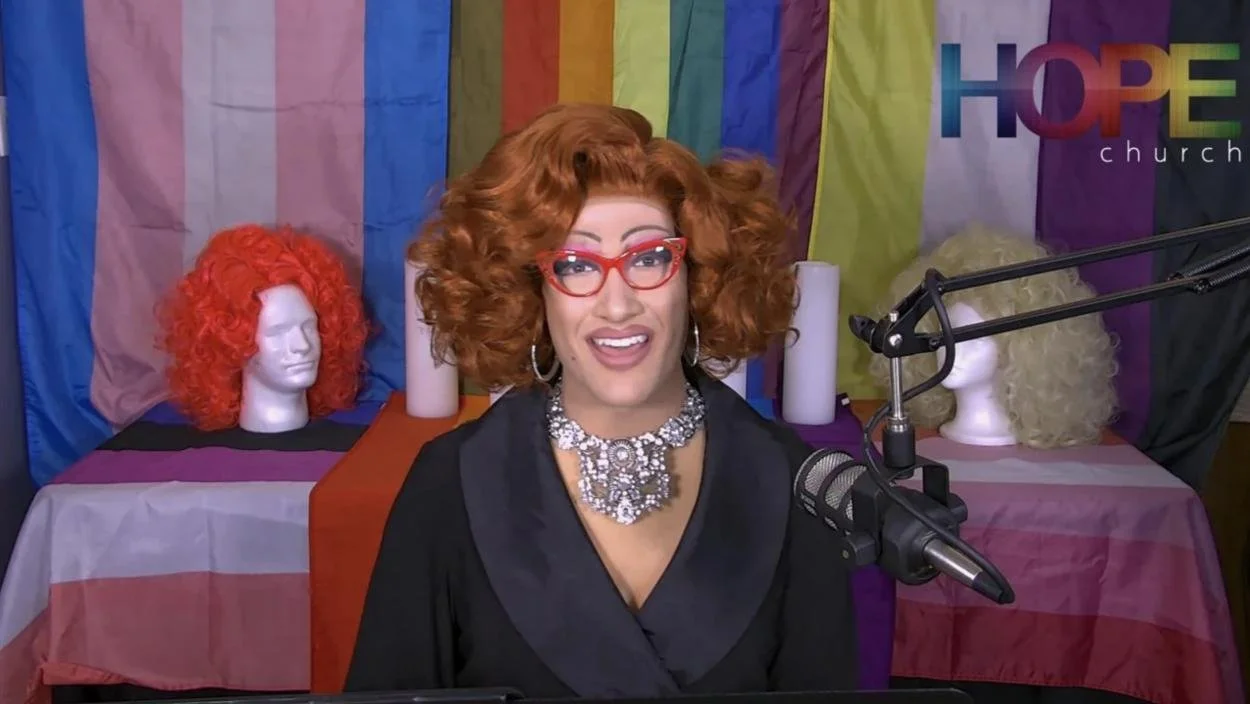
With that in mind, consider the ministry of Isaac Simmons — currently associate pastor at Hope United Methodist Church in Bloomington, Ill. — who has been accepted as a candidate for UMC ordination. Simmons (they/them) is best known as the drag-queen preacher Penny Cost.

At first glance, it would appear that Penny Cost is a perfect example of the LGBTQ issues causing the UMC split. However, I would argue that Simmons is a “condensed symbol” of the wider concerns of the global United Methodist coalition that wants to retain and defend the denomination’s current doctrines on a host of issues.

Consider the following from The American Spectator piece with this headline: “Methodist Church’s First Drag Queen Pastor: ‘God Is Nothing’.” This is, of course, a conservative publication. However, the following passage focuses on direct quotes from a new slam poem posted online by Penny Cost:

“God is nothing,” the self-described “dragavangelist” repeats throughout the poem, adding, “the Bible is nothing” and “religion is nothing.” In the end, he concludes God and the Bible are nothing “unless we wield it into something.”

“God must be f***ing nothing,” he says, “if her boundaryless, transubstantiated bodies of color are run down, beaten, and strewn in the streets of America instead of ruling the runways of life.”


Please respect our Commenting Policy