Politics

How the Rupnik scandal and elite news coverage are shaping the legacy of Pope Francis

How the Rupnik scandal and elite news coverage are shaping the legacy of Pope Francis

The more I read about Pope Francis and President Joe Biden, the more I realize that they are similar.

I mean, both are Catholic, and that’s where the similarities end, right?

That may be the case for most, but they are quite similar in how they are covered by the mainstream press.

Let me explain.

Without getting too much into the weeds here, Biden has been dogged by multiple scandals involving his troubled son Hunter. You wouldn’t know that, however, from much of the mainstream press coverage of this presidency. Journalists remain too concerned with former President Donald Trump — how could they not? — and the recently-averted government shutdown.

Conservative media have covered Hunter Biden’s alleged wrongdoings and shady business practices since the 2020 presidential election. That was when the public was were told by the mainstream press that Hunter’s woes were based on Russian misinformation. Here we are nearly three years later and, yes, it turns out that there is a there there.

This brings us to Pope Francis and scandals swirling around him.

Wait! What scandals, you ask? Hold that thought.

The mainstream press has been fond of this pope and media consumers can see that whenever he says something that matches progressive left-wing political ideology. When it comes to scandal, however, there’s little to no coverage. Case in point: The Rupnik case.

Like Hunter Biden’s laptop, you may not have heard of the Rupnik case. Most mainstream news organizations chose not to cover the latest developments to come out of Rome just last month.

Thus, here’s a recap: Marko Rupnik, a Jesuit priest, became the focus of an investigation late last year when multiple allegations of sexual misconduct against him were reported in the Italian press. They mostly concerned sexual abuse of nuns who were part of Rupnik’s religious community and artistic studio in Rome.

When the extent of the allegations, over a period of many years, became evident, suspicions were raised that one of the most famous Jesuit priest in the world might have been given lenient treatment from the three most powerful Jesuits in the church.



Please respect our Commenting Policy

Trouble in nondenominational land: ‘Supply chain crisis' is creating empty pulpits

Trouble in nondenominational land: ‘Supply chain crisis' is creating empty pulpits

Long ago, the Rt. Rev. C. FitzSimons Allison was a bishop in good standing in the Episcopal Church.

A year ago, however, he resigned — at the age of 95 — to serve in the Anglican Church in North America, which is an ecclesiastical body that is recognized as valid by many Anglican bishops in Africa, Asia and the Global South, but not by the Archbishop of Canterbury.

Needless to say, he has witnessed more than his share of Anglican debates about the future of the Anglican Communion, a communion in which national churches are in rapid decline in rich, powerful lands like the United States, Canada and England, but exploding with growth in the Global South.

During one global meeting, Allison watched a symbolic collision between these two worlds. Bishops from North America and their allies were talking about moving forward, making doctrinal changes in order to embrace the cultural revolutions in their lands. They were sure that Anglicans needed to evolve, or die.

Finally, a frustrated African bishop asked three questions: “Where are your children? Where are your converts? Where are your priests?” These questions are highly relevant, amid stark demographic changes in First World churches.

I thought of this Anglican parable when reading a Frank Lockwood feature in the Arkansas Democrat Gazette that ran with this double-decker headline: “Churches of Christ grappling with preacher shortage.” I don’t want to critique this story for two obvious reasons: (1) Lockwood has been a friend of mine for several decades and (2) one of the major voices in the story is veteran GetReligionista Bobby Ross, Jr.

But the trends noted in this report are serious and proof that it’s simplistic to say that these kinds of problems exist in doctrinally “progressive” denominations, and that’s that. Thus, I think this is a story that many journalists and religion-beat readers need to see. Here’s the overture:

Churches of Christ have a supply and demand problem — thousands of houses of worship and not enough preachers to fill the pulpits.

During Harding University's 100th annual Lectureship in Searcy …, roughly 100 people gathered for a session titled "Minister Shortages in Today's Church."


Please respect our Commenting Policy

Plug-In: Vatican Synod on Synodality is sure to make some Catholics mad and others happy

Plug-In: Vatican Synod on Synodality is sure to make some Catholics mad and others happy

Religion-beat professionals are following tragic news out of Pakistan: Dozens are dead after a suicide bombing in a crowd of people celebrating the birthday of Islam’s prophet, The Associated Press’ Abdul Sattar reports.

Meanwhile, Sen. Dianne Feinstein of California — the longest serving woman senator — has died at 90. An obituary by the Washington Post’s Emily Langer recounts that Feinstein “attended an elite Catholic high school where she was the only Jewish student.”

This is our weekly roundup of the top headlines and best reads in the world of faith. We start by previewing a major summit of the Catholic Church.

What To Know: The Big Story

‘Truly important’: “This is the biggest thing happening in the Catholic Church since Vatican II, there is no question about that,” a scholar tells The Tablet’s Carol Zimmerman.

John L. Allen Jr. of Crux characterizes the upcoming Synod of Bishops on Synodality as “this fall’s Catholic equivalent of the Super Bowl.”

“The unprecedented gathering of 464 Catholic clergy and laypeople, including women, begins Oct. 4 at the Vatican,” Religion News Service’s Claire Giangravé reports. More from RNS:

While some might dismiss the highly anticipated event as a meeting on meetings, the term synodality under Pope Francis has expanded to reflect his vision for dialogue and decision-making in the church.

“I am well aware that speaking of a ‘Synod on Synodality’ may seem something abstruse, self-referential, excessively technical, and of little interest to the general public,” Francis said to journalists at the Vatican on Aug. 26.

he summit will bring 464 Catholic clergy and laypeople, including women, to the Vatican to discuss hot-button issues ranging from sexual abuse to LGBTQ inclusion and female ordination.

“It is something truly important for the church,” the pope said.

Divided American clerics: Ideological rifts among U.S. bishops are in the spotlight ahead of the Vatican meeting, according to The Associated Press’ David Crary:


Please respect our Commenting Policy

Thinking about the legacy of 'Team Ted,' as Vatican insiders talk about the next pope

Thinking about the legacy of 'Team Ted,' as Vatican insiders talk about the next pope

If I have learned anything about mainstream journalism it is this: Editors love partisan political horse races.

This framework is, alas, also used when journalists ponder vacancy signs on the Throne of St. Peter in Rome.

In this kind of contest, scribes almost always (they don’t have to do this, of course) decide that there is a good horse and a bad horse. Most of the time, the “good” candidate is defined as the one who is in favor of “reform.”

What does “reform” mean, for most mainstream journalists? As I noted long ago in this post — “Who gets to ‘reform’ what?” — it helps to look up that loaded word in an online dictionary or two:

REFORM …

* make changes for improvement in order to remove abuse and injustices; "reform a political system"

* bring, lead, or force to abandon a wrong or evil course of life, conduct, and adopt a right one; "The Church reformed me"; "reform your conduct" ...

* a change for the better as a result of correcting abuses; "justice was for sale before the reform of the law courts" ...

* improve by alteration or correction of errors or defects and put into a better condition; "reform the health system in this country"

* a campaign aimed to correct abuses or malpractices.

Now, who gets to define what is and what is not an “abuse,” an “evil course of life,” an “injustice” or a “malpractice”?

That would be the players behind the horse race who are trusted by newsroom leaders and owners.

Thus, before we get to this weekend’s “think piece,” let’s pause and look back to a 2013 speech at Villanova University (YouTube at the top of this post) by the former, now disgraced, cardinal Theodore McCarrick. At the 18-minute mark or so, this media-maven Vatican player discusses his behind-the-scenes networking activity ahead of the conclave that gave the world Pope Francis.

So often the kingmaker in American Catholic life, McCarrick describes a meeting with an “influential Italian gentleman” at the North American College in Rome.


Please respect our Commenting Policy

Podcast: What would happen if GetReligion provided 'hot' GOP debate questions?

Podcast: What would happen if GetReligion provided 'hot' GOP debate questions?

I’m not a fan of the cable-television festivals called “presidential debates,” because they rarely feature any substantial debates and the candidates don’t act presidential.

Maybe this is more evidence that I am what I am, a journalist who is a registered third-party person who doesn’t fit in America’s Republican-Democrat binary vise (rather like Megyn Kelly’s take here).

However, the producers at Lutheran Public Radio had an interesting idea for this week’s “Crossroads” podcast (CLICK HERE to tune that in). They asked me to prepare questions — thinking religion-beat, GetReligion-oriented stuff — that I would ask if (#ducking) I was the moderator at last night’s GOP presidential debate at the Ronald Reagan Library.

I came up with 10 or so questions and I’ll share some of those shortly. However, I knew that the subjects that most interest me — as an old-school First Amendment liberal — would not be on this debate’s menu.

First, let’s deal with the orange elephant in the room. The New York Post, in it’s “exclusive drinking game for the second Republican presidential debate,” reminded viewers to:

Take a sip of WATER …

… every time Donald Trump is mentioned. This will keep you hydrated.

Later, the Post team offered these style points:

Take a sip of your drink …

… every time a candidate says “woke”

… when a candidate calls another candidate by an unflattering nickname

… when someone references the Biden Crime Family

… when a candidate uses a 3-letter acronym (think FBI, IRS, DEI, CDC)

… when a candidate tries to deflect when asked if they think the election was rigged

… when a candidate says they support Trump’s movement (but think they’re the one to finish the job)


Please respect our Commenting Policy

This is still news? Mainline Protestantism, once central in U.S. culture, keeps collapsing

This is still news? Mainline Protestantism, once central in U.S. culture, keeps collapsing

Until the 1960s, more than half of Americans identified with the “Mainline” Protestant churches that “have played an outsized role in America’s history,” says a Sept. 13 report from the Public Religion Research Institute (PRRI).

No longer, as is well known among clergy and parishioners who pay attention, scholars and religion journalists.

Is this news? Throughout America’s history, no religious community has suffered anything remotely like the Mainliners’ unremitting collapse (click here for waves of Ryan Burge ink) over the past six decades — even as the national population grew.

Several recent reports indicate that this remarkable situation is continuing, and well worth updating.

Definition: “Mainline” denominations, the most prominent of which are known to sociologists as the “Seven Sisters,” have roots in the Colonial or Early Republic eras, memberships that are mostly white and relatively affluent and well-educated, affiliated with the National Council of Churches and World Council and share a doctrinal commitment to pluralism or liberalism that contrasts sharply with conservative and “evangelical” Protestant groups (including many believers in their own pews).

Last week, bishops of the Episcopal Church discussed the latest statistics during an online meeting. Though offering income has held steady, there was a 6% drop in membership from 2021 to 2022, the worst ever, and that total is down 23% over the past decade to the current 1,584,685. Average worship attendance nationwide rose a bit to 373,000, a slight bump as the COVID-19 crisis waned, but down 43% over the decade. The median local congregation now has 111 members and Sunday attendance of 35.

This denomination maintains and issues good statistics, and The Guy suggests a more thorough look would cover tell-tale indexes of vitality such as trends in infant and adult baptisms, weddings, Sunday School enrollment, ordinations and foreign mission staffs and spending. For additional info on this, see this new post from Burge: “The State of the Episcopal Church in 2022.”


Please respect our Commenting Policy

Hey, Tennessean folks: Has SBC President Bart Barber changed theologically? Yes or no?

Hey, Tennessean folks: Has SBC President Bart Barber changed theologically? Yes or no?

This is a strange one. In a recent profile of the Rev. Bart Barber — the current president of the Southern Baptist Convention — the Nashville Tennessean team did something that was both unusual and totally predictable.

Unusual? My state’s dominant newspaper used a theological term when it needed to find an accurate political term, of some kind. Yes, you read that right. I just urged some journalists — in this case — to use accurate “political” language instead of mangled doctrinal language.

Predictable? The abused theological term was “fundamentalist.”

To make matters even more complicated, the Tennessean used an ACCURATE historical-political reference in the headline — “Bart Barber defied the Conservative Resurgence. How it is now shaping his SBC leadership” — and then turned around and used “fundamentalist” in the overture.

Dang it! (I will also ask: Is the pronoun “it” in the headline a reference to Barber’s decisive act of defiance or to the Conservative Resurgence itself?) Here’s that flawed overture:

Bart Barber defied the top brass.

In May 2018, the Texas pastor and his fellow trustees at Southwestern Baptist Theological Seminary in Fort Worth fired seminary president Paige Patterson, the architect of the fundamentalist takeover of the Southern Baptist Convention. Following years of financial-related controversies, revelations about Patterson mishandling reports of sexual abuse pushed Southwestern’s board past a point of no return.

Barber, once a loyal foot soldier in Patterson’s movement, was a decisive vote in Patterson’s dismissal, thereby severing his allegiance. 

The emphasis on the “Conservative Resurgence” as a movement inside the SBC is accurate, since that is a commonly used term among historians. The Tennessean kind of explained that term later in the story, and we will get to that.

After making that wise choice, why use the church-history term “fundamentalist” at the top of the story? That’s a word that fit with some Southern Baptists who supported (as opposed to leading) the “Conservative Resurgence,” but not to all. Using that term also suggested that Barber has changed some of his theological beliefs, as opposed to his stance on crucial issues in SBC politics.

I see zero evidence in this news report that Barber has changed theologically. It that is the case, then ask him hard questions about that and then report the answers.


Please respect our Commenting Policy

Pope Francis vs. Bishop Strickland feud highlights the good and bad of journalism today

Pope Francis vs. Bishop Strickland feud highlights the good and bad of journalism today

Another week and yet another headline about Pope Francis feuding with a doctrinally conservative American prelate.

It’s become an all-too-common story and one that the legacy media often can’t resist.

It was late last month that the pope lamented what he called a “reactionary” Catholic church in the United States, where he said political ideology had replaced faith. Pope Francis had made the comments on August 5 in a private meeting in Lisbon — published three weeks later by the Jesuit journal Civilta Cattolica — with members of the Jesuit order, of which he is a member, during his trip for World Youth Day.

The pope’s comments, and the expected fallout, were widely covered by both the secular and Catholic press in the United States and abroad.

The latest salvo in this transatlantic war-of-words took place last week, on Sept. 11, when The Pillar reported that the pope had “discussed with Vatican officials the prospect of requesting the resignation of Bishop Joseph Strickland of the Diocese of Tyler, Texas.”

This is what The Pillar reported:

The pope met Sept. 9 with Archbishop Robert Prevost, OSA, head of the Dicastery for Bishops, and Archbishop Christophe Pierre, apostolic nuncio to the United States — both cardinals-elect.

Several sources close to the dicastery told The Pillar ahead of the meeting that the prelates would present the pope with the results of an apostolic visitation of Stickland’s diocese, conducted earlier this year, as well as subsequent public actions by the bishop, who has emerged as an outspoken critic of the Holy Father.

“The situation of Bishop Strickland is the agenda,” one senior official close to the dicastery told The Pillar, “and the expectation is that the Holy Father will be requesting his resignation — that will certainly be the recommendation put to him.”

While noting that the papal audience did not exclusively concern the Bishop of Tyler, who has previously accused the pope of having a “program [for] undermining the Deposit of Faith,” the official said that Strickland’s case was set to be the “primary point of discussion.”


Please respect our Commenting Policy

Here we go again: Did Coco Gauff have a prayer after her U.S. Open triumph?

Here we go again: Did Coco Gauff have a prayer after her U.S. Open triumph?

Enquiring tennis fans (may) want to know: Is the young U.S. Open champion Coco Gauff a “good” religious believer or some kind of “bad” conservative Christian whose beliefs should be avoided in the mainstream press?

I am getting to this story late, because I have been on the road for more than a week for pressing family reasons. However, it’s clear that Gauff is going to be one of the more inspiring sports figures of 2023, and in this case “inspiring” can have several valid meanings.

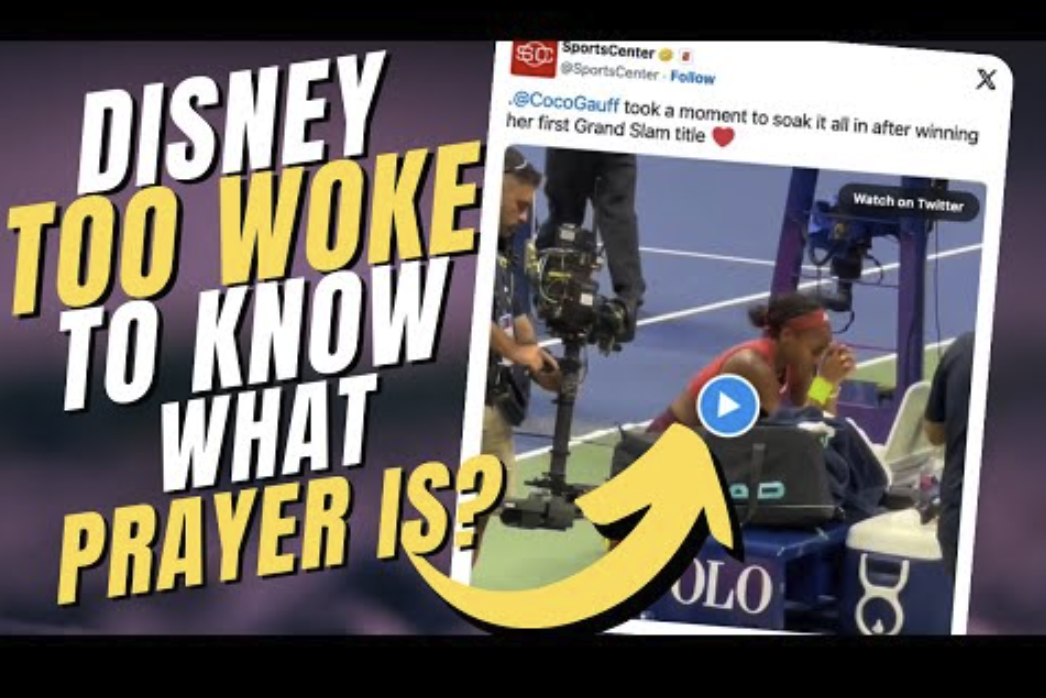
So let’s start with the obvious hot-button image from social media, as in that ESPN SportsCenter post on X containing a video clip that showed the new champion kneeling, with her head bowed and her hands against her forehead in a rather obvious symbolic position.

The ESPN tweet said (all together now): “@CocoGauff took a moment to soak it all in after winning her first Grand Slam title (heart emoji)”

Pro Football Hall of Fame coach Tony Dungy — one of the most outspoken Black Christians in mainstream media — wasn’t amused by this faith-free language and responded on X. This, in turn, was picked up by “conservative” media, since religious faith is often viewed as a “conservative” thing. Here’s a major chunk of the New York Post coverage:

“I hate to break this to you SportsCenter but Coco Gauff was not ‘soaking it all in’ at this moment. She was praying. She has been very open about her Christian faith in the past. It seems pretty obvious what she is doing here,” Dungy wrote.

Gauff spoke about her faith after winning the first Grand Slam title of her career after she was asked what it meant to her to win the title on home soil.

“Oh my goodness. It means so much to me. I feel like I’m a little bit in shock in this moment,” Gauff said. “That French Open loss was a heartbreak for me. I realized God puts you through tribulations and trials. This makes this moment even more sweeter than I could imagine.

“I don’t pray for results. I just ask that I get the strength to give it my all. Whatever happens, happens. I’m so blessed in this life. I’m just thankful for this moment. I don’t have any words for it, to be honest.”

Let’s stress the obvious journalism point, once again.


Please respect our Commenting Policy