International News

Plug-In: Why my old school district pulled 41 books from libraries -- including the Bible

Plug-In: Why my old school district pulled 41 books from libraries -- including the Bible

I don’t remember the Keller Independent School District making national headlines when I was a student here in the 1980s. Even back then, this North Texas community — which began with a railroad extension from Fort Worth in the 1850s — was growing.

But in my time at Keller High School, then the district’s only high school, Keller was still more farm town than burgeoning suburb. We had one grocery store along U.S. 377 and no McDonald’s — I drove to nearby North Richland Hills to flip Quarter Pounders my junior and senior years.

An old gray water tower that proclaimed “Keller: Home of the Indians” greeted visitors to our town, referring to the school mascot. I edited the student newspaper The Wigwam, played sousaphone in the marching band and graduated 23rd in a class of about 300 in 1986. The next year, our former drum major, Michelle Royer, won the Miss USA Pageant — the biggest news I recall from those days.

My parents still live in the area, so I visit frequently and have witnessed Keller’s explosive growth, including multiple exits along Interstate 35.

This week, I’ve watched with interest as the Keller school district’s decision to remove 41 books from its libraries, including the Bible and an illustrated version of “Anne Frank’s Diary,” has made headlines everywhere from the Texas Tribune to the New York Times. What in the world is happening?

Basically this: The national culture wars have come to the local school board. And not just in Keller.

A previous Plug-in highlighted stories by the Fort Worth Star-Telegram’s Emily Brindley and The Tennessean’s Liam Adams on school board candidates campaigning on Christianity and conservatism.

Each of the books pulled in Keller — including the Bible — was challenged by a parent, lawmaker or other community member in the last year, USA Today’s Jeanine Santucci reports.

The Washington Times’ Mark A. Kellner points out:

“Anne Frank’s Diary: The Graphic Adaptation” is an illustrated version of the bestselling classic written by a young Jewish girl in the Netherlands as she and her family hid from Nazi occupation forces. The story ended when the Franks were captured and sent to concentration camps; Anne and her sister Margot died, most likely of typhus, in the Bergen-Belsen camp. Her father Otto survived and published the diary, which had been hidden by his secretary, after the war.
Please respect our Commenting Policy

Some trends in global Anglican Communion are starting to look rather Black and White

Some trends in global Anglican Communion are starting to look rather Black and White

There was nothing unusual about Nigerian Archbishop Henry Ndukuba leading the 2021 dedication rites for Holy Trinity Cathedral Church, which was packed with Nigerian Anglicans and a dozen or so bishops.

But this historic service was held in Houston and the cathedral is not part of the Diocese of Texas or the U.S. Episcopal Church. Some clergy at this Church of Nigeria North American Mission event were recognized as Anglicans by the Archbishop of Canterbury. Some were not.

This puzzle became more complicated recently during Lambeth 2022, which Nigeria boycotted, along with the churches of Uganda and Rwanda. Other Global South bishops, during Lambeth standoffs with Archbishop of Canterbury Justin Welby over the status of doctrines on marriage and sex, declined to receive Holy Communion with openly gay and lesbian bishops.

"There is a profound asymmetric quality to the Anglican Communion, where the voice of the bulk of its membership is either absent or muted," said the Rev. David Goodhew of St. Barnabas Church in Middlesborough, England. He is the author of a series of articles about African Anglicanism for Covenant, the weblog of The Living Church, an independent Anglican publication founded in 1878.

"If one adds up the number of bishops who didn't share Holy Communion at Lambeth … that is a very large number," he said. "I have been startled by the number of descriptions that said this Lambeth was a success. I don't know how one makes that claim when it would appear the bulk of the Anglican Communion's bishops couldn't come together to receive Communion. That looks like a disaster."

Bottom line: Global South Anglicans are experiencing a "volcano of growth" and remain "at loggerheads" with the shrinking churches of the United Kingdom, North America and other western nations. While most Global South bishops serve growing flocks -- roughly 75% of active worshipers in the 77-million-member Anglican Communion -- many western bishops lead what Goodhew called "micro-dioceses" with under 1,000 active members or "mini-dioceses" with fewer than 5,000.

The Church of Nigeria, meanwhile, claims 17 million members and the Center for Global Christianity at Gordon-Conwell Seminary, near Boston, estimates active participants at 22 million. The other churches skipping Lambeth 2022 were Uganda, with 10 million members, and Rwanda, with 1 million members.

The Church of England remains Anglicanism's power hub. It has 26 million members, but 2019 weekly attendance was about 679,000 -- before the COVID-19 crisis.


Please respect our Commenting Policy

Another tragedy for Coptic Christians: Did the New York Times get the bigger picture?

Another tragedy for Coptic Christians: Did the New York Times get the bigger picture?

Every now and then, your GetReligionistas receive emails from readers who are infuriated by the headline on a story, as opposed to the contents of the actual story. Why, they ask, do reporters write terrible headlines like that?

This provides another chance to let readers know a basic newsroom fact: Reporters rarely, if ever, write the headlines that go over their stories. They are written by copy editors.

(It’s possible that this fact has changed in the digital age. Maybe, as economic woes shrink news teams, reporters are asked to submit headlines. Young journalists can drop me notes telling me to get a clue.)

All of this is a set-up to discuss a double-decker New York Times headline that recently caused me to do a near spit take while drinking my morning cold-caffeine beverage. See if you can spot the offending phrase:

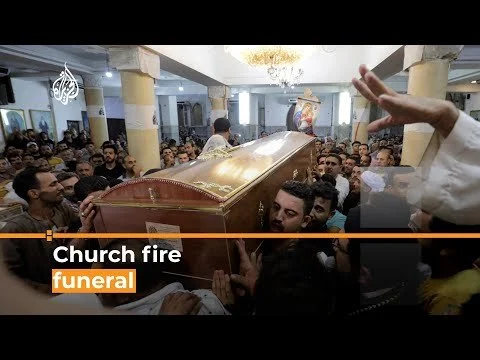
A Boom, a Fire and a Stampede: Dozens Die at a Coptic Church in Egypt

A blaze that killed at least 41 at a church in greater Cairo caused anguish among a religious minority that has long felt itself oppressed in Egypt

The key words, for this Orthodox believer, were these (with an added dose of italics — “a religious minority that has long felt itself oppressed.”

Whoa. The Copts feel that they are oppressed? This is a matter of emotions or their own opinions of what is happening to them?

In short, are there any experts who study global religious-freedom issues who do not accept, as a reality — demonstrated for centuries — that Coptic believers are persecuted or at least “oppressed” in Egypt? If readers question that statement, I would suggest a quick scan through this U.S. State Department report — “2021 Report on International Religious Freedom: Egypt.

Now, the good news is that the actual Times report eventually offers quite a bit of information about the plight of Coptic believers. But first, here is the overture that helps set up the implied question in this tragedy: When is a church fire more than a simple church fire?


Please respect our Commenting Policy

At Lambeth 2022, many Anglican bishops could not 'walk together' to the altar

At Lambeth 2022, many Anglican bishops could not 'walk together' to the altar

While Canterbury is urging Anglicans to keep "walking together," the 2022 Lambeth Conference demonstrated that many of the Anglican Communion's bishops can no longer even receive the Eucharist together.

Doctrinal conflicts over biblical authority and sexuality have raged for decades, with growing churches in the Global South clashing with the shrinking, but wealthy, churches in England, America and other Western regions. During this 12-day conference, which ended Sunday (August 8), conservatives from Africa, Asia and elsewhere declined to receive Holy Communion with openly gay and lesbian bishops. Several provinces -- including the massive Church of Nigeria -- boycotted Lambeth 2022 altogether.

"For the large majority of the Anglican Communion the traditional understanding of marriage is something that is understood, accepted, and without question, not only by bishops but their entire church," said Archbishop of Canterbury Justin Welby, in a mid-conference address. "To question this teaching is unthinkable, and in many countries would make the church a victim of derision, contempt and even attack."

Bishops in the Anglican minority, he added, "have not arrived lightly at their ideas. … They are not careless about Scripture. They do not reject Christ. But they have come to a different view on sexuality after long prayer, deep study and reflection on understandings of human nature. For them, to question this different teaching is unthinkable."

Throughout Lambeth 2022, the Global South Fellowship of Anglican Churches -- representing about 75% of Anglican church attendance -- pushed to reaffirm a 1998 Lambeth resolution that "homosexual practice" is "incompatible with Scripture," while also urging Anglicans to "oppose homophobia." It stressed centuries of doctrine that "sexuality is intended by God to find its rightful and full expression between a man and a woman in the covenant of marriage, established by God in creation, and affirmed by our Lord Jesus Christ." That earlier resolution passed with 526 votes in favor, 70 opposed and 45 abstentions.

Writing to Lambeth participants, Welby said the "validity" of that resolution "is not in doubt" and that the "whole resolution is still in existence."

However, the archbishop did not allow a vote on the issue and he said he would not, as requested by Anglican primates in the past, discipline the unorthodox.


Please respect our Commenting Policy

Traditional Latin Mass feud news remains scarce: How reporters can grasp what's at stake

Traditional Latin Mass feud news remains scarce: How reporters can grasp what's at stake

What’s the deal with all the emotional meltdowns about the traditional Latin Mass? I mean, no one speaks Latin anymore.

It sounds like a line that could have come out of the mouth of comedian Jerry Seinfeld during one of his stand-up acts. It isn’t part of his act, but it is a more than symbolic question that Catholics have been pondering over the past year.

It was last summer when Pope Francis signed a motu proprio — Latin for a papal document personally signed by the pope to signify his special interest in a topic — on this very subject. In the July 16, 2021, decree, the pope approved clarifications regarding restrictions on the traditional Latin Mass in an effort to ensure that liturgical reform is “irreversible” and that bishops strive to enforce changes made after the Second Vatican Council.

Specifically, bishops were told to ban ordinations of priests and confirmations using the old rite. They also were instructed to limit the frequency of rites by priests who have managed to receive a dispensation to celebrate Mass in Latin.

What’s the deal with the traditional Latin Mass? It turns out a lot.

The Novus Ordo Mass, which has been celebrated since 1965, is the norm among Catholic churches in this country and around the globe. Coverage, particularly last year, of the Traditional Latin Mass took on a political twinge in the pages of The New York Times. This is how their story from July 16 of last year framed the debate:

Pope Francis took a significant step toward putting the Roman Catholic Church’s liturgy solidly on the side of modernization on Friday by cracking down on the use of the old Latin Mass, essentially reversing a decision by his conservative predecessor.

The move to restrict the use of an old Latin rite in celebrating Mass dealt a blow to conservatives, who have long complained that the pope is diluting the traditions of the church.

Francis placed new restrictions on where and by whom the traditional Latin Mass can be celebrated and required new permissions from local bishops for its use.

The key words to look for in mainstream news reports are “modernization” and “conservative,” as if this pope was doing something positive and that Pope Benedict XVI had been somehow stuck in the past.


Please respect our Commenting Policy

New York Times: LGBTQ rights are a key factor in Ukraine (even if many Ukrainians disagree)

New York Times: LGBTQ rights are a key factor in Ukraine (even if many Ukrainians disagree)

When I was a sophomore at Baylor University (soon after the cooling of the earth’s crust) the great journalism professor David McHam had an interesting pre-computer way of demonstrating what he wanted to see when a student prepared a second draft of a news story.

Taking a metal straight edge (think pica pole), he would tear the copy into horizontal blocks of text. Then he would rearrange these into a different order, locking them in place with clear tape. Then he would say something like this: “You buried some of the most important information. Go rewrite the story in this order.”

This brings me to a New York Times story about religion, culture, politics and war in Ukraine. There’s a lot of interesting material here, but readers who want to know some crucial basic facts will need to be patient — because they are buried deep in this report. The double-decker headline offers the basic framework:

War Spurs Ukrainian Efforts to Legalize Same-Sex Marriage

The role of gay soldiers, the lack of legal rights for their partners, and the threat of Russia imposing anti-L.G.B.T. policies have turned the war into a catalyst for change in Ukraine.

Now, before I go any further, let me note that, yes, I am Orthodox and I attend a parish that includes Slavic believers, as well as lots and lots of American converts. Also, my two visits to Kiev left me convinced Ukraine is — as the Soviets intended — a tragically divided nation. My views are identical to those of Alexander Solzhenitsyn, on that subject.

When Russian began its evil invasion, I posted a note on Facebook that ended with this:

EU-USA was arrogant enough to think they could — with money, culture and military tech — turn Eastern-Russian Ukrainians into Europeans. Will Putin be arrogant enough to think he can, with blood, turn Western-European Ukrainians into Russians?

I raise this issue because, at a crucial point deep in this Times story, I believe it is relevant. Hold that though.

The anecdotal lede for this story focuses on the fears of a young Ukrainian combat medic named Olexander Shadskykh. That leads to the thesis statement:


Please respect our Commenting Policy

Plug-In: Compelling headlines from 'Penitential Pilgrimage' to Canada by Pope Francis

Plug-In: Compelling headlines from 'Penitential Pilgrimage' to Canada by Pope Francis

Pope Francis made a “penitential pilgrimage” to Canada this week to apologize to Indigenous peoples for abuses at church-run residential schools.

Rome-based journalists traveling with Francis did an excellent job covering the historic trip. I’m talking about folks such as Religion News Service’s Claire Giangravé, the Wall Street Journal’s Francis X. Rocca and the National Catholic Reporter’s Christopher White.

But a single correspondent can’t match the powerful reporting of a global team of religion writers, such as that assembled by The Associated Press.

Besides Vatican reporter Nicole Winfield, AP dispatched Pulitzer-winning religion writer Peter Smith, whose home base is Pittsburgh, and Rob Gillies, its bureau chief in Toronto, to cover the papal visit. Other writers, such as David Crary, Holly Meyer and Anita Snow, helped with the various angles. (That’s not even to mention the amazing photography of the global religion team’s Jessie Wardarski.)

The result: a stellar package highlighted by headlines such as these:

Pope’s Indigenous tour signals a rethink of mission legacy (by Nicole Winfield)

Indigenous Canadians wary, hopeful as pope prepares apology (by Peter Smith)

Church apologies: Top leaders say sorry for historical sins (by Holly Meyer and Peter Smith)

A religiously diverse Edmonton hosts Pope Francis visit (by Peter Smith)

Pope apologizes for ‘catastrophic’ school policy in Canada (by Nicole Winfield and Peter Smith)

Pope in headdress stirs deep emotions in Indian Country (by Anita Snow)

Pope in Canada prays for healing for ‘terrible’ colonization (by Nicole Winfield, Peter Smith and Rob Gillies)

Pope in Quebec amid decline of Catholic Church in province (by Rob Gillies)


Please respect our Commenting Policy

Podcast: Anglicans in liberal West and conservative Global South face broken communion -- again

Podcast: Anglicans in liberal West and conservative Global South face broken communion -- again

This week’s “Crossroads” podcast was recorded (live on radio and then edited) this past Wednesday afternoon and it is already a bit out of date (CLICK HERE to tune that in).

You see, this episode was intended as a kind of “walk-up” feature about press issues at the 15th Lambeth Conference of Anglican bishops from around the world (July 26-Aug. 8) in Canterbury. At that point, there wasn’t much coverage to critique, other than some reports the Guardian, as in: “Justin Welby forced to allow Anglican bishops to reject statement on sexuality.” Since then, Religion News Service has released this: “Same-sex marriage sparks divisive debate at twice-delayed Lambeth Conference.”

As you can see, the coverage — so far — has been shaped by a familiar template in which decades of Anglican warfare is reduced to a rather political fight over homosexuality, as opposed to church doctrines about biblical authority and sex outside of traditional marriage.

The twist in this old, old story is that most of the heroes in the press coverage are White progressives from rich First World nations and the villains are People of Color from the Global South (think Africa and Asia). Does that framework sound familiar to many news consumers? Hold that thought.

The podcast argued that sexuality is the popular news hook for the Anglican wars, but that the doctrinal issues at stake run much deeper. Thus, I would like to place the unfolding Lambeth 2022 drama in the context of what your GetReligionistas have long called “Anglican timeline disease.

With that in mind, let’s flash back to 1992 — that’s three decades, for those keeping score. Here is the top of the 1999 “On Religion” column I wrote about this behind-the-scenes event: “The time for broken communion?” This is long, but essential:

It's been seven years since Bishop C. FitzSimons Allison faced the fact that some of his fellow bishops worship a different god than he does.

The symbolic moment came during an Episcopal House of Bishops meeting in Kanuga, N.C., as members met in small groups to discuss graceful ways to settle their differences on the Bible, worship and sex. The question for the day was: "Why are we dysfunctional?"

"I said the answer was simple — apostasy," said Allison, a dignified South Carolinian who has a doctorate in Anglican history from Oxford University. "Some of the other bishops looked at me and said, 'What are you talking about?'"


Please respect our Commenting Policy

Ciao, GetReligion: Thanks, all, for my tenure. Critic that I am, though, here are some final thoughts

Ciao, GetReligion: Thanks, all, for my tenure. Critic that I am, though, here are some final thoughts

I’ve been a contributor to GetReligion since 2015, when founder Terry Mattingly recruited me over salad at an Annapolis mall eatery. I’m grateful that he did.

Seven years is, for me, a hefty professional run. But nothing lasts for ever. Change is constant. In short, this is my last regular GetReligion post.

During my time here I’ve noticed what I consider an imbalance in the stories GetReligion bloggers generally choose to critique. It is this: The underwhelming and frequently inaccurate religion news coverage too often offered by “mainstream media” is criticized at GetReligion on a near-daily basis. The ignorance of important religion details and the coverage’s overall poor quality are often attributed to mainstream journalists’ “secular,” or “progressive,” worldviews.

Another regular criticism is that mainstream media journalists view everything through a zero-sum political lens. This, goes the argument, renders them incapable of understanding or communicating religious complexity as it’s actually lived by believers living outside the blue-state mindset. Politics is all that really matters, is the trope.

hese broadsides are standard GetReligion fare. Importantly, the accusations are generally on target. It’s more than a coincidence that the GetReligion team members behind this website have decades of experience in the mainstream press.

Religion journalism has suffered greatly in this Internet era. Relatively few news outlets ever invested in upping their religion coverage. Today, even fewer do. Blame that on journalism’s downward economic spiral brought about by the World Wide Web explosion — a major theme here at GetReligion.

However, what’s too often missed here is criticism of the similar lackluster coverage originating in clearly conservative media. At GetReligion, conservative-market media more often than not get a pass. This is, in part, because conservative media’s most popular content is offered by right-wing commentators who make little to no effort to hide their biases and whose stock in trade is pure opinion.


Please respect our Commenting Policy