Evangelicals

Podcast: Journalists should ask if faith-based schools clearly state their doctrines on sexuality

Podcast: Journalists should ask if faith-based schools clearly state their doctrines on sexuality

I forget who originally came up with the term “Romeaphobia.”

This can be defined as the hatred or fear of all things that can be viewed as links to Roman Catholicism or the early church in general. Obviously, this affects issues linked to worship and church governance. However, in my experience (I grew up in Texas), many evangelicals (especially Baptists) have a fear of clear, authoritative doctrinal statements that, you know, might be interpreted as “Roman” creeds. All together now: We are “Bible Christians” and that’s that.

I am not saying this to take a shot at my heritage (I am very thankful for the deep faith and examples of my family and my father was a Southern Baptist pastor). The reason I mention this up is because, in my opinion, this anti-creedal Romeaphobia is playing a major role in an important news story all over America. This was the hook for this week’s “Crossroads” podcast (CLICK HERE to tune that in).

Does this USA Today headline sound familiar? It should, for readers from sea to shining sea: “Christian Florida school tells parents gay and transgender students must 'leave immediately'.”

My goal here is to offer advice to reporters who want to do accurate, fair-minded coverage of these church-state skirmishes (let’s hope there are some out there). I’m also offering press-relations advice to terrified leaders of Christian schools at all levels, from kindergartens to colleges. The Romeaphobia angle? That takes us into legal nuts-and-bolts questions about these conflicts.

Let’s start with the rather familiar USA Today overture:

A Florida-based Christian school sent out an email informing parents that LGBTQ-identifying students "will be asked to leave the school immediately."

According to the email obtained by NBC News, the top administrator of Grace Christian School in Valrico, Florida, Barry McKeen, sent the email to the families for the kindergarten-grade 12 school on June 6. He later confirmed and doubled down on the policy in an Aug. 18 video on the school's official Facebook page.

The June email read: "We believe that any form of homosexuality, lesbianism, bisexuality, transgender identity/lifestyle, self-identification, bestiality, incest, fornication, adultery and pornography are sinful in the sight of God and the church. Students who are found participating in these lifestyles will be asked to leave the school immediately."

For starters, private schools — liberal and conservative — have First Amendment rights, including the right to clearly state their foundational doctrines and, thus, disciplines that apply to staff, faculty and students. Tip No. 1 for reporters and church leaders: Get to know the details of the UNANIMOUS 2011 U.S. Supreme Court decision commonly referred to as the Hosanna Tabor case.

But we need to figure out what actually happened in this Florida case.


Please respect our Commenting Policy

Look at a United Methodist timeline: Why are conservatives going nuclear with lawsuits?

Look at a United Methodist timeline: Why are conservatives going nuclear with lawsuits?

The slowly evolving trainwreck that is the disunited United Methodist Church is an unbelievably complicated story and I have lots of sympathy for journalists who are being asked to cover it — week after week — in normal-length news reports.

I have some right to say this, since I have been covering this story since 1984 or earlier.

For starters, there is no one United Methodist Church and there hasn’t been one for decades. See this flashback column that I wrote a few years ago: “Old fault lines can be seen in the ‘seven churches’ of divided Methodism,” which was followed by “Doctrinal debates that define the divided United Methodists.

The bottom line, once again: This war has always been about biblical authority and a host of other doctrinal clashes, with battles about homosexuality grabbing the headlines.

Anyway, I was reading another update from The Nashville Tennessean the other day — “United Methodists grapple with schism as 300-plus churches leave across U.S.” (high paywall) — and something hit me (other than the fact that “schism” still isn’t an accurate word for what is happening here). The key was looking at several key events on a timeline.

First, let’s plug in a key fact from a recent Religion News Service report about the doctrinally conservative UMC congregations who are trying to hit the denominational exit doors in Western North Carolina and Florida. The lawyers trying to sue the UMC establishment are, you see, are working on a deadline

A lawyer for the Western North Carolina Annual Conference, which has more than 1,000 congregations, responded … saying it would not comply since the request does not follow the disaffiliation plan approved by a special session of the United Methodist Church’s General Conference in 2019.

That plan allows churches to leave the denomination through the end of 2023. They can take their properties with them after paying two years of apportionments and pension liabilities.

Tick, tick, tick.

That 2019 General Conference was, of course, the watershed event in which a coalition of growing Global South churches and some conservative Americans infuriated the shrinking UMC establishment by passing the “Traditional Plan,” while also (#TriggerWarning) urging enforcement of “Book of Discipline” doctrinal stands on marriage and sexuality.


Please respect our Commenting Policy

Some trends in global Anglican Communion are starting to look rather Black and White

Some trends in global Anglican Communion are starting to look rather Black and White

There was nothing unusual about Nigerian Archbishop Henry Ndukuba leading the 2021 dedication rites for Holy Trinity Cathedral Church, which was packed with Nigerian Anglicans and a dozen or so bishops.

But this historic service was held in Houston and the cathedral is not part of the Diocese of Texas or the U.S. Episcopal Church. Some clergy at this Church of Nigeria North American Mission event were recognized as Anglicans by the Archbishop of Canterbury. Some were not.

This puzzle became more complicated recently during Lambeth 2022, which Nigeria boycotted, along with the churches of Uganda and Rwanda. Other Global South bishops, during Lambeth standoffs with Archbishop of Canterbury Justin Welby over the status of doctrines on marriage and sex, declined to receive Holy Communion with openly gay and lesbian bishops.

"There is a profound asymmetric quality to the Anglican Communion, where the voice of the bulk of its membership is either absent or muted," said the Rev. David Goodhew of St. Barnabas Church in Middlesborough, England. He is the author of a series of articles about African Anglicanism for Covenant, the weblog of The Living Church, an independent Anglican publication founded in 1878.

"If one adds up the number of bishops who didn't share Holy Communion at Lambeth … that is a very large number," he said. "I have been startled by the number of descriptions that said this Lambeth was a success. I don't know how one makes that claim when it would appear the bulk of the Anglican Communion's bishops couldn't come together to receive Communion. That looks like a disaster."

Bottom line: Global South Anglicans are experiencing a "volcano of growth" and remain "at loggerheads" with the shrinking churches of the United Kingdom, North America and other western nations. While most Global South bishops serve growing flocks -- roughly 75% of active worshipers in the 77-million-member Anglican Communion -- many western bishops lead what Goodhew called "micro-dioceses" with under 1,000 active members or "mini-dioceses" with fewer than 5,000.

The Church of Nigeria, meanwhile, claims 17 million members and the Center for Global Christianity at Gordon-Conwell Seminary, near Boston, estimates active participants at 22 million. The other churches skipping Lambeth 2022 were Uganda, with 10 million members, and Rwanda, with 1 million members.

The Church of England remains Anglicanism's power hub. It has 26 million members, but 2019 weekly attendance was about 679,000 -- before the COVID-19 crisis.


Please respect our Commenting Policy

A religion, academic and business story: Is there a 'best' Bible to use and quote?

A religion, academic and business story: Is there a 'best' Bible to use and quote?

RACHAEL ASKS:

Is there a Bible that’s the most accurate?

THE RELIGION GUY’S ANSWER:

Almost all the varied 20th and 21st Century English translations on sale are sufficiently accurate and can be relied upon, though debates will never end on some details.

The first and fundamental aspect of accuracy is experts’ shared consensus on the best available texts in the original languages of Hebrew and Greek that underlie all translations, based upon a far richer body of surviving manuscripts than we have for other ancient writings. Here’s a somewhat over-simplified rundown.

Hebrew versions of the Jewish Bible or Tanakh, which Christians call the Old Testament, employ Judaism’s authoritative Masoretic Text. The ancient Hebrew language did not use written vowels, so medieval scholars known as Masoretes added “vowel points,” markings that standardized oral traditions on the correct readings of the words. This led to the 9th Century Aleppo Codex, corroborated by the 11th Century Leningrad Codex and other rabbinical manuscripts.

These carefully preserved texts are virtually identical in wording, though with some variations in pointing, and provide the basis for Jewish and Christian Bibles. The 15th Century emergence of printed Bibles further standardized the Hebrew text. The 20th Century rediscovery of biblical books among the 2,000-year-old ”Dead Sea Scrolls” added certain variations that translators consider.

With the New Testament, thousands of Greek manuscripts and fragments from Christianity’s early centuries exist. Today’s translators work from a standard “eclectic” Greek version formulated from these by specialists in “textual criticism” who decide which variants are closest to the original writings. Technical note: “earliest” does not necessarily mean “best” manuscript.

The resulting shared resource for translations is the German Bible Society’s continually updated text with all important variations, most recently the 2017 “Nestle-Aland Greek New Testament, 28th Edition, with Critical Apparatus.” Major translations undergo periodic tweaking based on this ongoing work. A prominent evangelical, the late Bruce Metzger of Princeton Theological Seminary, was the American leader in this international project.

Modern English Bibles provide candid footnotes that alert readers to important textual variants, which rarely affect basic biblical doctrines.


Please respect our Commenting Policy

ProPublica punts when digging into why the Family Research Council calls itself a church

ProPublica punts when digging into why the Family Research Council calls itself a church

Sadly, ProPublica, the independent journalism organization that does a ton of investigative work, has no designated religion beat professional. But occasionally they do cover religion, including this recent piece on the Washington, D.C., based Family Research Council (FRC).

Sadly, the piece doesn’t come near the level of other ProPublica investigative works, for the reasons I’ll describe below.

The issue at hand is the FRC’s designation of itself as a church, a move that nonprofits sometimes make to evade IRS reporting requirements on how contributions are spent. For those of us who’ve spent any time in Washington, the idea of the FRC being a church is somewhat amusing, as everyone knows it operates more like an issues-driven think tank.

The question of what does or does not constitute a church has bubbled for years, including when the IRS resisted calling Scientology a church. It finally did so in 1993.

During the Obama administration from 2008-2011, Sen. Charles Grassley, an Iowa Republican, investigated six televangelists who weren’t making their financial records public. It was after this time that religious activist groups began reconstituting themselves as churches.

When the chief executive of Mozilla resigned in 2014 following release of donor records showing he had contributed toward banning same-sex marriage, more groups decided that becoming a “church” was the only way to insure their donor records remained secret. Other groups made the jump in anticipation of government interference in the hiring and firing of employees, when decisions are based on disagreements about doctrinal and lifestyle covenants.

The Family Research Council’s multimillion-dollar headquarters sit on G Street in Washington, D.C., just steps from the U.S. Capitol and the White House, a spot ideally situated for its work as a right-wing policy think tank and political pressure group.

From its perch at the heart of the nation’s capital, the FRC has pushed for legislation banning gender-affirming surgery; filed amicus briefs supporting the overturning of Roe v. Wade; and advocated for religious exemptions to civil rights laws. Its longtime head, a former state lawmaker and ordained minister named Tony Perkins, claims credit for pushing the Republican platform rightward over the past two decades.

With whom or what denomination is Perkins ordained?


Please respect our Commenting Policy

Is America's religion cup half-empty or half-full? Two new takes on the omnipresent 'nones'

Is America's religion cup half-empty or half-full? Two new takes on the omnipresent 'nones'

The uber-trend in 21st Century American religion is the increase in “nones” who cite no religious affiliation or identity when pollsters phone. Last December, the Pew Research Center reported that 29% of the adult population currently self-describes as either atheist, agnostic or — by far the biggest category — “nothing in particular” regarding religion.

Thus the media and religious professionals will want to examine two new assessments of the situation.

Religion’s cup looks half-empty, a familiar scenario, in the book “Reorganized Religion: The Reshaping of the American Church and Why It Matters” by Bob Smietana. But the cup is half-full for a team at Baylor University’s top-flight Institute for Studies of Religion, whose findings are summarized in a (paywalled) Wall Street Journal item. For access to the full academic report on "nones" research (Interdisciplinary Journal of Research on Religion, volume 18, article 7), contact the institute at ISR@baylor.edu or 254 -710-2841.

Smietana is a well-positioned veteran guide as a Religion News Service national reporter, formerly with the Nashville Tennessean and Christianity Today magazine. His book is especially useful for journalists new to the religion beat as he surveys this generation’s dire data of decline, mingled with interviews of assorted dropouts and questers.

His over-all theme is that America and Americans depend on what’s called “organized religion,” actual face-to-face gatherings now weakened by both COVID and societal undertow. Organized secularism simply cannot offer a substitute for building and serving communities. Pointed questions are posed by Eboo Patel, the founder of Interfaith America raised Ismaili Muslim, summed up as follows by Smietana.

“What would happen if all the religious and faith-based institutions in your community disappeared? All the churches and schools, the hospitals and medical clinics, homeless shelters and food pantries, all the tutoring programs and benevolence funds. Who would pick up the slack? Who would tutor kids, resettle refugees, run shelters for battered women, and devote themselves to the whole host of charitable activities, large and small, that faith groups do?”

That doesn’t even touch help to individuals that nobody notices or the religious aspect of religion, the inherent need to worship, the sense of wholeness and purpose within a puzzling cosmos that faith can provide, or the resulting emotional and even physical well-being demonstrated in many secular studies.


Please respect our Commenting Policy

Sports, passion, faith: The ties that bind are always there, even if journalists miss them

Sports, passion, faith: The ties that bind are always there, even if journalists miss them

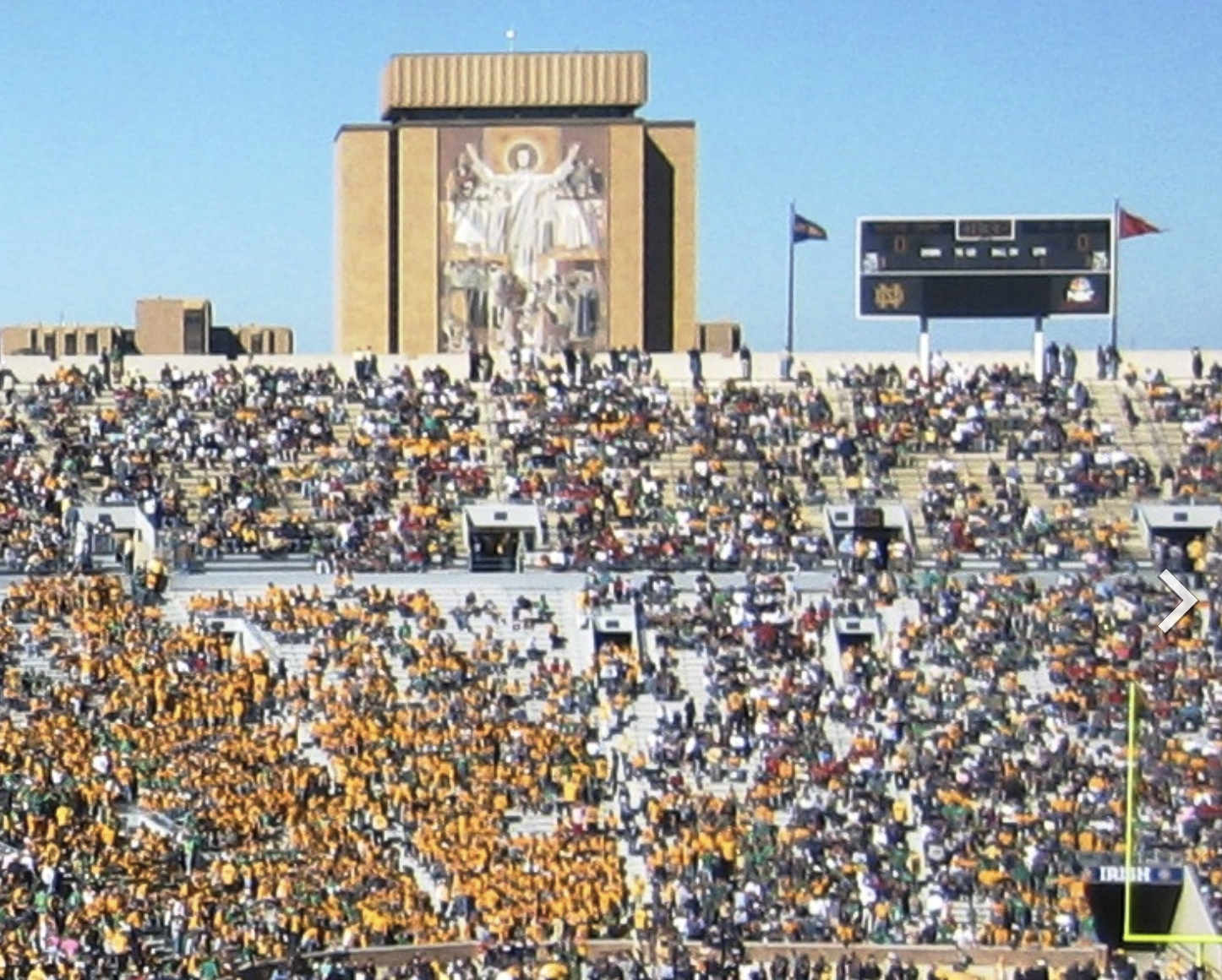
Sports, in so many ways, are almost like a religion for many people. Like religion, sports can convey important lessons about culture and values. From the times of the Ancient Greeks, athletes were sometimes accorded the status of gods.

Not much has changed since ancient times. Modern society has given god-like status to many athletes. Lebron James, Tiger Woods and Lionel Messi are just three athletes who garner such adulation on a global scale.

The question here at GetReligion is how this relationship shows up in news stories about sports, especially stories in which religious faith is — according to the athletes themselves — a key element in their lives and their success.

A new book by Randall Balmer, a historian who holds the John Phillips Chair in Religion at Dartmouth University, called “Passion Plays: How Religion Shaped Sports in North America” (University of North Carolina Press) explores the relationship between sports and religion. It will be available starting Sept. 20. For journalists and news readers, this book can be a door into some important topics in the news.

Balmer is an academic, not a journalist. Yet, he is on to something here -- something most sports writers miss altogether when they cover games or write player features. This is a book about subjects that religion-beat pros need to consider, since so few sports pros appear willing to do so.

GetReligion hasn't shied away from sports in the past and how it often intersects with faith and religion, as seen in this Google search for “GetReligion,” “sports” and “ghosts.”

For years, GetReligion has noted God-sized gaps in sports stories. We refer to these holes as "holy ghosts." Consider the titles of these posts: “Tragic death of NBA coach's wife Ingrid Williams and a missing element in the news,” “God credited with shrinking figure skater's brain tumor, but otherwise terrific story haunted by ghost” and “Haunted house Olympics: How many of the faith-driven stories did you see in Rio coverage?

Balmer writes in the introduction that the book “examines how the history of religion across North America connects in fascinating ways to the emergence of modern team sports.” He also argues, very persuasively, that modern sports have “evolved into a phenomenon that generates at least as much passion as traditional religion.”

I can relate to Balmer’s general argument.


Please respect our Commenting Policy

At Lambeth 2022, many Anglican bishops could not 'walk together' to the altar

At Lambeth 2022, many Anglican bishops could not 'walk together' to the altar

While Canterbury is urging Anglicans to keep "walking together," the 2022 Lambeth Conference demonstrated that many of the Anglican Communion's bishops can no longer even receive the Eucharist together.

Doctrinal conflicts over biblical authority and sexuality have raged for decades, with growing churches in the Global South clashing with the shrinking, but wealthy, churches in England, America and other Western regions. During this 12-day conference, which ended Sunday (August 8), conservatives from Africa, Asia and elsewhere declined to receive Holy Communion with openly gay and lesbian bishops. Several provinces -- including the massive Church of Nigeria -- boycotted Lambeth 2022 altogether.

"For the large majority of the Anglican Communion the traditional understanding of marriage is something that is understood, accepted, and without question, not only by bishops but their entire church," said Archbishop of Canterbury Justin Welby, in a mid-conference address. "To question this teaching is unthinkable, and in many countries would make the church a victim of derision, contempt and even attack."

Bishops in the Anglican minority, he added, "have not arrived lightly at their ideas. … They are not careless about Scripture. They do not reject Christ. But they have come to a different view on sexuality after long prayer, deep study and reflection on understandings of human nature. For them, to question this different teaching is unthinkable."

Throughout Lambeth 2022, the Global South Fellowship of Anglican Churches -- representing about 75% of Anglican church attendance -- pushed to reaffirm a 1998 Lambeth resolution that "homosexual practice" is "incompatible with Scripture," while also urging Anglicans to "oppose homophobia." It stressed centuries of doctrine that "sexuality is intended by God to find its rightful and full expression between a man and a woman in the covenant of marriage, established by God in creation, and affirmed by our Lord Jesus Christ." That earlier resolution passed with 526 votes in favor, 70 opposed and 45 abstentions.

Writing to Lambeth participants, Welby said the "validity" of that resolution "is not in doubt" and that the "whole resolution is still in existence."

However, the archbishop did not allow a vote on the issue and he said he would not, as requested by Anglican primates in the past, discipline the unorthodox.


Please respect our Commenting Policy

Thinking about missing pieces of Axios report on changes in Latino life, politics and, yes, faith

Thinking about missing pieces of Axios report on changes in Latino life, politics and, yes, faith

GetReligion, as a rule, has never been interested in public-relations features.

So why lead the top of a weekend “think piece” with a Baptist Press story that is obviously the kind of glowing public-relations work that is a stable in church-market, denominational media of all kinds?

That’s easy to explain. You see, this feature — “Church ESL camp preps Hispanic elementary students for school year” — is a perfect example of a trend in the wider evangelical world that is linked to one of the most important political, and religious, stories in America right now.

Why is that?

Read the top of this story and think to yourself: This is an absolutely normal story in Southern Baptist Convention life at this point in time.

Fanny Baltanado planned to spend just six months visiting her new granddaughter in Texas when the unanticipated COVID-19 pandemic thwarted her return to Nicaragua. She would need to find a church home near Humble, Texas.

An adult English as a second language class attracted Baltanado in March to Cross Community Church, where she became a regular attendee and in August, helped the church teach ESL to local Hispanic elementary students in a back-to-school camp.

“For me, this was an amazing experience because we are able to bring the love of Jesus Christ to the people, especially kids,” Baltanado said. “I think they are the base of the society, and we need to help them to be more comfortable, to be more confident with themselves, because they are (in) difficult times.”

ESL classes ranked as a top community need when Del Traffanstedt and his wife Charmaine planted Cross Community Church in the majority Spanish-speaking Eastex-Jensen area of northeast Houston in September 2021. The couple learned of the need for the ESL camp for children after launching their first adult class in March, said Charmaine Traffanstedt, who directs the church’s ESL ministry.

What is the political angle in that local-church story?

Answer: Flash back a few days ago to my post that ran with this headline: “Axios looks at the hot political (of course) trend of Latinos becoming evangelical voters.”

I am returning to that topic again because (a) this truly is a story that news consumers will be hearing about as we head into midterm elections and beyond and (b) because I had an obvious “senior moment” when writing that earlier post.


Please respect our Commenting Policy