Baptists

What happens after Anaheim '22? That will unfold in pulpits, pews and big SBC institutions

What happens after Anaheim '22? That will unfold in pulpits, pews and big SBC institutions

Before the Southern Baptists Convention's strong vote to approve what supporters called "bare minimum" sexual-abuse reforms -- with victims in the crowd weeping with relief -- there was a strategic amendment to the recommendations.

Rather than stay with the independent Guidepost Solutions organization, the Abuse Reform Implementation Task Force would seek to use "best practices in keeping with Southern Baptist church polity," while a "Ministry Check" website tracking those "credibly accused" of abuse would be "established and maintained by an independent contractor."

Activist Rachel Denhollander pleaded, before the vote: "Institutions must be held accountable. It doesn't matter who they are. Justice and truth are always what we should pursue."

Afterwards, the attorney and #ChurchToo abuse survivor posted another challenge on Twitter: "It is the first, most basic steps. But it is a testament to the survivors who fought so long and so hard. I am grateful. Now let's keep working."

That work will depend on the cooperation of pastors and church leaders in the SBC's 47,000 local churches, as well as the administrators and trustees of agencies, boards, seminaries and other institutions at the state and national levels.

The bottom line: In Southern Baptist "polity" -- with sprawling structures of autonomous congregations that, to varying degrees, fund state, national and global ministries -- there are no leadership structures resembling local Presbyterian presbyteries, regional annual conferences among United Methodists or the powerful diocesan structures of Catholics, Episcopalians and others. Local churches ordain, hire and fire clergy.

Outsiders often struggle to understand the theological and practical implications of Baptist polity, said Thomas Kidd, who teaches church history at Midwestern Baptist Theological Seminary and Baylor University.

"Many people continue to think that the SBC can make its churches do this or that or the other and that simply isn't true," he said.

Please respect our Commenting Policy

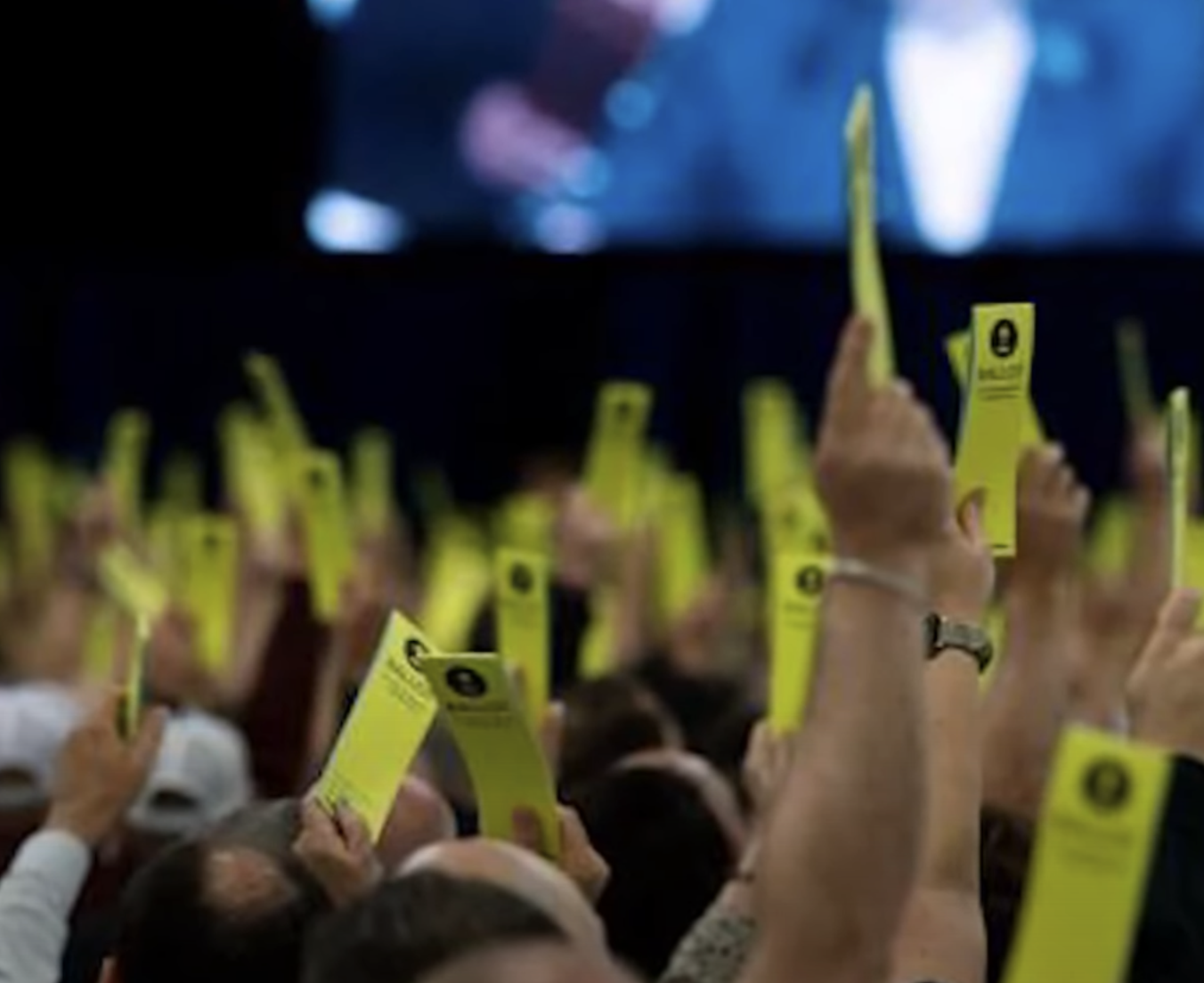
Podcast: Now what, after SBC 'messengers' have waved their yellow voting cards?

Podcast: Now what, after SBC 'messengers' have waved their yellow voting cards?

Here’s a warning to reporters who are preparing for future national meetings of the Southern Baptist Convention: Never call these folks “delegates.”

They are not delegates at some kind of political event. They are “messengers” from their local autonomous churches. You see, this isn’t some kind of cocktail-hour mainline Protestant denominational whatever, and many Baptists don’t like the word “denomination,” either. This is a “convention” and it only meets for three days each year.

Use the wrong language and Southern Baptists will give you a steely gaze and then say something nasty, like “Well, bless your heart.”

Quite a few journalists attended this year’s SBC meeting because there were headline-worthy — from their editors’ point of view — topics on the agenda, like clergy sexual abuse, Critical Race Theory and an election to determine if some new-breed conservative “pirates” (that was their term from 2021) were going to wrest the wheel of the ship away from the allegedly “woke” establishment conservatives.

As you would imagine, host Todd Wilken and I dug into all of this during the “Crossroads” podcast this week (CLICK HERE to tune that in). One of the big themes was that the hard-news coverage of this convention — especially by “Location, location, location” pros from major SBC centers, like Houston and Nashville — was top-notch.

Veteran GetReligion scribe Bobby “Positive” Ross, Jr., will offer pages of URLs in his Plug-In feature this week, so I will not try to do that (I’ll post a link when it goes public). But this is what happens when major newsrooms send religion-beat professionals to cover a major event. Readers don’t have to agree with every single thing that they saw in the #SBC2022 coverage, but what we had here was a tsunami of serious coverage from professionals, backed by the skilled Baptist Press team running the on-site newsroom.

With that in mind, let me note a Big Ideas from this podcast.

* If you study attendance numbers at previous “hot” SBC meetings, you will notice a logical trend linked to a map of the Bible Belt. In this online list, note the 1985 Dallas convention drew 45,519 messengers and the 1986 Atlanta convention drew 40,987.

Yes, these were the pivotal years in the historic “conservative resurgence” in SBC life. But, truth is, those numbers also reflect how far ordinary messengers can drive in one day jammed into the buses or vans owned by “ordinary” SBC congregations.


Please respect our Commenting Policy

Plug-In: Faith groups continue to debate solutions to blitz of mass shootings in America

Plug-In: Faith groups continue to debate solutions to blitz of mass shootings in America

God and guns.

After a string of mass shootings nationwide, conversations with people of faith inevitably turn to that subject.

Ken Factor and Lawson Vaughn are friends and fellow Christians. I met both while in Tulsa this past weekend to report on their church mourning the massacre of four people.

I asked Factor and Vaughn about possible solutions following the recent attacks at a Buffalo, New York, supermarket, an Uvalde, Texas, school and a medical office in their own community.

Factor stressed that he has been a registered Republican for nearly 40 years.

But he said, “I think we need some kind of restrictions on guns. I don’t know that the Second Amendment applies to things like me deciding, ‘I’m going to go get an AR-15 today.’”

In Vaughn’s view, though, firearms aren’t the real problem.

“I think there’s something to be said just for the erosion of the home, the family,” he said. “I mean, it starts with raising kids to respect others and having families that go to church.”

As The Associated Press’ Deepa Bharath and Holly Meyer report, the recent shootings have exposed divisions on the gun issue in faith communities and raised this question: “Are you pro-life if you are pro-gun?”

At The Oklahoman, Carla Hinton offers in-depth coverage of religious views on gun control — including a letter signed by more than 50 leaders that was recently delivered to Tennessee’s Republican governor, Bill Lee.


Please respect our Commenting Policy

Thinking about that 'Define evangelical' thing, with Andrew Walker, Ryan Burge (and Mark Noll)

Thinking about that 'Define evangelical' thing, with Andrew Walker, Ryan Burge (and Mark Noll)

If you search for “define evangelical” in the 18 years worth of material stored here at GetReligion you will find about four screens worth of information. Here’s what that looks like in a Google search.

Believe it or not, this was a hot topic before the advent of Orange Man Bad and the dreaded “81% of White evangelicals” mantra.

Debates about the meaning of the church-history term “evangelical” are so old that I once asked the Rev. Billy Graham for his take. Here’s some information about his answer, drawn from this “On Religion” column: “Define 'evangelical' – please.”

… You might assume that the world's most famous evangelist has an easy answer for this tricky political question: "What does the word 'evangelical' mean?" If you assumed this, you would be wrong. In fact, Graham once bounced that question right back at me.

"Actually, that's a question I'd like to ask somebody, too," he said, during a 1987 interview in his mountainside home office in Montreat, N.C. This oft-abused term has "become blurred. ... You go all the way from the extreme fundamentalists to the extreme liberals and, somewhere in between, there are the evangelicals."

Wait a minute, I said. If Billy Graham doesn't know what "evangelical" means, then who does? Graham agreed that this is a problem for journalists and historians. One man's "evangelical" is another's "fundamentalist."

That leads us to the topic of this quick, and rather rare, Monday “think piece” (I’m traveling right now and rather unplugged, so I wrote this several days ago).

Thus, at the top of this post you will see a video feature from The Gospel Coalition in which two academics — political scientist Ryan Burge ( a GetReligion contributor) and ethicist-apologist Andrew Walker — debate this topic: “Is ‘Evangelical’ a Political or Theological identity?” (Careful readers may have noticed that, a few lines earlier, I called it a “church-history term” and I’m sticking to that.)

I will let Burge and Walker speak for themselves.


Please respect our Commenting Policy

Plug-In: Faith in Uvalde, even as national media attention focuses on police and guns

Plug-In: Faith in Uvalde, even as national media attention focuses on police and guns

In the 10 days since a gunman killed 19 children and two teachers at an elementary school in Uvalde, Texas, questions about the incompetent police response have dominated the headlines.

So, too, has the political debate over gun violence, specifically the assault-style weapons used in Uvalde as well as recent mass shootings in Buffalo, New York, and — just this week — Tulsa, Oklahoma.

Rightly so.

But faith, too, has emerged as a vital part of the story, as we first highlighted last Friday. Once again this week, that is where we start.

Check out this must-read coverage:

A church, a gathering place for generations, becomes a hub for Uvalde’s grief (by Rick Rojas, New York Times).

Funeral after funeral, Uvalde’s only Catholic priest leans on faith (by Teo Armus, Washington Post).

Meet the first minister of gun violence prevention (by Emily McFarlan Miller, Religion News Service).

In Uvalde, a ministry of listening and silence (by Addie Michaelian, World).

‘This is wailing, weeping, heartfelt grief. This is what this town is feeling’ (by Audrey Jackson, Christian Chronicle).

The arrow in America’s heart (by Elizabeth Dias, New York Times).

A former pastor grieves the loss of his great-granddaughter in Uvalde (by John Burnett and Marisa Peñaloza, NPR).

On Texas shooting, Vatican Academy for Life says just laws ‘protect all citizens’ (by Elise Ann Allen, Crux).


Please respect our Commenting Policy

Podcast: Americans have long been divided (and often confused) on abortion issues

Podcast: Americans have long been divided (and often confused) on abortion issues

When people ask me to list some must-read books — if the goal is understanding religion and the news — the first one I mention is “Culture Wars: The Struggle to Define America” by sociologist James Davison Hunter.

Pundits love to toss “culture wars” around as a kind of journalism hand grenade, but few bother to flash back to this 1991 classic and note how Hunter defined that term. In 1998 I wrote a column — “Ten years of reporting on a fault line” — in which I noted Davison’s description of America’s ongoing legal and political wars about religion, morality and culture.

The key: Americans were no longer debating specific religious beliefs or traditions. Instead, he said they were fighting about “something even more basic — the nature of truth and moral authority.”

… America now contains two basic worldviews, which he called "orthodox" and "progressive." The orthodox believe it's possible to follow transcendent, revealed truths. Progressives disagree and put their trust in personal experience, even if that requires them to “resymbolize historic faiths according to the prevailing assumptions of contemporary life."

The book Hunter wrote in 1994, right after “Culture Wars”? It was called “Before the Shooting Begins: Searching for Democracy in America's Culture Wars.” Hold that thought.

All of this brings me to this week’s “Crossroads” podcast (CLICK HERE to tune that in) focusing on a new Lifeway Research study — on behalf of the Land Center for Cultural Engagement at Southwestern Baptist Theological Seminary — probing how religious faith and practice affect what Americans believe about abortion. The survey took place days before the leak of the draft opinion by Justice Samuel Alito indicating that the U.S. Supreme Court is poised to overturn Roe v. Wade.

The survey results are complex and will provide little comfort for those committed to a consistent pro-life stance or. on the other side, the defense of America’s pro-abortion-rights legal structures built on Roe.

In the podcast, I argued that this survey deserves mainstream media coverage — but I sincerely doubt that this will happen. Why?


Please respect our Commenting Policy

Journalists might ask: Did fundamentalists actually win their debate with modernists?

Journalists might ask: Did fundamentalists actually win their debate with modernists?

Countless sermons each weekend may prove inspiring for American churchgoers, but historians “will little note nor long remember” most of them.

One great exception, titled “Shall the Fundamentalists Win?,” was delivered 100 years ago this spring by the Rev. Harry Emerson Fosdick at New York City’s First Presbyterian Church.

Fosdick threw a bright spotlight on the “Fundamentalist-Modernist controversy,” both predicting and demanding that his fellow modernists would win the era’s theological war. The Presbyterian Church had been debating whether to expel biblical liberals since 1892 and in 1910 mandated what later became known as the “five points of Fundamentalism.”

Yes, some of the pioneers of the “fundamentals of the faith” were part of the old Protestant mainline.

Fosdick’s oration attacked three of these beliefs, including the necessity of belief in Jesus Christ’s literal Virgin Birth and Second Coming. But his third target was pivotal, the contention that as the inspired Word of God, the Bible is free of error on history as well as spiritual and moral teachings. Fosdick conveyed the canard that this meant God “dictated” the words to earthly stenographers and then championed “progressive” revelation as promoted by scholarly biblical criticism. (Along the way he remarked that rigid interpretation of the Quran was a similar “millstone about the neck” for Islam.)

A dictionary note is required here. Fosdick defended what he called “evangelical” religion, using the word to broadly signify Protestants of whatever theology. In the 1940s, conservative Protestant foes of the modernists began embracing that same word to distinguish themselves from the unpopular hard-line “fundamentalists.”

Got that? The label has stuck ever since, though some contend it now signifies a Republican political bloc more than a theological movement.


Please respect our Commenting Policy

Prayers and laments in Uvalde: 'May God heal their little hearts, their little souls'

Prayers and laments in Uvalde: 'May God heal their little hearts, their little souls'

Another week.

Another mass shooting — this time at an elementary school in Uvalde, Texas.

I lack the words to convey the enormity of this tragedy. Instead, as we mourn the 19 innocent children and two teachers slain Tuesday, let’s reflect on these expressions of faith and lament:

“We don’t know what to pray. … We just know we’re hurting, and our God hurts with us.” — Zach Young, worship pastor for Crossroads Community Church in San Antonio (via San Antonio Express-News story by Jacob Beltran)

“We’re just trying to encourage each other and trying to get through this.” — John Juhasz, outreach minister for Getty Street Church of Christ in Uvalde (via story by Washington Post team)

“The only way we can fix this country is to get down on our knees and humble ourselves before God. I am here to support this community and to ask God to heal our land.” — Jennifer Fry, mother of two young children, interviewed at a prayer vigil in Uvalde (via story by Wall Street Journal team)

“We may not understand what happened … but we seek the Lord, as best we can.” — Carlos Contreras, minister at Primera Iglesia Bautista (First Baptist Church) in Uvalde (via Texas Tribune story by Erin Douglas and Jason Beeferman)

“Prayer should be where we start, not where we finish. If we were praying genuine prayers about gun violence, we would see a lot more genuine action.” — Taylor Schumann, author of ”When Thoughts and Prayers Aren’t Enough: A Shooting Survivor’s Journey Into the Realities of Gun Violence” (via Religion News Service story by Emily McFarlan Miller)

“The Catholic Church consistently calls for the protection of all life; and these mass shootings are a most pressing life issue on which all in society must act — elected leaders and citizens alike.” — Catholic Archbishop Gustavo Garcia-Siller of San Antonio (via America story by Michael O’Loughlin).


Please respect our Commenting Policy

Podcast: Those hellish SBC sexual-abuse stories? They may be coming to a zip code near you

Podcast: Those hellish SBC sexual-abuse stories? They may be coming to a zip code near you

There’s an old saying in the real estate business about properties that get hot and then sell quickly: “Location, location, location.”

That’s precisely where we are right now with the sexual-abuse scandal that looms over the core institutions of the giant, complex, sprawling Southern Baptist Convention.

Where is the story heating up right now? Where is the story going in the future? The answer to both of those questions is: “Location, location, location.” This is true with current events (and events yet to come) and it’s also true with the must-read coverage of this big story. We focused on both sides of that equation during this week’s GetReligion podcast (CLICK HERE to tune that in).

First, let’s talk about the journalism behind this story, which has been building for several years now (see this Bobby Ross, Jr., “Plug-In” update for a starter). Everything begins in Texas and Tennessee and reporters there who are doing the heavy lifting — in Nashville and Houston, to be specific. You can see this, ironically, in this Washington Post story: “How two Texas newspapers broke open the Southern Baptist sex scandal.” Here is the overture:

Houston Chronicle city hall reporter Robert Downen was on the night shift one evening in 2018, just a few months into the job, when something caught his attention.

Scrolling through an online federal court docket, he spotted a lawsuit that accused Paul Pressler, a prominent former judge and leader of the Southern Baptist Convention, of sexual assault. While the case had been previously reported, newly filed documents painted an even more damning picture, including the revelation that Pressler had previously agreed to pay his accuser $450,000. Downen, then 25, probed more deeply and discovered other survivors of church abuse, who made it clear to him, he recalled, that “if you think this problem is confined to one leader, we have quite a bit to show you.”

Downen’s ever-growing spreadsheet of cases soon inspired a larger reporting effort to quantify the scope of sex abuse within the massive Protestant denomination. Journalists at the Chronicle and the San Antonio Express-News teamed up to create a database of cases involving nearly 300 church leaders and more than 700 victims for their landmark 2019 “Abuse of Faith” series.

A wave of outrage in response to the series rocked the Southern Baptist Convention, prompting its Executive Committee to hire an outside firm to investigate.

Sexual-abuse accusations against Pressler had been rumbling for decades behind closed doors and in locked-tight legal proceedings. I first heard about them in the early 1980s, through a well-placed contact at CBS News, when I first hit the religion beat at The Charlotte News. There was smoke, but no one could get to the fire. The fact that this SBC giant’s accusers were young males only added to the tension.

If you know SBC life — I grew up as a Texas Baptist preacher’s kid and my whole family has Baylor University ties — then you may know this old saying: Texas is the wallet on which the SBC sits.


Please respect our Commenting Policy