Baptists

Thinking with two key Southern Baptists: Concerning those scary Gallup Poll numbers

Thinking with two key Southern Baptists: Concerning those scary Gallup Poll numbers

Let’s fly up to high altitude for a moment, before reading two interesting think pieces about those Gallup Poll numbers — “U.S. Church Membership Falls Below Majority for First Time” — that launched a kazillion headlines.

If you’ve been paying attention to the state of Christianity in America for the past 50 years or so, you’re aware of several broad trends.

* In terms of demographics, the world of oldline Protestantism — the “Seven Sisters” churches — is in freefall, with these aging denominations losing around 50% of their members after peaking in the 1960s.

* Catholic churches have grown, kind of, in part due to rising numbers of Latinos in the pews. Worship numbers are down. New vocations for priests and nuns are way down (but it’s fascinating to note the cases in which numbers are steady, or rising). Mass attendance and birth-rate trends are crucial.

* Evangelical Protestants surged, especially in the Sunbelt, filling much of the public-square void created by mainline decline. Growth was especially strong with charismatics and Pentecostals — Black and White. In the past decade or two, the rapid growth of nondenominational or even post-denominational churches and networks has hurt mainstream evangelicalism, especially the Southern Baptist Convention. Most evangelical numbers have stalled or gone into a slower decline.

Summary: Churches are growing or holding steady if members are (a) having children, (b) raising children in the faith, (c) retaining the loyalty of those children into the next generation and (d) winning converts (that final point has more to do with doctrine than politics).

Notice that the words “Donald Trump” are missing. Like I said, this is a view from the heavens.

With all that in mind, let’s look at two essays: “Why American Church Membership Is Plummeting,” by historian Thomas Kidd, care of The Gospel Coalition website, and “Why the Church Is Losing the Next Generation,” in the latest newsletter by the Rev. Russell Moore of the SBC’s Ethics and Religious Liberty Commission.

First, here are two crucial chunks of the Kidd essay, which opens — logically enough — with a discussion of the weaknesses of polling data.

… (A)s I have suggested before, we should take religion polls with a grain of salt. … They usually tell us about some trends on the religious landscape, to be sure, but they are almost always open to widely varying interpretation. Polls are at their best when there is little wiggle room for interpretation in the data.



Please respect our Commenting Policy

Plug-In: Even with ailing digit, Bobby Ross, Jr., manages to cut and paste week's top stories

Plug-In: Even with ailing digit, Bobby Ross, Jr., manages to cut and paste week's top stories

Power Up: The Week’s Best Reads

1. Evangelical leaders are encouraging their congregants — many of whom are skeptical — to get the vaccine.

* Why "the pathway to ending the pandemic runs through the evangelical church" (by Kathryn Watson, CBS News)

* Love Your Neighbor' And Get The Shot: White Evangelical Leaders Push COVID Vaccines (by Sarah McCammon, NPR)

* White Evangelical Resistance Is Obstacle in Vaccination Effort (by Elizabeth Dias and Ruth Graham, New York Times)

* Vaccine skepticism runs deep among white evangelicals in US (by David Crary, Associated Press)

2. A Nashville church is planting a community garden to survive after the building was destroyed in tornadoes last year.

* A tornado destroyed their church. Now, faith takes root in a garden planted to serve the community (by Holly Meyer, The Tennessean)

* After 13 months apart, Easter service brings Watson Grove church members together again (by Cassandra Stephenson, The Tennessean)


Please respect our Commenting Policy

'Nothing in particular' is the growing American religion niche few are studying

'Nothing in particular' is the growing American religion niche few are studying

While working on the 1985 book "Habits of the Heart," the late sociologist Robert N. Bellah met "Sheila," who described her faith in words that researchers have quoted ever since.

"I can't remember the last time I went to church," she said. "My faith has carried me a long way. It's Sheilaism. Just my own little voice." The goal was to "love yourself and be gentle with yourself. … I think God would want us to take care of each other."

A decade later, during the so-called "New Age" era, researchers described a similar faith approach with this mantra -- "spiritual but not religious."

Then in the 21st Century's first decade, the Pew Research Center began charting a surge of religiously unaffiliated Americans, describing this cohort in a 2012 report with this newsy label -- "nones."

Do the math. "Nones" were 10% of America's population in 1996, 15% in 2006, 20% in 2014 and 26% in 2019. This stunning trend linked many stories that I have covered for decades, since this past week marked my 33rd anniversary writing this national "On Religion" column.

Obviously, these evolving labels described a growing phenomenon in public and private life, said political scientist Ryan Burge of Eastern Illinois University, author of the new book, "The Nones: Where They Came From, Who They Are, and Where They Are Going."

But hidden under that "nones" umbrella are divisions that deserve attention. For example, the 2018 Cooperative Congressional Election Study found that 5.7% of the American population is atheist, 5.7% agnostic and 19.9% "nothing in particular."

"When you say 'nones' and all you think about is atheists and agnostics, then you're not seeing the big picture," said Burge, who is a contributor at the GetReligion.org website I have led since 2004. "Atheists have a community. Atheists have a belief system. They are highly active when it comes to politics and public institutions.

"But these 'nothing in particular' Americans don't have any of that. They're struggling. They're disconnected from American life in so many ways."


Please respect our Commenting Policy

New podcast: Familiar splits among white 'evangelicals,' only now they're about vaccines

New podcast: Familiar splits among white 'evangelicals,' only now they're about vaccines

It’s really a matter of simple math and logic.

Let’s start with this question, stripped of the political and journalism questions attached to it: Which of the following numbers is larger and, thus, more important — 45 or 55?

If you said “45,” then you’re ready to write headlines and edit controversial stories for The New York Times.

Before we move on, let’s ask another question that was at the heart of this week’s “Crossroads” podcast (click here to tune that in). I’ll frame this in as neutral a manner as possible: If members of the Democratic Party were divided 55% “yes” to 45% “no” on a major decision, would you see this (a) as a sign that Democrats were united in opposition to the question at hand or (b) that Democrats were starkly divided on the question, with a majority taking a positive stance? I should mention that the 55% “yes” vote includes virtually all of leaders of major institutions within the world of Democratic Party life.

With that in mind, let’s contemplate the story under the following double-decker headline from the Times:

White Evangelical Resistance Is Obstacle in Vaccination Effort

Millions of white evangelical adults in the U.S. do not intend to get vaccinated against Covid-19. Tenets of faith and mistrust of science play a role; so does politics.

This brings us to the crucial summary material in this story:

The opposition is rooted in a mix of religious faith and a longstanding wariness of mainstream science, and it is fueled by broader cultural distrust of institutions and gravitation to online conspiracy theories. The sheer size of the community poses a major problem for the country’s ability to recover from a pandemic that has resulted in the deaths of half a million Americans. And evangelical ideas and instincts have a way of spreading, even internationally.

There are about 41 million white evangelical adults in the U.S. About 45 percent said in late February that they would not get vaccinated against Covid-19, making them among the least likely demographic groups to do so, according to the Pew Research Center.

“If we can’t get a significant number of white evangelicals to come around on this, the pandemic is going to last much longer than it needs to,” said Jamie Aten, founder and executive director of the Humanitarian Disaster Institute at Wheaton College, an evangelical institution in Illinois.


Please respect our Commenting Policy

Obvious question: Maybe Christian faith played a role in the Scott Drew and Baylor hoops story?

Obvious question: Maybe Christian faith played a role in the Scott Drew and Baylor hoops story?

Frankly, I am not the most enthusiastic of Baylor University alums (I once passed up a request to apply for a faculty slot by telling the president that I had already died once in Waco wasn’t anxious for a reprise).

Still, you didn’t think that the Baylor basketball team was going to win the national championship (after being a favorite in the COVID-canceled 2020 dance) without a word of comment here? I mean, I have heard from other Baylor grads who worked their way through lots of the mainstream news coverage of the March Madness finale while thinking “ghost,” “ghost,” “another religion ghost.”

Yes, this was the Texas Baptists vs. Jesuits matchup that hoops fans wanted. And then you had the simple reality that Baylor (for better and for worse) is the world’s most prominent Baptist academic institution.

But how could the press ignore or short-change the fact that the story of coach Scott Drew and his underdog Bears was packed with valid religion facts and themes? Would all fans care that Final Four MVP Jared Butler teaches a Sunday School class for little kids? Probably not. But millions of people would.

But they key to everything was this big question: Why was Drew at Baylor in the first place? Why did he pack up and head to Waco 18 years ago, when the program was dead, dead, dead or worse. Here’s the top of a long CBS Sports feature: “Scott Drew never let others change his story, path or program, and that's how he led Baylor to its first title.”

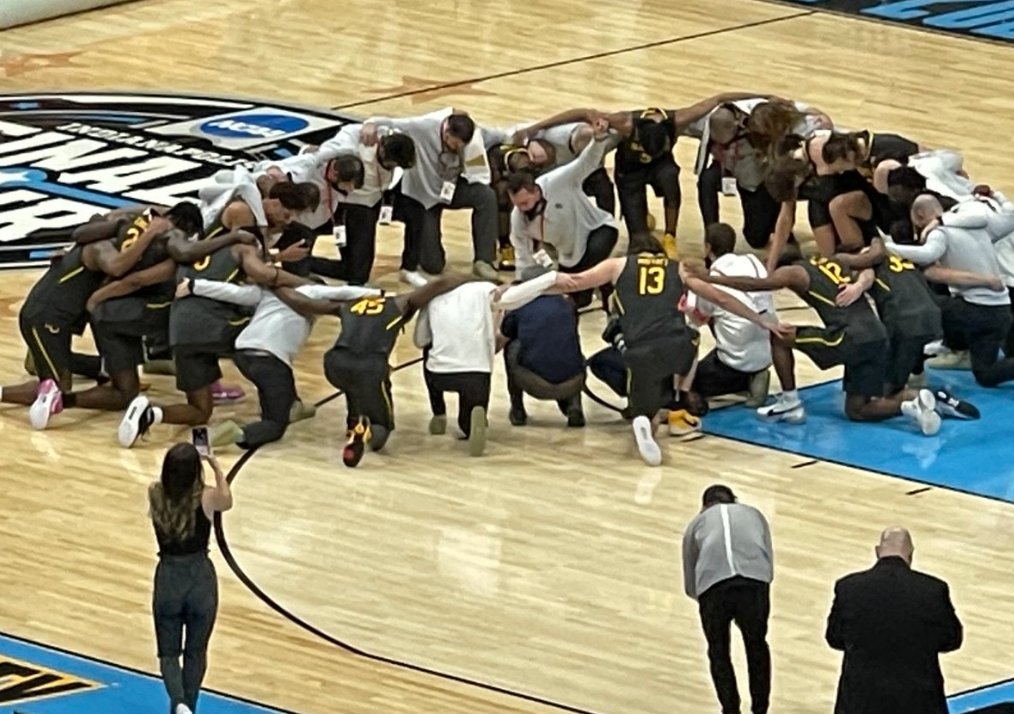
Leaping into the arms of his staff. College basketball's happiest coach on his happiest night. When it was over, Drew brought everyone into a huge circle on the court. They kneeled and said a prayer.

The greatest program reinvention in men's college basketball history was complete.

Drew took the Baylor job in 2003 when the program was near disintegration. The job Drew's done at Baylor in the 18 years since -- impressive is an understatement. There was no set of instructions when he got there, because there wasn't even a drawer to put them in. This was not a rebuild; what Baylor could be, in 2003, was a figment of Drew's imagination.

Drew is described in all kinds of upbeat, but strange, ways. This is one happy, upbeat, positive-thinking weirdo. Does it matter that, when he describes his bond with Baylor, he talks in terms of Christian faith, family and a sense that God called him to this job? Is that part of this national news story, just because Drew says so and there is tons of evidence that he means it?


Please respect our Commenting Policy

Hail to the resurrection of the Religious Left, creating media blitz No. 175 (or thereabouts)

Hail to the resurrection of the Religious Left, creating media blitz No. 175 (or thereabouts)

The Easter season 2021 came with legacy media belief in the resurrection -- of the Religious Left.

Since Jerry Falwell (Senior) emerged from the underbrush, how many times have we read forecasts that religiously inspired political liberals will supplant the political prominence and influence of the Religious Right? This must be something like round 175.

The latest, headlined "Progressive Christians Arise! Hallelujah!", emerged from the word processor of Nicholas Kristof, who treats religious themes more often than fellow New York Times commentators — except David Brooks and Ross Douthat.

The Religious Left, so prominent in the New Deal days and the anti-war and civil rights efforts of the 1960s, never went away. Witness the perpetual political pronouncements from the “Seven Sisters” of Mainline Protestantism, for example the United Methodist Church lobby headquartered across the street from the U.S. Capitol and next door to the U.S. Supreme Court.

Journalists need to carefully evaluate these claims because renewed political impact by a Religious Left would loom large on story agendas. What's the evidence?

Kristof pins hopes heavily upon Democrats with religious leanings "moving onto center stage" as follows. Catholic President Joe Biden is a faithful churchgoer (unlike Donald Trump). Veep Kamala Harris regularly "attended" Baptist churches (but note the past tense). Senator Elizabeth Warren "taught" Sunday School (another past tense). Senator Cory Booker and Transportation Secretary Pete Buttigieg "speak the language of faith fluently." And media star Alexandria Ocasio-Cortez says Catholicism "inspires" her radicalism.

The column also touts troubles on the right. Some of those rabid U.S. Capitol rioters invoked religion.


Please respect our Commenting Policy

Plug-in: Double standard? Treatment of Boulder suspect's faith raises tough question

Plug-in: Double standard? Treatment of Boulder suspect's faith raises tough question

Another week.

Another mass shooting.

Another 21-year-old suspect.

Last week's news coverage of Robert Aaron Long, charged in the deaths of eight people — including six women of Asian descent — at three Atlanta-area spas, focused on his ties to a Southern Baptist congregation.

Long's arrest sparked a barrage of stories and columns on evangelical theology, racism and "purity culture," including a Religion News Service op-ed headlined "Blaming Christians for the Atlanta shootings isn't persecution, it's prosecution."

On the other hand, Ahmad Al Aliwi Alissa's Muslim background has figured less prominently — so far — in reporting on the suspect in Monday's massacre that claimed 10 lives at a King Soopers grocery store in Boulder, Colorado.

In profiling the suspect, some major news organizations haven’t mentioned his religious affiliation at all. RNS has emphasized concerns that Alissa's arrest might ramp up "Islamophobia" and spark hate crimes as Muslims gather in congregational settings. (It’s a familiar storyline, going at least back to 9/11.)

"I think there definitely is a double standard," said Warren Smith, an evangelical who serves as president of the independent charitable giving watchdog MinistryWatch.com.

Smith, a longtime investigative reporter, offers this advice for covering a mass shooting: Stick to the facts. Avoid speculating on the gunman’s motives. Focus on the victims and the helpers.

"The perpetrator’s story will have an opportunity to come out in the legal process,” Smith said. “Let coverage of that process be the place where the perpetrator’s story is told factually, dispassionately, empathetically."

But the facts, not a double standard, are the reason for the different emphases in the Georgia and Colorado cases, said a journalist friend who is reporting on the Boulder massacre.

"The big difference to me is that police investigators brought up the 'sex addiction' question quickly and directly in Atlanta, which led people to seek where that guilt came came, which led to religious background," my friend said.


Please respect our Commenting Policy

Purity culture questions: A friendly, but crucial, dialogue between two evangelical thinkers

Purity culture questions: A friendly, but crucial, dialogue between two evangelical thinkers

The purity culture wars continue over on Twitter, where a crucial question — from a journalism perspective — can be seen in the following sequence.

There is no question that some church leaders went too far with purity culture themes and rites, including hellish actions by abusive men. Can anyone deny that? However, can journalists (and their academic and activist sources) assume that because evil happened in some cases means that it happened in all cases? And, to be specific, do journalists have on-the-record evidence that the alleged shooter in Atlanta was, in fact, warped by abusive people at an abusive church?

GetReligion published two posts linked to these debates. Check out Julia Duin’s post here: “Panning purity culture: What the press doesn't get about basic Christian doctrines on sex.”

Then, I raised other basic journalism questions here: “Wait a minute: How is a sermon on the Second Coming linked to shootings in Atlanta?

Before we get to this weekend’s two “think pieces” on this topic — by religious-liberty activist David French and Crossway books executive Justin Taylor — here is a flashback to a key passage in my post, which is linked to some of Taylor’s constructive criticism of the French piece.

It’s not enough to say that this or that conservative congregation, or counseling center, or parachurch ministry is “evangelical” and, thus, the public can assume that Christian doctrines were used in manipulative ways. …

Ponder this equation: Journalists cannot assume that a specific evangelical flock advocates dangerous doctrine X, simply because there are experts (progressive evangelicals even) who insist that all evangelicals teach dangerous doctrine X and, thus, we know that dangerous doctrine X causes broken, manipulated individuals to do hellish things.

At some point, journalists need to find specific people advocating specific ideas and actions — using research methods that are deeper than second-hand reports and the convictions of hostile experts on one side of fights about the Sexual Revolution.

This brings us to French’s must-read piece:


Please respect our Commenting Policy

New podcast: Tensions with NCAA and Christian schools? That issue will not go away

New podcast: Tensions with NCAA and Christian schools? That issue will not go away

A decade or so ago, I had a chance to speak to journalism students at Oral Roberts University. My strongest memories — other than visions of the shiny modernist architecture — center on an unusual moment during a campus chapel service.

There’s nothing unusual about a Christian university having a full-house chapel service. There’s nothing unusual about a student-led praise-rock band blasting out Contemporary Christian Music songs that inspired lots of people to do their share of swaying and dancing.

But here’s the memory. My visit to the campus took place during a meeting of ORU’s board of trustees, who sat together near the front of the auditorium during chapel. Looking down from the balcony, I was surprised to see that (a) many of the trustees were rather young, (b) a much higher than normal number of them were Black or Latino and (c) several were enthusiastically dancing with the students, including at least one in an aisle (the current board doesn’t look quite as young).

All of this was a reminder that much of the racial and cultural diversity at ORU — a major factor in campus life — was and is linked to the school’s roots in charismatic and Pentecostal Christianity, a movement that as been highly multiracial since its birth. Founder Oral Roberts was a famous, and often controversial, leader among charismatic Christians, even though, as an adult, he aligned with the United Methodist Church (which is more conservative in Oklahoma than, let’s say, parts of Illinois and other blue zip codes).

I bring this up because of a recent USA TodayFor the Win” column that served as the hook for this week’s “Crossroads” podcast (click here to tune that in). Here’s the headline for that piece, which was written by the “race and inclusion editor” at USA Today sports: “Oral Roberts University isn't the feel good March Madness story we need.” Here is a crucial passage:

… As the spotlight grows on Oral Roberts and it reaps the good will, publicity and revenue of a national title run, the university’s deeply bigoted anti-LGBTQ+ polices can’t and shouldn’t be ignored.

Founded by televangelist Oral Roberts in 1963, the Christian school upholds the values and beliefs of its fundamentalist namesake, making it not just a relic of the past, but wholly incompatible with the NCAA’s own stated values of equality and inclusion.


Please respect our Commenting Policy