Holiday musings from Brazil: Is it time for missionaries to leave indigenous tribes alone?

Holiday musings from Brazil: Is it time for missionaries to leave indigenous tribes alone?

It’s that time of year again.

We’re talking about The Holidays, the season when Thanksgiving and Christmas bookend America’s annual celebration of its history of Christian influences, even if today’s mass-media crush obscures that. It’s a season of family gatherings, annual notes to far-flung friends and acquaintances, garish holiday-themed sweaters designed to provoke smiles, and, for some, even a few religious services.

It’s a big deal journalistically, too, of course. Editors/producers and reporters/content providers seek out warm-and-fuzzy, feel-good features meant to remind media consumers of the genuine goodness individual humans are capable of showing others, including strangers.

We call it the holiday spirit and, except for the rampant consumerism, I appreciate the seasonal goodwill. And why not? Upbeat news is a welcome change from the disconcerting stories we’re usually fed. It’s good for the soul, and I need not subscribe to the traditional beliefs for it to warm my heart.

It’s also a time when journalists seek to probe the theological aspects of our holiday narratives, often to the distaste of those news consumers who prefer the comforting familiarity of traditional tellings or even the more sobering messages of traditional Christian faith in Advent and Christmas.

Such stories — here’s one example from a few years back that ran in the Guardian — are tricky, requiring solid sourcing and clear, even-handed and respectful explanations.

Another category of holiday stories addresses the consequences of past Christian actions that a reporter can link to the season, even if the link is indirect at best. Take this recent Washington Post story — “This tribe helped the Pilgrims survive for their first Thanksgiving. They still regret it 400 years later” — on how the indigenous tribe, the Wampanoag, that first encountered the Pilgrims in what is now Massachusetts were decimated by the encounter. Here’s a large bite of it:

Just as Native American activists have demanded the removal of Christopher Columbus statues and pushed to transform the Columbus holiday into an acknowledgment of his brutality toward indigenous people, they have long objected to the popular portrayal of Thanksgiving.

For the Wampanoags and many other American Indians, the fourth Thursday in November is considered a day of mourning, not a day of celebration.


Please respect our Commenting Policy

Coverage of the Arlene's Flowers story may be over, but many more cases are on the way

Coverage of the Arlene's Flowers story may be over, but many more cases are on the way

Last week, a famous set of court cases: Arlene’s Flowers v. State of Washington and Ingersoll and Freed v. Arlene’s Flowers, Inc., was settled, allowing both sides to retreat with some feeling of vindication.

The case concerned Barronelle Stutzman, owner of a flower shop in eastern Washington state who was friends with a local gay male couple — but who refused to provide flowers for their same-sex wedding because of her traditional Christian beliefs about marriage.

The gay couple sued her and then the state attorney general, Bob Ferguson, also sued her, saying she couldn’t discriminate on basis of religion. It wasn’t about discrimination, she said. After all, she’d served gay customers before and had employed gay florists in her shop. But her religious beliefs gave her no choice but to refuse to create floral arrangements for the wedding rite.

The case went to the U.S. Supreme Court. The high court, which had just ruled on a similar Colorado case, Masterpiece Cakeshop v. Colorado Civil Rights Commission, remanded it back to Washington state for further consideration in light of their favorable decision on behalf of the owner of the cake shop. But, true to form for those of us living in this ultra-blue state, the Washington Supreme Court ruled again against Stutzman.

The case returned to the U.S. Supreme Court, where Justices Neil Gorsuch, Samuel Alito and Clarence Thomas agreed to take the case. However, that was one justice short of what was needed. (An essay at First Things asked questions about why certain other conservative justices bailed on taking this case).

Now 77 and more than ready to retire, Stutzman settled this month, paying Robert Ingersoll, one of the two men, $5,000 and freeing herself of additional legal costs. You may remember that she raised some $174,000 through GoFundMe before the managers of the website rejected her beliefs and shut her down.

Here's how the Tri City Herald, the local paper, covered the Stutzman’s finale:


Please respect our Commenting Policy

Complex doctrinal story or mere politics? Hmmm ... What shaped news about U.S. bishops?

Complex doctrinal story or mere politics? Hmmm ... What shaped news about U.S. bishops?

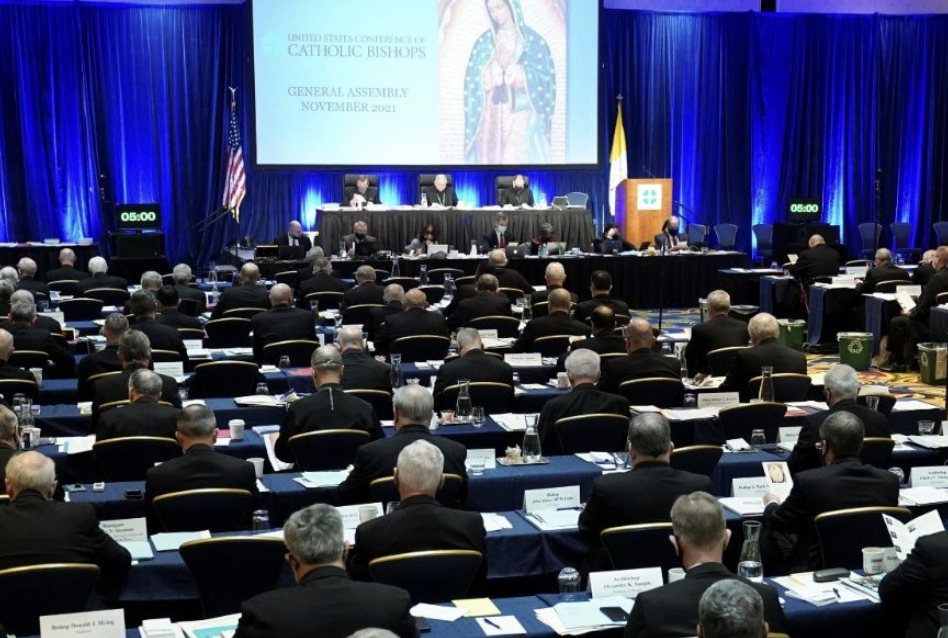
Let’s face it. This Baltimore meeting of the United States Conference of Catholic Bishops was a classic example of what kind of stories drive front-page news in the mainstream press.

For starters, you had a complicated story about a doctrinal, moral and institutional crisis in Roman Catholicism today — the collapse of Catholic beliefs and practice related to sin, confession, forgiveness and Holy Communion.

Then you had a political story that, for journalists, pitted the satanic hordes of conservative bishops linked, somehow, to Donald Trump against the wise, progressive, nuanced shepherds who sympathize with ordinary Catholics like President Joe Biden.

Guess which story framed most of the coverage? Consider this headline from the journalistic college of cardinals at The New York Times: Catholic Bishops Avoid Confrontation With Biden Over Communion.” And here’s the overture:

BALTIMORE — The Roman Catholic bishops of the United States backed away from a direct conflict with President Biden …, approving a new document on the sacrament of the eucharist that does not mention the president or any politicians by name.

At issue was the question of which Catholics, under which circumstances, are properly able to receive communion, one of the most sacred rites within Christianity. For some conservative Catholics, the real question was more pointed: Should Catholic politicians who publicly support and advance abortion rights be denied the sacrament?

For some of the most outspoken critics of Mr. Biden and other liberal Catholic leaders, the document represented a strategic retreat.

OK, here is a blunt question about that last statement: Is there any evidence that ANY DRAFT of this document — "The Mystery of the Eucharist in the Life of the Church" (.pdf here) — included a single reference to Biden, the White House or the presidency? If conservatives drove the process that led to this document, as assumed in the news coverage, isn’t it logical that references of this kind would have made it into digital ink at some point?


Please respect our Commenting Policy

Plug-In: Minichurches and burned-out pastors -- four crucial COVID-19 trends to follow

Plug-In: Minichurches and burned-out pastors -- four crucial COVID-19 trends to follow

COVID-19 rages on.

So does the pandemic’s big impact on American religion.

From in-person attendance declining to pastors burning out, here are four related trends to watch:

(1) Churches changed during the pandemic and many aren’t going back (by Janet Adamy, Wall Street Journal)

“The number of churchgoers has steadily dropped in the U.S. over the past few decades,” Adamy reports. “But Covid-19 and its lockdown restrictions accelerated that fall. In-person church attendance is roughly 30% to 50% lower than it was before the pandemic, estimates Barna Group, a research firm that studies faith in the U.S.”

(2) Why the minichurch is the latest trend in American religion (by Bob Smietana, Religion News Service)

Smietana profiles a small church in Wisconsin, noting, “Cornerstone is part of the fastest-growing group of congregations in America: the minichurch. According to the recently released Faith Communities Today study, half of the congregations in the United States have 65 people or fewer, while two-thirds of congregations have fewer than 100.”

(3) The pastors aren’t all right: 38% consider leaving ministry (by Kate Shellnutt, Christianity Today)

“Pastoral burnout has worsened during the pandemic,” Shellnutt explains. “A Barna Group survey released (this week) found that 38 percent of pastors are seriously considering leaving full-time ministry, up from 29 percent in January.”

See related coverage from the Washington Times, by former GetReligionista Mark A. Kellner.

(4) Most churches find financial stability in 2021 (by Aaron Earls, Lifeway Research)

“Emerging from the pandemic, most churches don’t seem to be underwater financially, but many are treading water,” Earls reports.


Please respect our Commenting Policy

From Off Broadway to movie screens: The complicated conversion story of C.S. Lewis

From Off Broadway to movie screens: The complicated conversion story of C.S. Lewis

While historians argue about what C.S. Lewis did or didn't say, it can be stated with absolute certainty that the Oxford don never patted down his rumbled, professorial tweed jacket before exclaiming, "Where's my phone?"

That line occurs at the start of "The Most Reluctant Convert," as actor Max McLean enters a movie set preparing for the first scene. Seconds later, the camera follows him into the real Oxford, England, where Lewis was a scholar and tutor at Magdalen College.

At first, the famous Christian writer explains how he became an atheist. When he walks into the real White Horse pub, he orders two pints of beer, with one for the viewer. Soon, scenes from his memories spring to life, with Lewis striding through them as a narrator.

"Lewis is in his imagination. He's personified in his thoughts. … I do think that the structure emerged out of the fact that Lewis had a lot to say," said McLean, laughing.

Thus, director Norman Stone -- a BAFTA winner for BBC's "Shadowlands" -- let the "voice of Lewis articulate his struggle, his passion. He is one of those rare individuals where one's intellect, one's emotions and one's spirituality are completely intertwined," said McLean.

All of this is second nature to McLean since the film covers much of the same territory as his own "C.S Lewis Onstage." This was a one-man show at the Fellowship for Performing Arts in New York City, an off-Broadway company McLean founded and guides as artistic director. It has staged other Lewis works, such as "The Screwtape Letters" and "The Great Divorce," drawing warm reviews from The New York Times and other major publications.

The first-person narration, explained McLean, was primarily drawn from Lewis' autobiography, "Surprised by Joy," and the many volumes of his personal letters.

The jump from stage to screen, of course, allowed the film's creators to seek permission to film in some of the most important sites linked to Lewis' life.


Please respect our Commenting Policy

Many like to speculate: What was the biblical 'thorn in the flesh' that plagued St. Paul?

Many like to speculate: What was the biblical 'thorn in the flesh' that plagued St. Paul?

THE QUESTION:

What was the biblical "thorn in the flesh" that so plagued St. Paul?

THE RELIGION GUY'S ANSWER:

We'll never be sure. But the question is perennially fascinating.

"Thorn in the flesh" is one of many commonplace phrases we take from the Bible. It appears in 2 Corinthians chapter 12, where St. Paul writes that he knew "a man" -- modestly referring to himself -- who was "caught up into Paradise and heard things that are not to be told." He describes the aftermath of his powerful experience in verses 7-9:

To keep me from being too elated, a thorn was given me in the flesh, a messenger of Satan to torment me, to keep me from being too elated. Three times I appealed to the Lord about this, that it would leave me, but he said to me, “My grace is sufficient for you, for power is made perfect in weakness.” So, I will boast all the more gladly of my weaknesses, so that the power of Christ may dwell in me. (New Revised Standard Version)

Other English translations say "arrogant," "conceited," "lifted up," "proud" or "exalted" instead of "elated."

Christians through history have pondered what so plagued this New Testament writer and Christian founder (though we can imagine his close colleagues knew). Some say it was a interior spiritual or psychological challenge, while others see opponents, obstacles or persecution his pioneer missionary work coped with.

Many focus on the telltale word "flesh" and insist it must have been some physical malady.


Please respect our Commenting Policy

Podcast: Why was the New York Times so interested in Marvin Olasky? Take a guess ...

Podcast: Why was the New York Times so interested in Marvin Olasky? Take a guess ...

Why was The New York Times so interested in Marvin Olasky and his views on journalism and Christian faith?

That’s a question that I heard several times this week from readers and others.

Actually, the Times published a previous article on Olasky, which I mentioned in a post here earlier this week (“Wut happened? Tensions behind World's move to push Olasky out of his editor's chair”). So let’s tweak that question a bit, to get to the point that host Todd Wilken and I discussed in this week’s “Crossroads” podcast (click here to listen to it).

Why was the Times team so interested — it’s a long, complex feature — in Olasky right now?

Actually, the answer to that question is pretty clear. Read the headline: “His Reasons for Opposing Trump Were Biblical. Now a Top Christian Editor Is Out.” Now,. read the thesis statement:

At one level, Mr. Olasky’s departure is just another example of the American news media sinking deeper into polarization, as one more conservative news outlet, which had almost miraculously retained its independence, is conquered by Mr. Trump.

It also marks the end of a remarkable era at a publication that has shaken evangelical churches and related institutions with its deeply reported articles. … At a time when hot takes get the clicks, these articles offered something old-fashioned and hard for any community to take: accountability reporting.

That’s actually two answers, isn’t it.

Answer No. 1: Trump, Trump, Trump, Trump. Answer No. 2: Olasky has built a magazine known for producing hard-news articles. That’s rare, in today’s digital world dominated by a quick-click business model that loves opinions and commentary work. The editorial approach at World was shaped by cultural, religious conservatism, more than partisan politics.

Think of this magazine as an evangelical version of the late, great New Republic.


Please respect our Commenting Policy

How will media cover the secretive Afghan mullah who will shape Islam's global status?

How will media cover the secretive Afghan mullah who will shape Islam's global status?

Showing his age, The Guy notes with amusement that early in his career "Afghanistanism" meant "the practice (as by a journalist) of concentrating on problems in distant parts of the world while ignoring controversial local issues" (per the authoritative Merriam-Webster)!

Today, many will argue that no nation is more important in news terms than the Islamic Emirate of Afghanistan, which affects both international turmoil and Islam's global status and cultural direction.

Journalists may ask, “Why?” This is probably the most heavily Muslim of nations and the Taliban who regained power in August proudly proclaim totalist governance based upon strictly interpreted and enforced Sharia (Islamic religious law). This example of Islam in action presents a huge challenge to the world religion.

A two-page (paywalled) Wall Street Journal status report by chief foreign correspondent Yaroslav Trofimov last weekend said the militantly Sunni Taliban have yet to impose the harshest policies that provoked wide condemnation during the prior Taliban years in power.

But the future is iffy.

For the moment, females seem able to attend primary school, but mostly not high school and college. Rigid bans on women leaving home unless accompanied by male relatives have not reappeared, and some women continue careers though many do not.

Public spectacles of beheading of opponents, and street beatings by religious police, have not resumed (though there are social-media rumors), nor have music and visual art yet been restricted. Shia and Sufi Muslims, and the tiny enclaves of non-Muslims, are understandably anxious, along with Christians, both coverts and missionaries who chose to remain after the exodus. (Other aspects of autocratic rule are commonplace in that part of the world.)


Please respect our Commenting Policy

Believe it or not: A story that gives decent coverage to a Catholic crisis pregnancy center

Believe it or not: A story that gives decent coverage to a Catholic crisis pregnancy center

I’ve been so used to reading snide MSM articles about pro-lifers in Texas who are reveling in the state’s new anti-abortion regs — and the lengths women in that state are going to have abortions.

So, when I saw a positive take on the head of a crisis pregnancy clinic, I did a double take.

On Saturday, the Washington Post profiled Tere Haring’s crisis pregnancy clinic in San Antonio and her assertion that: Give a woman some diapers and you’ll save a baby.

The best quote in the piece:

“I always tell people, ‘Diapers save a lot more babies than ultrasounds.’ ” Haring said. “I don’t want an ultrasound machine. I want tons of diapers. Buy me $20,000, $40,000, $50,000 worth of diapers because if you have a woman who comes in with four kids — yeah, looking at the baby, she realizes it’s a human being. But if you tell her, ‘I’m going to give you diapers for all four kids,’ believe me, the diapers for all four kids is going to save that baby a lot quicker than a little pennant on the screen.”

Wow — a piece about a Catholic woman doing the unglamorous work of helping the pregnant and poor through a crisis pregnancy center — written with no snark whatsoever.

That’s historic. And against the grain, judging from the horrible comments appended to the piece, many written by some really demented people who can’t conceive of someone out of the goodness of her heart doing such a work.

It’s been my position that there are tons of religious folks all over the globe who do valiant work for unpopular causes. It just takes a little digging to find them. And reporter Casey Parks, who worked for the Oregonian 11 years before coming to the Post this past September, found one.

SAN ANTONIO — Tere Haring worked the math. Already, the antiabortion nonprofit she runs had given away a record number of baby items during the pandemic. She’d helped five women a day in 2020, and she’d handed out 71 car seats, 45,569 diapers, and $71,000 in rent assistance. Then, in September, a state law banning abortions after six weeks went into effect. By late October, Haring was seeing seven or eight clients a day. The phone rang, then rang again.

That uptick was just the beginning, Haring figured.


Please respect our Commenting Policy