
Side question re: viral story about baby Jesus, Mary and Joseph in a cage: Which Bible to quote? (updated)

Side question re: viral story about baby Jesus, Mary and Joseph in a cage: Which Bible to quote? (updated)

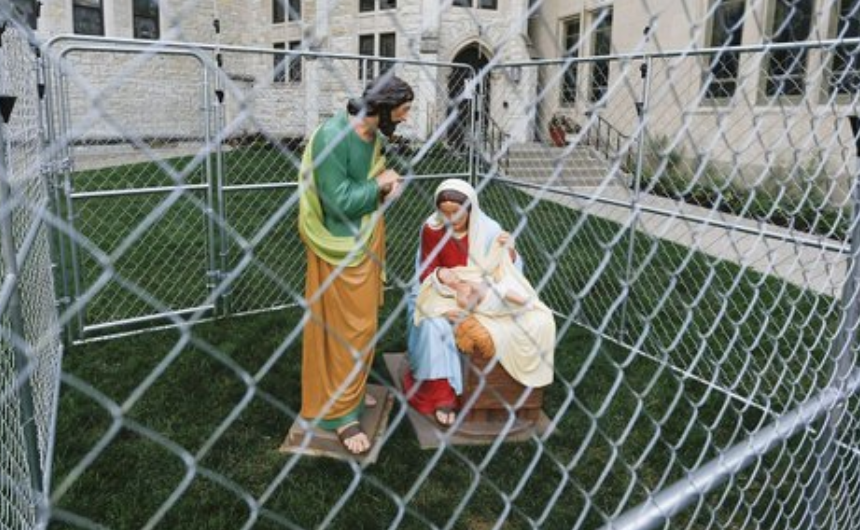
Baby Jesus, Mary and Joseph in a cage?

Everyone seems to talking about that viral religion story, as The Tennessean faith reporter Holly Meyer points out. 

In case you missed it, the Indianapolis Star reports that the three biblical figures "were incarcerated behind a barbed wired-topped, chain link fence on the lawn of Monument Circle's Christ Church Cathedral on Tuesday."

The reason:

The Rev. Stephen Carlsen, dean and rector of Christ Church, said the caged Holy Family is a protest to President Donald Trump's zero-tolerance policy that is holding families in detention centers at the U.S.-Mexico border.

"I know what the Bible said," Carlsen said. "We're supposed to love our neighbors as ourselves."

It's a fascinating story, and I'd urge you to check it out. But for the purposes of this post, I have a side question: Which version of the Bible should a news organization quote in a story such as this?

I'll admit surprise at the one the Gannett newspaper chose to quote:

The Rev. Lee Curtis, who came up with the idea for the demonstration, said the Biblical trio was a family of refugees seeking asylum in Egypt after Jesus' birth. 

"An angel of the Lord appeared to Joseph in a dream, saying, 'Arise, take the young Child and His mother, flee to Egypt, and stay there until I bring you word; for Herod will seek the young Child to destroy Him,'" the Message Bible says in Matthew 2:13-14. "When he arose, he took the young Child and His mother by night and departed for Egypt."

"This family is every family, and every family is holy," Curtis said. 

For those not familiar with The Message, it's a contemporary version in modern English. The religion satire news site Babylon Bee has published stories such as "‘The Message’ Now Available In Popular Comic Sans Font" and "7 Updates ‘The Message’ Totally Needs." Among the proposed updates: Substituting all references to Jesus with "The J-Man." That gives some indication of how seriously (read: not) some take that translation.

I'm not sure I've ever seen The Message be the go-to version quoted in a news story. (I'll eagerly await all the links proving me wrong.) My first thought was perhaps the Star was trying to put the verses in language readers could understand.


Please respect our Commenting Policy

Religion at World Cup 2018: Christianity Today spots valid hard-news hook worth covering

Over the nearly 15 years of GetReligion's run, I have learned quite a few lessons about content and online clicks.

No, I'm not talking about the sad reality that hardly anyone reads and retweets positive posts that praise good religion reporting in the mainstream press.

I am referring to the fact that GetReligion readers are way, way, way, way less interested in sports that most readers. However, the GetReligion team has always included some sports fans -- in addition to me -- and we persist in thinking that "religion ghosts" and quality reporting on faith issues matter just as much in sports journalism as anywhere else. And we're not just talking about Tim Tebow updates.

This brings me, of course, to the biggest thing that is happening in the world right now. Yes, a news event bigger than that open seat on the U.S. Supreme Court.

We're talking about World Cup 2018, of course. When you look at global media and passionate fans, nothing can touch it.

Now, there are always religion-news hooks during a World Cup, because religion plays a huge role in most cultures around the world. In the past decade or so, for example, there has been lots of coverage of the strong evangelical and Pentecostal presence on the high-profile squad fielded by Brazil. Of course, some scribes have found political implications of that trend.

This year, if you've been tuned in, it’s been interesting to watch Fox Sports trying to figure out how to handle all of the Russian churches that keep showing up whenever the graphics team needs to produce dramatic, sweeping images of the host nation. Was it just (Orthodox) me or, early on, had the Fox digital tech team removed some crosses from the top of some of those signature onion domes?

Anyway, the religion-news coverage has been rather right, this time around. However, Christianity Today just ran a story that I would like to recommend to journalists who are looking for valid news angles in the Russia World Cup.

Once again, the Brazilian squad is involved, but there's more to this story than that. Check out the dramatic double-decker headline:


Please respect our Commenting Policy

Rainforest thoughts: Considering news coverage of Orthodox ecumenical patriarch's views on climate

I’m writing this sitting on the deck of a rainforest lodge in a remote corner of southwest Costa Rica just a few miles north of Panama. And I’m wondering; when will today’s afternoon tropical downpour begin?

They don't call them rainforests for nothing.

The forest surrounding the Golfo Dulce is thick and seriously humid, filled with a dazzling variety of climbing, slithering, flying, and just plain-old walking wildlife doing what they can to survive and multiply. (My wife would be happy to do without the gazillions of insects, but it just ain't a rainforest without them. Sorry.) And the best part?

Virtually all the hills and mountains here are government protected. No hunting, no logging -- no human habitations other than a few widely scattered, and small, lodges along the gulf’s shoreline and reachable only by small boat.

Given where I am, is it any wonder that the following two stories caught my attention the day previous to my arrival here last week?

The first was from The New York Times, detailing the rapid loss of rainforest environments around the globe -- and their importance to slowing the growing planetary upheaval we call climate change. Click here for that story. If you happen to know little about how critical rainforests are to the global environment, or how fast they're disappearing, please read this piece in full. Consider it a crash course.

The second piece is from the Washington Post. It carries the enchanting dateline, “ABOARD THE SHIP MORE SPACIOUS THAN THE HEAVENS.” That’s the name of a ship commanded (not literally; I'm sure he didn't steer it) by the Orthodox Ecumenical Patriarch Bartholomew I, one of the world's most environmentally oriented global religious leaders.

Just goes to show you that while you may be a staunch theological traditionalist -- is there any Christian body more traditionalist in form than the Orthodox churches? -- you can still be quite progressive on other issues. This is one reason the GetReligion team is not fond of journalists pinning shallow labels on people with complex beliefs.

Here’s the top of the story written by Juliet Eilperin, who deserves a shoutout for her prolificacy and ability to toggle between being the Post’s senior national affairs correspondent chronicling the Trump administration’s policy changes, and global environmental stories.

(Wait. Maybe that’s how she stays sane in today’s Washington.)


Please respect our Commenting Policy

As Jahi McMath — girl at center of life-support controversy — dies, coverage still haunted by ghosts

GetReligion first commented on the story of Jahi McMath back in 2014 in a post titled "God, faith and church (or not)" by my wife, Tamie Ross.

More recently, my colleague Julia Duin delved into a magazine piece on McMath in a post titled "To die or not to die: The New Yorker probes the case of a 13-year-old girl."

Each of those posts lamented the lack of specific details concerning religion and the family's theological reasons for wanting to keep the teen on life support.

So it's little surprise to find much of the recent news coverage of McMath's death haunted by holy ghosts.

Let's start with a big chunk of CNN's report:

(CNN) Jahi McMath, an Oakland teenager whose brain-death following a routine tonsil surgery in 2013 created national headlines, died on June 22, according to the family's attorney.

She was 13 when she underwent surgery to treat pediatric obstructive sleep apnea, a condition that made her stop breathing in her sleep and caused other medical problems.

Nearly five years later, "Jahi died as the result of complications associated with liver failure," the statement from attorney Christopher Dolan said.

She underwent surgery on December 9, 2013 at the Children's Hospital & Research Center Oakland. After the procedure to remove her tonsils, adenoids and extra sinus tissue Jahi was alert and talking to doctors and even requested a Popsicle.

According to her family, Jahi was in the intensive care unit when she started to bleed and went into cardiac arrest. On December 12, 2013 she was declared brain-dead. Her family disagreed with the declaration.

This launched a months-long battle between the hospital, which sought to remove Jahi from a ventilator after doctors and a judge concluded she was brain-dead, and her relatives, who fought in court to keep her on the ventilator and contended she showed signs of life.

See any missing words there?


Please respect our Commenting Policy

The New York Times 'reports' on an old mantra: Free speech for me, but not for thee

If you are a journalist of a certain age, as well as an old-guard First Amendment liberal, then you remember what it was like trying to get people to understand why you backed ACLU efforts in 1978 to defend the rights of a neo-Nazi group to march through Skokie.

Clearly this march was going to cause pain and emotional suffering, since that Chicago suburb included many Holocaust survivors. But First Amendment liberals stood firm.

If you grew up Southern Baptist in the Bible Belt, it was also hard to explain why you thought Hustler magazine had the right to publish a filthy, sophomoric satire of the Rev. Jerry Falwell, including a fake claim that he had committed incest with his mother in an outhouse.

That case went to the U.S. Supreme Court. As a New York Times report at the time noted, this Hustler piece was clearly satire and the First Amendment wasn't supposed to protect people from feeling offended or even abused by voices in the public square.

The central legal issue is whether, in the absence of the kinds of false statements purporting to be fact on which libel suits are based, a public figure like Mr. Falwell should be able to win damages from a publication that intentionally causes emotional distress through ridicule, tasteless or otherwise.

Several Justices suggested they were grappling with a conflict between the freedom of the press to carry on a long tradition of biting satire, and what Justice Antonin Scalia called the concern that ''good people should be able to enter public life'' without being exposed to wanton abuse in print.

I remember, back then, liberals saying they would be quick to defend the First Amendment rights of conservatives who spoke out on tough, tricky and even offensive issues.

This brings me to one of the most Twitter-friendly stories of this past weekend, a Times report that ran with this rather blunt headline: "Weaponizing the First Amendment: How Free Speech Became a Conservative Cudgel." It's amazing how little religious content is in this report, in light of waves of religious-liberty fights in recent years.

If you are looking for the thesis statement or statements in this article -- which I think was meant to be "news," not analysis -- here it is: 

... Liberals who once championed expansive First Amendment rights are now uneasy about them.


Please respect our Commenting Policy

When reporting on bitter fighting in central Nigeria, the truth is (somewhere) out there

Recently I saw a tragic piece on BBC about the Fulani –- a nomadic tribe in central Nigeria –- and the victims they prey upon. Knowing a little bit about the ethnic and religious divides tearing up Nigeria today, I knew that there had to be religion angle somewhere.

It turns out there's a ton of them and the story is more complex than you think. Sadly, there's not a ton of international media out there reporting about this mainly because it's Over There (Africa, where people are always killing each other, right?) and it's a dangerous place for a journalist to be. And persecution and warfare linked to religion is, well, not a subject many journalists want to ponder.

But today's troubles Over There often become tomorrow's troubles Over Here, as we saw with the 9/11 attacks. So, let us attend:

At least 86 people have died in central Nigeria after violent clashes broke out between farmers and cattle herders, police in Plateau state said.

Some reports say fighting began on Thursday when ethnic Berom farmers attacked Fulani herders, killing five of them.

A retaliatory attack on Saturday led to more deaths.

I had to look at the South China Morning Post to get more details. The Post's account said the Berom herders first attacked five Fulani herdsmen and cattle. Furious, the Fulani struck back and when the dust cleared, dozens were dead.

Back to BBC, including a glimpse of the complex religion angle in this tragedy. Note the important word "mostly." 

The area has a decades-long history of violence between ethnic groups competing for land. ... It's an age-old conflict that has recently taken on a new level of brutality.


Please respect our Commenting Policy

Another shoe drops: Jonathan Merritt calls it quits at Religion News Service

Let's see: In the Urban Dictionary, the phrase "Waiting for the other shoe to drop" is defined like this (with a joke thrown in for good measure, in the full text): "To await an event that is expected to happen, due to being causally linked to another event that has already been observed."

However, one gets the impression that the words "the other" in that phrase imply the existence of only one other show. It still sounds like the newsroom at Religion News Service contains lots of other shoes and some of them have yet to drop -- following the now infamous meltdown linked to the forced exit of former editor-in-chief Jerome Socolovsky, after clashes with publisher Tom Gallagher, who is best known for his opinion work on the Catholic left.

Lots of digital ink was spilled during that episode, including two lengthy GetReligion posts by our own Julia Duin. Check out, "RNS analysis: How America's one religion wire service melted down over a long weekend (Part I)" and "RNS meltdown II: New media reports, new details and Lilly Endowment confirms $4.9 million grant."

Now there is this, from columnist and blogger Jonathan Merrett: "Why I am leaving Religion News Service after 5 years."

If you follow Merritt's work, you know that he is one of the most important journalistic voices who has emerged on the evangelical left -- both at RNS and at The Atlantic -- especially on issues linked to LGBTQ debates and women's rights.

Now, some of his critics would say the "post-evangelical" left, but I'm not sure that nuance is justified since it is almost impossible to define what the word "evangelical" means, these days. In terms of heritage, Merritt is best understood as a liberal Baptist. Yes, doctrinally liberal Baptists exist and there's a lot of history there. Ask Bill Clinton.

Anyway, Merritt has posted his take on what happened, at his own website. Here is that text:


Please respect our Commenting Policy

Beyond Roe, Bork and Trump: Can Americans find a way to discuss hot moral issues?

I am old enough that I can -- if I focus my mind really hard -- remember what our public discourse was like before the Supreme Court became the only issue in American politics that really, ultimately, mattered.

How did America become a nation in which dialogue and compromise is impossible? Why is the U.S. Supreme Court always ground zero on all of this? What role is the mainstream press playing in this painful equation, especially when covering news linked to religious, moral and cultural clashes?

These kinds of questions are at the heart of this week's "Crossroads" podcast (click here to tune that in), which focuses on the painful state of political life in this age of Donald Trump, an age in which the status of the high court is even more controversial than ever, with Kennedy's retirement serving as another fuse on this bomb. 

But let's back up a minute, to when old folks like me were young. 

Yes, the 1960s were wild times, of course. The war in Vietnam was incredibly divisive and the nation was rocked by assassinations. Tragic divisions over race were real and could not be ignored. 

Still, everything changed for millions of Americans on Jan. 22, 1973. From that moment on the status of Roe v. Wade -- political wars over defending or overturning that decision -- loomed over every nomination to the U.S. Supreme Court and every presidential election, as well. 

Then came October 23, 1987 and the vote on the nomination of Judge Robert Bork to the high court. Bork was a former Yale Law School professor (former students included Bill Clinton and Hillary Rodham) who embraced and taught originalism -- the legal theory that the U.S. Constitution should be interpreted as written by the founders.

If you want to catch the flavor of the debate over Bork, here is the famous statement by Sen. Ted Kennedy: 


Please respect our Commenting Policy

Friday Five: Capital Gazette journalists, SCOTUS news, an unsung hero's passing and more

"I’m just undone by what happened at the Capital Gazette," said my friend Carla Hinton, religion editor at The Oklahoman. "These are strange and heartbreaking times we are living in. Praying for my fellow journalists and their families."

"It's especially traumatic because so many of us started our careers at newspapers like the Capital Gazette," responded my friend Steve Lackmeyer, a longtime business reporter at The Oklahoman. "We know these people, we know these newsrooms..."

Amen and amen.

No, the senseless slaying of journalists isn't any more tragic than the mass shootings — at schools, churches and other businesses — that keep making headlines in America.

But for those of us in this profession, the Capital Gazette tragedy hits especially close to home.

Want to understand the heart and passion that make many journalists tick? Read this Twitter thread by Nyssa Kruse, an intern at the Hartford Courant.

Now, let's dive into the Friday Five:


Please respect our Commenting Policy