Worship

Forget about Hollywood for a moment: Where is the biblical Mount Sinai located?

Forget about Hollywood for a moment: Where is the biblical Mount Sinai located?

QUESTION:

Where is biblical Mount Sinai located?

THE RELIGION GUY’S ANSWER:

Why would anyone wonder about the sacred spot where God through Moses revealed the Ten Commandments and other biblical laws? Just look at the name. Doesn’t everybody know that Mount Sinai must of course be on the Sinai Peninsula and, specifically, at a long-venerated location there?

And yet a New York Times feature on June 25 reported that since Saudi Arabia opened up to tourists in 2019, some U.S. Christians have regularly traveled to the nation’s northwestern corner east of the Gulf of Aqaba and south of Jordan, to view what they insist is the true location – oddly enough, within Islam’s founding nation!

As the Times reported, the Arabia claim has been promoted by evangelical Christian tour guides, adventurers and treasure-hunters through popular books, Internet articles and videos. But there’s far more to it. Well-credentialed scholars of the Bible and ancient history in the Near East have proposed this location, which has been gaining ground in recent decades.

At least 13 locations for Mount Sinai (also called Mount Horeb in the Bible) have been proposed, according to the 1993 commentary on the Book of Exodus by Sweden’s Goran Larsson. Jewish tradition never preserved the identity of any location. In fact, Christians are far more interested in the question than Jews, who are more focused on historic sites in the Holy Land. Israeli skeptics and secularists even doubt the entire story about Moses and God’s giving of the Torah.

An article like this can only sketch a vigorous and highly complex debate, so interested readers are invited to explore the matter, starting with resources listed below.

To begin, it’s worth considering a proposed Mount Sinai location within present-day Israel in the southwestern sector of the arid southern wilderness known as the Negev.


Please respect our Commenting Policy

Americans need moving vans? AP says it's politics, politics, politics, politics, politics, politics, etc.

Americans need moving vans? AP says it's politics, politics, politics, politics, politics, politics, etc.

No doubt about it: The rise of the divided states of America is one of the most important news stories of our time, and that has been obvious for several decades now (think red-blue JesusLand cartoons starting in 2000, or thereabouts).

The bottom line: If you don’t own a copy of David French’s 2020 book, “Divided We Fall: America's Secession Threat and How to Restore Our Nation,” then order one right now.

How many times have I quoted that volume’s tense, scary opening sentences? Here’s that passage, again, from my recent red journalism vs. blue journalism piece for the journal Religion & Liberty:

The bottom line: Americans are divided by their choices in news and popular culture, choosing to live in protective silos of digital content. America remains the developing world’s most religious nation, yet its secularized elites occupy one set of zip codes, while most religious believers live in another. These armies share no common standards about “facts,” “accuracy,” or “fairness.”

“It’s time for Americans to wake up to a fundamental reality: the continued unity of the United States cannot be guaranteed,” wrote French. At this moment, “there is not a single important cultural, religious, political, or social force that is pulling Americans together more than it is pulling us apart.”           

The Los Angeles Times published the definitive “This is all about economics, stupid!” piece about this trend, which I discussed in this recent GetReligion post: “Yo, LA Times — Maybe, must maybe, issues of faith, family and culture matter in California?”

The Big Idea in that piece was the truth that, when striving to avoid covering issues of religion and culture, journalists have the option of stressing economic issues, as well as politics, politics, politics. Now, the Associated Press had produced a news feature with a variation on that theme. Headline: “Conservatives go to red states and liberals go to blue as the country grows more polarized.”

This time around, the story does include lots of commentary about “cultural” issues, but culture is defined — quite literally — as politics, politics, politics, politics, politics, politics, politics, politics, politics, politics, politics, politics, politics, politics, politics, politics, politics, politics, politics, politics, politics, politics, politics, politics, politics, politics, politics, politics, politics, politics. Actually, I may have missed one or two variations on the word “politics” in this AP report.

References to “religion”? Zero. “Faith”? Zip. “Morality?” Nada.


Please respect our Commenting Policy

After 10 years of mystery, the Orthodox shepherds of Aleppo remain missing

After 10 years of mystery, the Orthodox shepherds of Aleppo remain missing

Metropolitan Paul Yazigi had no way to know that he was about to vanish into the chaos of the Turkish-Syrian border during the violent rise of the Islamic State.

"If we want to be good children to God, then we don't thank Him only when He gives us [blessings]," he said, in one of his final sermons (translated from Arabic) before he was kidnapped on April 22, 2013.

"Also, when we are hurting, we say to Him: 'Your hand must be taking care of us, and we thank You.' …A Christian is a creature that gives thanks to God for all things one knows and doesn't know, for both the good and the hardships one faces in his life."

Sermons about faith and suffering are always timely in ancient churches.

The bishops of Aleppo, Syria -- Metropolitan Yazigi and Metropolitan Yohanna Ibrahim of the Syriac Orthodox Church -- disappeared 10 years ago while seeking the release of two kidnapped priests. Their car was surrounded by a pack of armed men, as they maneuvered through risky checkpoints near west of Aleppo. Their driver died in the gunfire, but a survivor later testified that the kidnappers were not speaking Arabic and appeared to be from Chechnya.

There were no ransom demands from the terrorists. The shepherds of Aleppo simply vanished, inspiring few headlines outside the Middle East.

The 10-year anniversary passed quietly this spring, after years of special prayers during Orthodox worship services around the world.

"I don't think anyone can assume, at this point, that they are still living. But there is a sense that we don't know enough about what happened to have a sense of closure," said Father Thomas Zain, dean of St. Nicholas Antiochian Orthodox Cathedral in Brooklyn, New York.

"It's likely that they were kidnapped in Turkish territory, which added another level of complexity to the political situation."


Please respect our Commenting Policy

Yes, Protestants disagree with the ancient churches on the status of the siblings of Jesus

Yes, Protestants disagree with the ancient churches on the status of the siblings of Jesus

QUESTION:

“Did Jesus Have Brothers & Sisters?”

THE RELIGION GUY’S ANSWER:

The quote above is the headline for an article this month by Ginny Baxter, the “Woman to Woman” blogger on Patheos.com. She figures “the answer is a definite ‘maybe.’ “

On this age-old but ever-debated topic, The Guy would answer that — as is often the case — it depends on what church is fielding the question.

From ancient times, Catholicism and Orthodoxy have said “No.” They believe in Mary’s “perpetual virginity,” meaning that she and husband Joseph never had sexual relations and Jesus was the only child she ever gave birth to.

(This issue should not be confused with Christianity’s belief in the “virginal conception” or “virgin birth,” that Mary conceived Jesus miraculously without a biological human father, as recorded in the Gospels of Matthew and Luke.)

In the early Protestant Reformation, Martin Luther broke from Catholicism on numerous matters, including mandatory celibacy for priests, but continued to believe that Mary was “ever-virgin,” although he believed that personally and did not state it as a required doctrine. Virtually all Protestants since his time have answered, “Yes, Jesus did have siblings.”

The New Testament does not mention that Mary was “ever-virgin.” Jesus’ (adoptive) father Joseph was present with Mary when Jesus taught in the Temple at age 12 (see Luke 2:41-50). But then Joseph disappears from the Gospels’ narratives, so interpreters assume he died at some point before Jesus began his public ministry around age 30.

The ”Proto-Gospel of James,” probably composed in the late 2nd Century A.D., may have been the first writing to depict an ever-virgin Mary.


Please respect our Commenting Policy

New York City has evolved into a complex, tense 'post-secular' cultural chess board

New York City has evolved into a complex, tense 'post-secular' cultural chess board

Early in his church-planting work in New York City, the Rev. Tim Keller focused on what he called the Center City, which started in lower Manhattan, near Wall Street, and extended past Central Park.

The Presbyterian Church in America seminary professor camped in the old Tramway Diner under the 59th Street Bridge at 2nd Avenue, asking New Yorkers probing questions about their lives. He dug into the socialist Dissent Magazine to learn the city's secular lingo.

But New York was already evolving in 1989, when Redeemer Presbyterian Church opened its doors two weeks after Easter, said Tony Carnes, leader of the "A Journey through NYC Religions" website.

Changes began in the 1970s in the city's boroughs "with more internationals arriving from all over," including Global South cultures in which "no one doubts that faith is an important part of life," he said, reached by telephone. "It took time to see these changes affect Manhattan, but they did."

In 2000, Carnes' team found -- through a face-to-face census with church leaders -- 120 evangelical congregations in the Manhattan Center City. That number reached 197 a decade later, 251 in 2014, 308 in 2019 and are expected to near 370 in 2024.

"We know there are others, because we hear things all the time," said Carnes. "We just haven't found them all -- yet."

For decades, researchers considered New York City a lab for the brand of secularism defined by Harvard Divinity School historian Harvey Cox, author of the influential "The Secular City" in 1965. In a famous quotation, he noted: "Secular Humanism is opposed to other religions; it actively rejects, excludes, and attempts to eliminate traditional theism from meaningful participation in the American culture."

However, at sidewalk level it's obvious that there are "two New Yorks," noted Carnes. While secularism remains dominant in mass media, academia and other parts of the cultural establishment, the reality is more complex in Queens, Brooklyn, the Bronx, Staten Island and now parts of Manhattan.


Please respect our Commenting Policy

Add to newsroom calendars? Millions of Christians marked the Feast Of Sts. Peter and Paul

Add to newsroom calendars? Millions of Christians marked the Feast Of Sts. Peter and Paul

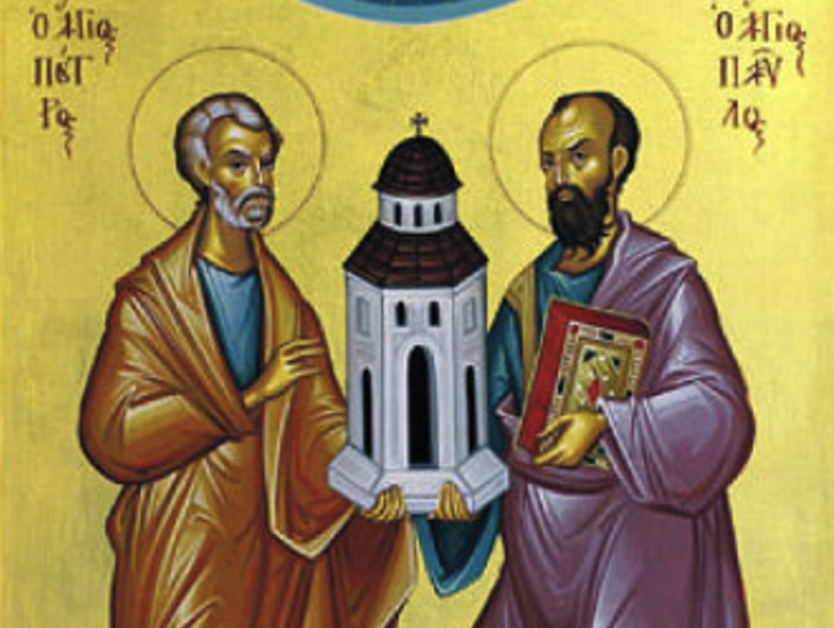
The feast day of St. Peter and St. Paul is a significant celebration on the Christian calendar, especially in the ancient churches of the East and West, because it commemorates the lives of two of the most important martyrs and leaders in all of Christian history.

However, this is not a holy day that shows up on the “must cover” list in many newsroom calendars. A quick Google News search for the past few days will demonstrate that reality.

Should that change? The annual feast is observed on June 29 and holds deep religious and historical significance for Christians around the world.

The date commemorates the death of the two saints. They are believed to be buried at the two basilicas that bear their names — St. Peter’s and St. Paul’s Outside the Walls in Rome. Through their tireless efforts and unwavering faith, Peter and Paul left an indelible mark on Christianity, shaping the faith’s foundations and spreading the message of Jesus in the world.

The feast day serves as a reminder of the enduring power of faith and the transformative impact of Christ’s message. It calls believers to emulate the courage and commitment displayed by these apostles. Their lives serve as a testament to the transformative power of encountering Christ and the call to proclaim His message of love and salvation to the world.

In recent years, it has also become — more than once — the hook for major ecumenical events involving Rome and Eastern Orthodoxy.

Here is what journalists and readers need to know about the Feast of Saints Peter and Paul:

St. Peter, also known as Simon, was one of the 12 apostles chosen by Jesus to be one of his closest followers. Catholics consider him the first pope and the founder of the church in Rome. Peter was a humble fisherman when Jesus called him to be a “fisher of men.”


Please respect our Commenting Policy

Podcast: Can New York City's arts avengers save a tiny, but ultra-valuable, mainline church?

Podcast: Can New York City's arts avengers save a tiny, but ultra-valuable, mainline church?

I was stunned (I kid you not) that editors at The New York Times didn’t find a way to slip the word “hulk” or even “avengers” into the Gray Lady’s latest feature on politics and the wild, wild world of Manhattan real-estate. Oh, and there is some religion news in here, somewhere.

What am I talking about?

Well, this week’s “Crossroads” podcast (click here to tune that in) focused on a story that ran with this dry, wordy, double-decker headline: “Why Mark Ruffalo and Wendell Pierce Are Fighting for a Crumbling Church — Congregants of the West Park Presbyterian Church, a Manhattan landmark, want it torn down and replaced by condos. Celebrities are joining the fight to save it.”

In the sprawling Marvel Comic universe, Ruffalo played that Big Green Guy. But you probably knew that.

Let’s work our way through this story, looking for evidence of the religion-beat story — it appears that zero religion-beat personnel were involved — that is at the heart of this story that the Times prelates see as a conflict about money, politics and, maybe, culture. Religion? Not so much.

In the podcast, I also noted that versions of this story are unfolding in urban areas around America, linked to the catastrophic decline of America’s mainline Protestant and the more Americanized versions of Roman Catholic life. What happens to their strategically located and very valuable urban sanctuaries?

The overture, which builds up to the sermon-esque thesis statement:

For years, a conflict over whether to tear down one of New York City’s historic churches, a 19th-century Romanesque Revival building on the Upper West Side, has been cast in epic terms, as a battle between the little people and big business.

In this case, however, those who see themselves as representing the little people include a growing list of New York celebrities.

And big business? That would be a real estate firm working with the tiny congregation of the West Park Presbyterian Church, which says it cannot afford to fix up the deteriorating building and hopes to sell it to a developer to build new luxury apartments on the site.


Please respect our Commenting Policy