Worship

Should elite European officials outlaw Jewish and Muslim ritual slaughter for meat?

Should elite European officials outlaw Jewish and Muslim ritual slaughter for meat?

THE QUESTION:

Should Europeans outlaw ritual slaughter for meat practiced by Judaism and Islam as cruelty to animals?

THE RELIGION GUY’S ANSWER:

With such unprecedented political mayhem, Americans can be forgiven for barely noticing important events overseas.

The Guy, who believes threats to religious freedom warrant especially close attention, highlights a Dec. 17 ruling by the Court of Justice, the highest tribunal in the European Union (which covers 27 member nations with the departure of Great Britain). Readers will want to check out this recent Ira Rifkin post on this topic: “EU hypocrisy? Foie gras and factory farming continue, but kosher and halal traditions nixed.”

The decision, on referral from Belgium’s Constitutional Court, approved a regional statute mandating that animals be stunned before they are slaughtered for meat. This requirement directly pits animal-welfare advocates against Judaism and Islam, in which long-standing tradition allows observant believers to eat only meat from ritual slaughter, which forbids such stunning. European Jews and Muslims plan to appeal the decision, which could influence policies in other nations.

The court acknowledged that religious liberty is important, but on balance stated that the crackdown in Belgium occurs in “an evolving societal and legislative context which is characterized by an increasing awareness of the issue of animal welfare.” Several European nations already require stunning before slaughtering. (In the United States, statutes require stunning but allow for religious exemptions.)

Adding to the emotions in Europe, this dispute brings to mind that in 1933 Germany’s new Nazi-influenced regime prohibited Jewish slaughter on grounds of the stunning problem. More recently, this argument has been employed by Islamophobes.

The Conference of European Rabbis, which represents believers in 40 nations, said such prohibitions “put Jewish life at risk.” Omer Yankelevitch, a member of Israel’s parliament and the government diaspora affairs minister, wrote similarly in the Jerusalem Post last week. He said the European Union is violating freedom of religion and “harms the viability of Jewish communities in Europe,” so intense diplomatic efforts will be undertaken to respect the age-old observance.

Those who enjoy eating meat may give barely a thought to the methods used to produce it, although perhaps some reflected on this reality when COVID outbreaks brought attention to slaughterhouse conditions.

Please respect our Commenting Policy

New podcast: Why the infamous 'McCarrick doctrine' haunted U.S. Catholic bishops this week

New podcast: Why the infamous 'McCarrick doctrine' haunted U.S. Catholic bishops this week

It was a great week to be a Cardinal Theodore McCarrick Catholic.

Now, before anyone gets mad, let me stress that the McCarrick mentioned during this week’s “Crossroads” podcast (click here to tune that in) was not the “Uncle Ted” McCarrick known for bunking with seminarians or the trusted priest or bishop accused of fondling teen-aged boys from families that trusted him.

No, it was Cardinal McCarrick, the consummate networker, trusted fundraiser, ecclesiastical kingmaker and media manipulator. This was the man who, as archbishop of Washington, D.C., created the so-called “McCarrick Doctrine” that protected national-level Catholic politicians whose faith was a crucial part of their lives and images, even if many ancient doctrines didn’t mesh well with their political agendas. This McCarrick also claimed — in a public speech — to have helped elect Pope Francis.

This was the McCarrick whose legacy helped shape the remarkable war inside the U.S. Conference of Catholic Bishops that jumped into clear view on Inauguration Day.

It was easy to see this coming. I wrote about it several weeks ago in this “On Religion” column: “Joe Biden and the U.S. Catholic bishops — Tensions remain about Holy Communion.” And Catholic-press veteran J.D. Flynn clearly knew something big was coming when, a day before the Biden inauguration, he wrote an analysis — “Biden and the bishops. This probably will not go well” — for his new (and essential) website called The Pillar. Check out this lede:

Shortly after President Joe Biden begins his term of office, the U.S. bishops will be derided as culture warriors and abortion obsessives, unwilling to find common ground with the administration of the second Catholic U.S. president.

Sure enough, the elected leader of America’s Catholic bishops issued a letter (hold that thought) criticizing Biden’s actions supporting abortion rights, while hinting at clashes over religious liberty (Hello, Little Sisters of the Poor) and church doctrines on marriage and sex.

This drew an angry social-media response from Catholic progressives — including key men wearing red hats. Their outcry led to this headline in The Washington Post: “As Biden is sworn in, president of U.S. bishops assails him over abortion.”

In a bombshell report, The Pillar noted that the Vatican tried to ban the distribution of the USCCB statement by Gomez — at least until team Pope Francis could release a more politically nuanced letter. That headline: “Vatican intervened to spike US bishops’ Biden statement release.”

But back to the Post. The overture for that report says exactly what one would expect it to say:


Please respect our Commenting Policy

UK ready to welcome waves of Hong Kong residents (Yes, BBC ignored religion angles)

UK ready to welcome waves of Hong Kong residents (Yes, BBC ignored religion angles)

On the night of the Hong Kong handover to China, I walked through that great city’s old airport — noting the many residents who sat, passports in hand, preparing to leave. I was leaving after a small international gathering of journalists and academics focused, naturally, on religion and the news.

I talked to a few of the solemn people I saw that night in 1997. Some said they were leaving for good. Others said they were going abroad to explore the legal and economic hurdles they would need to clear if or when they decided to leave. I didn’t hear a single optimistic voice.

Like the people I interviewed for the two “On Religion” columns I researched during that stey, they said that they expected that, in a few years, the Chinese authorities would crack down on dissent, free speech and, yes, some mentioned freedom of religion. Here are those columns: “Silence and tension in Hong Kong” and “Hong Kong II: There’s more to life than $.”

I bring this up because of an important story that is unfolding, in slow motion, in the United Kingdom. Here is the top of a long BBC website story with this headline: “The Hong Kong migrants fleeing to start new lives in the UK.

The UK will introduce a new visa at the end of January that will give 5.4 million Hong Kong residents — a staggering 70% of the territory's population — the right to come and live in the UK, and eventually become citizens.

It is making this "generous" offer to residents of its former colony because it believes China is undermining Hong Kong's rights and freedoms.

Not everyone will come. Some of those eligible to leave have expressed their determination to stay and continue the fight for democracy.

In the end, Britain estimates that about 300,000 will take up the visa offer over the next five years.

As you would expect, the story introduces a family that is already in the UK, exploring their reasons for making the leap. Any signs of religion here?

Readers are told that Andy Li and his wife Teri Wong moved to York in October, just after the announcement of plans for this policy change. They said, no surprise, that they were thinking about their children, daughter Gudelia, 14, and son Paul, 11.

"We feel that the things we treasure about Hong Kong — our core values — are fading over time," said Mr Li. "So we decided we needed to provide a better opportunity for our children, not only for their education, but also for their futures."


Please respect our Commenting Policy

Catholic press braces for Biden presidency: How it will further polarization on doctrine

Catholic press braces for Biden presidency: How it will further polarization on doctrine

Inauguration Day this year comes two weeks after pro-Trump rioters descended on the U.S. Capitol before President-elect Joe Biden’s victory was certified by lawmakers. It was the latest — and most stark — demonstration of how our nation’s media ecosystem is in a state of decay and under attack.

Two weeks removed from that awful day, it’s worth taking stock in where we are, how we got here and, more importantly, what can we expected over the next four years under Biden.

This road, more than a decade in the making, was exasperated by Donald Trump’s presidential run and election in 2016. At the same time, citizens on the left and right have grown increasingly weary of institutions (the press being one of them) and that’s made violence an acceptable means for retribution.

As a result, the political, cultural and religious polarization that has taken place over the past four years, ignited further last year amid a pandemic and the presidential election, can’t be undone. The violence on Jan. 6 in Washington, D.C. is the latest tangible example of where we are as a country. The National Catholic Register made this observation in the wake of the riot:

The United States is troubled today by something deeper: At its core this is a spiritual and cultural crisis, even more than a political one.

The Founding Fathers worried about the same factionalism we saw on full and ugly display at the Capitol. But in the past, as Alexis de Tocqueville observed in Democracy in America, shared religious values have provided a glue that allowed for peaceful coexistence in our strikingly individualistic nation, while reminding us that politics was not ultimate.

Today, that is no longer the case. The system of Judeo-Christian values that grounded our political and civic life for more than two centuries has eroded and not been replaced. The ensuing vacuum means our national tendency toward factionalism has no “ballast” to steady the ship of state at turbulent moments, such as this disputed presidential transition.

The events of the last six months and how they have been covered by news organizations — spanning the COVID-19 lockdowns and #BlackLivesMatter protests to the presidential race and the attack on the Capitol — mark an end to an era in press history. It would appear that the American Model of the Press is dead and that reality has become mangled as Americans get their news through a prism of advocacy, partisan media sources.

This journalism earthquake has shaken Catholic media, as well. Hold on, because that’s where we are headed.


Please respect our Commenting Policy

After the U.S. Capitol riot: Personality cults do not mix well with traditional Christian faith

After the U.S. Capitol riot: Personality cults do not mix well with traditional Christian faith

Year after year, thousands of Americans attend the March for Life, marching past the U.S. Capital on a late January date close to the anniversary of Roe vs. Wade.

Most of the marchers are young and come by bus from Catholic and evangelical schools. While most of the groups present are conservative, there are smaller groups like Secular Pro-Life and Democrats for Life. Most of the banners contain slogans such as, "Abortion Hurts Women," "Love Life, Choose Life" or "We are the Pro-Life Generation."

Things were different at the Save America March backing President Donald Trump's efforts to flip the 2020 election. Some banners contained messages like "Jesus is my Savior, Trump is my President." But many more proclaimed "Stand with Trump!" or "Trump 2020: No More Bulls--t."

It's one thing to march for a cause. It is something else to hail a political leader as the key to saving America, said Southern Baptist Seminary President R. Albert Mohler, Jr., a central figure in evangelical debates about Trump.

"The American experiment in ordered liberty is inherently threatened by a cult of personality. And we saw the results of that. … So many of those who were there as protestors explicitly said that they were there in the name of Donald Trump," said Mohler, in a podcast the day after U.S. Capitol riot. "It was Trump that was the name on the banners. They were not making the argument about trying to perpetuate certain political principles or even policies or platforms."

History shows that personality cults -- left or right -- are dangerous, he stressed. After this "American nightmare," Christians should soberly ponder the "way sin works" and its impact on powerful leaders who are tempted to become demagogues.

"Demagoguery simply means that you have a character who comes to power on the basis of emotion, rather than argument, and passion rather than political principles," said Mohler.

It's crucial to know that, in 2016, Mohler was numbered among evangelical leaders who opposed Trump's candidacy. When the New York City billionaire clinched the GOP nomination, Mohler tweeted: "Never. Ever. Period."

But in 2020 he said he would vote for Trump in support of the Republican Party, thus opposing the Democratic Party platform.


Please respect our Commenting Policy

Thinking with Bob Dylan (sort of): Everything is broken in the three Americas of 2021

Thinking with Bob Dylan (sort of): Everything is broken in the three Americas of 2021

So. Much. To. Read.

So. Much. To. Think. About.

This is one of those times when it really helps to cue up a Bob Dylan playlist and turn up the volume.

I have two Dylan playlists that fit the bill, right now — Dylan Hymns I and Dylan Hymns II. They aren’t full of real hymns or even Gospel arrangements (that’s in the Dylan Gospel playlist), but they are full of songs with obvious faith content from the openly born-again albums and then the many interesting discus that followed, almost always with a few tracks that include clear Christian images and themes.

Hang in there with me. I am getting to this weekend’s “think pieces,” I promise.

The Dylan Hymns II playlist opens with another version of the same song that ended Dylan Hymns I — “When the Night Comes Falling From the Sky” (click here for a fiery live take with Tom Petty and the Heartbreakers). That would be a great song for right now. But the song that really fits is, “Everything Is Broken” (lyrics here). Here’s some crucial images from the end of the song:

Broken cutters, broken saws
Broken buckles, broken laws
Broken bodies, broken bones
Broken voices on broken phones
Take a deep breath, feel like you’re chokin'
Everything is broken

Every time you leave and go off someplace
Things fall to pieces in my face

Broken hands on broken ploughs
Broken treaties, broken vows
Broken pipes, broken tools
People bending broken rules
Hound dog howling, bullfrog croaking
Everything is broken

This brings us to our first “think piece,” by Axios CEO Jim VandeHei. The thesis statement says, “America, in its modern foundational components, is breaking into blue America, red America, and Trump America — all with distinct politics, social networks and media channels.”

The emphasis here is, of course, politics and there is no openly stated religion theme. You know: politics is real and religion is not so real.


Please respect our Commenting Policy

New podcast: New York Times says 'Christian nationalism' tied to white 'evangelical power'

New podcast: New York Times says  'Christian nationalism' tied to white 'evangelical power'

At the 2016 Southern Baptist Convention, messengers from churches across the nation approved a resolution calling for Americans to “discontinue the display of the Confederate battle flag as a sign of solidarity of the whole Body of Christ.”

The speaker of the Mississippi House of Representatives, Philip Gunn, was there (full Baptist Press report here) as chair of the Southern Baptist Seminary board of trustees. He went home determined to help do something about his state’s flag. Mississippi’s new flag dropped the Confederate symbolism of the old, replaced by a magnolia blossom and the phrase “In God We Trust.”

This is clearly an example of a major evangelical institution using its clout — “power,” if you will.

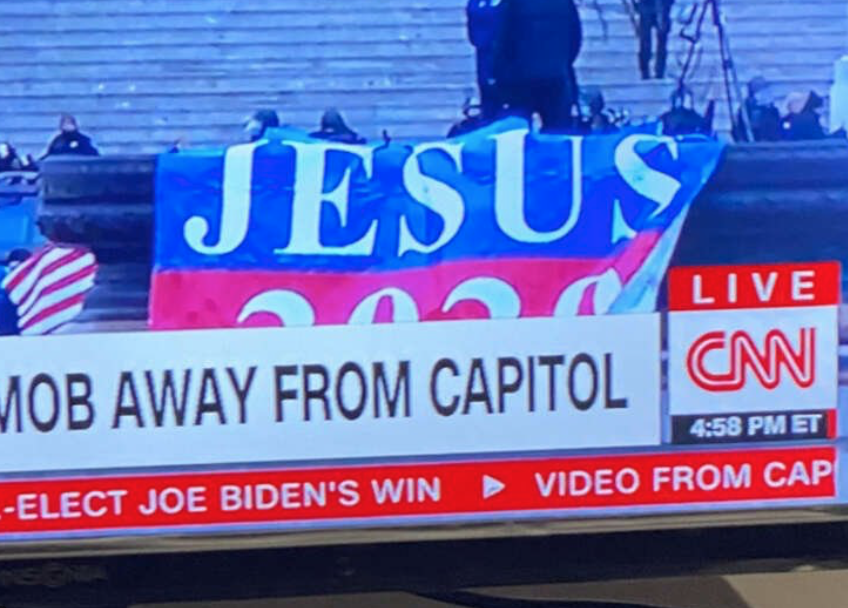
This brings us — using a back door, I will admit — to this week’s “Crossroads” podcast (click here to listen to that), which focuses on the waves of coverage about Christians symbols and banners among participants in both the “Save America March” backing Donald Trump and the deadly riot outside and inside the U.S. Capitol. How did some F-bomb screaming rioters end up chanting “Hang Mike Pence!” while others nearby played loud Contemporary Christian Music?

The hook for this rather complicated podcast discussion with host Todd Wilken was one of those voice-from-on-high, magisterial New York Times passages — with zero attribution to sources — that speaks for the Acela Zone ruling elites. The double-decker headline proclaimed:

How White Evangelical Christians Fused With Trump Extremism

A potent mix of grievance and religious fervor has turbocharged the support among Trump loyalists, many of whom describe themselves as participants in a kind of holy war.

Are we talking about ALL Trump loyalists? Or is it simply MANY of them? Hold that thought, because we will return to it shortly.

But here is the key passage that needs to be read carefully, more than once:

The blend of cultural references, and the people who brought them, made clear a phenomenon that has been brewing for years now: that the most extreme corners of support for Mr. Trump have become inextricable from some parts of white evangelical power in America. Rather than completely separate strands of support, these groups have become increasingly blended together.


Please respect our Commenting Policy

Big symbols, big story: Pope Francis changes church law to put women 'on the altar' in robes

Big symbols, big story: Pope Francis changes church law to put women 'on the altar' in robes

It’s not every day that the pope changes canon law. Pope Francis did just that in allowing women a larger role during Mass.

The pope said, using a powerful phrase in Catholic thought, that this headline-grabbing change was based on “a doctrinal development” seen in the recent life of the church.

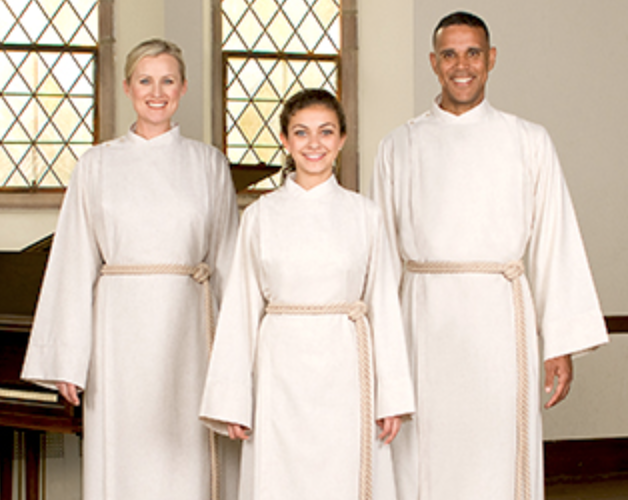
The move — in the wake of a decades-old priest shortage — will grant “non-ordained ministers” the chance to serve as lectors, read scripture, act as eucharistic ministers and, in a crucial symbolic change, wear robes while serving in the sacred space around the altar. The changes, however, will continue to forbid women from being made deacons or ordained priests.

The pope changed canon law to read: “Lay people who have the age and skills determined by decree of the Episcopal Conference, they can be permanently assumed, through the established liturgical rite, to the ministries of lectors and of acolytes; however this contribution does not give them the right to support or to remuneration by the church.”

For the sake of comparison, the law had previously read: “Lay men who possess the age and qualifications established by decree of the conference of bishops can be admitted on a stable basis through the prescribed liturgical rite to the ministries of lector and acolyte.”

In other words, this codifies into the canon the role of women as part of Roman liturgical rite. The announcement, however, caused lots of confusion, especially among many Catholics who have already witnessed women in some of these roles for decades.

The Associated Press headline on the story read, “Pope says women can read at Mass, but still can’t be priests.” That vague language didn’t clarify matters.

In a letter that accompanied the changes, the pontiff said he wanted to bring “stability” and “public recognition” to women already serving during the Mass. Beyond the headline, the AP, in its reporting of the announcement, said that the pope had “amended” church law “to formalize and institutionalize what is common practice in many parts of the world: Women can be installed as lectors, to read Scripture, and serve on the altar as eucharistic ministers. Previously, such roles were officially reserved to men even though exceptions were made.”

The original AP story caused even more confusion when it initially reported that women could read the Gospel during Mass.


Please respect our Commenting Policy

Prayers for the soul of Brian Sicknick: Did anyone ask officers faith questions after Capitol riot?

Prayers for the soul of Brian Sicknick: Did anyone ask officers faith questions after Capitol riot?

When you live somewhere, you develop friendships and contacts that survive — especially in the age of email and social media.

I lived and worked in Baltimore and Washington, D.C, for a decade-plus and my commute took me to Union Station and then past the U.S. Capitol. Many of my students had press passes on the Hill and that landmark was simply part of work-day life.

Right after the rioting last week, I received an email through church contacts requesting prayers for the “repose of the soul of a friend and U.S. Capitol Police officer, Brian,” as well as prayers for other police who were injured. Christians in the USCP and linked to it were spreading this request.

It’s impossible to read all of the coverage of the January 6th riots. But if you dig into the coverage at all, you are sure to hit detailed coverage of the “Fight for Trump” rioters who carried Christian symbols and banners inside the U.S. Capitol security zone, even while surrounded by others chanting, “Hang Mike Pence” and slogans that can’t be printed here.

Let me stress, once again, that this coverage was and is valid. The impact of QAnon in corners of white evangelicalism cannot be denied and many of other conspiracy theory believers “speak evangelical” even if they’re not churchgoers.

The note from friends in Beltway land led me to look for signs of religion-news coverage on the other side of that battle line between police and the rioters. I know the U.S. Capitol community well enough to know that there are all kinds of prayer groups and Bible studies there, on both sides of the aisle and crossing them. Do similar groups exist in the USCP? Did anyone ask if Brian Sicknick was part of such a support network?

It’s clear that Sicknick was an unusual and even inspiring man, an officer appreciated by Democrats and Republicans. We know something about his politics, naturally. He was an Air National Guard veteran who, in some ways, backed Donald Trump. Sicknick was also a critic of many mainstream Republicans.

A Washington Post story quoted Chief Master Sgt. Lance C. Endee — Sicknick’s squad leader in the guard — as saying: “I think Brian had a bigger impact on people than he would have ever realized.” That same story included this:

In a statement, Sicknick’s family said “many details regarding Wednesday’s events and the direct causes of Brian’s injuries remain unknown and our family asks the public and the press to respect our wishes in not making Brian’s passing a political issue.”


Please respect our Commenting Policy