
Women

Lots of Ilhan Omar stories major on her politics -- but none really talk about her faith

U.S. Rep. Ilhan Omar has gotten ultra-favorable coverage (this NPR piece is an example) as the history-making one-of-two-first-ever Muslim women to serve in Congress.

A one-time refugee in Kenya, the Somalia-born politician came to Virginia as a child, moved to Minnesota, got a political science degree from North Dakota State University, got involved in political activism and, like President Barak Obama, was a community organizer for minority groups in a large American city. She is now the country’s first hijab-wearing member of Congress.

She’s also faced death threats, been tweeted against by President Donald Trump and gotten major condemnation over her description on March 23 of September 11 as “some people who did something.”

I wrote about the reaction of some Minnesotans to the influx of Somali refugees in their state not long ago. This lengthy profile on Omar on the British web site MiddleEastEye.net goes in the opposite direction: Setting out the benefits of the Somalis getting politically involved.

Omar, as the first Somali-American to make it to the Minnesota state legislature and then to Congress, is part of a new cohort of path-breaking politicians daring to challenge not only US President Donald Trump but the broader American political establishment.

But Omar is more than just a congresswoman with fight. She is a refugee from a country that is now part of the president's Muslim ban; she is black, visibly Muslim; a walking antithesis to Trump's purview of America.

Within months, she has shaken the halls of Congress. As an "other" she is now the embodiment of what is fast becoming a fight for America's soul.

The story is an interesting meander through the many Muslim personalities the author meets while trying (somewhat fruitlessly) to get an interview with Omar. He does get a few words with her here and there but Omar seems loathe to divulge too much.

What strikes me in this –- and other articles I’ve dug up -– is how little Omar refers to her Muslim background. We hear nothing about how her faith influences her life. We get no idea of what mosque she attends, how she fits prayer into her work schedule and what precepts of the Quran she follows.

Please respect our Commenting Policy

The Los Angeles Times' piece on Instagram-loving witches lacks any critical edge

Ever since the Los Angeles Times re-started its Column One feature in January, there’s been some really innovative journalism there, even though the material featured there always seems pretty one-sided.

So I was intrigued to see a recent piece on the “working witches of Los Angeles.” Kind of brings back memories of The Real Housewives of Beverly Hills, right?

How much would religion, I wondered, be part of this story?

Not so much.

Oh, there was a ton of content on New Age practices and shamanistic spirituality but it’s tough to categorize these folks. Are they Wiccans? Pagans? Goddess worshippers? Just because the reporter left no hints about their leanings doesn’t mean they don’t exist.

The Oracle of Los Angeles was feeling frazzled.

It was already 2 p.m. and she hadn’t had time to prepare lunch, much less wipe the ash from her altar. A tarot card client had just left her yellow Craftsman house in West Adams, evidenced by the smell of incense still lingering in the air. Within an hour, she was scheduled to meet with another client who was struggling to complete a PhD thesis.

In the meantime, she still had to prepare for her weekly podcast, create a purifying ceremony for a new business--and get her nails done for a reality TV appearance. Any downtime would be consumed with writing. The second draft of her memoir was due to her publisher in a week.

The Oracle, who also goes by Amanda Yates Garcia, is a former arts educator with a master of fine arts in writing, film and critical theory from California Institute of the Arts. For the past eight years she has made her living as a professional witch, performing “energetic healings,” “intuitive empowerment sessions” and the occasional exorcism, while also teaching workshops on the art of magic online and at her home, independent stores, and sites like the J. Paul Getty Museum.

Sadly, the story never unpacks what “the occasional exorcism” entails, as this witch doesn’t believe in either God or Satan.


Please respect our Commenting Policy

In Baptist circles, which is the more powerful position: SBC president or SBC seminary president?

I have a fair amount of experience reporting on the Southern Baptist Convention, going back two decades when I served as religion editor for The Oklahoman and traveled to the denomination’s annual meetings.

In my time with The Associated Press in Dallas, I did a 2004 series on the 25th anniversary of the 1979 conservative takeover of the Southern Baptist Convention. Last year, freelancing for the Washington Post, I covered an all-night meeting at which Paige Patterson was removed as president of Southwestern Baptist Theological Seminary in Fort Worth, Texas.

But I’ll acknowledge that I’m no expert on the nation’s largest Protestant denomination. For example, I don’t have a clear idea of whether the Southern Baptist Convention’s president — an elected role generally filled by a pastor — is a more powerful, substantial position than serving as president of one of the denomination’s six regional seminaries. It seems to me that perhaps the seminary presidents are bigger, more major players in the long term.

The reason I bring this up is that the ongoing news coverage of the SBC’s sex abuse scandal — in which Patterson keeps making all the wrong kind of headlines — typically cites Patterson’s past SBC presidency before mentioning his tenure as seminary president.

In fact, the Fort Worth Star-Telegram — which should be as informed on this story as anyone — seems somewhat confused about which role Patterson was kicked out of last year.

Here’s the lede of the Star-Telegram’s report on a lawsuit (warning: the details are chilling) filed last week:

A woman who said she was threatened and humiliated after reporting multiple rapes to former Southern Baptist Convention president Paige Patterson has filed a lawsuit against him.

The lawsuit, which was filed by a former student of the Southwestern Baptist Theological Seminaryin Fort Worth, was unsealed this week. 

It says the woman was the victim of multiple violent sexual assaults on the school’s campus by a fellow student, who also was employed at the seminary, in 2014 and 2015. But even before she became a student, the lawsuit says, the seminary “was not a safe place for young women.”

But here’s the deal: Patterson was president of the SBC in 1999 and 2000. That was 20 years ago.


Please respect our Commenting Policy

Pilgrimage: Normandy and Lourdes defy the stereotypes of France's ardent secularism

For such a secular country, there are certainly lots of religious symbols to be found in France and religious institutions and activities continue to make news.

The country and many of its citizens do pride themselves on the principle of laicite — French for secularism — but is there really an absence of religion in public life?

Not really. It’s true that Notre Dame, one of the biggest symbols of European Christianity for centuries, has been cordoned off for the past two months after a tragic fire, deemed accidental, destroyed the roof. The cathedral, which will undergo a major renovation, is off limits to tourists. Nonetheless, the towering house of worship remains a symbol of Paris and part of this beautiful city’s skyline. The city’s other churches worth a visit include the Church of Saint Sulpice and the Basilica of the Sacred Heart, known as Sacre-Coeur.

Outside Paris, God’s visibility is even more pronounced. Two very different sites — Lourdes, one of the holiest in the world for Roman Catholics, and the U.S. cemetery at Normandy — have the ability to bring visitors closer to God in very different ways. There are reminders everywhere of the country’s religious past and how that symbolism continues to play a part in the lives of millions, both visitors and residents, who visit them. As a result, it’s not so unusual for tour operators to include packages to visit both sites.

It is worth noting that this notion of secularism, as it pertains to French government policies, was the result of a law passed in 1905 calling for this strict separation of church and state. While true that religious symbols have been removed from French public life (a possible reason why so many Muslims have found integration so difficult), Lourdes and Normandy may be the two places where this very human law seems to not apply.

First stop on this countrywide pilgrimage is Lourdes. A six-hour train ride (fares range from $134 to $193 roundtrip) from Paris gets you to Lourdes, a southern trip through the French countryside until finally pulling into the foothills of the Pyrenees mountains. While many take trains into Lourdes to embark on their pilgrimage, many from across Europe (particularly those from neighboring Italy and Spain) board coach buses to get there.

Lourdes became a major pilgrimage site after a 14-year-old girl named Bernadette Soubirous claimed to see the Blessed Virgin Mary on Feb. 11, 1858 through a vision. Soubirous would see Mary another 17 times near a grotto over the course of five months. Unaware she was having a vision, Mary told the girl: “I am the Immaculate Conception.”  


Please respect our Commenting Policy

Matt Chandler's Southern Baptist Convention 'interview' shows how not to deal with bad press

Earlier this week, tmatt wrote about and spotlighted a New York Times bombshell about what certainly appeared to be the cavalier approach a major Southern Baptist megachurch took to dealing with a sexual predator in its midst.

A summation of the Times piece is further down in my post, but the damage done by this article was so extensive that the Rev. Matt Chandler, the pastor, broke away from his sabbatical to fly to Birmingham in an attempt to salvage his reputation. He showed up at a lunch meeting of Baptist pastors to answer questions from an emcee but — here’s the key — not to take questions from the audience.

The video of that “interview” is atop this piece. It’s a headshaker and a perfect example of how way too many religious leaders think journalism is supposed to be public relations. The pastor’s first sentence out of the blocks is, “I’m here because I don’t want what we’re trying to do to lose momentum and steam.”

It’s not “I’m concerned for the victim and her family,” or “I feel we messed up and I want to apologize,” but no, he doesn’t want to derail his church’s expansion plans. (Additional note - it’s been pointed out to me that Chandler was referring to movement within the SBC for a meaningful resolution on the abuse issue, not about his church’s future, so I stand corrected there.)

The Times reporter who’d broken the story tweeted that she planned to attend the pastor’s appearance. I still haven’t found out whether she managed to nab him in the hallway beforehand or afterwards.

She did run this piece on his speech:


Please respect our Commenting Policy

Kick 'em out? Southern Baptists seek ways to fight sexual abuse in autonomous local churches

Before we take a look at what appears to have been the key development at this year’s Southern Baptist Convention, let’s pause and discuss a few matters linked to how America’s largest non-Catholic flock does business.

One of the first things reporters learn (.pdf here), when they show up at national SBC gathering, is that the people attending are not “delegates” — they are “messengers” from local churches. Again, this is a sign of the degree to which Baptist identity is built on church authority residing in autonomous local congregations. The Southern Baptist Convention is a convention that exists when it is in session. It can vote to create a publishing house, or mission boards or an “executive committee” to do specific tasks in between conventions.

But SBC folks get testy when reporters assume that Southern Baptists are supposed to be organized like Presbyterians, Methodists or, heaven forbid, Episcopalians. What makes SBC meetings so wild is that all kinds of people in that big room can grab a floor microphone. With that in mind, let’s look at a crucial part of a New York Times story, focusing on efforts to handle sexual-abuse issues:

Thousands of pastors voted late Tuesday afternoon to address the problem in a concerted way for the first time, enacting two new measures they say are a first step to reform. Outside the arena where they were gathered, victims and their families protested what they considered an inadequate response.

The pastors voted to create a centralized committee that would evaluate allegations against churches accused of mishandling abuse. They also approved an amendment to their constitution that would allow such churches to be expelled from the convention if the allegations were substantiated.

“Protecting God’s children is the mission of the church,” the denomination’s president, J.D. Greear, said on Tuesday morning as he addressed the gathering. “We have to deal with this definitively and decisively.”

Wait a minute. SBC “pastors” voted to take these steps? Since when are all of the SBC “messengers” pastors?

The Times should correct that error immediately. It appears that the same mistake showed up in a 2018 Times story and I missed it at that time. As in:


Please respect our Commenting Policy

That strong New York Times #ChurchToo horror story -- with clues pointing to big SBC issues

Throughout the 16-plus years that GetReligion has been around, I have received emails asking why the mainstream press has focused on clergy sexual abuse cases in the Church of Rome, but not abuse cases in liberal and conservative Protestant flocks.

That’s an important question and one that looms over the intense media coverage we are currently seeing — with good cause — at the Southern Baptist Convention meetings in Birmingham (click here for Bobby Ross Jr. round-up on preliminary coverage).

That is also the subject at the heart of a gripping #ChurchToo feature at The New York Times — “Her Evangelical Megachurch Was Her World. Then Her Daughter Said She Was Molested by a Minister” — linked to SBC debates about sexual abuse. It’s a solid, deep story about one controversy in a powerful congregation and it contains clues pointing toward larger issues that will, eventually, have to be covered in the national press.

You see, there are reasons that SBC leaders — the ones who truly want to act — have struggled to come up with a one-plan-fits-all proposal to crack down on the monsters in their midst. To understand why, I want to flash back to an important Joshua Pease essay that ran a year ago at The Washington Post. Here’s my commentary about that: “ 'The Sin of Silence' in The Washington Post: It's easy to hide sin in an independent-church maze.”

The following chunk of the Pease essay is long, but essential for those who want to understand the larger issues that lurk in the painful new piece at the Times.

Without a centralized theological body, evangelical policies and cultures vary radically, and while some church leaders have worked to prevent abuse and harassment, many have not. The causes are manifold: authoritarian leadership, twisted theology, institutional protection, obliviousness about the problem and, perhaps most shocking, a diminishment of the trauma sexual abuse creates – especially surprising in a church culture that believes strongly in the sanctity of sex. ...

The problem in collecting data stems, in part, from the loose or nonexistent hierarchy in evangelicalism. Catholic Church abusers benefited from an institutional cover-up, but that same bureaucracy enabled reporters to document a systemic scandal. In contrast, most evangelical groups prize the autonomy of local congregations, with major institutions like the Southern Baptist Convention having no authority to enforce a standard operating procedure among member churches.

Journalists: Please read that passage two or three times. The Southern Baptists have a real problem, here, and it’s not going to go away. It’s a theological problem, as well as a legal one.


Please respect our Commenting Policy

Ready, set, go! The much-anticipated Southern Baptist Convention annual meeting starts in 3, 2, 1 ...

Sex abuse. Women’s roles. Abortion.

All could make headlines at the Southern Baptist Convention’s annual meeting, which starts Tuesday in Birmingham, Ala.

But as The Associated Press notes, the sex abuse scandal that has rocked the nation’s Protestant denomination for months is expected to dominate the yearly gathering.

That scandal started, of course, with a bombshell investigation by the Houston Chronicle and the San Antonio Express-News. The Texas papers have kept at the investigation and delivered a final piece of their series Sunday. That front-page report focused on “Baptist abuse victims’ battle: silence, survival, speaking out.” It’s certainly a worthy read in advance of the SBC meeting.

Just two years ago, someone (OK, maybe it was me) whined about reporters’ seeming lack of interest in the SBC’s meeting. But in 2019, the gathering is, no doubt, the journalistic place to be.

GetReligion’s own Richard Ostling offered a tip sheet last week for news writers covering the Baptist extravaganza, as he put it. And on Sunday, GR editor Terry Mattingly featured a think piece by the SBC’s Russell Moore.

Already, The Tennessean’s Holly Meyer — who is covering the meeting with her Gannett colleague Katherine Burgess of Memphis’ Commercial Appeal — has filed her first story from Birmingham.

Meyer reports from a pre-convention meeting of the denomination’s executive committee:

BIRMINGHAM, Ala. — The Southern Baptist Convention's executive committee took steps Monday to make it clear that it can kick out churches that show a disregard for sexual abuse. 

While the ability to sever ties with such churches already exists, the executive committee voted to enshrine in the convention's constitution that addressing sexual abuse is part of what it means to be a Southern Baptist church

"In the culture, situations and issues arise from time to time where we need to make explicit what has already been implicit," said Pastor Mike Stone, chairman of the executive committee. "These actions are a confirmation of what Southern Baptists have always believed."

The top administrative body, which acts on behalf of the convention when it is not in session, also supported a bylaw change on Monday that would form a special committee to address misconduct allegations, including sexual abuse, against churches. 

The new panel would conduct inquiries — not investigations — into the allegations and make a recommendation to the executive committee about whether the convention should be in fellowship with the church in question. 


Please respect our Commenting Policy

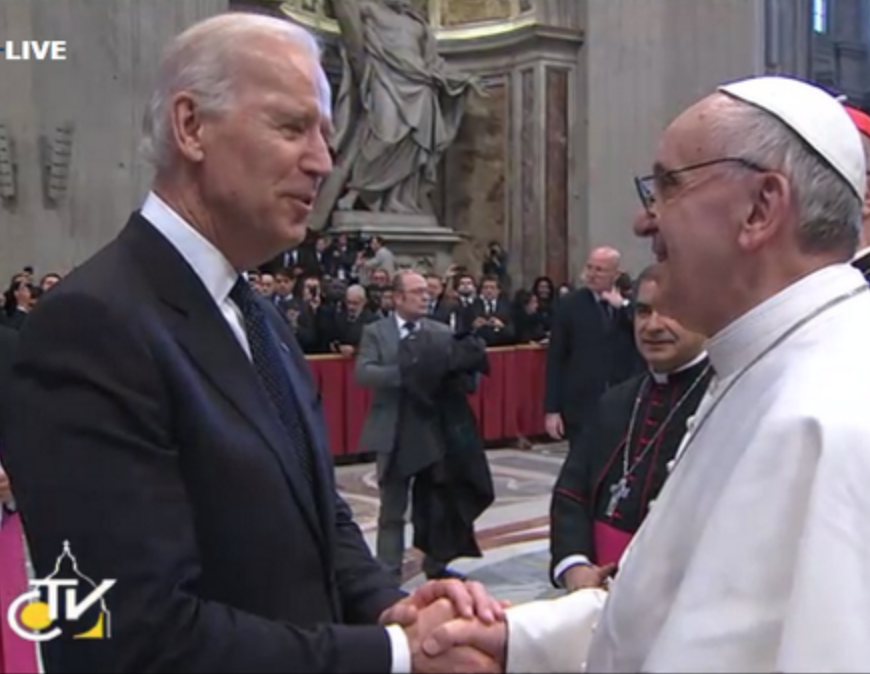
Yo, New York Times editors: There are several Catholic angles linked to Joe Biden's abortion flip

Yo, New York Times editors: There are several Catholic angles linked to Joe Biden's abortion flip

As many pro-life Democrats and others have noted in social media: That didn’t take long.

After years of opposing the use of taxpayer dollars to fund abortion — supporting the Hyde Amendment — former Vice President Joe Biden bowed the knee to primary-season realities in this “woke” era of Democratic Party life and reversed himself on this issue. Thus, he erased one of his few remaining ties to his old role as a centrist, compromise figure in his party on moral, cultural and religious issues.

Needless to say, the word “Catholic” may have something to do with this story. That term even made it into the New York Times coverage of this policy flip. See this all-politics headline: “Behind Biden’s Reversal on Hyde Amendment: Lobbying, Backlash and an Ally’s Call.

The overture focused on the political forces that yanked Biden’s chain, from members of his staff to rivals in the White Race. The Planned Parenthood team called early and often. Then, down in the body of the story, there was this:

A Roman Catholic, Mr. Biden has spent decades straddling the issue of abortion, asserting his support for individual abortion rights and the codification of Roe v. Wade, while also backing the Hyde Amendment, arguing that it was an inappropriate use of taxpayer money.

But Mr. Biden, his allies acknowledge, had plainly misread what activists on the left would accept on an extraordinarily sensitive issue. For all his reluctance to abandon his long-held position on federal funding for abortion, Mr. Biden ultimately shifted in order to meet the mood of emergency within his party’s electoral base.

The big word, of course, is “base” — which usually means “primary voters.” The question is whether the “base” that turns out in primary season has much to do with the mainstream voters that are crucial in the Rust Belt and the few Southern states that a Democrat has a chance to steal in a general election.

So where, in this Times report, were the voices from pro-life Democrats and progressive and centrist Catholics who wanted to see Biden try to reclaim blue-collar and Catholic votes that, in 2016, ended up — #LesserOfTwoEvils — going to Donald Trump? I would imagine they are hiding between the lines in the following material:


Please respect our Commenting Policy