Terry Mattingly

New podcast: Familiar splits among white 'evangelicals,' only now they're about vaccines

New podcast: Familiar splits among white 'evangelicals,' only now they're about vaccines

It’s really a matter of simple math and logic.

Let’s start with this question, stripped of the political and journalism questions attached to it: Which of the following numbers is larger and, thus, more important — 45 or 55?

If you said “45,” then you’re ready to write headlines and edit controversial stories for The New York Times.

Before we move on, let’s ask another question that was at the heart of this week’s “Crossroads” podcast (click here to tune that in). I’ll frame this in as neutral a manner as possible: If members of the Democratic Party were divided 55% “yes” to 45% “no” on a major decision, would you see this (a) as a sign that Democrats were united in opposition to the question at hand or (b) that Democrats were starkly divided on the question, with a majority taking a positive stance? I should mention that the 55% “yes” vote includes virtually all of leaders of major institutions within the world of Democratic Party life.

With that in mind, let’s contemplate the story under the following double-decker headline from the Times:

White Evangelical Resistance Is Obstacle in Vaccination Effort

Millions of white evangelical adults in the U.S. do not intend to get vaccinated against Covid-19. Tenets of faith and mistrust of science play a role; so does politics.

This brings us to the crucial summary material in this story:

The opposition is rooted in a mix of religious faith and a longstanding wariness of mainstream science, and it is fueled by broader cultural distrust of institutions and gravitation to online conspiracy theories. The sheer size of the community poses a major problem for the country’s ability to recover from a pandemic that has resulted in the deaths of half a million Americans. And evangelical ideas and instincts have a way of spreading, even internationally.

There are about 41 million white evangelical adults in the U.S. About 45 percent said in late February that they would not get vaccinated against Covid-19, making them among the least likely demographic groups to do so, according to the Pew Research Center.

“If we can’t get a significant number of white evangelicals to come around on this, the pandemic is going to last much longer than it needs to,” said Jamie Aten, founder and executive director of the Humanitarian Disaster Institute at Wheaton College, an evangelical institution in Illinois.
Please respect our Commenting Policy

Obvious question: Maybe Christian faith played a role in the Scott Drew and Baylor hoops story?

Obvious question: Maybe Christian faith played a role in the Scott Drew and Baylor hoops story?

Frankly, I am not the most enthusiastic of Baylor University alums (I once passed up a request to apply for a faculty slot by telling the president that I had already died once in Waco wasn’t anxious for a reprise).

Still, you didn’t think that the Baylor basketball team was going to win the national championship (after being a favorite in the COVID-canceled 2020 dance) without a word of comment here? I mean, I have heard from other Baylor grads who worked their way through lots of the mainstream news coverage of the March Madness finale while thinking “ghost,” “ghost,” “another religion ghost.”

Yes, this was the Texas Baptists vs. Jesuits matchup that hoops fans wanted. And then you had the simple reality that Baylor (for better and for worse) is the world’s most prominent Baptist academic institution.

But how could the press ignore or short-change the fact that the story of coach Scott Drew and his underdog Bears was packed with valid religion facts and themes? Would all fans care that Final Four MVP Jared Butler teaches a Sunday School class for little kids? Probably not. But millions of people would.

But they key to everything was this big question: Why was Drew at Baylor in the first place? Why did he pack up and head to Waco 18 years ago, when the program was dead, dead, dead or worse. Here’s the top of a long CBS Sports feature: “Scott Drew never let others change his story, path or program, and that's how he led Baylor to its first title.”

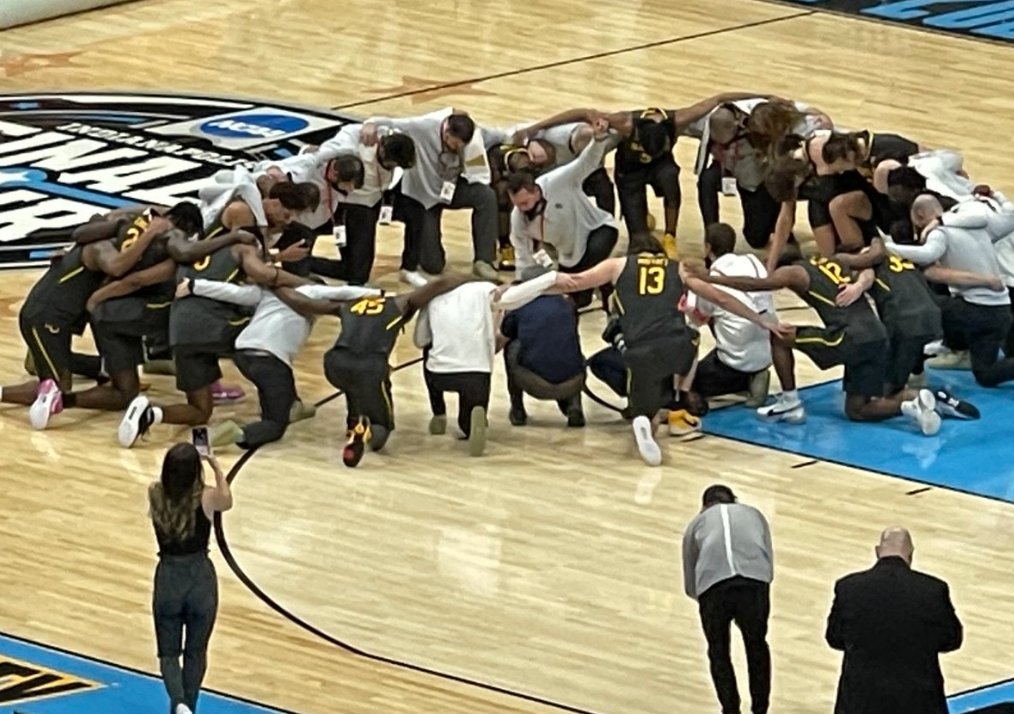
Leaping into the arms of his staff. College basketball's happiest coach on his happiest night. When it was over, Drew brought everyone into a huge circle on the court. They kneeled and said a prayer.

The greatest program reinvention in men's college basketball history was complete.

Drew took the Baylor job in 2003 when the program was near disintegration. The job Drew's done at Baylor in the 18 years since -- impressive is an understatement. There was no set of instructions when he got there, because there wasn't even a drawer to put them in. This was not a rebuild; what Baylor could be, in 2003, was a figment of Drew's imagination.

Drew is described in all kinds of upbeat, but strange, ways. This is one happy, upbeat, positive-thinking weirdo. Does it matter that, when he describes his bond with Baylor, he talks in terms of Christian faith, family and a sense that God called him to this job? Is that part of this national news story, just because Drew says so and there is tons of evidence that he means it?


Please respect our Commenting Policy

This just in! Millions of folks are sort of religious, a key to church membership decline

This just in! Millions of folks are sort of religious, a key to church membership decline

When it came to poll numbers about religion and American life, the late George Gallup, Jr., wasn’t all that interested in many of the most obvious questions.

As he told me in several telephone interviews, starting in the 1980s: The religion numbers just don’t add up. You could see the same sentiments in some of his public addresses.

Gallup — who died in 2011 — wasn’t impressed by the high numbers of Americans who told pollsters that they believe in God, attend worship services on a regular basis and say that faith is “very important” in their lives. That didn’t seem to fit with national patterns of divorce and family breakdown. He kept trying to find ways to ask questions that focused on the role of religious faith in daily life.

When push came to shove, Gallup was convinced that about 20% of Americans were seriously practicing some form of religious faith. The number might be lower than that.

Thus, that recent blitz of news about church membership trends. As the Washington Post headline stated: “Church membership in the U.S. has fallen below the majority for the first time in nearly a century.” Here’s some of the overture:

The proportion of Americans who consider themselves members of a church, synagogue or mosque has dropped below 50 percent, according to a poll from Gallup. … It is the first time that has happened since Gallup first asked the question in 1937, when church membership was 73 percent. …

In 2020, 47 percent of Americans said they belonged to a church, synagogue or mosque. The polling firm also found that the number of people who said religion was very important to them has fallen to 48 percent, a new low point in the polling since 2000.

Click here for the Gallup report on these findings, old and new. Here is another summary from 2019. And here is some additional background from the new Gallup release:

Gallup asks Americans a battery of questions on their religious attitudes and practices twice each year. The following analysis of declines in church membership relies on three-year aggregates from 1998-2000 (when church membership averaged 69%), 2008-2010 (62%), and 2018-2020 (49%). …

The decline in church membership is primarily a function of the increasing number of Americans who express no religious preference.


Please respect our Commenting Policy

'I Love Jesus, But I Want to Die' -- A sobering message to church leaders on mental health

'I Love Jesus, But I Want to Die' -- A sobering message to church leaders on mental health

The first time Sarah J. Robinson tried to kill herself was eight months after she became a born-again Christian.

She had struggled with suicidal thoughts since elementary school. She would imagine jumping into highway traffic or fill her hand with pills and consider swallowing them. But her depression only deepened after she was baptized as a teen and poured herself into Bible studies and upbeat youth-group projects.

She felt like a failure. Finally, she pressed a knife harder and harder into her skin -- but she couldn't force herself to end it all on the kitchen floor. Looking back, she wrote: "I didn't want my family to find me there, so I got up and put the knife away. I climbed into bed, put on a worship CD, cursed God and went to sleep."

Robinson kept stacks of journals and they provided crucial material for "I Love Jesus, But I Want to Die," a book written during three years of struggle and research. Her battles with depression have continued, even during her years working as a youth minister.

Images of handwritten pages appear in the book, including this 2007 plea: "Lord, I'm struggling. I need your help. This week has been really rough -- I've been sad & lonely & angry & numb. I cut myself and berated myself, wished for the end, tried so hard to hide it. I'm not just empty -- I've become a vacuum, taking on more and more of the absence of your presence. … God, please don't let me be lost."

It was hard to be that vulnerable, said Robinson, reached by telephone in Nashville. But including actual journal pages "seemed like a no-brainer" if the goal was to "let other people who are hurting know they are not alone. I wanted them to know that I've been there -- in that kind of midnight."

Among secular researchers, it's common to find two views of mental-health issues, said Robinson, citing the work of Stanford University researcher Carol Dweck. The first is a "fixed mindset" that assumes these conditions are predetermined and unchangeable. Thus, "setbacks and failures reveal who we really are and will always be," said Robinson." The second is a "growth mindset" that says individuals can adapt and change.

In pews and pulpits, many believers simply assume all mental-health struggles represent a lack of faith. Strugglers will be healed if they dedicate themselves to Bible study and prayer, while turning away from their sins. Church-based "pastoral counseling" is an option.

"The idea is that if I put the right things into the spiritual vending machine, then I'll get the right things out," said Robinson.


Please respect our Commenting Policy

New podcast: Rising tensions between religious liberty, pronoun wars, academic freedom, etc.

New podcast: Rising tensions between religious liberty, pronoun wars, academic freedom, etc.

My name is Terry Lee Mattingly. However, when I converted to Eastern Orthodoxy, I took the name of a patron saint — St. Brendan the Navigator.

Let’s pretend that I am young and attending a state university right now and that I have decided to require professors to address me as “Holy St. Brendan the Navigator.” It is, after all, my name. While we are at it, let’s say that all of the Catholic and Orthodox students take the same tack, if their saint names are different then the names they were given at birth.

Some professors would wince, but go along with this. But let’s say that one professor is very secular, a Marxist perhaps, and he refuses — stating that my request violates his personal convictions. I threaten to sue, along with other students in the same situation. Game on.

How would the leaders of this taxpayer-funded public university respond? Would this be treated as a natural request on my part, with the understanding that any refusal would attack my sense of identity? What if I requested that my university ID card state my name as “St. Brendan the Navigator”?

It’s a crazy question, of course. But it would — at a state university — raise issues about the First Amendment (free speech and religious liberty) and academic freedom. These questions were at the heart of this week’s “Crossroads” podcast discussion. Click here to tune that in. [This episode also includes a bizarre gaffe when — I’m wrestling with a painful medical condition right now — I messed up my own saint’s name, mixing St. Brendan’s title with that of St. Nicholas of Myra. Listen for it.]

At the heart of the podcast discussion is a timely question: Can the state force the professor to recognize and even affirm — with public speech — beliefs that violate his conscience?

Now, as readers probably guessed right from the get go, this podcast focuses on another matter of personal identity — the degree to which professors can be forced to cooperate with students who chose to use any of the myriad and evolving gender pronouns linked to the LGBTQ+ movement. We looked at a Washington Post story with this headline: “A professor was reprimanded for refusing to use a transgender student’s pronouns. A court says he can sue.

Now, when these clashes take part in PRIVATE schools — left or right, religious or secular — it’s clear (pending passage of the Equality Act) that these doctrinally defined institutions have a right to create belief and lifestyle covenants that settle issues of this kind. Students can chose to affirm these beliefs, freely signing on the dotted line, or go to school somewhere else.

But what about state schools built and operated with tax dollars?


Please respect our Commenting Policy

Vague doctrine at for-profit company? Tennessean nails key issue in new Ramsey lawsuit

Vague doctrine at for-profit company? Tennessean nails key issue in new Ramsey lawsuit

Get ready for more stories in which religious believers clash with the increasingly woke doctrines proclaimed, and enforced, by the Human Resource personnel in modern corporations.

Can your company fire you for declining to use a colleague’s preferred pronouns? What happens if (a) someone declines to remove a study Bible from his or her desk or (b) some believers refuse to hang LGBTQ+ rainbow solidarity posters in their offices? What if an employee marches in a right-to-life parade? Battles continue, in some workplaces, over crosses, beards, headwear and other religious symbols.

That’s one side of the HR culture wars. Meanwhile, it’s clear — pending the outcome of the Equality Bill debates — that faith-defined nonprofits have the right to create lifestyle and doctrinal covenants for the people who chose to sign them and, thus, work in these ministries.

But what about for-profit companies led by executives who want to maintain faith-friendly images? What are the limits on their policies?

For example, Hobby Lobby won its U.S. Supreme Court case after rejecting the Obamacare requirement that contraceptives be included in employee benefits packages. But what if for-profit company leaders said that, for faith-based reasons, they could investigate and fire employees who USED contraceptives?

This brings us to another fascinating dispute inside the Ramsey Solutions empire. The Tennessean headline asks: “Can you be fired over your sex life? Dave Ramsey thinks so.” Here is the overture:

While a former employee has accused Ramsey Solutions of terminating her because of her pregnancy, the company disputes the claim. Company lawyers said in court filings the employee was fired for premarital sex and so were a dozen other employees.

Former administrative assistant Caitlin O'Connor, who was employed by Ramsey Solutions for over four years and never disciplined, said when she announced she was pregnant in June and requested paperwork for maternity leave, she was terminated for her pregnancy since she isn't legally married to her longtime partner, the baby's father.

Lawyers for Ramsey Solutions, owned by Dave Ramsey — a conservative financial titan who made headlines when he hosted a giant Christmas party during the pandemic and refused to let his employees work from home — said O'Connor wasn't fired because she was pregnant. She was terminated for having premarital sex.


Please respect our Commenting Policy

Returning to Kamp Kanakuk: Is this new expose a work of journalism, theology or both?

Returning to Kamp Kanakuk: Is this new expose a work of journalism, theology or both?

Readers with long memories will recall that, when the Internet arrived it had an immediate impact on important subjects that rarely received adequate coverage in mainstream media.

Take religion, for example. The lower cost of publishing online led to an explosion of forums, listservs, newsletters, online “radio” channels, podcasts and weblogs. Some failed or evolved into new forms — consider the long and complicated histories of Beliefnet and Patheos — and others became, well, normal.

Now, in the “cancel culture” era, it’s clear that another example of online evolution is affecting serious coverage of religion, as well as other complicated topics.

I am referring to the controversies surrounding Substack and the myriad newsletters and alternative publications thriving there. For a sample of the fea paranoia surrounding Substack, click into this thread from a professor at the UCLA Center for Critical Internet Inquiry or read between the lines of this Washington Post column: “The Substack controversy’s bigger story.” Here is a sample of that:

Substack is a start-up for self-publishing email newsletters: Writers decide how often to write and whether and how much to charge; Substack sends the newsletters and collects any fees. The ease of use has made it popular with journalists. …

Some of the most prolific users are heterodox political writers who had found mainstream publications an increasingly poor fit. A number quickly rose to the top of the Substack leader boards. This attracted the gimlet eye of the cancelers: Other online writers — some of whom had their own Substack newsletters — have leveled accusations of transphobia and other offenses. A nascent boycott aims to pressure Substack into deplatforming the alleged offenders. Reportedly, their campaign is having some effect.

“Heterodox” is an interesting word. It appears, in this context, to define the work of various kinds of conservatives or, even worse, free thinkers (Andrew Sullivan and Bari Weiss, for example) who accuse many “liberals” or “progressives” of turning dangerously illiberal.

This brings me to this weekend’s must-read missive from Nancy and David French, care of The Dispatch, an alternative conservative online publication that is thriving in this new online environment. Here is the dramatic double-decker headline atop this long feature:

‘They Aren’t Who You Think They Are’

The inside story of how Kanakuk — one of America’s largest Christian camps — enabled horrific abuse.


Please respect our Commenting Policy

Catholic left seeks (and finds?) signs of hope after Vatican ruling on same-sex unions

Catholic left seeks (and finds?) signs of hope after Vatican ruling on same-sex unions

After a media firestorm ignited by a Vatican condemnation of same-sex unions -- because God "cannot bless sin" -- Catholic progressives immediately looked for hope in the words of bishops, President Joe Biden and even Pope Francis.

In his Sunday Angelus address after the March 15 ruling, the pope stressed that modern seekers want to "see Jesus" in acts of love, not persecution.

Catholics must promote "a life that takes upon itself the style of God -- closeness, compassion and tenderness," said the pope. "It means sowing seeds of love, not with fleeting words but through concrete, simple and courageous examples, not with theoretical condemnations, but with gestures of love. Then the Lord, with his grace, makes us bear fruit, even when the soil is dry due to misunderstandings, difficulty or persecution, or claims of legalism or clerical moralism."

While Pope Francis gave "his assent" to this ruling, the Jesuit publication America cited anonymous Vatican sources saying the Angelus remarks suggested that he was "distancing himself" from the work of the Congregation for the Doctrine of the Faith.

That document said God "does not and cannot bless sin: He blesses sinful man, so that he may recognize that he is part of his plan of love and allow himself to be changed." As for same-sex unions, it added: "The presence in such relationships of positive elements … cannot justify these relationships and render them legitimate objects of an ecclesial blessing, since the positive elements exist within the context of a union not ordered to the Creator's plan."

Bishop Johan Bonny of Antwerp -- who represented Belgium at the 2015 Vatican Synod on Marriage and the Family -- said those words left him "ashamed on behalf of my Church. … I want to apologize to all those for whom this 'responsum' is painful and incomprehensible: faithful and committed Catholic homosexual couples, the parents and grandparents of homosexual couples and their children, pastoral workers and counsellors of homosexual couples," he wrote on Facebook.

"I know homosexual couples who are legally married, have children, form a warm and stable family, and moreover, actively participate in parish life. A number of them are employed full-time in pastoral work or ecclesial organizations." Why, he added, deny the "similarity or analogy with heterosexual marriage here?"


Please respect our Commenting Policy

Purity culture questions: A friendly, but crucial, dialogue between two evangelical thinkers

Purity culture questions: A friendly, but crucial, dialogue between two evangelical thinkers

The purity culture wars continue over on Twitter, where a crucial question — from a journalism perspective — can be seen in the following sequence.

There is no question that some church leaders went too far with purity culture themes and rites, including hellish actions by abusive men. Can anyone deny that? However, can journalists (and their academic and activist sources) assume that because evil happened in some cases means that it happened in all cases? And, to be specific, do journalists have on-the-record evidence that the alleged shooter in Atlanta was, in fact, warped by abusive people at an abusive church?

GetReligion published two posts linked to these debates. Check out Julia Duin’s post here: “Panning purity culture: What the press doesn't get about basic Christian doctrines on sex.”

Then, I raised other basic journalism questions here: “Wait a minute: How is a sermon on the Second Coming linked to shootings in Atlanta?

Before we get to this weekend’s two “think pieces” on this topic — by religious-liberty activist David French and Crossway books executive Justin Taylor — here is a flashback to a key passage in my post, which is linked to some of Taylor’s constructive criticism of the French piece.

It’s not enough to say that this or that conservative congregation, or counseling center, or parachurch ministry is “evangelical” and, thus, the public can assume that Christian doctrines were used in manipulative ways. …

Ponder this equation: Journalists cannot assume that a specific evangelical flock advocates dangerous doctrine X, simply because there are experts (progressive evangelicals even) who insist that all evangelicals teach dangerous doctrine X and, thus, we know that dangerous doctrine X causes broken, manipulated individuals to do hellish things.

At some point, journalists need to find specific people advocating specific ideas and actions — using research methods that are deeper than second-hand reports and the convictions of hostile experts on one side of fights about the Sexual Revolution.

This brings us to French’s must-read piece:


Please respect our Commenting Policy