Terry Mattingly

New podcast: Conspiracy theory news isn't going away, so how will religious leaders respond?

New podcast: Conspiracy theory news isn't going away, so how will religious leaders respond?

Here we go again. This week’s “Crossroads” podcast (click here to tune that in) offers yet another journey into the world of QAnon and its impact in American pews.

All the evidence is that this subject is not going away, even as it gets more complex. See this week’s post entitled, “The New York Times looks at QAnon leader who is, wait, a Manhattan mystic from Harvard?” Some interesting court trials loom ahead, no doubt, after the January 6th riot at the U.S. Capitol.

Still, if you were looking for a thesis statement that captures how elite American newsrooms view QAnon, and the red-hot topic of conspiracy theories in general, it would be a bite of revealed truth drawn from the must-read “Shadowlands” package published last June by The Atlantic. In “The Prophecies of Q,” author Adrienne LaFrance claimed that QAnon is an emerging sect that is defined by its evangelical hopes and dreams, since the “language of evangelical Christianity has come to define the Q movement.”

In a GetReligion post at the time (“The Atlantic probes QAnon sect and finds (#shocking) another evangelical-ish conspiracy“) I offered my own opinion on that:

There are times, when reading the sprawling “Shadowland” package … when one is tempted to think that the goal was to weave a massive liberal conspiracy theory about the role that conservative conspiracy theories play in Donald Trump’s America.

At the center of this drama — of course — is evangelical Christianity. After all, evangelical Christians are to blame for Trump’s victory, even if they didn’t swing all those crucial states in the Catholic-labor Rust Belt.

It’s almost as if evangelicals are playing, for some strategic minds on the left, the same sick, oversized role in American life that some evangelicals assign to Hillary Clinton, George Soros, Bill Gates and all those liberal Southern Baptist intellectuals who love Johnny Cash and Jane Austen.

That’s still half of what I think on this topic.

It is certainly true that (a) leaders of the “political cult” called QAnon — to use a term from a must-read Joe Carter FAQ on this topic — speak fluent evangelical and that (b) the gospel according to Q and similar conspiracy heresies have influenced many people in pews (including some who traveled to the National Mall for Trump’s March to Save America rally).

That’s an important, ongoing story that must be covered.


Please respect our Commenting Policy

The New York Times looks at QAnon leader who is, wait, a Manhattan mystic from Harvard?

The New York Times looks at QAnon leader who is, wait, a Manhattan mystic from Harvard?

It would have been hard to have consumed mainstream press coverage during the 2020 race for the White House without hearing quite a bit about the impact of QAnon and other conspiracy theories on the most dedicated followers of Donald Trump. Conspiracy theories on the other side of American life? Not so much.

At the same time, for totally valid reasons, it was impossible to read about QAnon and other conspiracy theories without hearing about their impact in church pews, as well as blue-collar bars. In some media reports, QAnon was presented as an “evangelical” Christian movement, pure and simple.

Here at GetReligion, we have argued that the impact of QAnon in grassroots evangelical culture has been obvious and that this is an important story. (See this post, in particular: “Thinking about QAnon — Joe Carter sends strong warning to evangelicals about new heresy.”)

At the same time, it has been hard — so far — to argue that there is evidence that major institutions, denominations and leaders at the heart of evangelical culture have been sucked into this tragedy. (See this podcast and post, in particular: “New York Times says 'Christian nationalism' tied to white 'evangelical power'.”)

At this point, I am convinced that QAnon is, to use Joe Carter’s term, a “political cult” led by social-media activists who clearly know how to rattle the chains of evangelicals who are obsessed with speculating about the End Of All Things.

With all of that in mind, I was interested to dig into the recent New York Times multi-media feature that ran with this dramatic double-decker headline:

A QAnon ‘Digital Soldier’ Marches On, Undeterred by Theory’s Unraveling

Valerie Gilbert posts dozens of times a day in support of an unhinged conspiracy theory. The story of this “meme queen” hints at how hard it will be to bring people like her back to reality.

I assumed that this story would contain some religious content, if not clouds of speculation about evangelical involvement in QAnon.

So who is Gilbert?


Please respect our Commenting Policy

'Hamilton,' the prophets and liberal Catholicism: Poet Amanda Gorman took her shot

'Hamilton,' the prophets and liberal Catholicism: Poet Amanda Gorman took her shot

After Inauguration Day, everyone was buzzing -- obviously -- about weary Sen. Bernie Sanders and his mittens, as well as Lady Gaga's massive social-distance enforcing dress. Commentators explored the socio-political importance of the various shades of purple worn by female Democrats, while Garth Brooks raised eyebrows with blue jeans and maskless-hugs of assorted presidents.

Oh, and President Joe Biden belted out an address that was Bill Clinton-esque in terms of length.

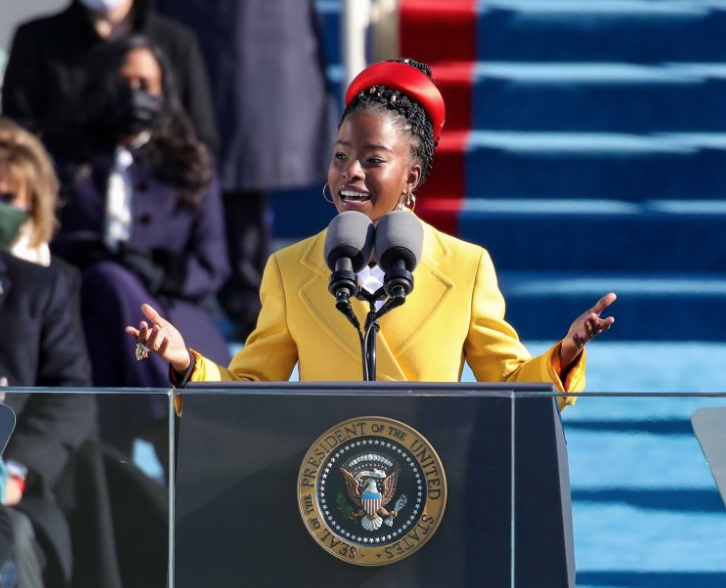
But there was no question that the day’s rising star was Amanda Gorman, the young poet in the canary-yellow coat who certainly didn’t throw away her shot. The question, for GetReligion readers, was whether there was a religion angle in her work that meshed with the rest of the Inauguration Day celebration of the Gospel according to the Religious Left.

Anyone with a computer-based device and a search engine could easily learn that the answer was, “Yes.”

As one would expect, the New York Times offered the definitive faith-free story: “Amanda Gorman Captures the Moment, in Verse.” Now, it was totally valid that the overture underlined the role that the January 6th conspiracy-theory apocalypse played in the creation of the poem. The question is whether this young Catholic woman’s faith was part of her response to it.

Two weeks ago, the poet Amanda Gorman was struggling to finish a new work titled “The Hill We Climb.” She was feeling exhausted, and she worried she wasn’t up to the monumental task she faced: composing a poem about national unity to recite at President-elect Joseph R. Biden Jr.’s inauguration.

“I had this huge thing, probably one of the most important things I’ll ever do in my career,” she said in an interview. “It was like, if I try to climb this mountain all at once, I’m just going to pass out.”

Gorman managed to write a few lines a day and was about halfway through the poem on Jan. 6, when pro-Trump rioters stormed into the halls of Congress, some bearing weapons and Confederate flags. She stayed awake late into the night and finished the poem, adding verses about the apocalyptic scene that unfolded at the Capitol. …

At one point, this Times piece came close to exploring the DNA of key passages in her poem. Of course, the “Hamilton” influence was relevant (hold that thought). Then there was this:


Please respect our Commenting Policy

America remains bitterly divided: But is this country veering closer to another civil war?

America remains bitterly divided: But is this country veering closer to another civil war?

Call it the "Texit" parable.

America's new civil war begins with the Supreme Court overturning Roe v. Wade, creating an abortion-free zone in the Bible Belt and most heartland states.

Enraged Democrats pledge to end the U.S. Senate filibuster and expand the number of high-court justices. After restoring Roe, they seek single-payer health care, strict gun control and sweeping changes in how government agencies approach the First Amendment, with the IRS warning faith groups to evolve -- or else -- on matters of sexual identity. Big Tech begins enforcing the new orthodoxy.

Conservatives rebel and liberals soon realize that most of America's military, including nuclear weapons, are in rebel territory. Then federal agents kill Alabama's pro-life, Black governor -- while trying to arrest him as a traitor. That's too much for Gov. Francisco Gonzalez of Texas, who decides that it's time for a new republic.

David French fine-tuned this "Texit" vision early in 2020, while finishing "Divided We Fall: America's Secession Threat and How to Restore Our Nation." Best-known as a #NeverTrump conservative pundit, most of the Harvard Law graduate's career has focused on old-school First Amendment liberalism -- which in recent decades has meant defending conservative religious believers in religious liberty cases.

The book's first lines are sobering, especially after recent scenes on Capitol Hill.

"It's time for Americans to wake up to a fundamental reality: the continued unity of the United States cannot be guaranteed," wrote French. Right now, "there is not a single important cultural, religious, political, or social force that is pulling Americans together more than it is pulling us apart."

Americans are divided by their choices in news and popular culture. America remains the developing world's most religious nation, yet its increasingly secularized elites occupy one set of zip codes, while most traditional religious believers live in another. In politics, more and more Democrats are Democrats simply because they hate Republicans, and vice versa.

Ironically, cultural conservatives now find themselves hoping that the Supreme Court will protect them, said French, reached by telephone. Conservatives know they have lost Hollywood, academia, America's biggest corporations, the White House and both houses of Congress.

"I constructed the Texit scenario around court packing because that has become their last firewall," said French.


Please respect our Commenting Policy

New podcast: Why the infamous 'McCarrick doctrine' haunted U.S. Catholic bishops this week

New podcast: Why the infamous 'McCarrick doctrine' haunted U.S. Catholic bishops this week

It was a great week to be a Cardinal Theodore McCarrick Catholic.

Now, before anyone gets mad, let me stress that the McCarrick mentioned during this week’s “Crossroads” podcast (click here to tune that in) was not the “Uncle Ted” McCarrick known for bunking with seminarians or the trusted priest or bishop accused of fondling teen-aged boys from families that trusted him.

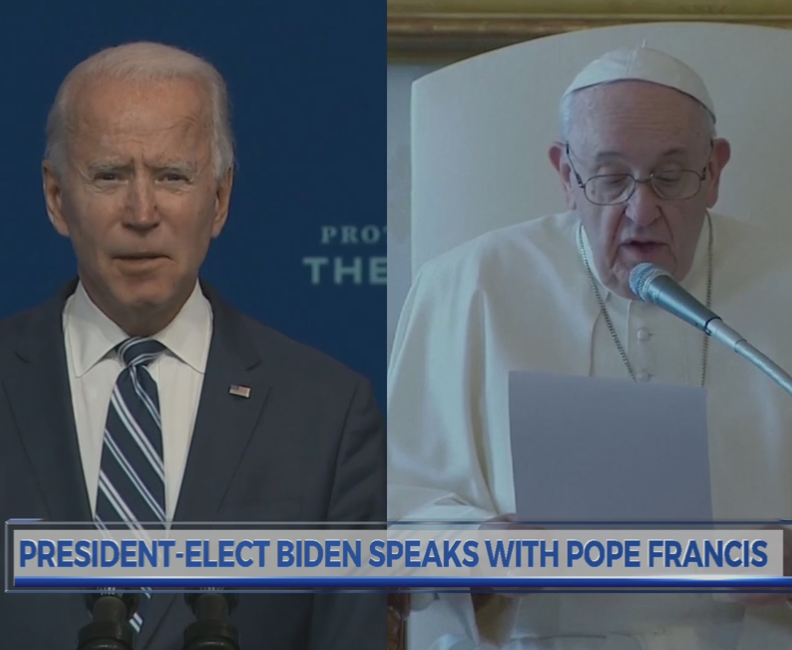
No, it was Cardinal McCarrick, the consummate networker, trusted fundraiser, ecclesiastical kingmaker and media manipulator. This was the man who, as archbishop of Washington, D.C., created the so-called “McCarrick Doctrine” that protected national-level Catholic politicians whose faith was a crucial part of their lives and images, even if many ancient doctrines didn’t mesh well with their political agendas. This McCarrick also claimed — in a public speech — to have helped elect Pope Francis.

This was the McCarrick whose legacy helped shape the remarkable war inside the U.S. Conference of Catholic Bishops that jumped into clear view on Inauguration Day.

It was easy to see this coming. I wrote about it several weeks ago in this “On Religion” column: “Joe Biden and the U.S. Catholic bishops — Tensions remain about Holy Communion.” And Catholic-press veteran J.D. Flynn clearly knew something big was coming when, a day before the Biden inauguration, he wrote an analysis — “Biden and the bishops. This probably will not go well” — for his new (and essential) website called The Pillar. Check out this lede:

Shortly after President Joe Biden begins his term of office, the U.S. bishops will be derided as culture warriors and abortion obsessives, unwilling to find common ground with the administration of the second Catholic U.S. president.

Sure enough, the elected leader of America’s Catholic bishops issued a letter (hold that thought) criticizing Biden’s actions supporting abortion rights, while hinting at clashes over religious liberty (Hello, Little Sisters of the Poor) and church doctrines on marriage and sex.

This drew an angry social-media response from Catholic progressives — including key men wearing red hats. Their outcry led to this headline in The Washington Post: “As Biden is sworn in, president of U.S. bishops assails him over abortion.”

In a bombshell report, The Pillar noted that the Vatican tried to ban the distribution of the USCCB statement by Gomez — at least until team Pope Francis could release a more politically nuanced letter. That headline: “Vatican intervened to spike US bishops’ Biden statement release.”

But back to the Post. The overture for that report says exactly what one would expect it to say:


Please respect our Commenting Policy

UK ready to welcome waves of Hong Kong residents (Yes, BBC ignored religion angles)

UK ready to welcome waves of Hong Kong residents (Yes, BBC ignored religion angles)

On the night of the Hong Kong handover to China, I walked through that great city’s old airport — noting the many residents who sat, passports in hand, preparing to leave. I was leaving after a small international gathering of journalists and academics focused, naturally, on religion and the news.

I talked to a few of the solemn people I saw that night in 1997. Some said they were leaving for good. Others said they were going abroad to explore the legal and economic hurdles they would need to clear if or when they decided to leave. I didn’t hear a single optimistic voice.

Like the people I interviewed for the two “On Religion” columns I researched during that stey, they said that they expected that, in a few years, the Chinese authorities would crack down on dissent, free speech and, yes, some mentioned freedom of religion. Here are those columns: “Silence and tension in Hong Kong” and “Hong Kong II: There’s more to life than $.”

I bring this up because of an important story that is unfolding, in slow motion, in the United Kingdom. Here is the top of a long BBC website story with this headline: “The Hong Kong migrants fleeing to start new lives in the UK.

The UK will introduce a new visa at the end of January that will give 5.4 million Hong Kong residents — a staggering 70% of the territory's population — the right to come and live in the UK, and eventually become citizens.

It is making this "generous" offer to residents of its former colony because it believes China is undermining Hong Kong's rights and freedoms.

Not everyone will come. Some of those eligible to leave have expressed their determination to stay and continue the fight for democracy.

In the end, Britain estimates that about 300,000 will take up the visa offer over the next five years.

As you would expect, the story introduces a family that is already in the UK, exploring their reasons for making the leap. Any signs of religion here?

Readers are told that Andy Li and his wife Teri Wong moved to York in October, just after the announcement of plans for this policy change. They said, no surprise, that they were thinking about their children, daughter Gudelia, 14, and son Paul, 11.

"We feel that the things we treasure about Hong Kong — our core values — are fading over time," said Mr Li. "So we decided we needed to provide a better opportunity for our children, not only for their education, but also for their futures."


Please respect our Commenting Policy

Evangelical 'power' and U.S. Capitol rioting: What about Franklin Graham and Falwell Jr.?

Evangelical 'power' and U.S. Capitol rioting: What about Franklin Graham and Falwell Jr.?

As a rule, I don’t use GetReligion posts to respond to feedback from readers. But several people — in emails, for the most part — have raised two crucial, and valid, questions about last week’s “Crossroads” podcast and post: “New York Times says 'Christian nationalism' tied to white 'evangelical power'.”

Actually, it’s the same question asked in two different ways. Hold that thought.

In the podcast and post, I argued that a much-read New York Times piece (“How White Evangelical Christians Fused With Trump Extremism“) did a fine job while offering illustrations that conspiracy theories such as the QAnon gospel have soaked into many pews and a few pulpits, especially in independent (and often small) charismatic and evangelical churches. My question was whether the feature provided solid evidence for this thesis:

The blend of cultural references, and the people who brought them, made clear a phenomenon that has been brewing for years now: that the most extreme corners of support for Mr. Trump have become inextricable from some parts of white evangelical power in America. Rather than completely separate strands of support, these groups have become increasingly blended together.

The key word was “power,” as in “some parts of evangelical power” becoming “inextricable” from the “most extreme” forms of Trump support — which has to be a reference to those who planned, not the legal National Mall rally for Trump, but the illegal armed attack on the U.S. Capitol.

In response, I wrote:

… Anyone who studies “evangelicalism” — white or otherwise — knows that we are talking about a movement based on the work of powerful denominations (this includes megachurches), parachurch groups, publishers (and authors) and major colleges, universities and seminaries.

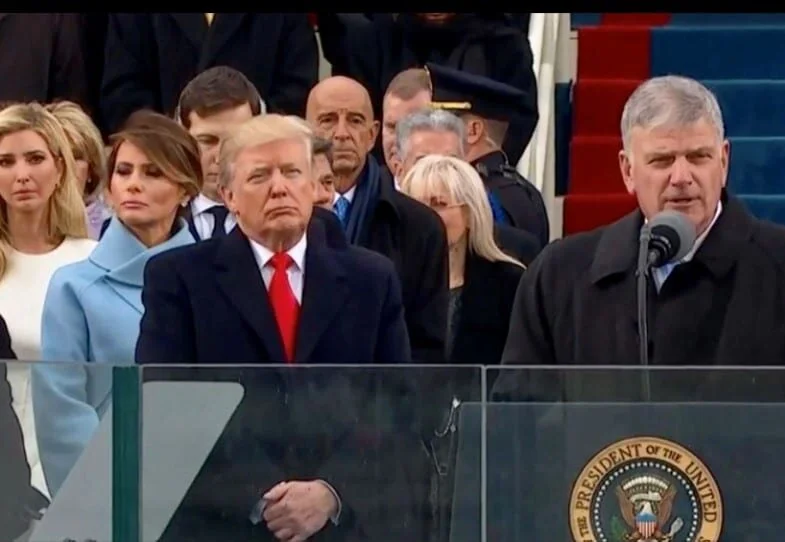
This led to several people asking this valid question: What about the Rev. Franklin Graham? Others asked: What about Jerry Falwell, Jr., and Liberty University?

These are certainly examples of evangelical brand names — Graham and Falwell.


Please respect our Commenting Policy

After the U.S. Capitol riot: Personality cults do not mix well with traditional Christian faith

After the U.S. Capitol riot: Personality cults do not mix well with traditional Christian faith

Year after year, thousands of Americans attend the March for Life, marching past the U.S. Capital on a late January date close to the anniversary of Roe vs. Wade.

Most of the marchers are young and come by bus from Catholic and evangelical schools. While most of the groups present are conservative, there are smaller groups like Secular Pro-Life and Democrats for Life. Most of the banners contain slogans such as, "Abortion Hurts Women," "Love Life, Choose Life" or "We are the Pro-Life Generation."

Things were different at the Save America March backing President Donald Trump's efforts to flip the 2020 election. Some banners contained messages like "Jesus is my Savior, Trump is my President." But many more proclaimed "Stand with Trump!" or "Trump 2020: No More Bulls--t."

It's one thing to march for a cause. It is something else to hail a political leader as the key to saving America, said Southern Baptist Seminary President R. Albert Mohler, Jr., a central figure in evangelical debates about Trump.

"The American experiment in ordered liberty is inherently threatened by a cult of personality. And we saw the results of that. … So many of those who were there as protestors explicitly said that they were there in the name of Donald Trump," said Mohler, in a podcast the day after U.S. Capitol riot. "It was Trump that was the name on the banners. They were not making the argument about trying to perpetuate certain political principles or even policies or platforms."

History shows that personality cults -- left or right -- are dangerous, he stressed. After this "American nightmare," Christians should soberly ponder the "way sin works" and its impact on powerful leaders who are tempted to become demagogues.

"Demagoguery simply means that you have a character who comes to power on the basis of emotion, rather than argument, and passion rather than political principles," said Mohler.

It's crucial to know that, in 2016, Mohler was numbered among evangelical leaders who opposed Trump's candidacy. When the New York City billionaire clinched the GOP nomination, Mohler tweeted: "Never. Ever. Period."

But in 2020 he said he would vote for Trump in support of the Republican Party, thus opposing the Democratic Party platform.


Please respect our Commenting Policy

Thinking with Bob Dylan (sort of): Everything is broken in the three Americas of 2021

Thinking with Bob Dylan (sort of): Everything is broken in the three Americas of 2021

So. Much. To. Read.

So. Much. To. Think. About.

This is one of those times when it really helps to cue up a Bob Dylan playlist and turn up the volume.

I have two Dylan playlists that fit the bill, right now — Dylan Hymns I and Dylan Hymns II. They aren’t full of real hymns or even Gospel arrangements (that’s in the Dylan Gospel playlist), but they are full of songs with obvious faith content from the openly born-again albums and then the many interesting discus that followed, almost always with a few tracks that include clear Christian images and themes.

Hang in there with me. I am getting to this weekend’s “think pieces,” I promise.

The Dylan Hymns II playlist opens with another version of the same song that ended Dylan Hymns I — “When the Night Comes Falling From the Sky” (click here for a fiery live take with Tom Petty and the Heartbreakers). That would be a great song for right now. But the song that really fits is, “Everything Is Broken” (lyrics here). Here’s some crucial images from the end of the song:

Broken cutters, broken saws
Broken buckles, broken laws
Broken bodies, broken bones
Broken voices on broken phones
Take a deep breath, feel like you’re chokin'
Everything is broken

Every time you leave and go off someplace
Things fall to pieces in my face

Broken hands on broken ploughs
Broken treaties, broken vows
Broken pipes, broken tools
People bending broken rules
Hound dog howling, bullfrog croaking
Everything is broken

This brings us to our first “think piece,” by Axios CEO Jim VandeHei. The thesis statement says, “America, in its modern foundational components, is breaking into blue America, red America, and Trump America — all with distinct politics, social networks and media channels.”

The emphasis here is, of course, politics and there is no openly stated religion theme. You know: politics is real and religion is not so real.


Please respect our Commenting Policy