
Terry Mattingly

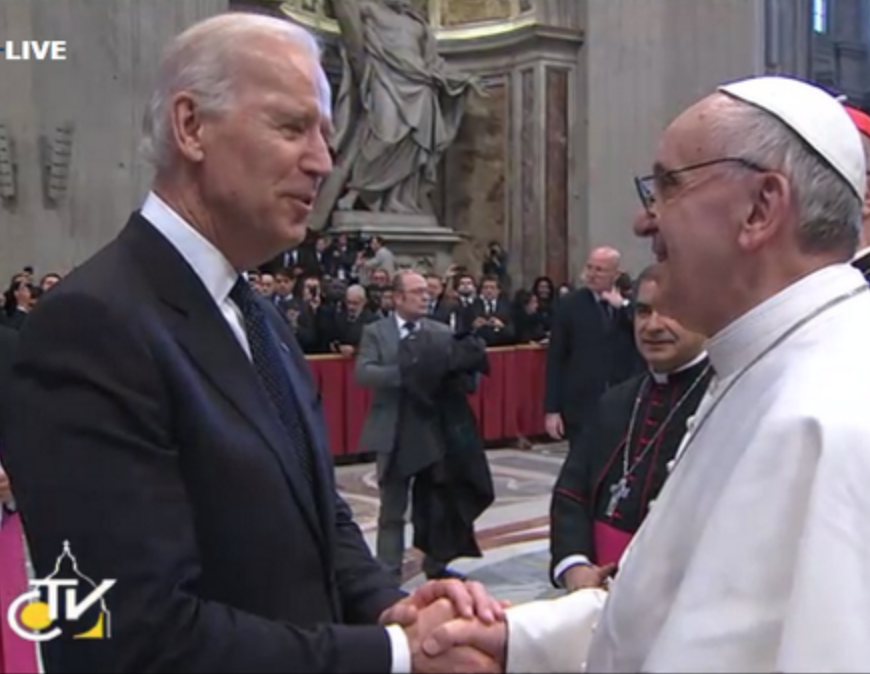
Yo, New York Times editors: There are several Catholic angles linked to Joe Biden's abortion flip

Yo, New York Times editors: There are several Catholic angles linked to Joe Biden's abortion flip

As many pro-life Democrats and others have noted in social media: That didn’t take long.

After years of opposing the use of taxpayer dollars to fund abortion — supporting the Hyde Amendment — former Vice President Joe Biden bowed the knee to primary-season realities in this “woke” era of Democratic Party life and reversed himself on this issue. Thus, he erased one of his few remaining ties to his old role as a centrist, compromise figure in his party on moral, cultural and religious issues.

Needless to say, the word “Catholic” may have something to do with this story. That term even made it into the New York Times coverage of this policy flip. See this all-politics headline: “Behind Biden’s Reversal on Hyde Amendment: Lobbying, Backlash and an Ally’s Call.

The overture focused on the political forces that yanked Biden’s chain, from members of his staff to rivals in the White Race. The Planned Parenthood team called early and often. Then, down in the body of the story, there was this:

A Roman Catholic, Mr. Biden has spent decades straddling the issue of abortion, asserting his support for individual abortion rights and the codification of Roe v. Wade, while also backing the Hyde Amendment, arguing that it was an inappropriate use of taxpayer money.

But Mr. Biden, his allies acknowledge, had plainly misread what activists on the left would accept on an extraordinarily sensitive issue. For all his reluctance to abandon his long-held position on federal funding for abortion, Mr. Biden ultimately shifted in order to meet the mood of emergency within his party’s electoral base.

The big word, of course, is “base” — which usually means “primary voters.” The question is whether the “base” that turns out in primary season has much to do with the mainstream voters that are crucial in the Rust Belt and the few Southern states that a Democrat has a chance to steal in a general election.

So where, in this Times report, were the voices from pro-life Democrats and progressive and centrist Catholics who wanted to see Biden try to reclaim blue-collar and Catholic votes that, in 2016, ended up — #LesserOfTwoEvils — going to Donald Trump? I would imagine they are hiding between the lines in the following material:

Please respect our Commenting Policy

Baptists and bishops: Must-read pair of weekend thinkers from Russell Moore and J.D. Flynn

Back in the religion-beat Good Old Days — roughly 1985-95 or hereabouts — religion-beat professionals in most American newsrooms could count on getting travel-budget money to cover at least two major events every year.

That would be the annual summer meeting of the national Southern Baptist Convention — prime years in the denomination’s civil-war era — and a meeting of the U.S. Conference of Catholic bishops, where some progressives were wrestling with Pope St. John Paul II and there were rumblings about a massive sexual-abuse scandal among priests and bishops.

Along with meetings of the Religion Newswriters Association, these were the dates on the calendars when the pros could get together and talk shop over a few modest meals/drinks on the company dime.

Well, those meetings roll on, of course, and continue to make news. A few reporters get to attend these major events, since they represent newsrooms that are (a) still quite large, (b) led by wise editors or (c) both. Lots of others scribes (speaking for a friend) catch key moments via streaming video, smartphone connections and transcripts of major speeches and debates.

With that in mind, here is a double-dose of weekend think-piece material linked to these two events which will take place in the next week or so in Birmingham, Ala., and Baltimore. Some people get barbecue and some get crab cakes.

First up, an essay by a key SBC voice, the Rev. Russell Moore of Beltway land, entitled: “10 Things I Wish Everyone Knew About Southern Baptists.” There are some important topics early on (“Westboro Baptist Church isn’t one of us” and “There are some things in our past we’re ashamed of”) but the most important info comes near the end, in terms of topics currently in the news. For example:

#8. We’re more ethnically diverse than you might think.

Among the fastest growing demographics in the Southern Baptist life are African-American, Hispanic, and Asian-American congregations. The most vibrant of our churches often include many languages and ethnic groups.


Please respect our Commenting Policy

Podcast puzzle: Why do editors send political reporters to cover complex religion stories?

It was the key moment in this week’s “Crossroads” podcast-radio session. Host Todd Wilken asked a relatively simple (you would think) question about mainstream news coverage of the Rev. David Platt’s decision to pray for President Donald Trump during a worship service at McLean Bible Church, a very influential D.C. Beltway megachurch.

This turned into a hot mess on Twitter (#NoSurprise). I wrote a GetReligion piece about the online controversy with this headline: “Praying for presidents? That's normal. Praying for Donald Trump? That fires up Twitter.

The initial coverage, of course, focused on the true religion in most American newsrooms — politics.

This brings me to the substance of Wilken’s question.

Toward the end of the first wave of coverage, Emma Green off The Atlantic wrote an essay — “On Praying for the President” — that paused and examined what actually happened at McLean Bible Church. She considered the history of pastors praying for presidents. She looked at the record of this particular minister. She also (#Amen) wrote about the actual contents of the prayer. In the body of the piece Green concluded:

What’s remarkable about this prayer is not that it happened, but that it shows how thoroughly the Trump era has opened the way for cynicism and outrage over even mundane, predictable Christian behavior. Within the world of evangelicalism, Platt does not roll with the hard-core Trump supporters; his prayer was studiously neutral, clear of boosterism and partisanship. While Trump has certainly amplified divisions among evangelicals over race, gender, and the rightful relationship between Christianity and politics, the choice to pray for a person in leadership is not a meaningful symbol of evangelicalism’s transformation under the 45th president.

Wilken asked this question: Why was Emma Green able to write that? Why did she “get” this story when many others did not?

The short answer is that Green is a religion-beat professional.

I could add, of course, that she is talented, works really hard and tries to accurately report the views of a wide range of religious believers, while working at a mainstream, left-of-center magazine of news and opinion. At this point, all of that goes without saying and Green consistently draws praise from religious conservatives as well as progressives. Anyone who reads GetReligion knows that, while we may debate with Green every now and then, this blog consistently praises her work. She often does more factual reporting in analysis pieces than others do in “hard-news” reports.

That’s the easy answer to Wilken’s question. In the podcast I used a rather long and complex sports metaphor (getting somewhat emotional in the process) that, I hope, went a bit deeper.


Please respect our Commenting Policy

Wait a minute: Catholics have a special 'version' of St. Mary who handles hurricanes?

I thought I had seen just about everything, in terms of strange news-media takes on ancient-church teachings on prayer and the saints. Apparently not.

Just the other day, I wrote a post praising a news report on this topic, in part because of a short, clear, explanation of the term “venerate,” as opposed to “worship,” when dealing with a relic of a Catholic saint. See this: “Facing the heart of Jean Vianney: Reporters should be careful when covering saints and prayer.”

Now we have this “Oh, no!” headline at CNN.com: “As hurricane season starts, coastal Catholics call on this holy go-between for protection from devastating storms.”

Let’s start with the basics: Do Catholics believe there is some form of divinity, other than the Holy Trinity — God the Father, Son and Holy Spirit — who hears prayers and performs miracles?

In this headline the “holy go-between” is clearly St. Mary, the mother of Jesus. The term “go-between” is a bit brash, but does hint at the early church belief that is is proper to ask saints to join their prayers to God for a miracle or an answer to some other request. Are these believers claiming that the saint — St. Mary in this case — has the power to protect them or is that a God thing?

Truth be told, I have heard Catholics say things like “I prayed to St. Name Here and this or that happened.” In most cases, if you ask, “So you’re saying the saint performed this miracle?”, they will pause and acknowledge that it is God who hears prayers and responds, in one form or another.

So we need to see if this CNN.com report gets that right. But that isn’t the main reason a Catholic journalist sent me this CNN link. Check out this overture and see if you can spot the heresy in this news story:

(CNN) As Hurricane Matthew whipped up Florida's Atlantic coast in 2016, Beth Williby got scared.

"That hurricane, in particular, just got my back up," the Jacksonville mom of four recalled. "So, I did what any modern woman would do, and I Googled: Who do you pray to for protection from hurricanes?"


Please respect our Commenting Policy

Democrat takes political stand against abortion: Wait a minute, isn't this governor a Catholic?

Let’s start here: Is it news when Democrats who are, to one degree or another, Catholic take actions that support abortion rights, especially with legislation linked to late-term abortions?

Well, ask Speaker of the House Nancy Pelosi. Pretty soon, we may hear discussions of this issue linked to former Vice President Joe Biden.

So now let’s ask a variation on this question: Is it news when a prominent Democrat who is a Catholic takes actions to limit abortion rights, while openly linking his political views on a variety of progressive “life issues” to the teachings of his faith?

I would say a strong “yes.” Then again, I spent decades attempting to vote as a pro-life Democrat. (Confession: I gave up and registered with a third-party in 2016.)

The political desk at The Washington Post (mildly) agrees, on this point, when covering the current drama unfolding around Gov. John Bel Edwards, down in the complex political state that is Louisiana. The headline: “Louisiana’s Democratic governor just defied his party and signed an abortion ban into law.

How about The New York Times? Hold that thought. First, here is a key passage that is buried pretty far down in the Post coverage. It does contain a crucial word — “Catholic.”

In Louisiana, the nation is seeing some of the last remaining antiabortion Democrats, a class of politician that has grown obscure in recent decades.

Edwards has been a high-profile member of that group since he was elected governor in 2015. Like other antiabortion Democrats, he likes to say he’s “pro-life for the whole life,” because he opposes abortion and supports policies such as Medicaid expansion and a higher minimum wage. In his post-vote statement, he said he believes that “being pro-life means more than just being pro-birth.”

The Army veteran and Catholic has said he traces his long-held views on abortion to his faith — and so do many of his constituents, he said.

“That’s the way I was raised,” Edwards said in an October episode of his monthly radio show. “I know that for many in the national party, on the national scene, that’s not a good fit. But I will tell you, here in Louisiana, I speak and meet with Democrats who are pro-life every single day.”

Yes, it would have been interesting to have heard more about how these “consistent life” Democrats apply their beliefs to political realities linked to immigration, gun control, the death penalty and a host of other “seamless garment” issues discussed in Catholic circles.


Please respect our Commenting Policy

Praying for presidents? That's normal. Praying for Donald Trump? That fires up Twitter

Is it controversial to pray for the president of the United States?

Not really. Anyone who knows anything about religious life in America knows that, week after week, people in a wide variety of religious congregations pray for the president (and the nation’s leaders in general) in a wide variety of ways. Sometimes these prayers are short, inserted in a longer litany of concerns (as in the Orthodox Christian parish I attend) and sometimes they are longer and more specific.

Here is a special-use prayer drawn from the world of liturgical mainline Protestantism (The Book of Common Prayer used in the Episcopal Church):

For the President of the United States and all in Civil Authority

O Lord our Governor, whose glory is in all the world: We commend this nation to thy merciful care, that, being guided by thy Providence, we may dwell secure in thy peace. Grant to the President of the United States, the Governor of this State (or Commonwealth), and to all in authority, wisdom and strength to know and to do thy will. Fill them with the love of truth and righteousness, and make them ever mindful of their calling to serve this people in thy fear; through Jesus Christ our Lord, who liveth and reigneth with thee and the Holy Spirit, one God, world without end. Amen.

Next question: Is it controversial to pray for President Donald Trump?

Apparently so. It appears that this answer is linked to another question that, for millions of Americans (including many journalists) remains controversial: Should Trump be recognized, in just about any way, as the president of the United States?

The world of Twitter journalism just had a fascinating firestorm about these questions — racing from a news report at The Hill all the way to a calm essay by Emma Green at The Atlantic, with a variety of comments by chattering-class voices in between. Let’s start with the politically charged basics, at The Hill: “Pastor defends prayer for Trump, says aim was not to endorse policies.” This event took place at one of the most high-profile evangelical megachurches near the D.C. Beltway.


Please respect our Commenting Policy

The Catholic matriarch of Creole cooking: Yes, the real Princess Tiana was a Catholic believer

What made Creole chef Leah Chase so unique?

There’s at least two ways to look at that question. You can ask, “What made her famous at the national level?” Fame is important, especially a person’s life and work is connected to A-list personalities in politics, entertainment and culture.

However, in this case I would say that that it was more important to ask, “What was the ‘X’ factor that made her a matriarch in New Orleans culture?” When you focus on that question, the word “Catholic” has to be in the mix somewhere — a core ingredient in the strong gumbo that was her life.

Thus, I was stunned that the NOLA.com tribute to Chase hinted at her faith early on, but then proceeded to ignore the role that Catholicism played in the factual details of her life. Look for the word “Catholic” in this piece: “Leah Chase, New Orleans’ matriarch of Creole cuisine, dead at 96.” You won’t find it, even though the overture opened the door:

Leah Chase, New Orleans’ matriarch of Creole cuisine, who fed civil rights leaders, musicians and presidents in a career spanning seven decades, died Saturday (June 1) surrounded by family. She was 96.

Mrs. Chase, who possessed a beatific smile and a perpetually calm demeanor, presided over the kitchen at Dooky Chase’s Restaurant until well into her 10th decade, turning out specialties such as lima beans and shrimp over rice, shrimp Clemenceau and fried chicken that was judged the best in the city in a poll by NOLA.com | The Times-Picayune. Every Holy Thursday, hundreds showed up to enjoy gallons of her gumbo z’herbes, a dark, thick concoction that contains the last meat to be eaten before Good Friday.

What, pray tell, is the importance of community life and faith linked to Holy Thursday and Good Friday?

Maybe editors in New Orleans simply assumed that Catholicism is a given in that remarkable city, something that does not need to be explained or, well, even mentioned. (Watch the NOLA.com video at the top of this post.)

In this case, if readers want to learn some facts about the role that Catholic faith played in this Creole queen’s life, they will need — wait for it — to dig into the magesterial obit produced by The New York Times: “Leah Chase, Creole Chef Who Fed Presidents and Freedom Riders, Dies at 96.”


Please respect our Commenting Policy

New York Times scribe has big problem with 'New South' -- it's full of backward church people

To be honest, I had shoved the Ginia Bellafante feature at The New York Times — “Abortion and the Future of the New South” — so far back into the “think piece” folder of guilt that I almost forgot that this “Big City” masterpiece still existed.

In this case, the term “masterpiece” is defined as a piece of first-person journalism that has to be in the running as one of the greatest summary statements of Gray Lady-speak ever put on paper.

I mean, Rod “Benedict Option” Dreher — a former Brooklyn resident — had already produced this truly fab summary statement of what’s going on here. Before we get to the latest response to the Bellafante opus — at Scalawag, hold that thought — let’s let Dreher kick off this thinker-fest:

I’m so sorry. Really, just very sorry. Here entitled Yankees like the NYT’s Ginia Bellafante thought the American South existed to give Millennial Brooklynites a place to reproduce Park Slope, but more affordably, and now we’ve gone and ruined it for them with our deplorable social and religious views.

Ah, right. All that icky religious stuff. That really messes things up for “Tess” and other relocated New Yorkers. Here is the essential Times-talk overture:

Tess wanted her own kingdom, and New York — forbidding, impossible — wasn’t going to let her build it. The start-up costs for the baking and catering business she envisioned were going to be too high; the rent on her apartment in Bed-Stuy was increasing. When she moved in it was $1,800 a month; just a few years later, it was approaching $3,400.

This young woman was a citizen of the New South now. Her business, Tess Kitchen, was thriving. Her New Orleans apartment, at $1,900 a month, had three bathrooms.

I called Tess on the day that the Louisiana House Health and Welfare Committee backed legislation to prohibit abortions once a fetal heartbeat was detected. This came 24 hours after Alabama passed the most restrictive abortion law in the country, one that does not allow exceptions for rape or incest. That followed the passage of another restrictive abortion law in Georgia.

Living in a very liberal city in a very conservative state is a trick mirror. “You really forget that you are in the Deep South here,’’ she said.

Need more? It’s all about the word “backward,” you see. You see the people who are, to New York-raised reformers, still yearning for the “Old South” are still fighting the Civil War.


Please respect our Commenting Policy

Question for journalists: Are Baylor's LGBTQ battles about politics or doctrine?

Question for journalists: Are Baylor's LGBTQ battles about politics or doctrine?

Let’s start with this question: Does the following sequence of events add up to a news story or not?

I. The world’s most prominent Baptist academic institution — Baylor University (I’m an alum) — gets involved in some heated debates about whether the campus LGBTQ group will be recognized as an official campus organization. That would (a) give it student-fee funds and (b) signal that regents consider the group’s work to be in accord with Baylor’s mission.

II. Representatives and “Baylor Family” supporters of the group Gamma Alpha Upsilon (GAY) start a petition asking the regents to affirm what previously was known as the Sexual Identity Forum.

III. Doctrinally conservative Baylor-ites respond with a petition of their own.

Here’s an interesting point to note: Only the progressive half of that online-petition equation draws coverage from The Waco Tribune-Herald.

IV. Shortly after that, the Baylor regents decline to meet with representatives of GAY. This draws more ink from the Tribune-Herald, once again with the left side of this debate receiving coverage. There is no content from those supporting Baylor’s doctrinal stance on sex and marriage (other than quotes from university policy and doctrinal statements).

V. Things got kicked up a notch, in terms of heat and public conflict, when the Rev. Dan Freemyer of the progressive Broadway Baptist Church in Fort Worth delivered the benediction at one of Baylor's spring graduation rites. Baylor traditionally gives this role to a Baptist clergyperson who is the parent of one of the graduates.

There’s more. Here is the top of my national “On Religion” column this week, which served as the hook for this week’s “Crossroads” podcast (click here to tune that in): 

God is doing new things in today's world, he said, while offering blunt prayer requests on behalf of the graduates.

"God, give them the moral imagination to reject the old keys that we're trying to give them to a planet that we're poisoning by running it on fossil fuels and misplaced priorities -- a planet with too many straight, white men like me behind the steering wheel while others have been expected to sit quietly at the back of the bus," said Freemyer.


Please respect our Commenting Policy