Surveys & polls

Yes, Southern Baptists are talking about '60 Minutes' (while Ryan Burge keeps doing the math)

Yes, Southern Baptists are talking about '60 Minutes' (while Ryan Burge keeps doing the math)

One thing is certain, if you follow political scientist Ryan Burge on Twitter. You are going to read quite a few things that you agree with and quite a few things with which you will disagree.

Here’s the key to that statement: It really doesn’t matter who “you” are. You can be a liberal mainline Protestant and you will read things that please you and things that infuriate you. Ditto, if you are Southern Baptist Convention leader.

If you are a religious “none,” in Pew Research Center terms, then Burge is mapping your life and beliefs, one chart after another. If you are a nondenominational, independent evangelical/charismatic leader, Burge was one of the first researchers who grasped that your world is now the fastest growing corner of the marketplace of American religion.

Burge makes many Southern Baptists mad. He also makes many Episcopalians and liberal mainliners mad, even though Burge is, himself, a progressive Baptist pastor/thinker as well as a political science professor at a state university. I would imagine, however, that leaders on the right and the left are learning that they are going to have to study the trends shown in all of those Burge charts on Twitter (and in his books).

To be honest with you, I can’t remember when I spotted Burge’s byline and I’m not sharp enough, in terms of computer skills, to spot the oldest item in the nearly 4,000 items that show up in a Google search for “Ryan Burge” and “Terry Mattingly.” I’m guessing 2018 or so. However, Burge has been cooperating with GetReligion for several years now, with me retweeting, oh, hundreds of his tweets with a “Yo. @GetReligion” slug. He also has allowed me to re-publish some of the essays he has written for the Religion in Public weblog (and for Religion Unplugged).

I bring all of this up for two reasons.

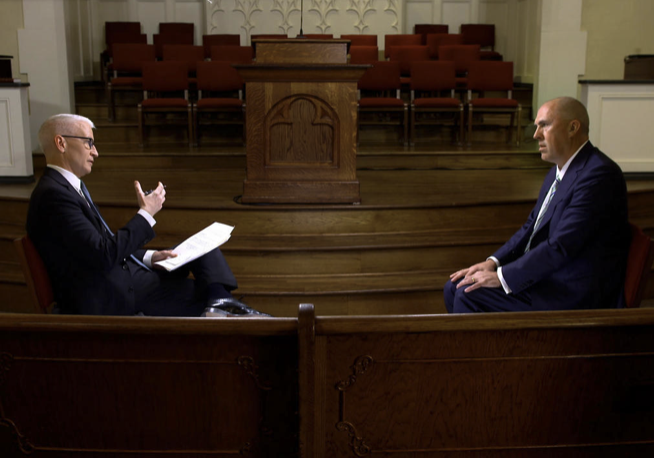
(1) Many news consumers who continue to follow legacy media may have seen him featured last night in a “60 Minutes” feature about the Rev. Bart Barber, the new president of the Southern Baptist Convention.

(2) Burge and I recently agreed on the format for a new GetReligion feature that we will call “Do the Math,” in which he will take four or five of his data-backed tweets and then connect them to spotlight trends that journalists need to follow.

Please respect our Commenting Policy

Plug-In: From Loretta Lynn to Aaron Judge, the week's top nine religion newsmakers

Plug-In: From Loretta Lynn to Aaron Judge, the week's top nine religion newsmakers

A country music queen. A home run king.

A former White House press secretary. A current U.S. Supreme Court plaintiff.

They are among nine key religion newsmakers who made headlines this past week (in alphabetical order):

Bart Barber: I’m showing a little bias here because I wrote this week’s Associated Press profile of Barber, a small-town Texas pastor and rancher elected to lead the 13.7 million-member Southern Baptist Convention at a time of major crisis. Barber will be featured Sunday night in a “60 Minutes” interview with Anderson Cooper.

Chris Jones and Sarah Huckabee Sanders: Jones is the Democrat and Sanders the Republican in Arkansas’ gubernatorial race. “With two preachers’ kids and a pastor in the race, Arkansans are poised to elect a governor who can sing hymns by heart and quote Scripture from memory,” the Arkansas Democrat-Gazette’s Frank Lockwood writes as he delves into faith and politics. (Sanders served as former President Donald Trump’s White House press secretary from 2017 to 2019.)

Aaron Judge: The New York Yankees star made history when he hit his 62nd home run of the season Tuesday night. Prayer and faith played a key role during Judge’s chase, reports the Deseret News’ Ryan McDonald.

Loretta Lynn: The country music superstar and Kentucky coal miner’s daughter died Tuesday at age 90. “She really was serious about her faith and a devout member of the church,” retired minister Terry Rush, who maintained a close friendship with Lynn, told me.

John Henry Ramirez: The Texas killer fought all the way to the U.S. Supreme Court to have his pastor lay hands on him and pray during his execution. “Just know that I fought a good fight, and I am ready to go,” Ramirez said before his death by lethal injection Wednesday, as noted by The Associated Press’ Juan A. Lozano and Michael Graczyk.

Lorie Smith and Jack Phillips: The two claim in an opinion piece for USA Today that Colorado is trampling on their First Amendment rights as Christian artists, and they’re fighting back. Website designer Smith’s case is headed to the U.S. Supreme Court, the Deseret News’ Kelsey Dallas reports.


Please respect our Commenting Policy

Will religious groups face questions linked to America's declining marriage stats? (Part II)

Will religious groups face questions linked to America's declining marriage stats? (Part II)

It's a message young people in the Church of Jesus Christ of Latter-day Saints hear early and often: You should get married, because marriage is wonderful and family life is at the heart of the faith.

The problem is that church leaders haven't grasped the power of cultural trends in technology, education and economics that are fueling sharp declines in statistics linked to dating, marriage and fertility, said Brian Willoughby of the Brigham Young University School of Family Life.

"The key word is 'tension,' " he said. Among the Latter-day Saints, these numbers are "not falling as fast" as in other groups, "but our young people are feeling tensions between the patterns they see all around them and what they hear from their parents and religious leaders.

“We are seeing the same changes -- only moving slower. The average age of people getting married is rising. Fertility rates are declining. … We can no longer assume that religious young people are some kind of different species."

It's urgent, he added, for congregations to "start making a more explicit case for marriage and family. Our young people know that marriage is important, but they don't know specific reasons for WHY it's important."

The result is what some researchers call the "marriage paradox." Young people continue to express a strong desire to "get married at some point," but they place an even higher priority on other "life goals," said Willoughby.

"Marriage becomes a transition in which they fear they will lose freedom or success. … They hear everyone saying: 'You go to these schools and get these degrees. You get job one that leads to job two. Don't let anything get in your way or get you off track.' With this kind of head-down approach, serious relationships can be a distraction on the path to success. … The heart isn't as important."

Thus, marriage isn't disappearing, but the population of young adults choosing marriage is shrinking -- especially among those with little or no commitment to religious life.


Please respect our Commenting Policy

Faith, family, dating and the looming marriage crisis in America (Part I)

Faith, family, dating and the looming marriage crisis in America (Part I)

For decades, viewers have enjoyed the Japanese reality-TV series "Old Enough!" in which preschool children venture into the streets alone to run errands for their parents.

What if American women asked their live-in boyfriends to stop playing videogames, leave their couches and run errands? In the Saturday Night Life sketch "Old Enough! Longterm Boyfriends!" guest host Selena Gomez asked her helpless boyfriend of three years, played by cast member Mikey Day, to buy her eyeliner and two shallots.

This man-baby ends up in tears with a big bag of onions and "a blush palette for African-American women." The frustrated girlfriend says she may need a mid-morning glass of wine.

There was wisdom in that comedy, for pastors willing to see it, said sociologist W. Bradford Wilcox, director of the National Marriage Project at the University of Virginia.

"There's a whole class of young men who are not flourishing personally and professionally. … The systems have broken down that help raise up attractive, successful men. Churches used to be one of those support systems," he said, reached by telephone.

"The future of the church runs through solid marriages and happy families. The churches that find ways to help men and women prepare for marriage and then encourage them to start families are the churches that will have a future."

The crisis is larger than lonely, under-employed and Internet-addicted men. Rising numbers of young women are anxious, depressed and even choosing self-harm and suicide.

The coronavirus pandemic made things worse, but researchers were already seeing danger signs, noted San Diego State psychology professor Jean Twenge, in a recent Institute for Family Studies essay.


Please respect our Commenting Policy

Ryan Burge at RNS: Thinking about the impact of political sermons, on left and right

Ryan Burge at RNS: Thinking about the impact of political sermons, on left and right

Hey churchgoers: How long has it been since you heard a political sermon?

Wait. We need to pause and discuss what a political sermon might sound like. For example, I think everyone would agree that an open endorsement of a political candidate from the pulpit would be “political.”

But what if a congregation or a denomination invited a political leader to speak in a worship service or some other event? This is something that happens on the political left and right. For generations, to name one example, Democrats have accepted warm, strategic invitations to speak — or perhaps simply exchange greetings — in African-American churches. It makes headlines when GOP leaders address major evangelical bodies (think Vice President Mike Pence and the Southern Baptist Convention).

More questions: What if a bishop or a preacher addresses issues that are clearly both doctrinal AND political, such as right-to-life concerns or threats to the environment? What about a conference focusing on ways religious groups can defend First Amendment rights, such as freedom of speech, freedom of association and freedom of religious practice? Is a liberal rally on abortion more “theocratic” than one organized by believers on the doctrinal right?

I ask these questions because of a piece GetReligion contributor Ryan Burge, he of the omnipresent charts and info on Twitter, wrote for Religion News Service. Here’s the newsy headline “When preachers get political, do they change minds? Preachers tend to risk political speech only when they know it will receive a warm reception.” The overture:

One of the most important and difficult questions among those who study religion and politics is just how important a pastor, rabbi, imam or other religious leader is when it comes to shaping the worldviews of their congregation. These figures get a weekly chance to dominate the attention of the people who come to listen to their sermons. They have a nearly unique opportunity to mold their congregants’ view of the theological, social and political world around them.

How often do pastors actually use that opportunity to speak out about the pressing issues of the day? Some new data gives us a look.

A Pew Research Center poll fielded in March of 2021 asked people if they had heard sermons that contained references to the fallout from the 2020 presidential election in the previous month. The survey asked about four topics specifically: the possibility that the 2020 election was rigged, former President Donald Trump’s inaccurate statements about election fraud, as well as support for or opposition to those who stormed the U.S. Capitol on Jan. 6, 2021.

That is certainly a rather Donald Trump-era dominated list, but that reflects several years of headlines. Meanwhile, it’s safe to say that President Joe Biden is in the White House, in large part, because of support from voters in Black churches during several primaries. But I digress.


Please respect our Commenting Policy

Question for journalists to mull: What will America's religious life look like in 50 years?

Question for journalists to mull: What will America's religious life look like in 50 years?

Scribes in the U.S. press snapped to attention last year when the Gallup Poll announced that as of 2020 less than half of Americans held religious memberships for the first time in its eight decades of asking the question. Only 47% of Americans said they belonged to a church, synagogue, mosque or other house of worship, a dramatic loss from the 70% as recently as 1999.

Now comes the Pew Research Center with a related pulse-pounder issued last week.

Pew figures that currently 64% of Americans (including children) identify as Christians in some sense, compared with 6% for other religions and a hefty 30% for “nones” and “nothing in particulars” — those without religious affiliation. Then we’re told that 50 years from now the Christian percentage may well fall to a modest 54% or even to a remarkable 35% in the worst-case scenario, while the non-religious population rises to somewhere between 34% and a slim majority of 52%.

Understandably, the Pew numbers became spot news for, among others, CBS, National Public Radio, the Washington Examiner and Washington Post, both newspapers in faith-focused Salt Lake City, USA Today, Britain’s The Guardian and a host of religious outlets.

This remains a good spot story for media that haven’t yet reported Pew’s basics. But even media that have reported the topline numbers could return to the theme with illustrative anecdotes and reactions from area religious leaders. And for sure journalists and religious analysts will want to give the full report some careful thought.

Pew emphasizes that its numbers are only “possibilities,” not “predictions of what will happen,” and comments that such a future would have “far-reaching consequences for politics, family life and civil society.” For example, also consider the multiple social science surveys that associate religious involvement with psychological and medical well-being and positive life outcomes for youths. Also, there is the impact of religious charity, not only effective huge organizations but private person-to-person interactions. Also, religions strengthen community in our “Bowling Alone” culture.

Pew calculated four future scenarios based largely upon the rates at which Americans may switch in or out of Christian identification and in or out of religious “none” status.


Please respect our Commenting Policy

Plug-In: A 50-year TV flashback -- Why 'The Waltons' wasn't afraid of religious faith

Plug-In: A 50-year TV flashback -- Why 'The Waltons' wasn't afraid of religious faith

During the pandemic lockdown, I rediscovered “The Waltons” and watched all 221 episodes.

Somewhere along the way, I learned that the classic TV show about a Depression-era family in rural Virginia made its prime-time debut on Sept. 14, 1972.

That’s 50 years ago.

I started emailing myself notes about religion references in specific episodes — those with titles such as “The Sinner”, “The Sermon” and “The Baptism” — and marked the anniversary date on my calendar. Journalists are always looking for a story, don't you know?

I pitched a piece to The Associated Press. To my delight, Global Religion news director David Crary and news editor Holly Meyer let me write it. This isn’t hard news, but I hope it’s interesting.

Speaking of AP friends, Matt Curry and I worked together in the Dallas bureau from 2003 to 2005. Curry later left journalism and attended Brite Divinity School at Texas Christian University. He's a big fan of “The Waltons,” and his family’s experience became the lede for my feature:

The Rev. Matt Curry’s parents were children of the Great Depression, just like “The Waltons” — the beloved TV family whose prime-time series premiered 50 years ago.

When Curry was growing up on a farm in northern Texas, his carpenter father and teacher mother often argued playfully over who had a poorer childhood.

“The Depression was the seminal time of their lives — the time that was about family and survival and making it through,” said Curry, now a 59-year-old Presbyterian pastor in Owensboro, Kentucky. “My dad used to talk about how his dad would go work out of town and send $5 a week to feed and clothe the family.”

So when “The Waltons,” set in 1932 and running through World War II, debuted on CBS on Sept. 14, 1972, the Currys identified closely with the storylines.

I enjoyed interviewing two stars of “The Waltons”: Richard Thomas (John-Boy Walton) and Kami Cotler (Elizabeth Walton).

The story explores how the series delved into spiritual themes at a time when the TV networks tended to avoid them.


Please respect our Commenting Policy

NBC News promotes its own Satanism-scare report, which is itself a kind of scare-news device

NBC News promotes its own Satanism-scare report, which is itself a kind of scare-news device

I have always found it interesting when major news organizations conduct a public-relations blitz — primarily with messages to other journalists — promoting one of their own news reports.

Obviously, the message to other journalists is this: We deserve praise for doing this story. The implied message is usually: We were brave to do this story. Now, all you other newsroom folks should follow our courageous example and cover this story, too.

In this case, we are talking about an NBC News press release with this dramatic double-decker headline:

NBC NEWS: SATANIC PANIC IS MAKING A COMEBACK, FUELED BY QANON BELIEVERS AND GOP INFLUENCERS

Baseless Accusations Are Branding People As Satanist Pedophiles At The Speed Of The Internet — Just Ask A GOP Prosecutor Who Recently Lost Re-Election.

There are several levels to This. Big. Story.

(1) There is a totally valid story about Internet-based attacks against a progressive Republican — David Leavitt, the prosecuting attorney for Utah County — attempting to smear him with wild stories about Satanic, cannibalistic attacks on children. Leavitt is active in the Church of Jesus Christ of Latter-day Saints and the younger brother of a former Utah governor, Mike Leavitt.

(2) There is a valid, and by now very familiar, story about QAnon, politicians, pedophiles, cannibalism, pizza and, of course, the work of Satan in one form of another (hold that thought). If you have followed GetReligion, you know that we think the world of QAnon conspiracy theories is important and worthy of tight, fact-based coverage.

(3) There are some, repeat “some,” Republicans on the right fringe who now rush to connect Satanic worship to all kinds of trends in the free-for-all that is modern American culture. These politicos have been known to blur the line between organized, public Satanic religious groups and the secret world (it’s hard to know the size of this phenomenon) of people attempting to practice dark arts of various kinds.

(4) There are many conservative, and very mainstream, religious believers who openly state their beliefs that incarnate evil — as in the biblical Satan — is at work, on one level or another, in activities including child abuse, domestic violence, terrorism, warfare, etc. Yes, some believe that using permanent forms of gender-transition surgery and puberty blockers on children fall into this category.

It’s important to note, however, that someone like Pope Francis saying that he sees Satanic forces at work in our world is not the same thing as people making accusations against, for example, the specific and official Church of Satan. Yes, Pope Francis has probably used more Satan-based language than any pope in several generations, including on some issues linked to the Sexual Revolution.

This NBC News report takes the important story at level (1) and links it to level (2) — which is valid. The problem, from my journalistic point of view, is that NBC News then attempts to take some poll-based information about questions at level (3) and even (4) and then blend that material with (2) Qanon and the (1) attacks on someone like Leavitt, arguing that belief in the reality of incarnate evil (a mainstream Christian belief, as in this Catholic Catechism reference) is creating a wider trend that threatens American democracy, or words to that effect.


Please respect our Commenting Policy