Scriptures

Thinking about those sad, old Vatican II 'fundamentalists' -- such as Pope Benedict XVI?

Thinking about those sad, old Vatican II 'fundamentalists' -- such as Pope Benedict XVI?

If religion-beat journalists looked carefully enough, they could see an interesting question lurking inside the rhetoric of the current Latin Mass wars.

That question: What does it mean to be “pro-Vatican II”? If reporters flip that question around it turns into this: What does one need to do to be “anti-Vatican II”?

For example, see this language at the top of a Catholic News Agency report this past summer with this headline: “Pope Francis: There are many ‘restorers’ in the US who do not accept Vatican II.

There are many “restorers” in the United States who do not accept the Second Vatican Council, Pope Francis said. …

Speaking to the editors of Jesuit journals, he criticized what he called “restorationism” in the Church, which he defined as the failure to accept Vatican II, the ecumenical council held from 1962 to 1965. He said: “Restorationism has come to gag the Council. …”

Note the tension between “accept the Council” and “gag the Council.” What, precisely, does it mean to “gag” the Second Vatican Council? Let’s keep reading:

“The problem is precisely this: in some contexts, the Council has not yet been accepted. It is also true that it takes a century for a Council to take root. We still have 40 years to make it take root, then!”

Pope Francis cited opposition to Vatican II when he issued the motu proprio Traditionis custodes in July 2021, limiting celebrations of the Traditional Latin Mass.

This leads to a logical question: What ARE the teachings of Vatican II? Are they the actual contents of the Council documents or are these teachings an evolving body of work with current and future Catholic leaders deciding what the Council meant to say? Yes, note how these questions echo decades of academic warfare about, well, everything from the U.S. Constitution to the New Testament.

This is a timely subject, in light of the recent death of Pope Benedict XVI — one of few remaining Vatican intellectuals who, as an advisor to a cardinal in the Vatican II sessions, had direct exposure to the debates that led to its final documents. Benedict stressed a strict reading of the contents of Council’s teachings on a host of subjects — such as liturgy and the future role of Catholic tradition.

That leads us to a Religion News Service think piece written before shortly before the death of Benedict XVI. The author, Jesuit Thomas Reese, is a priest who for decades has been one of the most powerful voices (think “usual suspects”) shaping news coverage of American Catholicism.

Please respect our Commenting Policy

Podcast: Benedict XVI protected ancient doctrines, while looking into an ominous future

Podcast: Benedict XVI protected ancient doctrines, while looking into an ominous future

The passing of any pope unleashes waves of news commentary, frequently with supporters clashing with critics in an attempt to help shape the narrative heading into the conclave to pick the next occupant of the Throne of St. Peter.

What about the passing of a pope emeritus? That would make things simpler, since there the current pope was still alive and in charge. Right?

Apparently not. The death of Pope Benedict XVI, if anything, seemed to raise the stakes in many lingering debates in Catholic life. My takeaway is that it represented the final, formal close of the era of St. Pope John Paul II, as well as that of Pope Benedict XVI, who, as Cardinal Ratzinger, had played a crucial theological role in support of John Paul.

Thus, this event — for many on the Catholic right and left — marked the end of the “Veritatis Splendor” era, with John Paul II’s emphasis on the defense of transcendent truths, and the open door into the Synod on Synodality era, with its modern Jesuit emphasis on dialogue and evolving doctrine.

The complex nature of this transition provided the hook for this week’s “Crossroads” podcast (CLICK HERE to tune that in).

How complex? For a glimpse of the sweeping nature of this story, check this post from the Catholic listserv Big Pulpit — which circulates daily lists of URLs to news reports, blog posts, podcasts and other commentary on Catholic affairs.

The January 2 offering include a list of “The Top-10 Most Visited Links” about the death of Pope Benedict XVI. That was followed with the “Next-10 Most Visited Links.” Then there was “Another-10 Most Visited Links” and “The-Next-Another-10 Most Visited Links.” This went on and on for another screen or two, with a total of 80 must-read links for that day.

That’s all. Good luck reading all of that — plus countless other offerings in both the mainstream press and countless Catholic commentary sources.

GetReligion readers will not be shocked to discover that, for many journalists, the death of this orthodox theologian was primarily a political story.


Please respect our Commenting Policy

NYTimes editors ask, 'When does life begin?' and (bravo) include religious and legal responses

NYTimes editors ask, 'When does life begin?' and (bravo) include religious and legal responses

You never know what newsroom professionals will decide is a “holiday” story, of one kind or another.

For example, major publications have through the years run a wide variety of bizarre and even offensive stories that were, somehow, supposed to be linked to Easter. That season is problematic since it is so explicitly Christian, as in the faith’s most important holy day.

Christmas is a different matter, since the season is a cultural steamroller at the level of pop culture, big business and church-state warfare (a drag queens and you are on A1, for sure). Toss in the need for valid year-end features and lots of staff taking vacations and things can get pretty complex for editors.

All of that was an introduction to what I think was a totally valid Christmas-Yearender feature that ran at The New York Times with this big-issue headline: “When does life begin? The question at the heart of America’s abortion debate is the most elemental — and the most complicated.”

Talk about a complex, yet absolutely essential, topic to address after the fall of Roe v. Wade, and it’s absolutely essential that the editors assigned this one to the religion desk. That made sense because it’s impossible to draw a bright red line between the spiritual and legal issues in this debate. As if that isn’t enough, a reporter then has to deal with valid debates on this issue among scientists, and religious leaders (think popes) commenting on those debates.

Thus, this is a story that will draw few cheers from activists on either side of America’s abortion wars. That’s a compliment, with this kind of story. Here is a large chunk of its summary-thesis material:

When does life begin?

In the months since the Supreme Court overturned Roe v. Wade, it has become unavoidable, as activists and politicians try to squeeze concrete answers from an eternal question of human existence.

Lawmakers and judges from Arizona to South Carolina have been reviewing exactly which week of development during pregnancy the procedure should be allowed. Some states draw the line at conception, or six weeks or 15 or around 40. Many others point to viability, the time when a fetus can survive outside the uterus. The implication is that after the determined time, the developing embryo or fetus is a human being with rights worth protecting.

Over the summer, when lawmakers in Indiana fought over passing a law banning most all abortions from conception, Republicans argued at length that a fertilized egg was a human life, at times citing their Christian principles — that “human life begins at conception” and “God our creator says you shall not murder.” A Democrat pointed to another answer found in Title 35-31.5-2-160 of the Indiana code: “‘Human being’ means an individual who has been born and is alive.” A disagreement over abortion policy became a fight over what it means to be human, the tension between conception and birth, church and state.

Like I said, that’s just the start.


Please respect our Commenting Policy

The complex legacy of Benedict XVI: Defender of tradition who opened door to Pope Francis

The complex legacy of Benedict XVI: Defender of tradition who opened door to Pope Francis

Pope Emeritus Benedict XVI, who served as head of the Roman Catholic church from 2005 until his surprise resignation in 2013, has died and his passing has fueled renewed debates about several newsworthy trends in the modern Catholic Church.

The scholarly Benedict, a former theology professor, was known for his writings and defense of traditional values to counter the increased secularization of the West. Benedict’s death at age 95 was announced by the Vatican. Pope Francis will preside over the funeral Mass on Jan. 5 at St. Peter’s Square.

Benedict XVI broke several records during his papacy, including being the first pontiff to have a Twitter account. In recent years, however, press coverage stressed his resignation from the papacy.

On February 11, 2013, the Vatican confirmed that Benedict XVI would resign at the end of that month as he neared his 86th birthday, becoming the first pope to step down since Gregory XII in 1415. His resignation ushered in the papacy of Francis, leaving Catholics around the world to grapple with the idea of two living pontiffs. In September 2020, Benedict became the longest-living pontiff — at 93 years, four months and 16 days — surpassing Pope Leo XIII, who died in 1903.

As for Benedict’s legacy, it remains mixed and complex. In the press coverage, it is crucial to note how journalists handle his childhood in Nazi Germany, his move from German liberalism to conservative thinking on doctrine and his public and private actions when handling church scandals.

Vatican observer John L. Allen, in a piece for the National Catholic Reporter in 2013, wrote:

“A legacy, of course, is partially in the eye of the beholder. For many feminists, gays, dissident theologians, liberal Catholics of various stripes, and victims of clerical abuse, Benedict simply wasn’t the pope they wanted. Others will be inclined to celebrate Benedict not so much for what he did, but what he represented. …

“For his part, Benedict probably won't be terribly interested in the discussion. He is, after all, a man who once joked to a French friend after the Paris papers had been hard on one of his speeches, ‘I’m like the cellist Rostropovich — I never read the critics.’”

A voracious writer and theologian, Benedict penned 66 books during his lifetime. Among the most notable are “Introduction to Christianity” (1968), “Called to Communion: Understanding the Church Today” (1996) and “Last Testament: In His Own Words” (2016). He also wrote a trilogy of popular books — written for the laity — on the life of Jesus. The Vatican has reported that his final words were: “Jesus, I love you.”


Please respect our Commenting Policy

Five Catholic storylines journalists will need to follow closely as we enter 2023

Five Catholic storylines journalists will need to follow closely as we enter 2023

There are only a few days left to go in 2022. It was a busy news year — loaded with stories with strong religion angles.

Many of those stories had Catholic angles that were important to highlight and report on. A year ago, I took a look at the top Catholic angles journalists needed to focus on heading into 2022. I was prescient in my outlook, highlighting the Supreme Court decision regarding abortion among the top things to focus on.  

This is what I wrote a year ago looking ahead to 2022:

Issues around politics and religion will likely dominate once again in 2022. The abortion issue and a pending Supreme Court decision regarding access to it will be a big story in the coming year. The Catholic church, a major part of the abortion debate in this country for decades, will play a major role in news stories that will be written over the coming months.   

As we prepare to ring in 2023, I want to highlight five big storylines and trends to look for over the next 12 months:

(5) Catholic politicians vs. bishops

The culture war that has embroiled many societies, especially in the United States and now Western Europe, will continue to pit Catholic bishops and politicians. It will be especially pronounced when it involves Catholic lawmakers.

We’ve already seen this with President Joe Biden and outgoing House Speaker Nancy Pelosi. Both are practicing Catholics who have butted heads with many bishops who keep noting public remarks and actions by these politicians that directly clash with centuries of Catholic doctrines on a great number of moral issues.

The U.S. Conference of Catholic Bishops recently elected a new president. As conference president, Archbishop Timothy Broglio of the Archdiocese of the Military Services will have to focus on many hot-button issues. Above all, fights over issues surrounding abortion and contraception will continue, including questions about whether politicians who openly clash with church teachings should receive Holy Communion.


Please respect our Commenting Policy

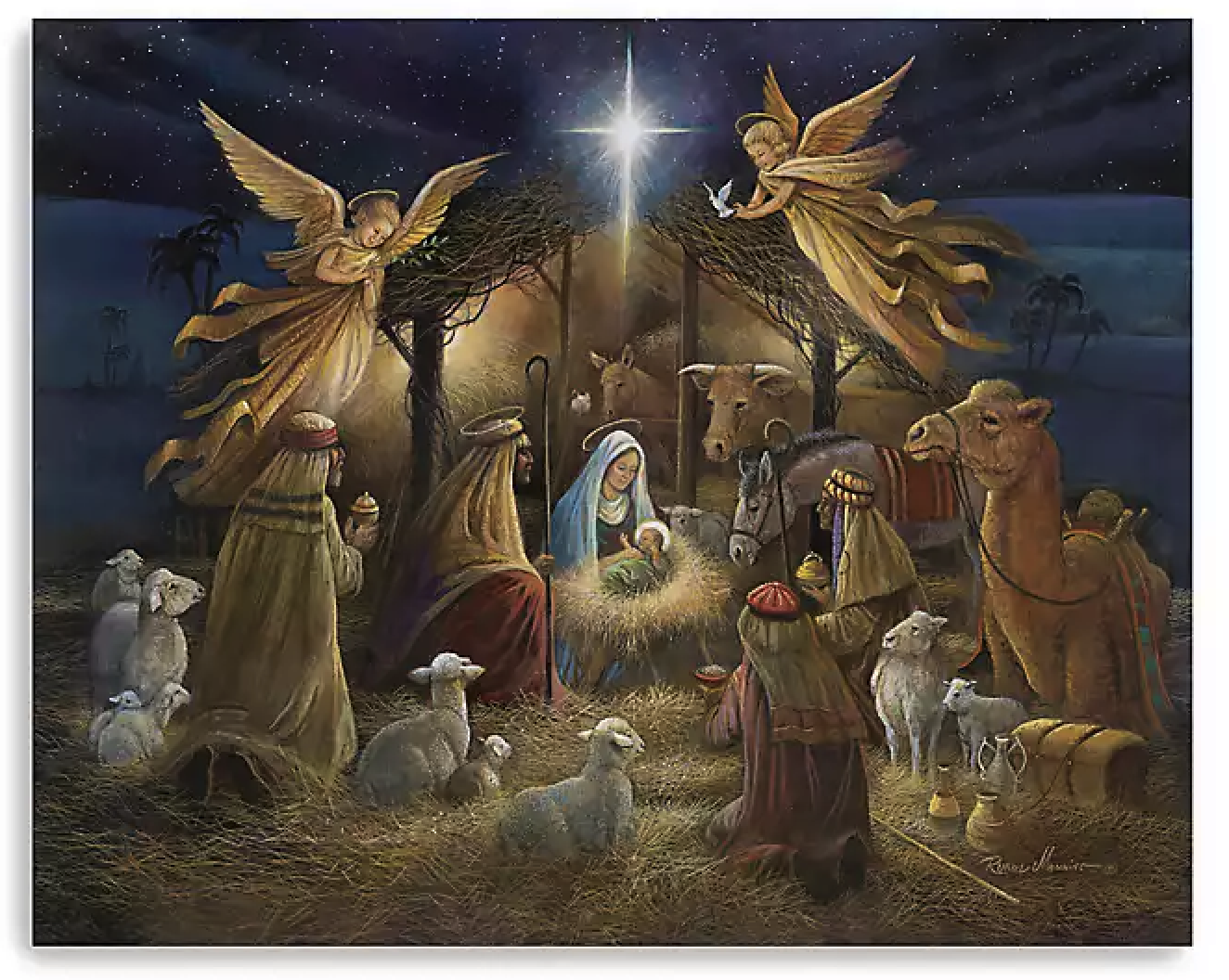
What's is behind the symbolism of shepherds and wise men worshipping newborn Jesus?

What's is behind the symbolism of shepherds and wise men worshipping newborn Jesus?

THE QUESTION:

What’s signified by shepherds and wise men worshipping the newborn Jesus?

THE RELIGION GUY’S ANSWER:

The world’s most-read and most-recited narratives are quite likely the two independent and contrasting accounts of Jesus’ birth that begin the biblical Gospels of Matthew and Luke.

A particularly striking difference is that Matthew has a Jewish flavor yet features Gentile “wise men from the East” of high status and Luke, aimed at a Gentile audience, tells us of humble Jewish shepherds. Intriguingly, neither Gospel knows of the other’s visitors who came to worship the baby of Bethlehem.

Several decades later, the Book of Acts records, the earliest Christians were busily converting not only Jews but a visiting Ethiopian official, hated Samaritans and Roman occupation soldiers, and then multicultural Gentiles across the Mediterranean region.

In the Christian understanding, the birth in Bethlehem fulfilled God’s promise in calling Abraham that “by you all the families of the earth will bless themselves” (Genesis 12:3) and the revelation to the prophet Isaiah that Israel would be “a light to the nations” (42:6, 49:6, 60:3).

By the early 50s A.D., the greatest of the early missionaries to Gentiles, St. Paul, would cite the universal call of Abraham as he taught believers that “there is neither Jew nor Greek, there is neither slave nor free, there is neither male nor female; for you are all one in Christ Jesus. And if you are Christ’s then you are Abraham’s offspring, heirs according to promise” (Galatians 3:6-9 and 28-29).


Please respect our Commenting Policy

That never-ending debate in modern churches: Should Christians baptize babies?

That never-ending debate in modern churches: Should Christians baptize babies?

THE QUESTION:

Unending Debate: Should Christians baptize babies?

THE RELIGION GUY’S ANSWER:

Yes or no, depending what church is answering the question.

A quote posted in August by Detroit Baptist Theological Seminary says this “debate over baptism has raged in the church for millennia” and “all sides argue passionately for their view.”

Jesus’ evangelism command to his followers in the Great Commission (Matthew 28:19) directed water baptism for church membership as observed in all types of Catholic, Orthodox and Protestant groups (except for the Quakers and Salvation Army).

Along with this, Baptists and other Protestants of like mind, view baptism as an “ordinance” to symbolize faith, not a “sacrament” where God bestows grace or regeneration. And, as discussed below, full immersion of the body in the water is their trademark practice.

Who should be baptized? Baptists et al. make a simple, straightforward argument. They see no explicit examples of infant baptism in the New Testament, only cases where baptism followed conscious conversion to a personal belief in Jesus Christ as Savior. Such “believer’s baptism,” of course, is impossible for infants and young children. The Great Commission linked baptism with religious instruction, and Acts 2:38 records that the original 3,000 Christian converts on the day of Pentecost repented for forgiveness of their sins before baptism.

Christians on the opposite side respond by citing New Testament examples where a “household” or “family” was baptized as a group and reason that young children were surely included.


Please respect our Commenting Policy

Religion News Service, and AP, offer the latest news from the left side of Christian higher ed

Religion News Service, and AP, offer the latest news from the left side of Christian higher ed

It’s another day, with yet another Religion News Service story about Christian higher education that fails to add one or two sentences of crucial material about ongoing clashes between centuries of Christian doctrine and the Sexual Revolution.

The setting for this news story, once again, is Seattle Pacific University — a Free Methodist institution in the progressive Pacific Northwest. Click here for flashbacks to GetReligion posts about news coverage of what is clearly a bitterly divided campus.

Once again, RNS readers never learn whether students and faculty on this campus sign — at enrollment or employment — what is usually called a “doctrinal covenant” or “lifestyle agreement.” This is a document in which members of a voluntary community pledge to support, or at the very least not openly oppose, a private school’s beliefs on a variety of moral and theological issues.

Many faith-based schools (on the religious left or right) have these covenants, but many do not. Thus, it’s crucial for news readers to know if students and faculty involved in a doctrinal conflict have chosen to sign covenants and, of course, the details of what is contained in the documents. This brings us to this RNS update, with a double-decker headline:

SPU board members seek dismissal of lawsuit over LGBTQ exclusion

The lawsuit, board members say, is an effort to 'intimidate and punish leaders of a religious institution for the exercise of protected First Amendment rights.'

This is a short story, based on documents linked to the lawsuit. Here is the overture:

Members of Seattle Pacific University’s board of trustees are asking a Washington state court to dismiss a lawsuit brought against the body by a group of students and faculty at the school, arguing that the suit is an effort to “intimidate and punish leaders of a religious institution for the exercise of protected First Amendment rights.”


Please respect our Commenting Policy

Plug-In: Religious liberty vs. gay rights -- LGBTQ debates escalate around the world

Plug-In: Religious liberty vs. gay rights -- LGBTQ debates escalate around the world

The latest clash of religious liberty versus gay rights at the U.S. Supreme Court.

Friction over LGBTQ issues in traditional faiths around the world, from the global Anglican Communion to the vast Muslim world.

Final congressional passage of a bill to protect same-sex marriage rights.

No doubt, there’s a common theme to some of this past week’s top headlines.

At The Associated Press, Jessica Gresko and Mark Sherman report:

The Supreme Court’s conservative majority sounded sympathetic Monday to a Christian graphic artist who objects to designing wedding websites for gay couples, the latest collision of religion and gay rights to land at the high court.

The designer and her supporters say that ruling against her would force artists — from painters and photographers to writers and musicians — to do work that is against their beliefs. Her opponents, meanwhile, say that if she wins, a range of businesses will be able to discriminate, refusing to serve Black, Jewish or Muslim customers, interracial or interfaith couples or immigrants.

Meanwhile, AP’s global religion team partners with its Lilly Endowment grant partners — Religion News Service and The Conversation — to examine LGBTQ belief and belonging around the world.

Among the specific stories:

Friction over LGBTQ issues worsens in global Anglican church (by AP’s Chinedu Asadu and David Crary and RNS’ Catherine Pepinster)

Across vast Muslim world, LGBTQ people remain marginalized (by AP’s Edna Tarigan, Mariam Fam and David Crary)

LGBTQ students wrestle with tensions at Christian colleges (by AP’s Giovanna Dell’Orto and RNS’ Yonat Shimron)


Please respect our Commenting Policy