
Scriptures

Side question re: viral story about baby Jesus, Mary and Joseph in a cage: Which Bible to quote? (updated)

Side question re: viral story about baby Jesus, Mary and Joseph in a cage: Which Bible to quote? (updated)

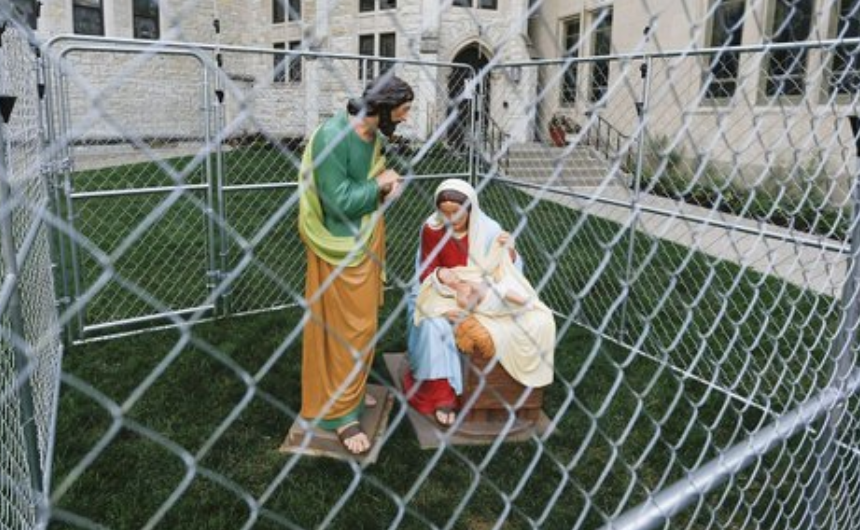
Baby Jesus, Mary and Joseph in a cage?

Everyone seems to talking about that viral religion story, as The Tennessean faith reporter Holly Meyer points out. 

In case you missed it, the Indianapolis Star reports that the three biblical figures "were incarcerated behind a barbed wired-topped, chain link fence on the lawn of Monument Circle's Christ Church Cathedral on Tuesday."

The reason:

The Rev. Stephen Carlsen, dean and rector of Christ Church, said the caged Holy Family is a protest to President Donald Trump's zero-tolerance policy that is holding families in detention centers at the U.S.-Mexico border.

"I know what the Bible said," Carlsen said. "We're supposed to love our neighbors as ourselves."

It's a fascinating story, and I'd urge you to check it out. But for the purposes of this post, I have a side question: Which version of the Bible should a news organization quote in a story such as this?

I'll admit surprise at the one the Gannett newspaper chose to quote:

The Rev. Lee Curtis, who came up with the idea for the demonstration, said the Biblical trio was a family of refugees seeking asylum in Egypt after Jesus' birth. 

"An angel of the Lord appeared to Joseph in a dream, saying, 'Arise, take the young Child and His mother, flee to Egypt, and stay there until I bring you word; for Herod will seek the young Child to destroy Him,'" the Message Bible says in Matthew 2:13-14. "When he arose, he took the young Child and His mother by night and departed for Egypt."

"This family is every family, and every family is holy," Curtis said. 

For those not familiar with The Message, it's a contemporary version in modern English. The religion satire news site Babylon Bee has published stories such as "‘The Message’ Now Available In Popular Comic Sans Font" and "7 Updates ‘The Message’ Totally Needs." Among the proposed updates: Substituting all references to Jesus with "The J-Man." That gives some indication of how seriously (read: not) some take that translation.

I'm not sure I've ever seen The Message be the go-to version quoted in a news story. (I'll eagerly await all the links proving me wrong.) My first thought was perhaps the Star was trying to put the verses in language readers could understand.


Please respect our Commenting Policy

Washington Post Magazine examines a Lone Ranger church, without any help from experts

One of the tragic facts about religion is that true believers have been known to go off the rails. Sometimes they take groups of people -- large or small -- with them into various degrees of oblivion. When this happens, it is common for people outside of these groups to use the word "cult" -- one of the most abused words in the religion-news dictionary.

Long ago, I took a course in contemporary religious movements and "cults" as part of my graduate work in the Church-State Studies program at Baylor University. It was easy to see that the term "cult" is like the word "fundamentalist." One person's cult is another person's "sect" or another's freethinking religious movement.

But here is the crucial point I need to make, before we look at that massive Washington Post Magazine feature that ran under this headline: "The Exiles -- Former members say Calvary Temple in Virginia pressures people to banish loved ones. What happens to those who leave?"

People who study "cults" use this term in one of two ways. There are sociological definitions, usually linked to the work of prophetic figures who hold dangerous degrees of control over their followers. Then there are theological definitions linked to religious groups in which a leader has radically altered core, historic doctrines of a mainstream faith.

You will find all kinds of "cult" talk if you plug "Calvary Temple" and the name of its leader, the Rev. Star R. Scott, into an Internet search engine. However, veteran freelance writer Britt Peterson avoided this term, for the most part, in this feature. I think that was wise.

Has this congregation in Northern Virginia evolved into a pseudo-cult operation? I don't know. What I do know is that it appears to be a perfect example of a trend in American Pentecostal and evangelical life that causes all kinds of trouble for journalists. I am referring, once again, to the rising number of independent churches -- large and small -- that have zero ties to any denomination or traditional faith group.

Many of these Lone Ranger churches are perfectly healthy. Many others go off the rails and, tragically, there is no shepherd higher up the ecclesiastical ladder to hold their leaders accountable. Thus, here is the crucial passage in this first-person magazine feature:

When the Azats joined Calvary in the mid-1980s, its charismatic pastor, Star Robert Scott, had been there for over a decade, starting as youth pastor at what was then the Herndon Assembly of God in 1973, according to former congregants.


Please respect our Commenting Policy

Friday Five: BYU conference, border separation, McCarrick scandal, Chris Pratt on MTV and more

I'm filing this edition of Friday Five from Provo, Utah, where I've spent the week attending — and speaking on a few panels — at Brigham Young University's Religious Freedom Annual Review.

In case you missed it Thursday (and based on our analytics, most of you did), GetReligion editor Terry Mattingly and I were part of a diverse group of journalists and attorneys who spoke on "Getting It Right, Media Coverage of Religion Freedom."

Check out my post to watch a video of that presentation, which includes The Atlantic religion journalism superstar Emma Green and other experts. As a bonus, you can see my Twitter thread that includes tmatt's "Seven Deadly Sins of the Religion Beat."

Now, let's dive into the Friday Five:

1. Religion story of the week: The controversy over the separation of families at the U.S.-Mexico border is the easy choice this week. 

Tennessee religion writer Holly Meyer, writing for The Commercial Appeal of Memphis, produced a compelling piece on ministry leaders who say the Bible compels their immigration work.

For more links and analysis, see our earlier posts headlined "Horror on the border: Some journalists starting to spot old cracks in Trump's support" and "Seven can't-miss takes on use of Romans 13 to defend policy on separating immigrant families."


Please respect our Commenting Policy

Horror on the border: Some journalists starting to spot old cracks in Trump's support

Remember that "lesser of two evils" theme in some of the coverage of Donald Trump's run for the White House?

The whole idea was that there were quite a few religious believers -- evangelicals and Catholics alike -- who were not impressed with The Donald, to say the least. However, they faced a painful, hellish decision in voting booths because the only mainstream alternative to this bizarre GOP candidate was Hillary Rodham Clinton, someone whose record on religious liberty, right-to-life issues, etc., etc., was truly horrifying.

Thus, that lesser-of-two-evils equation or, as a prophetic Christianity Today piece put it: "Most Evangelicals Will Vote Trump, But Not For Trump." Here at GetReligion, I addressed this pre-election trend here: "Listen to the silence: It does appear that most evangelicals will reluctantly vote Trump."

Now, ever since, I have urged journalists to look for the old cracks inside the evangelical and Catholic support for Trump. Yes, lots of white evangelicals were part of Trump's early base during the primaries. But just as many voted for him on election day while holding their noses (or while carrying a barf bag). At some point, I have argued, journalists could look for these cracks and find important stories.

This brings me to that New York Times headline the other day: "Conservative Religious Leaders Are Denouncing Trump Immigration Policies."

Conservative religious leaders who have long preached about the sanctity of the family are now issuing sharp rebukes of the Trump administration for immigration policies that tear families apart or leave them in danger.

The criticism came after recent moves by the administration to separate children from their parents at the border, and to deny asylum on a routine basis to victims of domestic abuse and gang violence.

Some of the religious leaders are the same evangelicals and Roman Catholics who helped President Trump to build his base and who have otherwise applauded his moves to limit abortion and champion the rights of religious believers.


Please respect our Commenting Policy

Seven can't-miss takes on use of Romans 13 to defend policy on separating immigrant families

Move over, Two Corinthians.

There's a new Bible reference making lots of headlines: Romans 13.

Who knew that Donald Trump and his administration would bring such attention to Scriptures?

In case you somehow missed this controversy, here are the basic details via The Associated Press:

WASHINGTON (AP) — Attorney General Jeff Sessions cited the Bible on Thursday in his defense of his border policy that is resulting in hundreds of immigrant children being separated from their parents after they enter the U.S. illegally.

Sessions, speaking in Fort Wayne, Indiana, on immigration, pushed back against criticism he had received over the policy. On Wednesday, a cardinal in the Roman Catholic Church said that separating mothers from their babies was “immoral.”

Sessions said many of the recent criticisms were not “fair or logical and some are contrary to law.”

“I would cite you to the Apostle Paul and his clear and wise command in Romans 13, to obey the laws of the government because God has ordained them for the purpose of order,” he said. “Orderly and lawful processes are good in themselves and protect the weak and lawful."

Sessions' remarks — coupled with White House press secretary Sarah Huckabee Sanders' declaration that "it is very biblical to enforce the law" — have sparked a wave of press attention exploring the meaning and history of Romans 13.

For those interested in insightful, enlightening coverage, here are seven can't-miss links:


Please respect our Commenting Policy

BBC puts half the facts in its Trinity Western lede, adding note of confusion to this story

When you look at prestige brand names in the world of news, it's hard to find institutions that can match the global impact of The New York Times and BBC News.

Journalists here in America are constantly aware of the impact of the Times, in terms of shaping the priorities of other newspapers from coast to coast. It's hard to find a small circle of journalists with more power than the editors who decide what goes on A1 in the Times.

However, anyone who has traveled around the world and gazed at hotel-room televisions knows that the BBC is omnipresent and very powerful just about everywhere.

Thus, let me add an editorial note to my GetReligion colleague Julia Duin's report -- "Trinity Western law school gets nixed, while the Canadian news coverage is mixed" -- focusing on how Canadian journalists covered the Trinity Western University decision at the Supreme Court of Canada.

In particular, I would like to focus on how this short report produced by the gatekeepers at the BBC handled a key detail in the community covenant (or as the CBC described it, the "so-called community covenant") that defines the doctrinal standards that guide life on that evangelical Protestant campus.

The headline on this report is certainly blunt, but it is accurate: "Canada's Supreme Court rules LGBT rights trump religious freedom." This brings us to the story's lede:

Canada's top court has ruled in favour of denying accreditation to a Christian law school that banned students from having gay sex.

Now, let me say right up front that this statement is accurate, sort of, and half-way true.


Please respect our Commenting Policy

Attention media folks: That White House PR event upset many on Southern Baptist right

To understand what's happening at the top of the Southern Baptist Convention these days, you really have to be willing to believe that, in the end, many religious believers truly believe that religious doctrine matters more than partisan politics.

Yes, I know. The headlines insist otherwise. Headlines tend to increase a few picas in size the minute the word "evangelicals" gets connected to the words "Donald Trump."

Here's a case in point. This past week, The New York Times basically ignored the dramatic national meeting of the Southern Baptist Convention -- with lots of developments linked to women and Baptists of color -- until it was possible to write a story with this headline: "Pence Reaches Out to Evangelicals. Not All of Them Reach Back."

But, hey, at least that one story did make an important point: One of the crucial tensions inside this particular SBC gathering was between clashing camps of solid "evangelicals." Actually, lots of people on both sides of that SBC debate about the Pence appearance would, under other circumstances, be called "fundamentalists" in the sacred pages of the Times.

This brings me to this weekend's think piece, which was written by Jonathan Leeman, editorial director of the 9Marks Journal and an active leader at Capitol Hill Baptist Church in Washington, D.C. He is also the author of a new book entitled, "How the Nations Rage: Rethinking Faith and Politics in a Divided Age."

The headline: "Truth, Power, and Pence at the SBC." Here's how this essay opens: 

I’m sitting here at the Southern Baptist Convention. Earlier today Vice President Mike Pence addressed the convention. We were told he initiated the offer to speak. I wish we had not accepted.

Don’t misunderstand. I’m grateful to God for our nation. I want him to bless it. But here’s a question for my fellow Southern Baptists and evangelicals more broadly: can you name a place in the Bible where God sends a ruler of a (non-Israelite) nation to speak to God’s people? Is the pattern not just the opposite?

Now, what's this all about? Is it a missive from a "moderate" (which means "liberal," in current SBC speak) at an urban church in a blue-zip DC zip code within shouting distance of the Capitol dome? 


Please respect our Commenting Policy

What did America’s three founding presidents believe about religion?

What did America’s three founding presidents believe about religion?

THE QUESTION:

Here’s one for July 4th:  What were the religious beliefs of the three founding presidents of the United States, George Washington, John Adams and Thomas Jefferson?

THE RELIGION GUY’S ANSWER:

The Fourth of July, 1826, the 50th anniversary of American independence, was the date when both John Adams and Thomas Jefferson died.

What were the odds?! The two served on the five-man Continental Congress committee responsible for the Declaration of Independence, and Adams, who recognized Jefferson’s golden pen, ensured that his younger colleague would be the author.

The immortal prose had a distinctively religious flavor, with non-sectarian affirmation of peoples’ unalienable human rights that were “endowed by their Creator,” citation of the laws bestowed by “nature’s God,” appeal to “the Supreme Judge of the world,” and with “firm reliance on the protection of divine Providence” during the improbable and risky rebellion against mighty Britain.

These two Founders coincided otherwise in life, as in death. Adams was the nation’s first vice president and Jefferson its first secretary of state in the administration of the first president, George Washington. Adams was then elected president in 1796 with runner-up Jefferson as his vice president. After the nasty 1800 campaign, during which Jefferson was assailed as a religious infidel, he turned the tables and defeated the incumbent Adams.

Adams was so furious he even boycotted Jefferson’s inauguration. Though these allies of independence had become fierce rivals, they reconciled later in life and exchanged fascinating letters that enrich the recent book “Friends Divided: John Adams and Thomas Jefferson” (Penguin) by prize-winning Brown University historian Gordon S. Wood.


Please respect our Commenting Policy

Whoa! You mean Southern Baptist 'messengers' are not of one mind on Trump-era life?

Well now. It appears we have a 2018 Southern Baptist Convention angle that will draw news coverage, maybe even from TV networks, since many newsroom managers weren't interested in America's largest Protestant flock wrestling with domestic violence and sexual abuse.

In other words, the Donald Trump angle has arrived -- with Vice President Mike Pence's appearance at the gathering in Dallas. And here is the shocker! It appears that not all Southern Baptists are united when it comes to baptizing their faith in partisan politics. You mean there are divisions among evangelicals in the age of Trump? 

There must be, because I read it in The Washington Post. But hold that thought, because I have a bit of picky religion-beat business to handle first.

If you've covered SBC life for a couple of decades, you know that SBC leaders really need to post a sign over the press facilities at this event that screams: "HEY! The people at this convention are MESSENGERS, not DELEGATES! Please get that right."

Why is this particular burr under the journalism saddle bother Southern Baptists so much? 

The bottom line: The Southern Baptist Convention is a convention, not a denomination. It exists when it's in session, with "messengers" from its rather freewheeling local congregations. In other words, this "convention" is not a formal "denomination" structured like those dang (Baptist speak there) Episcopalians, Presbyterians, United Methodists and what not.

There's even a FAQ book to help reporters handle these kinds of questions, for sale right here. Item No. 1? 

Who are the messengers? They are the folks who actually compose the convention when it meets. Why “messengers” and not “delegates”? Read the book. 

A decade or so ago, Baptist Press published an "Understanding the SBC" piece that noted:

Southern Baptist churches meet annually in convention. They do so by electing “messengers” who attend the Convention, and participate in the business of the Convention. In Southern Baptist parlance, representatives from churches are “messengers,” not “delegates.” Theoretically, they bring no authority from the churches over the Convention, and they take no authority from the Convention back to the churches. ...

Each Southern Baptist church can send as many as ten messengers to this annual convention meeting. The cap on the number of voting messengers is intended to ensure equality of small and large congregations alike.

Now, back to what really matters these days -- Trump-era political shouting. The headline on the relevant Washington Post piece proclaims: "Why Southern Baptists giving Mike Pence a platform is so controversial."


Please respect our Commenting Policy