Politics

Reality on bloody ground: That Pentecost massacre in Nigeria wasn't all that unusual

Reality on bloody ground: That Pentecost massacre in Nigeria wasn't all that unusual

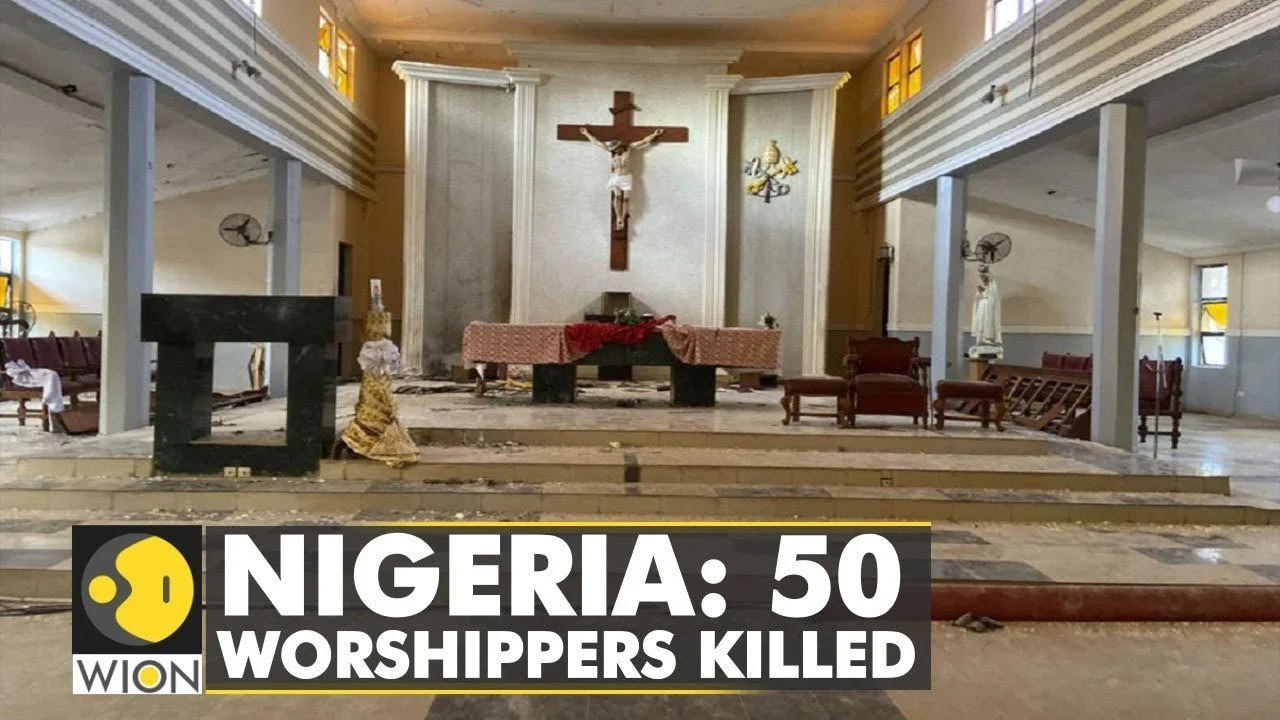
The massacre occurred during a Sunday Mass, but it wasn't an ordinary Sunday -- this was the great feast of Pentecost, which marks the end of the Easter season.

What's more, the gunmen didn't strike in tense northern Nigeria, where Christian communities are isolated in a majority-Muslim region. This 30-minute attack was inside St. Francis Catholic Church, located in the safer southwestern state of Ondo.

While 40 worshippers were confirmed dead, including five children, the number was almost certainly higher since many families buried their dead privately. Another 100 were wounded.

The scope of this attack was "unique," especially in southern Nigeria, but "this violence … was not unique in its occurrence," stressed Stephen Rasche, senior fellow at the independent Religious Freedom Institute in Washington, D.C. "These types of murders are taking place weekly, almost daily, in Nigeria -- murders of innocent Christians, being gunned down, slaughtered indiscriminately, throughout the north and, increasingly, into the central part of Nigeria and into the south."

Human-rights activists are trying to document the bloodshed. According to the nondenominational watchdog group Open Doors, the 4,650 Christians killed in Nigeria during 2021 accounted for 80% of such deaths worldwide -- nearly 13 per day. Nigeria's Christian death toll has topped 60,000 over the past two decades.

Nevertheless, this year's International Religious Freedom Report from the U.S. State Department said the "Secretary of State determined that Nigeria did not meet the criteria to be designated as a Country of Particular Concern for engaging in or tolerating particularly severe violations of religious freedom or as a Special Watch List country for engaging in or tolerating severe violations of religious freedom."

It's understandable that news reports about Nigeria have faded, in part because of Russia's invasion of Ukraine and pressing global economic issues, said Rasche, who visited Nigerian churches during this Holy Week and Easter.

Also, many Western leaders view atrocities in Nigeria as clashes between Christian farmers and Muslim cattle herders, with climate-change issues erasing safety zones between these groups.

Please respect our Commenting Policy

Gen Z and trends in religious faith and practice: Looking at 2021 and beyond

Gen Z and trends in religious faith and practice: Looking at 2021 and beyond

It’s been nearly two years since I’ve written a post about the precarious religious position of Generation Z (those born after 1995), and with data from late 2021 available it seems like a prime opportunity to update what we know about their religious inclinations.

Because almost all surveys only contact adult Americans (18+), we can’t get a full picture of the entirety of Gen Z, but just the oldest members of this generation. Thus, here I am analyzing those between the ages of 18 and 25 years old.

Let’s start broadly, comparing the religious composition of different generations beginning with the Silent Generation (who were born between 1925 and 1945).

In this generation, half of all respondents indicated that they were Protestant, while 22% said that they were Catholic. Just 8% of the Silent Generation say that they were atheists or agnostics and nearly the same share describe their religion as “nothing in particular” (10%). In sum, the oldest Americans are 72% Christian and 18% none.

Now, for Generation Z things are much different.

Just 22 % of the youngest adults describe themselves as Protestant — a more than 50% decline from the Silents. Catholics make up 14% of Gen Z, an eight percentage-point dip from the Silent Generation.

Of course, the share of nones is much larger. Seventeen percent of young people describe their religion as atheist or agnostic, and 31% say that they are attached to no religion in particular. Taken together, 36% of Gen Z are Christians, while 48% are nones.

For journalists, there is the news hook: This is the first generation in history in which the nones clearly outnumber the Christians.


Please respect our Commenting Policy

Podcast: What happens at Calvin doesn't stay at Calvin. True, so what now for LGBTQ wars?

Podcast: What happens at Calvin doesn't stay at Calvin. True, so what now for LGBTQ wars?

Back in the spring, we did a GetReligion podcast that was accompanied by a post with this title: “What parents (and journalists) can learn from LGBTQ debates at Calvin.

The Big Idea in that podcast was that Calvin University isn’t just another Christian college — it’s the base camp for a kind of Reformed intellectual A-team that punches way, way, way above its weight in the Council For Christian Colleges and Universities (the global network in which I worked and taught for a quarter of a century or so). Thus, I stated: “What happens at Calvin doesn’t stay at Calvin.”

If you have followed Calvin closely in recent decades, you know that a significant chunk of its faculty believes (this is my summary) that those who truly honor and teach the great Reformed Tradition of Calvinism know that it’s time for new Reformers (that would be them) to reform the out-of-date theological conclusions of their ancestors. You can see similar streams of thought among Methodists, Anglicans, Catholics and even (in a few zip codes) the Eastern Orthodox.

With that in mind, it’s time for this week’s “Crossroads” episode (CLICK HERE to tune that in), which offers an update on Calvin and tensions inside its denomination, care of a Religion News Service story with this headline: “Christian Reformed Church codifies homosexual sex as sin in its declaration of faith.” Actually, if you read carefully, the CRC affirmed 2,000 years of Christian teaching that (a) sex outside of marriage is a sin and (b) Christian marriages unite a man and a women. Here is the overture of that RNS story:

(RNS) — The Christian Reformed Church, a small evangelical denomination of U.S. and Canadian churches, voted … at its annual synod to codify its opposition to homosexual sex by elevating it to the status of confession, or deration of faith.

The 123-53 vote at Calvin University in Grand Rapids, Michigan, caps a process begun in 2016 when a previous synod voted to form a study committee to bring a report on the “biblical theology” of sexuality.

The vote, following a long day of debate, approves a list of what the denomination calls sexual immorality it won’t tolerate, including “adultery, premarital sex, extra-marital sex, polyamory, pornography and homosexual sex.”

“The church must warn its members that those who refuse to repent of these sins — as well as of idolatry, greed, and other such sins — will not inherit the kingdom of God,” the report says. “It must discipline those who refuse to repent of such sins for the sake of their souls.”

Just asking: That “what the denomination calls” language is interesting. Doesn’t that kind of imply that these teachings belong to the CRC alone — as opposed to being doctrines affirmed by the world’s largest Christian bodies, such as the Roman Catholic Church, Eastern Orthodoxy, Third World Anglicans and most evangelical and Pentecostal believers.


Please respect our Commenting Policy

What's news? Attacks on Christians in Nigeria provide an important case study

What's news? Attacks on Christians in Nigeria provide an important case study

As an undergrad, The Religion Guy took a valuable course titled “Evaluation and Display of News,” an elemental skill for journalists who cope with difficult choices.

Take the Johnny Depp-Amber Heard trash-a-thon. Please. Just as car crashes produce rubbernecking, “human interest” justified vast voyeurism that fed the market and stole print space and air time from more substantive stories.

Editors’ tendentious coverage decisions continually erode public trust in the media. Liberal outlets give scant play to the assassination plot against Brett Kavanaugh, harassment of other Supreme Court justices and their families and related attacks on a couple dozen pro-life agencies. Meanwhile, conservatives downplay the near-miss danger to Vice President Mike Pence and other high officials amid the January 6 attempt to block the Constitution’s election process.

The Guy could list other examples from both sides, and so could you.

Let’s leap across the Atlantic to assess neglectful news judgment regarding the important plight facing Christians in Nigeria. Their continual conflict with Muslim jihadi factions has left an estimated 37,500 dead since 2011, says the latest annual report (.pdf here) from the U.S. Commission on International Religious Freedom (www.uscirf.gov; contact media@uscirf.gov or 202–523–3240).

The nondenominational watchdog group Open Doors USA says that in 2021“more Christians were murdered for their faith in Nigeria than in any other country,” making up nearly 80% of Christian deaths worldwide. Nigeria is the “most dangerous place to be a Christian” in the world, says the Intersociety for Civil Liberty and Rule of Law, a Nigerian human rights monitor. Christian observers speak openly of “genocide.”

In addition to the deaths, it’s all but impossible to count up the maimed victims who’ve survived, the kidnapped schoolchildren and clergy, forced child marriages and forced conversions or the widespread destruction of Christians' churches, homes, shops and even whole villages.

Sounds like compelling news from here.


Please respect our Commenting Policy

Another SCOTUS win for 'equal access,' whether most journalists realized this or not

Another SCOTUS win for 'equal access,' whether most journalists realized this or not

For a decade or more, U.S. Supreme Court justices have been arguing about the separation of church and state. What we keep seeing is a clash between two different forms of “liberalism,” with that term defined into terms of political science instead of partisan politics.

Some justices defend a concept of church-state separation that leans toward the secularism of French Revolution liberalism. The goal is for zero tax dollars to end up in the checkbooks of citizens who teach or practice traditional forms of religious doctrine (while it’s acceptable to support believers whose approach to controversial issues — think sin and salvation — mirror those of modernity).

Then there are justices who back “equal access” concepts articulated by a broad, left-right coalition that existed in the Bill Clinton era. The big idea: Religious beliefs are not a uniquely dangerous form of speech and action and, thus, should be treated in a manner similar to secular beliefs and actions. If states choose to use tax dollars to support secular beliefs and practices, they should do the same for religious beliefs and practices.

At some point, it would be constructive of journalists spotted these “equal access” concepts and traced them to back to their roots in the Clinton era (and earlier). But maybe I am being overly optimistic.

You can see these tensions, kind of, in the Associated Press coverage of the new SCOTUS decision that addressed a Maine law that provided tax funds for parents who chose secular private schools, but not those who chose religious schools. The headline of the main report stated, “Supreme Court: Religious schools must get Maine tuition aid.”

Chief Justice John Roberts wrote the opinion for the majority in this 6-3 ruling. In this story, “liberal” is used to describe the majority.

“Maine’s ‘nonsectarian’ requirement for its otherwise generally available tuition assistance payments violates the Free Exercise Clause of the First Amendment. Regardless of how the benefit and restriction are described, the program operates to identify and exclude otherwise eligible schools on the basis of their religious exercise,” Roberts wrote.

The court’s three liberal justices dissented. “This Court continues to dismantle the wall of separation between church and state that the Framers fought to build,” Justice Sonia Sotomayor wrote.


Please respect our Commenting Policy

What happens after Anaheim '22? That will unfold in pulpits, pews and big SBC institutions

What happens after Anaheim '22? That will unfold in pulpits, pews and big SBC institutions

Before the Southern Baptists Convention's strong vote to approve what supporters called "bare minimum" sexual-abuse reforms -- with victims in the crowd weeping with relief -- there was a strategic amendment to the recommendations.

Rather than stay with the independent Guidepost Solutions organization, the Abuse Reform Implementation Task Force would seek to use "best practices in keeping with Southern Baptist church polity," while a "Ministry Check" website tracking those "credibly accused" of abuse would be "established and maintained by an independent contractor."

Activist Rachel Denhollander pleaded, before the vote: "Institutions must be held accountable. It doesn't matter who they are. Justice and truth are always what we should pursue."

Afterwards, the attorney and #ChurchToo abuse survivor posted another challenge on Twitter: "It is the first, most basic steps. But it is a testament to the survivors who fought so long and so hard. I am grateful. Now let's keep working."

That work will depend on the cooperation of pastors and church leaders in the SBC's 47,000 local churches, as well as the administrators and trustees of agencies, boards, seminaries and other institutions at the state and national levels.

The bottom line: In Southern Baptist "polity" -- with sprawling structures of autonomous congregations that, to varying degrees, fund state, national and global ministries -- there are no leadership structures resembling local Presbyterian presbyteries, regional annual conferences among United Methodists or the powerful diocesan structures of Catholics, Episcopalians and others. Local churches ordain, hire and fire clergy.

Outsiders often struggle to understand the theological and practical implications of Baptist polity, said Thomas Kidd, who teaches church history at Midwestern Baptist Theological Seminary and Baylor University.

"Many people continue to think that the SBC can make its churches do this or that or the other and that simply isn't true," he said.


Please respect our Commenting Policy

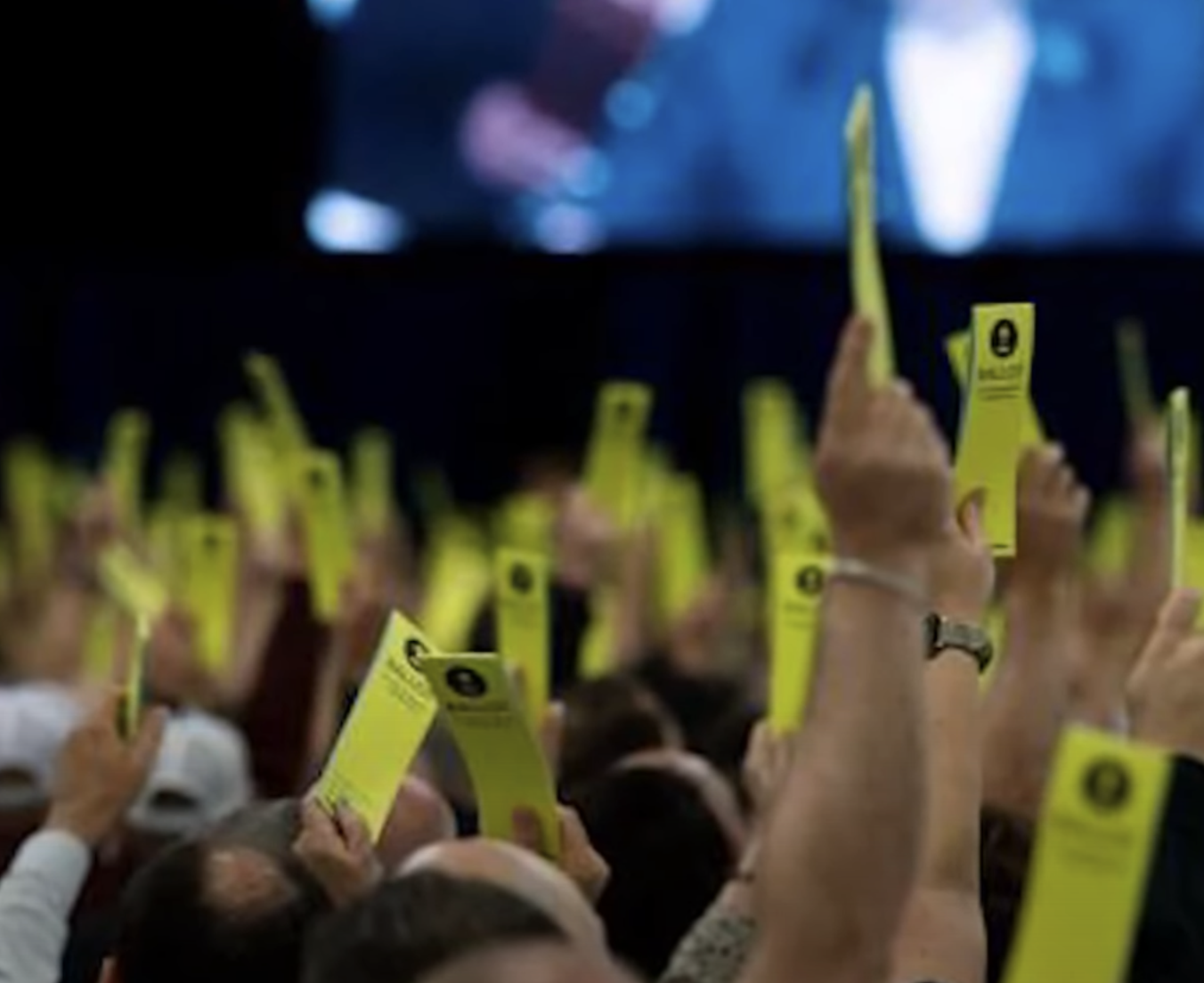
Podcast: Now what, after SBC 'messengers' have waved their yellow voting cards?

Podcast: Now what, after SBC 'messengers' have waved their yellow voting cards?

Here’s a warning to reporters who are preparing for future national meetings of the Southern Baptist Convention: Never call these folks “delegates.”

They are not delegates at some kind of political event. They are “messengers” from their local autonomous churches. You see, this isn’t some kind of cocktail-hour mainline Protestant denominational whatever, and many Baptists don’t like the word “denomination,” either. This is a “convention” and it only meets for three days each year.

Use the wrong language and Southern Baptists will give you a steely gaze and then say something nasty, like “Well, bless your heart.”

Quite a few journalists attended this year’s SBC meeting because there were headline-worthy — from their editors’ point of view — topics on the agenda, like clergy sexual abuse, Critical Race Theory and an election to determine if some new-breed conservative “pirates” (that was their term from 2021) were going to wrest the wheel of the ship away from the allegedly “woke” establishment conservatives.

As you would imagine, host Todd Wilken and I dug into all of this during the “Crossroads” podcast this week (CLICK HERE to tune that in). One of the big themes was that the hard-news coverage of this convention — especially by “Location, location, location” pros from major SBC centers, like Houston and Nashville — was top-notch.

Veteran GetReligion scribe Bobby “Positive” Ross, Jr., will offer pages of URLs in his Plug-In feature this week, so I will not try to do that (I’ll post a link when it goes public). But this is what happens when major newsrooms send religion-beat professionals to cover a major event. Readers don’t have to agree with every single thing that they saw in the #SBC2022 coverage, but what we had here was a tsunami of serious coverage from professionals, backed by the skilled Baptist Press team running the on-site newsroom.

With that in mind, let me note a Big Ideas from this podcast.

* If you study attendance numbers at previous “hot” SBC meetings, you will notice a logical trend linked to a map of the Bible Belt. In this online list, note the 1985 Dallas convention drew 45,519 messengers and the 1986 Atlanta convention drew 40,987.

Yes, these were the pivotal years in the historic “conservative resurgence” in SBC life. But, truth is, those numbers also reflect how far ordinary messengers can drive in one day jammed into the buses or vans owned by “ordinary” SBC congregations.


Please respect our Commenting Policy

Nowhere to hide: Los Angeles Times hit job focuses on one side of Biola University tensions

Nowhere to hide: Los Angeles Times hit job focuses on one side of Biola University tensions

If you have followed trends in academic and student life at Biola University over the past 25 years or so — I have spoken there about 10 times in that period — you know that this is a complex campus, with all kinds of divisions on theological, moral, political and cultural issues.

As a rule, campus administrators there are just as uncomfortable with strong conservative voices as they are with candid evangelical progressives. Thus, all kinds of Biola believers have learned to state radically different convictions in language that can be called “evangelical” to one degree or another. The goal is to keep painful fights out of publications read by parents, donors and even trustees.

It’s important to keep this in mind while reading the Los Angeles Times morality-tale sermon that ran the other day with this headline: “CRT, Trumpism and doubt roil Biola University. Is this the future of evangelical Christianity?” The headline failed to include the key issue in this story — clashes over the validity of 2,000 years of Christian doctrine on sexuality and marriage.

For additional insights on political and theological diversity found Christian campuses, it will help to read this classic 1995 essay at The Atlantic — “The Warring Visions of the Religious Right” — by the liberal Baptist scholar Harvey Cox of Harvard Divinity School (author of the ‘60s bestseller, “The Secular City”).

Oh, and speaking of liberal Baptist scholars, one of the defining voices in the new Los Angeles Times feature is David Gushee of Mercer University. It was totally valid to include his voice in this story, but it was interesting that he is quoted as a neutral academic expert on these matters, as opposed to being an articulate spokesman for activists on one side of the doctrinal war being covered in this story.

After all, it was Gushee who opened a classic 2016 essay for Religion News Service with these lines:

Middle ground is disappearing on the question of whether LGBT persons should be treated as full equals, without any discrimination in society — and on the related question of whether religious institutions should be allowed to continue discriminating due to their doctrinal beliefs.

It turns out that you are either for full and unequivocal social and legal equality for LGBT people, or you are against it, and your answer will at some point be revealed. This is true both for individuals and for institutions.

Neutrality is not an option. Neither is polite half-acceptance. Nor is avoiding the subject. Hide as you might, the issue will come and find you.

Thus, the Los Angeles Times has come to confront the leaders of Biola University.


Please respect our Commenting Policy

As Roe clock ticks, press avoids news about another big story -- attacks on Catholic churches

As Roe clock ticks, press avoids news about another big story -- attacks on Catholic churches

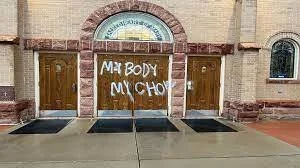
There have been at least 41 incidents of attacks against churches and crisis-pregnancy facilities since the May 2 leak of the Supreme Court draft decision that revealed the potential fall of Roe v. Wade.

The attacks have included property theft, vandalism, arson and property destruction.

How do we know this? A front page New York Times investigation this past Sunday?

No.

A round-up story in The Washington Post, USA Today, the Associated Press? Coverage on CBS, CNN or another major network?

No, no, no and, alas, no.

We know this because of The Washington Stand, which is described as the Family Research Council’s “outlet for news and commentary from a biblical worldview.” In other words, these events are “conservative” niche news (as opposed to, let’s say, attacks on “sanctuary movement” churches because of their activism on immigration).

This awful trend should come as no surprise. At least it wasn’t to me. I wrote a story recently at Religion Unplugged on the rash of vandalism — especially acts against Catholic churches — throughout this spring. I opened my news account with the theft of a tabernacle at a Brooklyn, N.Y., church (see this related GetReligion piece). Here’s an excerpt from my piece:

The desecration was the latest in a string of incidents across the United States, triggering fears of future vandalism given the supercharged political climate around abortion, LGBTQ rights and bishops denying politicians Communion.

The vandalism may not necessarily be tied to one or more of these factors — rising crime rates is also a possibility in the wake of the pandemic — but church officials remain vigilant as the summer approaches. While the motivations remain a mystery, the outcome has rattled Catholic churches across the country. Some have resorted to increased security measures, like locking doors when Masses aren’t taking place, installing security cameras and even erecting barbed wire and fences to avoid being targeted.

As we await a final Supreme Court ruling, we could be in for a long summer of violence and vandalism.

My criticism here is not in the news coverage this issue has received. Instead, it’s the lack of coverage.


Please respect our Commenting Policy