Politics

New York Times dares to interview Stephen Strang, a major player in Pentecostal media

New York Times dares to interview Stephen Strang, a major player in Pentecostal media

On the Sunday I was returning to the United States from an international trip, the New York Times ran a surprising story on a religion beat insider that, frankly, I never thought they’d touch.

All sorts of folks were sending me links to a business story on Stephen Strang, someone who is widely known in the charismatic universe but not so well known in wider Christian circles.

Yet, Times freelancer Sam Kestenbaum swooped down and delivered an informative, timely piece, which started as follows:

This spring, the media mogul Stephen E. Strang made an unusual apology to readers in the pages of his glossy magazine.

Mr. Strang presides over a multimillion-dollar Pentecostal publishing empire, Charisma Media, which includes a daily news site, podcasts, a mobile app and blockbuster books. At 70, he is a C.E.O., publisher and seasoned author in his own right. Despite all that, Mr. Strang worried something had gone awry.

“I’ve never been a prophet,” he wrote in a pleading March editor’s note. “But there were a number of prophets who were very certain that Trump would be elected.”

This had not come to pass. Mr. Strang continued, “I hope that you’ll give me the grace — and Charisma Media the grace — of missing this, in a manner of speaking.”

That was a back entrance into a story on the “Trump prophets,” which were dozens of well-known Pentecostal personalities who falsely prophesied that President Donald Trump would win a second term. Although a few apologized when it was clear Joe Biden would be taking the oath of office on Jan. 20, many refused, succumbing to fantasy theories that the election had been stolen.

(I’ve been covering the prophets story since late last year and earlier this year for GetReligion here, here and here, plus begging other religion writers to get up to speed with modern-day Pentecostalism and the way Pentecostals and their sister movement, the charismatics, was the spirituality of choice in the Trump White House.

Kestenbaum specializes in religion-news-of-the-weird pieces for the Times , and maybe, to him, Strang is weird. Oddly, the story (whose news hook is Strang’s newest book) ended up in the business section. My fav quote in the whole piece:

Mr. Strang seems to have discovered that one way to handle being publicly wrong is to change the subject and to pray readers stick around.

Yes, that’s what the whole prophecy movement has been doing since January. The next chunk of copy is the why-you-should-read-this part:

Beyond the spiritual test of unrealized prophecies, there are very earthly stakes here: Under Mr. Strang’s stewardship, Charisma had grown from a church magazine to a multipronged institution with a slew of New York Times best sellers, millions of podcast downloads and a remaining foothold in print media, with a circulation of 75,000 for its top magazine.

It is widely regarded as the flagship publication of the fast-growing Pentecostal world, which numbers over 10 million in the United States. With its mash-up of political and prophetic themes, Charisma had tapped a sizable market and electoral force. In 2019, one poll found that more than half of white Pentecostals believed Mr. Trump to be divinely anointed, with additional research pointing to the importance of so-called prophecy voters in the 2016 election.

His numbers are way too low; Pew Forum says charismatics and Pentecostals comprise about 23 percent (you heard that right) of the American population, so we’re talking about 65 million people. If that sounds like a lot of people, remember, this number includes charismatic Catholics.

As I read through the piece, I thought Kestenbaum hit it square on the nose many times.

Please respect our Commenting Policy

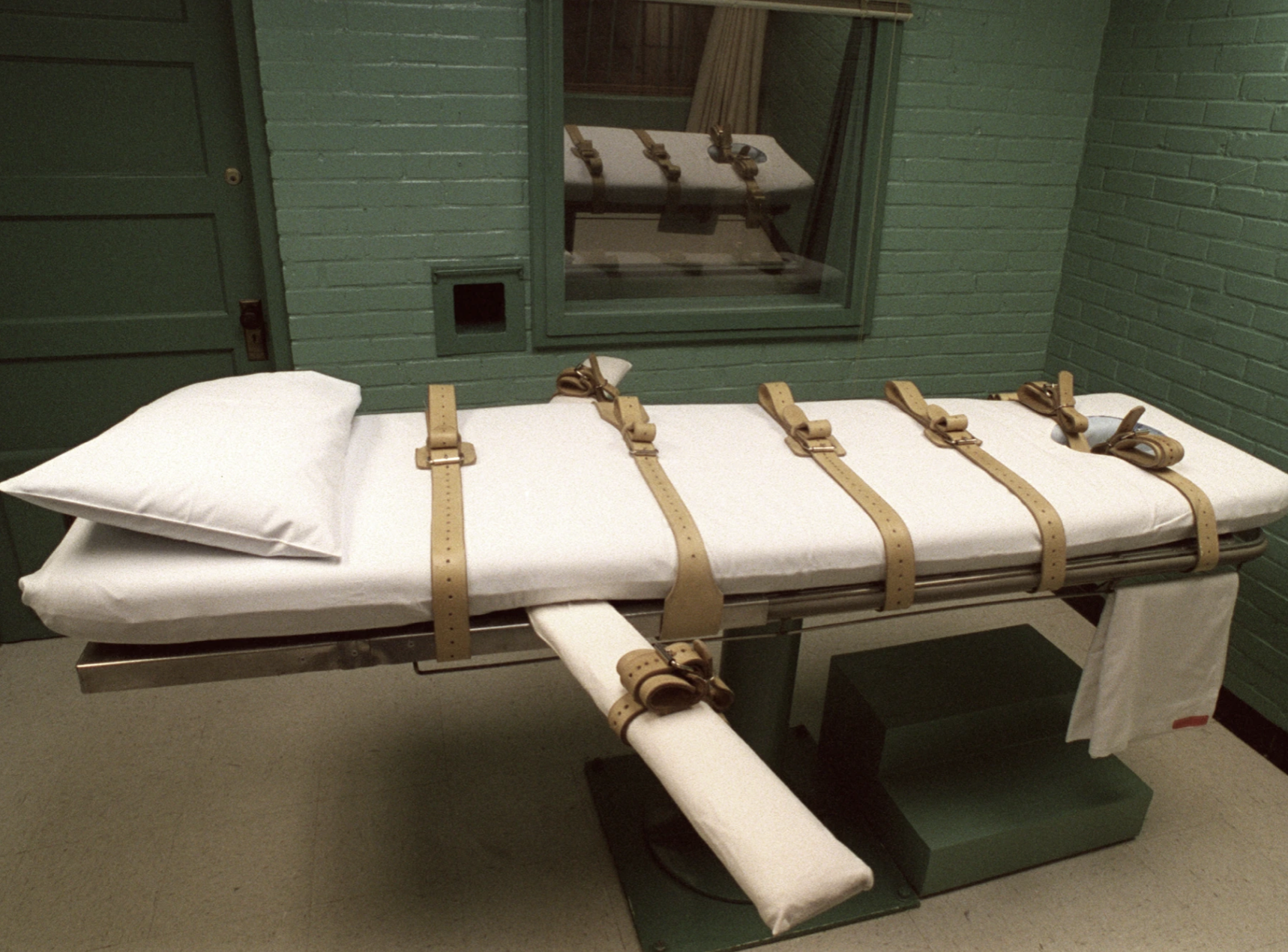
Thinking about prayers at executions: These stories offer glimpses of an old church-state unity

Thinking about prayers at executions: These stories offer glimpses of an old church-state unity

This is a “feeling guilty” post. For quite some time now, I have been planning to examine the coverage of some important religious-liberty cases that have been unfolding in the death-row units of prisons.

The decisions are worthy of coverage, in and of themselves. At the same time, these cases have demonstrated that it is still possible, in this day and age, for church-state activists on the left and right to agree on something. Maybe I should have put a TRIGGER WARNING notice at the start of that sentence.

Like I said the other day in this podcast and post — “Covering a so-called 'religious liberty' story? Dig into religious liberty history” — this kind of unity in defending religious freedom has become tragically rare (from my point of view as an old-guard First Amendment liberal). Indeed, to repeat myself, “America has come a long way since that 97-3 U.S. Senate vote to approve the Religious Freedom Restoration Act of 1993.”

The problem is that you rarely, if ever, see reporters catch this church-state angle in these decisions. The key is to look at who filed legal briefs in support of the religious liberty rights of the prisoners.

This brings me to an important Elizabeth Bruenig essay that ran the other day at The Atlantic, under this dramatic double-decker headline:

The State of Texas v. Jesus Christ

Texas’s refusal to allow a pastor to pray while holding a dying man’s hand is an offense to basic Christian values.

Here is the meaty overture:

Devotees to the cause of religious liberty may be startled to discover during the Supreme Court’s upcoming term that the latest legal-theological dispute finds the state of Texas locked in conflict with traditional Christian practice, where rites for the sick, condemned, and dying disrupt the preferences of executioners.


Please respect our Commenting Policy

New podcast: Covering a so-called 'religious liberty' story? Dig into religious liberty history

New podcast:  Covering a so-called 'religious liberty' story? Dig into religious liberty history

Believe it or not, America’s commitment to the First Amendment and religious liberty wasn’t dreamed up by the Religious Right.

However, at some point — mainly during press coverage of clashes between the Sexual Revolution and traditional forms of religion — religious liberty turned into “religious liberty” or even “so called ‘religious liberty’ ” and other language to that effect. America has come a long way since that 97-3 U.S. Senate vote to approve the Religious Freedom Restoration Act of 1993.

Now we are seeing waves of valid news coverage of religious liberty disputes linked to people seeking exemptions from mandates requiring COVID-19 vaccines. During this week’s “Crossroads” podcast (CLICK HERE to tune that in) I suggested that it would help for journalists to dig into the details of how courts have handled earlier religious liberty cases.

Consider this recent Washington Post headline, involving a White evangelical leader in Oklahoma: “This pastor will sign a religious exemption for vaccines if you donate to his church.” Here’s the overture:

A pastor is encouraging people to donate to his Tulsa church so they can become an online member and get his signature on a religious exemption from coronavirus vaccine mandates. The pastor, Jackson Lahmeyer, is a 29-year-old small-business owner running in the Republican primary challenge to Sen. James Lankford in 2022.

Lahmeyer, who leads Sheridan Church with his wife, Kendra, said Tuesday that in the past two days, about 30,000 people have downloaded the religious exemption form he created.

“It’s beautiful,” he said. “My phone and my emails have blown up.”

This minister isn’t alone in thinking this way. Here is a New York Daily News story about an African-American Pentecostal leader: “A Brooklyn preacher’s blessing is a pox upon his flock.”


Please respect our Commenting Policy

Latest angles on Trump-era 'evangelicals,' including questions about the vague label itself

Latest angles on Trump-era 'evangelicals,' including questions about the vague label itself

This Memo concerns not some breaking story but a potential scenario about U.S. "evangelical" Protestants that reporters on both the politics and religion beats should be watching.

For the umpteenth time we revisit the definition of this vibrant but challenged movement and its relation to a Republican Party that the secularized Donald Trump continues to dominate.

(See The Guy's effort at defining evangelicalism here, and remember that most media discussions involve White evangelicals only, since Black and Hispanic evangelicals are very different politically. And click here for a wave of tmatt posts on this topic.)

GetReligion team member Ryan Burge, an energetic political scientist who posts interesting data most days of the week, tweeted this chart on Sept. 16th showing how self-identified evangelicals described their own church attendance over a dozen years in Cooperative Election Study polling.

There's a clear developing trend. As recently as 2008, 58.6% of self-identified evangelicals said they worshiped weekly or more often, but less than half (49.9%) by 2020.

Over the same years, evangelicals who "seldom" or "never" attended grew from 16.1% to 26.7%. The slide did not begin with the Trump presidency but was already at work, since in 2016 the weekly-or-mores were down to 52.9% and seldom-or-nevers up to 22.6%.

The Guy considers attendance a good barometer of devotion, as a historically central value inside the evangelical subculture. We can speculate that similar downward slides might be occurring with other bonding activities in the evangelical tradition such as adult Bible classes, prayer meetings, small groups, daily devotions, evangelistic revivals and charity projects.

The numbers surely reflect the nation's 21st Century secularization. But Burge reaches the provocative conclusion that they mean evangelical "is not a religious term anymore." (What substitute word would suffice? There's a story theme for you.) Certain movement insiders have argued that a different label is needed because the term has taken on such a heavy Republican -- and Trumpublican -- flavor


Please respect our Commenting Policy

Why mainstream newsrooms can't be bothered to cover USCCB church vandalism report

Why mainstream newsrooms can't be bothered to cover USCCB church vandalism report

Abortion debates continue to dominate American politics. A Texas law banning most abortions after six weeks of pregnancy went into effect just three weeks ago, something that resulted in widespread national news coverage, with many of the stories showing familiar media-bias patterns.

Despite the 1973 Supreme Court decision that made abortion legal, this law makes attaining an abortion in Texas among the most restrictive in the country after the U.S. Supreme Court ruled 5-4 on Sept. 2 not to block it. This unleashed debate and further political animus between Democrats and Republicans as arguments over abortion in this country now stretch into a fifth decade.

The fallout from all this may have increased animosity against the Catholic church. The church’s stand — ancient and modern — against abortion has placed it at the forefront of this cause, along with many other traditional Christian denominations and organizations.

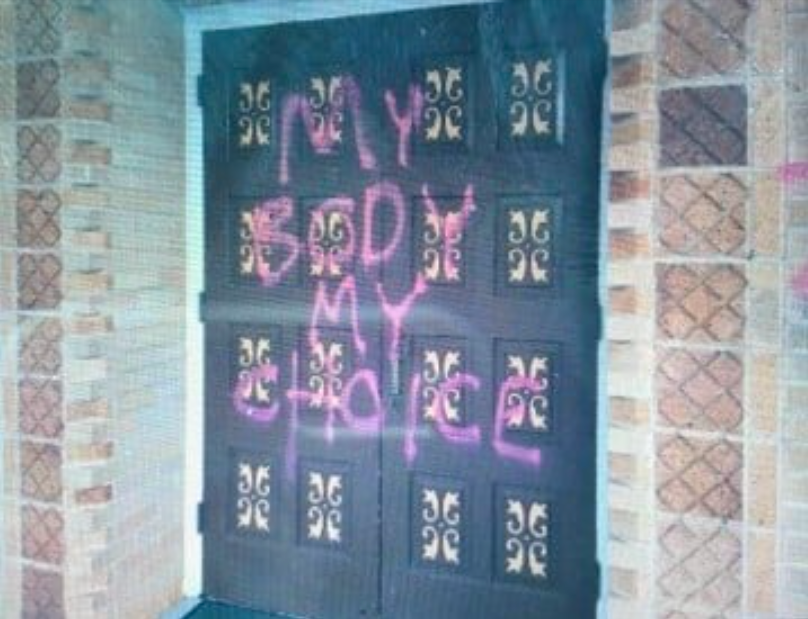
Some of this animosity has led to vandalism against U.S. churches. A Catholic church in Colorado was vandalized with graffiti showing support for legalized abortion days after the Supreme Court decision. This is how The Christian Post recently reported the story. This is long, but essential:

St. Louis Catholic Church, located in the Boulder suburb of Louisville, became the target of vandalism from abortion activists over the weekend. The doors to the church were spray-painted with the declaration “My body, My choice,” a common refrain among pro-choice activists. Church members discovered the graffiti when they gathered for worship on Sunday morning.

In addition to spraying the phrase “My body, my choice” on the church's doors, vandals targeted a marker on the property that read “Respect Life,” replacing the word “Life” with the phrase “Bodily Autonomy.” Additionally, the sign at the front of the church was defaced with the phrase “bans off our bodies.”

In a Facebook post on Monday, the Louisville Police Department noted that a surveillance camera recorded three individuals on the church property at 1:30 a.m. local time Sunday and asked the public for help with identifying them.

The Christian Post, as the name states, is a niche news source. The question here — once again — is why vandalism cases of this kind receive so little attention in the mainstream press.


Please respect our Commenting Policy

Francis tacks again: Did press catch pope's whole message on abortion and Eucharist?

Francis tacks again: Did press catch pope's whole message on abortion and Eucharist?

How does a ship’s captain sail against a headwind?

The maneuver is called “tacking” and it consists of steering the ship back and forth, at roughly 45 degree angles across the chosen course. The question — with all the left and right turns — is this: What is the course that runs through the middle? Where is the captain trying to go?

It’s impossible to figure that out by studying only the turns to the left or to the right. Dare I say that this task is even more difficult if the captain of the ship is a modern Jesuit?

So what was the course Pope Francis was trying to sail the other day during his in-flight Shepherd One press conference about abortion, Communion and the pastoral needs of Catholics (including, perhaps, powerful politicians)? In the mainstream press, the big turns were all to the left, with the pope warning U.S. bishops not to meddle in the state of President Joe Biden’s soul. Readers had to turn to Catholic publications to find any hint that Pope Francis was, perhaps, seeking a middle course.

This was best seen in the piece that ran in the “Politics Section” (#DUH) of the New York Times. The headline stated the basics:

Pope Weighs In on Calls to Deny Communion to Biden Over Abortion

“What must the pastor do?” Francis said when a reporter asked him about the subject. “Be a pastor, don’t go condemning.”

Everything readers needed to know, from the doctrinal point of view of the Times, was right up top:

ROME — Pope Francis weighed in on Wednesday on a debate roiling the Roman Catholic Church in the United States, where conservative bishops are pushing for guidelines that would deny communion to politicians, like President Biden, who support abortion rights.

“I have never refused the eucharist to anyone,” Francis said, though he added that he did not know of any instance when such a politician had come to him for communion.

Later, there was this:

“What must the pastor do?” he asked. “Be a pastor, don’t go condemning. Be a pastor, because he is a pastor also for the excommunicated.”


Please respect our Commenting Policy

Thinking with Ryan Burge (and one of his critics) about abortion and evangelical voting

Thinking with Ryan Burge (and one of his critics) about abortion and evangelical voting

If you follow political scientist Ryan Burge on Twitter (which you should do, of course), then you know that he sends out waves of poll information, creatively sifted, in the form of charts.

From time to time, people have been known to bounce questions back to him, seeking clarification or more specific numbers on some strange angle of the topic at hand. I confess that I have been known to do that.

Burge is relentlessly helpful in that online setting. However — imagine this — there are people who argue with him? On Twitter, of all places! Some disagree with his interpretations. On Twitter!

I’m being sarcastic, to make a point linked to this weekend’s pair of “think pieces.” I’m one of those guys who disagrees with Burge from time to time. That happens, when someone is delivering and then interpretting lots of information in a public forum. The difference with Burge is that he is relentlessly candid, even when dealing with numbers and trends that challenge lots of common news templates.

Recently, Burge wrote a commentary piece — backed with some of his charts — for Religion News Service, flashing back to some polling from 2018. The piece ran with this double-decker headline:

Abortion just isn’t the motivating issue for evangelicals it once was

Studies show white evangelicals, by and large, do not have a hard-line approach to abortion — other issues like immigration and race are taking priority over advocating for the unborn.

Whatever your stance on “life” issues, don’t you want to read more about that claim? Here is a key (and quite long) section of that:


Please respect our Commenting Policy

What's next in Afghanistan? Press will have to face issues of religion, culture and gender

What's next in Afghanistan? Press will have to face issues of religion, culture and gender

The headline on the National Catholic Register story is simple and timely: “Trapped by the Taliban, Praying for Escape from Afghanistan.

The reporting is simple, as well, as long as the journalists involved have established contacts with people inside Kabul who have smartphones and there are functioning cell towers and satellites. The story is built on people describing what they claim is going on around them, especially events affecting their families and friends.

These people are U.S. citizens, Afghans with U.S. “green cards” and others who cooperated with Western governments and agencies, including religious groups, during the 20 years of “nation building” in the war-torn land of Afghanistan.

The question is whether the contents of this story remain newsworthy, since Afghanistan has, for now, moved off the front burner in elite newsrooms. What happened? Clearly, Republicans and centrist Democrats had “pounced” on the topic while blasting President Joe Biden and his White House team.

But is this NCR piece news? Yes, it is. Also, this is a story journalists can study while looking for clues about realities, and news, at ground level in the Taliban’s new-old Afghanistan. Here is the overture:

For two decades, Sher Shah had worked alongside U.S. and Afghans to build a democratic country free from the Taliban and war. He had established a new life with his family in the U.S. with the help of Catholic Charities and a Catholic sponsor family, but briefly returned to Afghanistan this summer to attend his father’s funeral.

Now, he’s a man trying to escape the Taliban and get back home to the U.S.

More? Here is a claim — let me stress this is a CLAIM — coming from this source. But the Register report has other anonymous voices making similar statements in what appear to be telephone interviews or contacts via email.

U.S. Secretary of State Anthony Blinken has stated approximately 100 U.S. citizens and lawful permanent residents remain in Afghanistan. …

But Sher Shah said he has heard nothing from the State Department since Aug. 26 — and he made use of the State Department’s information posted on its website for U.S. citizens and lawful permanent residents stuck in Afghanistan.

“There are thousands of Americans still in Afghanistan,” he said. “And I’m one of them.”

The reality that emerges, in this stories and others, is that the United States and other Western forces were not engaged in 20 years of “nation building,” as in building an Afghanistan government that looked to the nation’s past — its monarchy, for example. It would be more accurate to say the goal was building a new culture, one that incorporated elements of modernity and even postmodernity in America and Europe.


Please respect our Commenting Policy

Are we finally witnessing the long-anticipated (by journalists) evangelical crack-up? 

Are we finally witnessing the long-anticipated (by journalists) evangelical crack-up? 

Those impossible-to-ignore and hard-to-define white " evangelicals" have, for decades, been the largest and most dynamic sector in U.S. religion. Are we finally witnessing an evangelical crack-up as so long anticipated -- and desired -- by liberal critics?

That's a big theme for the media to affirm or deny.

To begin, The Religion Guy is well aware that millions of these conservative Protestants quietly attend weekly worship, join Bible and prayer groups, try to help those in need, fund national and foreign missions and are oblivious to discussions of this sort on the national level.

For years we've seen a telltale slide of membership and baptisms in the Southern Baptist Convention, that massive and stereotypical evangelical denomination. At the same time, it’s clear (follow the work of Ryan Burge for background) that many of those Southern Baptists have simply moved to independent, nondenominational evangelical megachurches of various kinds.

But more than numbers, analysts are pondering insults to cultural stature, which greatly affect any movement's legitimacy, respect, impact and appeal to potential converts, especially with younger adults.

The Scopes Trial to forbid teaching of Darwinian evolution nearly a century ago continues to shape perceptions of evangelicalism and its fundamentalist wing, especially due to the fictionalized 1955 play and 1960 movie "Inherit the Wind." No doubt ongoing evangelical enthusiasm for Donald Trump has a similar negative impact among his critics, but this is not merely a political story but involves evangelicalism's internal dynamics. The Trump era exacerbates divisions that already existed despite unity in belief.

Turn to former GetReligion writer Mark Kellner, who is already making his mark (pun intended) as the new "faith and family" reporter for the Washington Times. Here is an essential recent read: “After scandals, is evangelical Christianity's image damaged?"

The immediate cause behind the question was an odd little incident that spoke volumes, the sacking of Daniel Darling as spokesman for National Religious Broadcasters (NRB).


Please respect our Commenting Policy