Politics

Luis Palau: New York Times dug deeper than the 'Billy Graham of Latin America' label

Luis Palau: New York Times dug deeper than the 'Billy Graham of Latin America' label

It was the kind of question that general-assignment television reporters asked Billy Graham, since they didn’t realize that it had become a cliche: Who will be the “next Billy Graham?”

I heard Graham answer this question several times (and discussed it in depth with him in a 1987 one-on-one interview) and his response almost always included three key points.

First of all, he would say that he really didn’t know how or why he became “Billy Graham,” as in the world’s most famous evangelist (click here for his famous “turtle on a fencepost analogy). Second, Graham thought it was strange that reporters seemed to assume that he would know who the “next Billy Graham” would be. And finally, why did evangelists in other parts of the world need to be compared to him?

Take Luis Palau, for example. Graham said he didn’t consider him the “Billy Graham” of Latin America or anywhere else. Luis Palau, Graham told me, was Luis Palau, and that was who God wanted him to be.

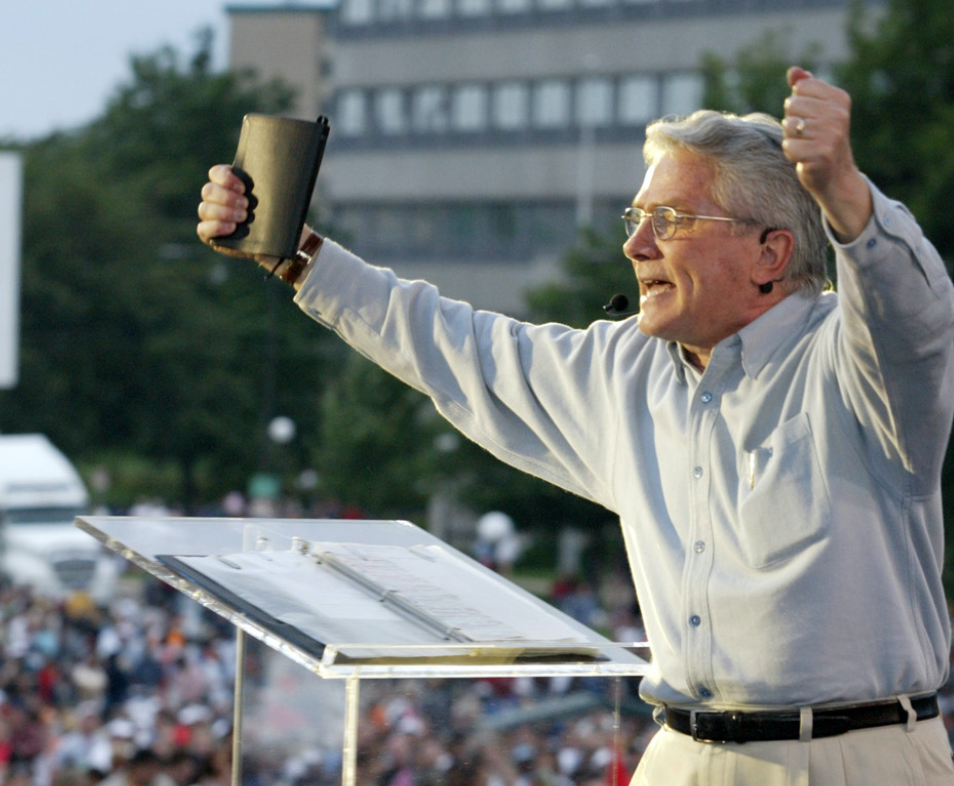
I bring this subject up, of course, because of the double-decker headline that ran atop the recent New York Times obituary for this singular figure in modern evangelical history: “

Luis Palau, the ‘Billy Graham of Latin America,’ Dies at 86

He rose from preaching on street corners in Argentina to ministering to millions around the world, then focused his ministry on liberal corners of the U.S.

I’m not blaming the Times for using that image, since it appeared — to one degree or another — in almost every major news feature about his passing. In fact, the key to the Times feature is that dug deeper than that cliche and showed why Palau was a major player, in his own right, in global evangelicalism.

Still, everyone knows where this story will begin. But note the transition in this key summary passage near the top of the Times obit:

Though his headquarters were in Oregon, Mr. Palau was often called “the Billy Graham of Latin America.” He addressed that region’s 120 million evangelicals through three daily radio shows (two in Spanish, one in English), shelves of Spanish-language books and scores of revival crusades, in which he might spend a week, and millions of dollars, preaching in a single city. The Luis Palau Association estimates that he preached to 30 million people in 75 countries.

Please respect our Commenting Policy

3D chess in Rome? Pope Francis approves Vatican decree affirming doctrines on marriage

3D chess in Rome? Pope Francis approves Vatican decree affirming doctrines on marriage

All together now: Is the pope Catholic?

Actually, in this age of conspiracy theories — on right and left — the question of the day appears to be: Is THIS pope Catholic? I am referring, of course, to the Vatican’s decision to affirm centuries of Christian doctrine stating that sex outside of marriage is (trigger warning) “sin” and that the sacrament of marriage is limited to the union of a man and a woman.

But, but, but, clearly Pope Francis must be playing some kind of three-dimensional chess with this action, moving the doctrinal pieces in some subtle way that will become clear in “reforms” at a later date? This was a case in which one could catch whiffs of disappointment and even conspiracy thinking on both the Catholic left and right (and in the press).

To see this in print, check out the overture in this Washington Post report: “Pope Francis says priests cannot bless same-sex unions, dashing hopes of gay Catholics.” The headline assumes, of course, that all gay Catholics oppose the church’s teachings on this matter but, well, nevermind.

ROME — Pope Francis has invited LGBT advocates to the Vatican. He has spoken warmly about the place of gay people in the church. He has called for national laws for same-sex civil unions.

But Monday, Francis definitively signaled the limits to his reformist intentions, signing off on a Vatican decree that reaffirms old church teaching and bars priests from blessing same-sex unions.

The pronouncement, issued at a time when some clerics were interested in performing such blessings, leans on the kind of language that LGBT Catholics have long found alienating — and that they had hoped Francis might change. It says that same-sex unions are “not ordered to the Creator’s plan.” It says acknowledging those unions is “illicit.” It says that God “cannot bless sin.”

The decree shows how Francis, rather than revolutionizing the church’s stance toward gays, has taken a far more complicated approach, speaking in welcoming terms while maintaining the official teaching. That leaves gay Catholics wondering about their place within the faith, when the catechism calls homosexual acts “disordered” but the pontiff says, “Who am I to judge?”

Let’s see. We have the standard use of the word “reform” to prejudge this matter. We have a sense of yearning that Pope Francis is taking a “more complicated approach” to this doctrinal issue.


Please respect our Commenting Policy

Surrounded by lions: Is there a backstory to Beth Moore's divorce from Southern Baptists?

Surrounded by lions: Is there a backstory to Beth Moore's divorce from Southern Baptists?

So far, 2021 has been pretty hospitable for some good religion stories, beginning with a Jan. 6 assault on the U.S. Capitol that included some conservative religious folks. On the heels of that story was an exposé on Christian finance guru Dave Ramsey written by Bob Smietana, the former Religion News Service editor-in-chief-turned-national-reporter .

Smietana had spent several years writing for the Southern Baptist-owned Lifeway Research. Someone (there?) tipped him off about a March 3 tweet by Lifeway’s biggest author, Beth Moore, saying she had cut her ties with the organization. Naturally, he wondered if there was more to it. According to several of his tweets, a spokeswoman for the sometimes reclusive Moore called him, asking if he’d like an interview.

Moore was fleeing the ship and Smietana was the lucky scribe who got to break the story.

Since then, the news has been pounced on by the religion-writing teams at the New York Times and Washington Post, industry publications such as Christianity Today and a variety of Southern Baptist outlets. Why? Because it’s not just about one celebrity Christian pulling up the stakes.

Rather, it’s become a judgment on an entire denomination about how it’s handled women’s issues, sexual abuse and former President Donald Trump.

Let’s begin with the actual RNS story, which begins with how Moore was considered the model Southern Baptist because of her powerful Bible studies that ministered to millions, but didn’t cross paths with the denomination’s strictures against women preaching. She also fulfilled other unwritten rules for popular women’s speakers on the Christian circuit: She was attractive, slim, married and a mom.

Then came President Trump.

Moore’s criticism of the 45th president’s abusive behavior toward women and her advocacy for sexual abuse victims turned her from a beloved icon to a pariah in the denomination she loved all her life. …

Because of her opposition to Trump and her outspokenness in confronting sexism and nationalism in the evangelical world, Moore has been labeled as “liberal” and “woke” and even as being a heretic for daring to give a message during a Sunday morning church service.


Please respect our Commenting Policy

Plug-in: Beth Moore, Southern Baptist trolls and a scoop that stunned Godbeat Twitter

Plug-in: Beth Moore, Southern Baptist trolls and a scoop that stunned Godbeat Twitter

In a little-noticed, late-night Twitter conversation on March 3, prominent author and speaker Beth Moore indicated that her Living Proof Ministries had ended its longtime partnership with Lifeway Christian Resources, a Southern Baptist Convention publishing house.

“Adored them but SBC baggage got to be too much,” Moore tweeted, matter-of-factly. “It was heartbreaking.”

A tip about the social media posts to Religion News Service national reporter Bob Smietana set in motion one of the year’s biggest religion news scoops.

Smietana called and set up an interview with Moore, who told him March 5 — last Friday — that she is “no longer a Southern Baptist.” After talking to Moore, the veteran religion writer then spent a nervous few days doing additional research and reporting — hoping no other journalist would learn about his in-depth exclusive.

When RNS published Smietana’s piece Tuesday, traffic quickly overwhelmed the wire service’s website, and the story became a trending topic on Twitter.

By Thursday, the Trump critic’s split with Southern Baptists was front-page news in the New York Times (read the story by Ruth Graham and Elizabeth Dias) and just missed the front page of the Washington Post (see the A2 coverage by Sarah Pulliam Bailey and Michelle Boorstein).

Other interesting follow-up coverage includes Holly Meyer’s report for USA Today, Kate Shellnutt’s story for Christianity Today and Ashlie D. Stevens’ analysis for Salon.

P.S. Kudos to RNS’ Emily McFarlan Miller for her front-page photo of Moore in the New York Times.


Please respect our Commenting Policy

Spot the theology issue: Top hymns of a year in which COVID-19 touched everything

Spot the theology issue: Top hymns of a year in which COVID-19 touched everything

It's a hymn that the faithful start singing whenever a Baptist church organist plays the opening chords -- because everyone knows it by heart.

All together now: "When peace like a river attendeth my way. When sorrows like sea billows roll. Whatever my lot, Thou hast taught me to say. … It is well, it is well, with my soul."

Chicago attorney Horatio Spafford wrote those words after losing his son to scarlet fever and then, a few years later, all four of his daughters in an 1873 shipwreck. His wife, Anna, survived and her telegram home from England began: "Saved alone. What shall I do?"

No one should be surprised that worship leaders frequently turned to "It Is Well With My Soul" as their people wrestled with the coronavirus pandemic, said the Rev. Roger O'Neel, who teaches in the worship and music program at Cedarville University in Ohio.

"People were feeling their way in 2020," he said. "It wasn't just the pandemic and people being locked down worshipping in (online) streamed services. We were also facing all the bitter political conflicts in our nation and the racial divisions that we were experiencing. …

"People were trying to find hymns that would speak to all of that, to the pain that everyone felt last year."

Faithlife, a Bellingham, Wash., company that publishes online worship and Bible study tools, recently released a report covering 2020 trends spotted in its Proclaim software. "It Is Well With My Soul" topped the hymns list, with usage increasing 68% after the pandemic hit.

The classic hymn "Great Is They Faithfulness" came next, with a 64% increase. It begins: "Great is Thy faithfulness, O God my Father, there is no shadow of turning with Thee; Thou changest not, Thy compassions, they fail not. As Thou hast been, Thou forever wilt be. Great is Thy faithfulness! … Morning by morning new mercies I see; All I have needed Thy hand hath provided -- great is Thy faithfulness, Lord, unto me."


Please respect our Commenting Policy

This is a religion question: How many kinds of 'nones' are there and what do they believe?

This is a religion question: How many kinds of 'nones' are there and what do they believe?

THE QUESTION:

How do the three main categories differ among America’s rising non-religious “nones”?

THE RELIGION GUY’S ANSWER:

Political scientist Ryan Burge of Eastern Illinois University (a contributor here at GetReligion) has lately emerged as the most prolific analyst of the religion factor in U.S. politics, The Religion Guy contends. He’s now out with a book examining the biggest trend of our times within U.S. religion: “The Nones: Where Thy Came From, Who They Are, and Where They Are Going.”

“Nones” refers to Americans who say they have “none” when pollsters ask about their religious affiliation or religious identity. Since the turn of the century they’ve grown rapidly and make up around a fourth of the U.S. adult population, so this book is highly recommended for anyone interested in contemporary American religion.

Burge is an interesting figure. On the one hand, he’s a hard-nosed, objective observer of poll-driven facts, while on the other a religious practitioner as a long-serving, part-time pastor of a American Baptist congregation. His local flock typifies our era’s second major trend, the unprecedented membership decline in aging white “mainline” Protestant denominations that in former times dominated the national culture, as distinguished from conservative “evangelical” Protestantism.

The most revelatory material in this data-rich survey of all things “none” is the distinctions among the three subcategories of non-religious people carefully marked out by Pew Research Center surveys. Atheists are those who are certain God does not exist, and the same for all supernatural aspects. Agnostics say we do not or cannot know such things. By far the largest segment of nones, however, choose Pew’s third option of “nothing in particular” (NIP).

Burge thinks the NIPs “might be the most consequential religious group in the United States, and no one is talking about them the way they talk about atheists or agnostics.” NIPs are one-fifth of the population and “the fastest-growing religious group in the United States.” On point after point, they are notably different from both atheists and agnostics. Lumping all the non-religious together as the same “glosses over vast differences in the lifestyles, occupations and political worldviews.”


Please respect our Commenting Policy

'Total Woman' redux: Obscure white evangelical says stupid things and it's national news

'Total Woman' redux: Obscure white evangelical says stupid things and it's national news

About the time that I started teaching journalism in Washington, D.C., I saw a movie in which Beltway professionals (including speechwriters) played a rather cynical bar game. I think the movie was “Speechless,” with Michael Keaton and Geena Davis.

If my memory is correct, the game was called “Spot the soundbite.” The goal was to watch a long, complicated political speech and then to accurately predict the tiny, often sensational 5-10 second “bite” that would make it into television news reports.

The message, of course, was that substance and nuance didn’t mean much in public life. Emotions and feelings linked to a fleeting soundbite — which could be funny or emotional or whatever — were what mattered. All together now: “Where’s the beef!” It was also clear that it was easy for journalists to pick good, sharp soundbites from “good” candidates and bad, stupid soundbites from “bad” candidates.

This brings us to this week’s “Crossroads” podcast (click here to tune that in), in which host Todd Wilken and I discussed the latest example of a preacher getting caught, in the age of YouTube and social media, failing to understand the rules of “Spot the soundbite.”

I heard about this epic news story when a former student — who has national print and television experience — sent me a wry email that said: “It’s weird that this random preacher’s sermon merits an NBC News story, no?” Indeed. In the world of short attention spans and tiny online news reports, this sermon by an unknown preacher, in a tiny church, in the middle of nowhere, in an obscure denomination, deserved a 900-word report.

My witty former student knew, of course, why this sermon received lots of national news coverage — including staff (not wire service) coverage in The New York Times (we will get to that shortly).

Yes, this preacher said some genuinely bizarre and disturbing stuff about women and marriage, especially when viewed through a #ChurchToo lens. However, was it national news that an unknown pastor said these things? Well, it is if the sermon contains the word “Trump” and this pastor can be turned into an archetypal symbol of white evangelicals in flyover country, the rubes many journalists blame for electing Orange Man Bad in the first place.

This preacher did not understand how to play “Spot the soundbite.”


Please respect our Commenting Policy

Christians, Jews, Muslims and lobbyists left and right fret over SCOTUS 'donor privacy' case  

Christians, Jews, Muslims and lobbyists left and right fret over SCOTUS 'donor privacy' case   

What cause could ever possibly unite Christian Right activists, the Council on American-Islamic Relations, the Zionist Organization, "pro-family," "pro-life," "pro-choice" and gun-rights lobbies, Mitch McConnell, the American Civil Liberties Union, Chamber of Commerce, Judicial Watch, NAACP, People for the Ethical Treatment of Animals, Planned Parenthood, Southern Poverty Law Center, Columbia University's First Amendment institute and religious-liberty advocates?

Answer: These and many more are allied in the Americans for Prosperity Foundation v. Becerra case (#19-251), which the U.S. Supreme Court put on its upcoming docket January 8.

Yes, that Becerra is Xavier, as in President Biden's controversial pick for secretary of Health and Human Services, acting in his previous role as California's attorney general. Moreover, this situation implicates the track record of his predecessor as A.G., Kamala Harris — now U.S. vice president and a major 2024 presidential prospect.

At issue is "donor privacy." Non-profit groups cannot operate or raise money in the state of California unless they give its attorney general the names and addresses of their major donors, the same list that's required as an appendix to their federal IRS returns. The non-profits argue that this violates their right to freedom of association under the Constitution's First Amendment.

Obviously this is something for alert media eyes, including pros on the religion beat.

Adding to news interest, this case displays contrasting beliefs of the U.S. Department of Justice in its Trump Administration brief filed last November (.pdf here) versus its revised stance under the new Biden Administration (.pdf here). The Trump brief strongly backs non-profit interest groups. The Biden brief dodges the question and asks the court to bounce the case for further investigation.

Religion specialists note: The Supreme Court consolidated the Americans for Prosperity case, raised by the libertarian political foundation established by the Koch brothers, with a second appeal from the Thomas More Law Center. This second agency provides free legal representation for "people of faith" to uphold "the religious freedom of Christians, time-honored family values and the sanctity of human life."


Please respect our Commenting Policy

Why are Latinos veering into GOP? It's all about money, money, money (and zero faith)

Why are Latinos veering into GOP? It's all about money, money, money (and zero faith)

I know, I know. If you have read GetReligion for the past four-plus years, you know that we’re convinced that the rise of the Latino evangelical voter (often paired with traditional Catholic Latino voters) is an emerging story in American public life.

Part of this story is the rise of Pentecostalism in the Spanish-speaking world (classic Pew Research Center study here) and another part is linked to the defense of Latino family values (to use a loaded phrase).

There’s much more to this story than the role these voters played in Donald Trump’s surprising (to some) showings in some Florida and Texas zip codes. Click here (“New York Times listens to Latino evangelicals: 'Politically homeless' voters pushed toward Trump”) and then here (“Concerning Hispanic evangelicals, secret Trump voters and white evangelical women in Georgia”).

To be blunt about it, it appears that political-desk reporters are struggling with this issue, in part because it undercuts some themes in long-predicted demographic trends backing Democrats. You can see that in the recent, oh-so-predictable New York Times story that ran with this massive double-decker headline:

A Vexing Question for Democrats: What Drives Latino Men to Republicans?

Several voters said values like individual responsibility and providing for one’s family, and a desire for lower taxes and financial stability, led them to reject a party embraced by their parents.

The story is getting some Twitter attention because of this magisterial statement of woke Times doctrine:

Some of the frustrations voiced by Hispanic Republican men are stoked by misinformation, including conspiracy theories claiming that the “deep state” took over during the Trump administration and a belief that Black Lives Matter protests caused widespread violence.

But it’s more important to focus on the bigger picture, which is that this trend is all about Latino men wanting to get rich by being part of the American dream. The overture is long, but essential:


Please respect our Commenting Policy