People

Religion-beat crash: RNS wades into intersectional fight between LGBTQ clout and race

Religion-beat crash: RNS wades into intersectional fight between LGBTQ clout and race

The journalism nightmare begins with an email, a text or, in the old days, a telephone call or a photocopy of a document in the mail.

Sources may or may not demand to remain anonymous. They want your newsroom to dive into a controversy that — in most cases — involves money, sex, power and what violations of religious law, criminal laws or both.

The source has tons of information on one side of a conflict that has two sides, or more. There is no way to write the story without multiple voices speaking — but only one side will talk. Nine times out of 10, there are legitimate issues of confidentiality, often legalities linked to counseling or medical care.

The reporter describes all of this to an editor. It’s clear this story will require untold hours of research (money, in newsroom terms) and, if the story ever pans out, the result will be long and complicated. The editor’s eyes glaze over. The question: Why is this story worth the time, money and effort?

I got one of those calls, long ago, about the sex life and financial times of PTL’s Jim Bakker. Eventually Charlotte Observer editors passed, pulling me off that lead. I left and, years later, a great reporter (see the essential Charles E. Shepard book) pulled the evolving threads together for a Pulitzer.

I cannot imagine how many emails and calls Robert Downen and Houston Chronicle reporters fielded before being allowed to dig into years of sexual abuse in the Southern Baptist Convention. I’m waiting for the book.

All of this is a long introduction to the challenges that, I suspect, loom over this double-decker Religion News Service headline:

Why the largest US Lutheran denomination apologized to a Latino congregation

It’s been a ‘perfect storm’ of charismatic personalities and a heightened awareness of racism, all brewing in one of the country’s whitest denominations

But the story doesn’t open with issues linked to race.

What we see in this unbelievably complicated story is a head-on collision between key elements of postmodern theories about “intersectionality.” Think race, sex, gender, economics and the demographic realities facing the declining world of oldline liberal Protestantism.


Please respect our Commenting Policy

Plug-In: Fear, shock, questions follow fatal Albuquerque shootings of four Muslim men

Plug-In: Fear, shock, questions follow fatal Albuquerque shootings of four Muslim men

First, fear. Then, shock.

Now, questions. Lots of questions.

The Muslim community in Albuquerque, New Mexico — and even nationwide — has dealt with a gamut of emotions since news broke this past weekend of the fatal shootings of four of their own.

“These hateful attacks have no place in America,” President Joe Biden said amid speculation the deaths might be tied to Islamophobia.

After the latest in the string of killings, Albuquerque Police Chief Harold Medina characterized the shootings as “disturbing” and said police had reason to believe they were related.

“We’re in fear for the safety of our children, our families,” Ahmad Assed, the president of the Islamic Center of New Mexico, said Saturday, as reported by the Wall Street Journal’s Sara Randazzo. “This is a very troubling time for all of us.”

Relief then mixed with shock as the Albuquerque Journal’s Elise Kaplan explains: Authorities charged an Afghan refugee named Muhammad Syed — a Muslim himself — in the homicides of Aftab Hussein, 41, on July 26 and Muhammad Afzaal Hussain, 27, on Aug. 1. Also, police called the 51-year-old Syed a prime suspect in the Nov. 7 fatal shooting of Mohammad Ahmadi, 62, and the Aug. 5 fatal shooting of Naeem Hussain, 25. A later story by Kaplan notes:

Officials estimate there are between 5,000 and 10,000 Muslims living in Albuquerque, representing various races, ethnicities and nationalities. Assed guessed about 80% are Sunni and 20% are Shiite. He said it’s common for members of both groups to visit the Islamic Center of New Mexico.

Of the four Muslim men who were killed, three were practicing Shiite Islam. Syed was a Sunni Muslim, as was Muhammad Afzaal Hussain.

At The Associated Press, Stefanie Dazio and Mariam Fam report:

Investigators received a tip from the city’s Muslim community that pointed toward Syed, who has lived in the U.S. for about five years, police said.

Police were looking into possible motives, including an unspecified “interpersonal conflict.”


Please respect our Commenting Policy

Let the palace intrigue over at Disney+ palace begin

Let the palace intrigue over at Disney+ palace begin

Screenwriter and director Tony Gilroy, showrunner off “Andor” in the Star Wars universe (premiers Sept. 21 on Disney+), spoke recently to a Television Critics Association event.

If even one member of the Religion News Association had been present, we might have an encyclical to discuss.

But let’s give credit where it’s due to Lance Gose of CBR.com (Comic Book Resources). Gose captured a few sound bites from Gilroy, who compared the guardians of Star Wars canon with the Vatican.

“If you think about Star Wars as the Roman Catholic Church, if you think about it as a religion, it has all kinds of factions, groups, and within it, there are all kinds of canon,” Gilroy said.

“We are constantly in touch with the Vatican about what we do, we are constantly checking everything we do,” he added. “We have a very complicated relationship with how we deal with everything that exists. We’re telling a story that we want to tell, and we are not violating the grand canon, let’s put it that way.”

Gilroy’s comparison prompts a few immediate questions for me. These are just for fun, but there may be some perfectly valid religion-beat hooks in here. As people frequently say here at GetReligion: Hold that thought.


Please respect our Commenting Policy

Memory eternal, Ron Sider: An evangelical thinker caught in political crossfire for decades

Memory eternal, Ron Sider: An evangelical thinker caught in political crossfire for decades

It was the kind of Pope John Paul II quotation that was powerful and prophetic -- but hard to print on a political bumper sticker.

"America will remain a beacon of freedom for the world as long as it stands by those moral truths which are the very heart of its historical experience," he said, during his 1999 U.S. tour. "And so, America: If you want peace, work for justice. If you want justice, defend life. If you want life, embrace truth -- the truth revealed by God."

One American activist who paid close attention was Ronald J. Sider, a Mennonite theologian who was already several decades into a career built on asking Americans to ponder precisely that equation.

Politicians on left and right would cheer as John Paul attacked the modern world's "culture of death," said Sider. But, in private, Democrats and Republicans would groan.

"People on the left will love what he had to say about the death penalty and racism and caring for the poor," said Sider, when I reached him by telephone. "But many liberals are going to squirm because he ties these issues directly to traditional Christian teachings on abortion and euthanasia and family life. Meanwhile, some people on the right will squirm because the pope made it very clear that he links these pro-life issues to the death penalty and poverty, sickness, hunger and even the environment."

Sider added: "We live in an age of incredible relativism in this society and even in the church. We live in a land that seems to have lost its way."

These kinds of tensions defined Sider's own struggles as a hard-to-label political activist and ecumenical leader. He died on July 27 at the age of 82.

Christianity Today listed Sider's classic "Rich Christians in an Age of Hunger" as one of the 20th century's most influential religion books. The flagship evangelical magazine also ran this headline with a cover story about Sider's career -- "Unsettling Crusade: Why does this man irritate so many people?"


Please respect our Commenting Policy

Pride meets Father's Day: Gay dads preach the 'radical inclusivity' of their Chicago parish

Pride meets Father's Day: Gay dads preach the 'radical inclusivity' of their Chicago parish

Landon Duyka and Alex Shingleton had almost given up on Catholicism.

Then they found Old St. Patrick's Church in Chicago, where their family was welcomed because the parish practices what its clergy call "radical inclusivity." This year, the two husbands created an online buzz when, after a decade in these pews, they shared the pulpit during a symbolic Sunday Mass.

“Chicago is celebrating Pride and, of course, today is Father's Day and, conveniently, we tick both of those boxes," said Duyka. "In all honesty, if you had told us as young boys who wasted countless hours of our lives in church trying to 'pray the gay away' that we someday would be standing in front of all of you in our Catholic church talking about our family on Father's Day, we would never have believed you."

At this historic parish, their adopted daughters are thriving. The youngest was baptized with no complications, unlike the "secret ceremony" for their first daughter at a previous church. In 2016, the Old St. Pat's altar featured -- for a month -- photos of victims from Orlando's Pulse nightclub massacre. Parishioners shook their hands during the Sign of the Peace. There was no need to worry about sermons opposing gay marriage or seeing conversion-therapy pamphlets.

The Father's Day "reflection" by Duyka and Singleton filled the homily slot in the Mass, following the Gospel reading. There was no homily, even though Canon law requires a "priest of deacon" to deliver one during Sunday Masses with a congregation.

The details of this Pride-season Mass inspired online debates since it occurred in the powerful Archdiocese of Chicago, led by Cardinal Blase Cupich.

Pope Francis recently named Cupich to the Vatican's Dicastery for Divine Worship and the Discipline of the Sacraments. The Chicago cardinal has been a fierce defender of the pope's Traditionis Custodes ("Guardians of the Tradition") document limiting use of the Tridentine Latin Mass. With its authority, Cupich has also restricted other worship traditions favored by Catholic conservatives, such as priests celebrating Mass "ad orientem," as opposed to the modern "versus populum" stance in which, when at the altar, they face their congregations.

On LGBTQ issues, Cupich made news with his response to a 2021 Congregation for the Doctrine of the Faith text forbidding blessings for same-sex couples.


Please respect our Commenting Policy

Thinking about Internet-age ethics with J.D. Flynn, especially rumors about dead popes

Thinking about Internet-age ethics with J.D. Flynn, especially rumors about dead popes

Everyone was talking about this story last week: Pope Benedict XVI is (a) dead, (b) not dead or (c) come on, what’s up with this tired Internet game again?

In that final category, I offer you the following mini-think piece from J.D. Flynn of The Pillar, that must-bookmark source of Catholic news, commentary and Canon law-specifics.

This whole circus was a classic example of people being tempted to report, as semi-news, the fact that online people were TALKING ABOUT something that was being reported with zero creditable attribution. Thus, Flynn starts with this basic equation:

… Pope emeritus Benedict XVI is still not dead. …

Why is that news?

Because last night an Italian schoolteacher named Tommaso De Benedetti created a moral panic online, with a hoax that seems to have been in the works for nearly a year.

“Moral” panic?

That’s an interesting choice of words. The key is that journalists had to stop and ponder whether they had the fortitude to not push the “RETWEET” button on a story that was essentially about Internet chatter.

Let’s keep walking through Flynn’s piece as he works his way through this:

Back in August 2021, the guy created a Twitter account for Bishop Georg Bätzing, who is president of the German bishops’ conference. The account managed to amass thousands of followers. He didn’t use the account, but he built that following by strategically following the right people, and allowing the Twitter algorithms to do the rest.

Then yesterday evening, he tweeted in German, English, and Spanish that Pope emeritus Benedict XVI had died.

The tweets took off like wildfire. Several media outlets picked them up, and a lot of producers and journalists retweeted them. My phone started blowing up — priests, bishops, and other journalists were all asking me if it was true.

What to do?


Please respect our Commenting Policy

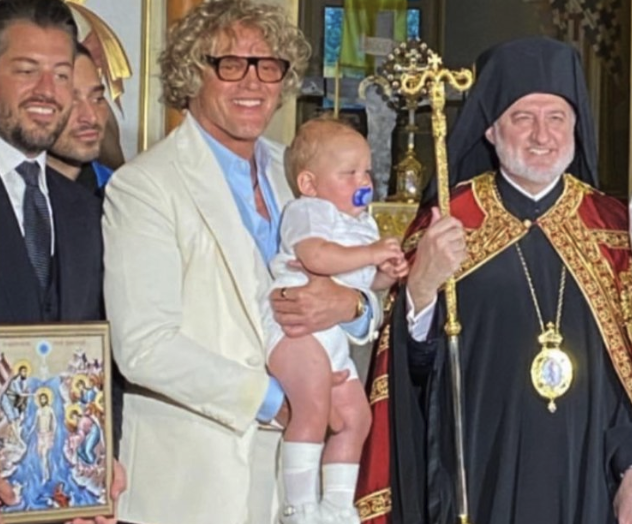
Big story? American (at this point) archbishop baptises famous gay couple's children in Greece

Big story? American (at this point) archbishop baptises famous gay couple's children in Greece

I think that I will write this post before I start getting emails (one or two from inside the wider circle of current and former GetReligionistas) asking whether or not I will write this post.

But first, before I get to the journalism question for this post, allow me to pause and discuss the meaning of a key term — “Byzantine.” Here is the word in context: To understand the following news story, journalists will need to enter the Byzantine world of Eastern Orthodox polity in North America.

The word “Byzantine,” when used as an adjective, has two definitions. First there is this:

… relating to Byzantium (now Istanbul), the Byzantine Empire, or the Eastern Orthodox Church

Now, that meaning is — sort of — relevant in this case. But this second definition is the one that we need:

… (of a system or situation) excessively complicated, and typically involving a great deal of administrative detail.

When people ask questions about Eastern Orthodox “news,” I frequently have to remind them that Eastern Orthodoxy is not the Church of Rome. We do not have a pope, even if, from time to time, the ecumenical patriarch in Istanbul has tried to promote (with the help of many elite newsrooms) a papal vision of his “first among equals” role among Orthodox patriarchs, stressing “first” instead of “equals.” See: Ukraine.

With that in mind, let’s look at the GreekReporter.com story that ran with this headline: “First Greek Orthodox Baptism for Child of Gay Couple in Greece.” The question: Is this an important “news” story worthy of complex, balanced, accurate coverage in, let’s say, a mainstream publication such as The New York Times? Jumping ahead, my answer is “yes,” but with a heavy emphasis on “complex, balanced, accurate coverage.” Here is the whole story from Greece:

Evanggelos Bousis and Peter Dundas, both of Greek descent, became the first gay couple to hold a Greek Orthodox Baptism for their children in Greece. …

The couple’s children, Alexios and Eleni, were baptized by his Eminence Archbishop Elpidophoros of America at the Panagia Faneromeni Church in the southern Athenian suburb of Vouliagmeni.


Please respect our Commenting Policy

Norm Macdonald's 'Nothing Special' -- final thoughts on mortality while the clock was ticking

Norm Macdonald's 'Nothing Special' -- final thoughts on mortality while the clock was ticking

Comedians frequently take shots at taboo targets, but that wasn't what Norm Macdonald was doing when he addressed Down's Syndrome while solo recording what became the new "Nothing Special" on Netflix.

"I love people with Down Syndrome," said Macdonald, in a no-audience performance packed with his familiar pauses and bemused expressions. "I wish I had Down Syndrome, and I'll tell you why. They're happy. You know what I mean? …

"What's wrong with that? … People get mad at them … and they pity them. Now, who's the bad person in that scenario?"

The former Saturday Night Life star -- who died September 14 after a secret nine-year fight with cancer -- recorded nearly an hour of material during the coronavirus pandemic, before yet another operation in the summer of 2020. He said he "didn't want to leave anything on the table in case things went south."

This Netflix finale offers fresh musings on mortality and morality that, with Macdonald's blunt language and haunting images, evolve into meditations on how modern people deceive themselves. The X-factors in his art were religious faith and his love of literature ranging from Mark Twain to Fyodor Dostoyevsky.

"Macdonald showed respect for basically everyone, with the exception of himself and people like O.J. Simpson and Bill Clinton," said Rich Cromwell, a television professional and essayist for The Federalist. "He was not a Christian comedian -- that's clear. But that was part of who he was, and he treated faith with respect. …

"This Down's Syndrome material is a perfect example. He didn't turn that into an overt argument about abortion, but it's clear that he is saying all life is worthy of respect, even if some people don't judge that life to be worthy. He's saying people with Down's Syndrome are God's children, no matter what."

"Nothing Special" ends with an A-list reaction panel -- David Letterman, Adam Sandler, Conan O'Brien, Dave Chappelle, David Spade and Molly Shannon -- who knew Macdonald as a friend and colleague. This special was full of "third-rail stuff," noted O'Brien.

Macdonald riffed on his own "degenerate" gambling sins, his fear of airplane crashes ("Ashes to ashes, stuff to stuff, as the scriptures say"), cannibalism, slut-shaming, racism, transgenderism and his fear of dying and discovering that he picked the wrong religion. He also discusses living wills and giving doctors explicit instructions not to yank "that plug in the wall" in the event of a coma.


Please respect our Commenting Policy