People

Devil is in the details, when covering battles inside the powerful McLean Bible Church

Devil is in the details, when covering battles inside the powerful McLean Bible Church

When I hear of a hostile takeover in a church, I think back to around 2006 when conservative Episcopalians were breaking free of their denomination, reclaiming the name “Anglican” and trying to take their church properties with them.

Usually they failed with conservative and liberal sides accusing each other of malfeasance. The lawyers got paid, of course.

This time around, the headlines are about conflict inside the largest evangelical church in the Washington, D.C., area and because it’s in northern Virginia, where so many inside-the-Beltway workers live, its problems have gotten a lot of press interest. It didn’t hurt that then-President Donald Trump visited the place on June 2, 2019, which stirred up lots of people.

Here’s a Washington Post piece that tries to explain what’s going on:

The leaders of McLean Bible, one of the D.C. region’s largest and most high-profile evangelical churches, are facing attempts from its own members to spread disinformation to take control of the church, Pastor David Platt warned the congregation in a sermon earlier this month.

Last month, the church was supposed to vote in new elders who oversee the church, and a group tried to shore up enough votes to block the appointed leaders. In a sermon on July 4, Platt said the group told other church members as they were walking into the meeting that the new elders would try to persuade church leadership to sell the church’s building in Vienna, Va. to local Muslims who would build a mosque.

McLean Bible — which is seen as a conservative evangelical congregation and once had more than 16,000 attendees — has long been an important church in Washington with four locations near the city. But threatening McLean now is a group that has spread all kinds of rumors, Platt said.

OK, so a local megachurch is having a catfight. How does one make such a story interesting to the rest of the world?

Simple: Make it about a greater issue, such as the generational conflict or politics, which is what NPR did in calling the place “a hub for Republican senators and Bush aides.”


Please respect our Commenting Policy

Covering Mark Driscoll and life after Mars Hill: Why isn't this a mainstream news story?

Covering Mark Driscoll and life after Mars Hill: Why isn't this a mainstream news story?

It’s been nearly seven years since Mars Hill Church, the fabulously successful multi-campus evangelical flock in Seattle, imploded when its pastor, Mark Driscoll, resigned. The church’s nearly 13,000-person Sunday attendance totals quickly dissolved, its headquarters and branch campuses were closed or sold.

I moved to the Seattle suburbs the following summer and had a long conversation with one of the church’s leaders. I’ve rarely turned down a chance to do a story, but it was clear that covering this mess would take up more time and emotional energy than I had time for.

Dodging a lawsuit that accused him of misappropriating $30 million worth of members’ tithes, Driscoll ended up moving to Scottsdale, Ariz., (whose sunny clime is like Shangri-la to many rain-drenched Seattleites) and starting a new church plant in 2016 called Trinity Church.

Recently, a number of stories have come out about Driscoll’s heavy-handed leadership and dysfunctional pastoring at Trinity that sounded all too similar to what went down in Seattle. The latest just came out Monday in Christianity Today:

Nearly 40 elders who served with Mark Driscoll during the final years of Mars Hill Church are publicly calling for him to step down from his current pastoral position and seek reconciliation with those he has hurt.

“We are troubled that he continues to be unrepentant despite the fact that these sins have been previously investigated, verified, and brought to his attention by his fellow Elders, prior to his abrupt resignation” from Mars Hill, they wrote in a statement released today to CT. “Accordingly, we believe that Mark is presently unfit for serving the church in the office of pastor.”

Christianity Today is one of two outlets that have been following the Mars Hill story a lot recently and I’ll get to CT’s podcast series in a moment.

But first I should first mention investigative journalist Julie Roys’ two podcasts. She’s been following the Mars-Hill-in-Arizona beat for some time, but her latest is an act of war. From the transcript of Inside the Driscoll Cult Part 1:

The cultic activities of Mark Driscoll and The Trinity Church have escalated to a whole new level. As Julie’s guests describe on this edition of The Roys Report, Driscoll is now sending cease and desist letters, threatening to sue whistleblowers.


Please respect our Commenting Policy

Plug-In: Who is the alleged Baptist minister accused in Haiti's presidential assassination?

Plug-In: Who is the alleged Baptist minister accused in Haiti's presidential assassination?

In 2018, I was blessed to visit Haiti with an American mission team and write about a Christian humanitarian aid organization that drills water wells around the world.

I keep thinking about that trip — and the amazing people I met — as I read about the latest turmoil facing that Caribbean island nation.

This week, I hand off the top part of my column to ReligionUnplugged’s managing editor, Meagan Clark. She found an interesting detail about the self-described pastor accused in the Haitian president’s assassination:

By Meagan Clark

An American suspect in Haiti’s presidential assassination, Christian Emmanuel Sanon, 63, was arrested at his gated home in Port-au-Prince by Haitian police last week.

Sanon identifies himself on social media as a “Medical Doctor and Christian Minister.” The Sun Sentinel of Fort Lauderdale, Florida, may have been the first to unearth that Sanon did not have a license to practice medicine in Florida. At ReligionUnplugged, we wondered about his faith background, credentials and motivations.

The New York Times, TIME and others reported that Sanon attended Midwestern Baptist Theological Seminary, citing the Florida Baptist Historical Society. But when I called Midwestern, the registrar’s office said the school has no records of Sanon ever attending, online or in-person.

A Florida Baptist Society representative told ReligionUnplugged that Sanon wrote in a biographical profile of himself that he attended Midwestern, and the society relies on honesty to compile its biographies. The representative said that in fact, the society has since learned that Sanon attended a training course that Midwestern sponsored, not the seminary itself. The Florida Baptist Society has updated its website.


Please respect our Commenting Policy

Story worth covering? Life and death challenges tested faith of Suns coach Monty Williams

Story worth covering? Life and death challenges tested faith of Suns coach Monty Williams

A reporter tossed a standard question at coach Monty Williams after the Phoenix Suns won the Western Conference finals, asking how he managed to be a tough NBA coach and a sympathetic mentor.

"I tell every new player … that the essence of my coaching is to serve," said Williams, the National Basketball Coaches Association's 2021 coach of the year. "As a believer in Christ, that's what I'm here for. … I tell them all the time, if I get on you, I'm not calling you out -- I'm calling you up."

That message meshes well with what superstar Chris Paul writes on his sneakers game after game: "Can't Give Up Now." That's a popular Gospel song with this chorus: "I just can't give up now. I've come too far from where I started from. Nobody told me the road would be easy and I don't believe He's brought me this far to leave me."

Williams and Paul have known each other for a decade, with professional and personal ties strengthened by pain and frustration. While Paul's on-court struggles are well documented, it's impossible to understand their bond without knowing the details of his coach's life as a Christian, husband and father of five children.

"The real reason to watch" the playoffs this year, said former ESPN commentator Jason Whitlock, in his "Fearless" podcast, is "that God has placed a messenger inside the NBA's secular madness. Monty Williams might be the most important man in sports. The 49-year-old former Notre Dame and NBA player is the leader and example that America needs right now."

The coach's story, he added, "belongs in a new Bible. Five years ago, a 52-year-old White woman high on meth drove her car headfirst into the car driven by Williams' wife Ingrid. Three of Williams' children were also in the car. The White woman died at the scene. … Ingrid Williams died a day later. Williams' children survived."

Williams was a promising Notre Dame freshman when Ingrid -- before their marriage -- stood by him after doctors said he had hypertrophic cardiomyopathy. Long before experts cleared him to play, Ingrid kept praying and offered this message: "Jesus can heal your heart."

Drafted by the New York Knicks, Williams began -- with a defibrillator courtside -- a nine-year NBA career that led into coaching. He quickly became known for his ability to inspire hope and teach leadership.


Please respect our Commenting Policy

Scripture, faith, race, politics: Mississippi Today on the story behind the state's new flag

Scripture, faith, race, politics: Mississippi Today on the story behind the state's new flag

Every newsroom in which I worked kept a large hardback Bible in the copy desk’s collection of reference books (this was pre-Internet, of course).

I often wondered why this was true, since almost every time I used long quotes in a news story or column in which believers talked about the specifics of their beliefs — because the material was directly linked to crucial facts or their motivations — most newsroom pros rolled their eyes. Those quotes tended to get shortened and, sometimes, edited out. This was especially true when politicians talked about their religious beliefs, for whatever reason.

I thought of this recently when I read a strong Mississippi Today feature — part one of a five-story series — about the role that Speaker of the House Philip Gunn played in changing that state’s controversial flag.

This was a story that centered on a public action, as seen in the headline: “Why Philip Gunn became the first prominent Republican to call for changing the state flag.”

Yes, the word “Republican” is important. But the key word there is “why.” Here is block of material early on that begins to link the political action with the beliefs behind it.

Less than a week before in South Carolina, a young white man walked into a Black church in Charleston and brutally murdered nine worshippers. Because the gunman had publicly documented his obsession with the Confederate battle emblem, the murders inspired debate across the country about the government-sanctioned use of the Confederate symbol.

The TV reporter asked Gunn about the Mississippi state flag, which was the last in the nation containing the Confederate battle emblem. While the camera rolled, Gunn advocated for a new flag.

As soon as Gunn left the fundraiser, he called Nathan Wells, his then-chief of staff and longtime top political adviser. The two had been privately talking for years about their shared disdain of the state flag and how they could work to change it.

“He said, ‘Nathan, uh, I think we need to release a statement,’ ” Wells recounted to Mississippi Today in an interview earlier this year.

That official statement in 2015 said:


Please respect our Commenting Policy

Once again, U.S. Supreme Court chooses to punt on a major religious liberty case

Once again, U.S. Supreme Court chooses to punt on a major religious liberty case

Florist Barronelle Stutzman and Robert Ingersoll have shared many details from the 2013 conversation that changed their lives and, perhaps, trends in First Amendment law.

For nine years, Ingersoll was a loyal customer at Arlene's Flowers in Richland, Wash., and that included special work Stutzman did for Valentine's Day and anniversaries with his partner Curt Freed. Then, a year after the state legalized same-sex marriages, Ingersoll asked her to design the flower arrangements for his wedding.

Stutzman took his hand, Ingersoll recalled, and said: "You know I love you dearly. I think you are a wonderful person, but my religion doesn't allow me to do this."

In a written statement to the Christian Science Monitor, Ingersoll wrote: "While trying to remain composed, I was … flooded with emotions and disbelief of what just happened." He knew many Christians rejected gay marriage but was stunned to learn this was true for Stutzman.

As stated in recent U.S. Supreme Court documents: "Barronelle Stutzman is a Christian artist who imagines, designs and creates floral art. … She cannot take part in or create custom art that celebrates sacred ceremonies that violate her faith."

This legal drama appears to have ended with Stutzman's second trip to the high court and its July 2 refusal to review a Washington Supreme Court decision the drew a red line between a citizen's right to hold religious beliefs and the right to freely exercise these beliefs in public life. Supreme Court justices Clarence Thomas, Samuel Alito and Neil Gorsuch backed a review, but lacked a fourth vote.

"This was shocking" to religious conservatives "because Barronelle seemed to have so many favorable facts on her side," said Andrew T. Walker, who teaches ethics at Southern Baptist Theological Seminary.

Stutzman is a 76-year-old grandmother and great-grandmother who faces the loss of her small business and her retirement savings. She has employed gay staffers. She helped Ingersoll find another designer for his wedding flowers. In the progressive Northwest, her Southern Baptist faith clearly makes her part of a religious minority.

"Barronelle is a heretic because she has clashed with today's version of progressivism," said Walker.


Please respect our Commenting Policy

Jimmy and Rosalynn Carter: Why did some journalists bury the faith tie that binds them?

Jimmy and Rosalynn Carter: Why did some journalists bury the faith tie that binds them?

If it’s been said once it’s been said a thousand times: Jimmy Carter may have been a very unsuccessful U.S. president, but his life after the White House has been top-notch.

In fact, according to a 2015 poll, the American public thinks he’s No. 1 among the nation’s post-presidents.

Obviously, there was that Nobel Peace Prize in 2002, which was awarded for “his decades of untiring effort to find peaceful solutions to international conflicts, to advance democracy and human rights, and to promote economic and social development." But if you ask average Americans what they admire about Carter’s life post-White House, I think most of them would mention two, or maybe three, parts of his life.

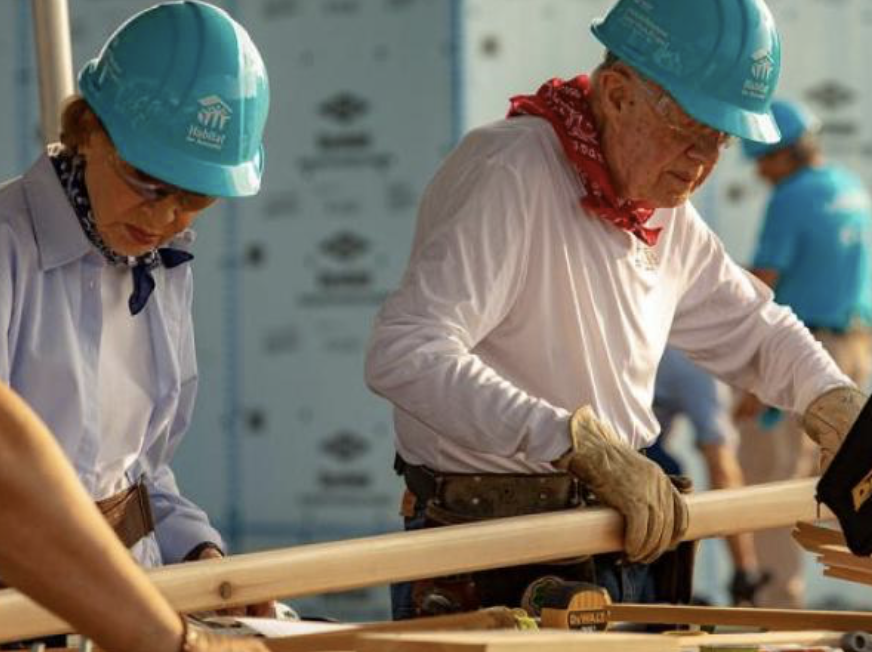
First, there is his record in volunteer work and public service, symbolized by decades of work with Habitat For Humanity building homes for the working poor. If you have followed that story at all, you know that Carter doesn’t just show up with a hammer for the photo-ops. Second, there is the remarkable marriage-partnership between Jimmy and Rosalynn Carter. I have heard Southerners refer to them as the “anti-Clintons,” as in Bill and Hillary Rodham.

Finally, there is — as Jerry Falwell, Jr., of all people, once put it — Carter’s many decades of work as the “world’s most famous Sunday school teacher.” Ths smiling Baptist did that work week after week whether there were TV cameras present or not.

That faith element was the subject of this week’s “Crossroads” podcast (click here to tune that in) in which host Todd Wilken and I looked at three mainstream-press features about Jimmy and Rosalynn Carter celebrating their 75th wedding anniversary. If readers are interested in the faith tie that binds in this marriage, they should start with this fine Washington Post feature, with it’s one-word headline: “Inseparable.” Here’s the overture:

PLAINS, Ga. — When they arrived, they strolled hand-in-hand toward their pond with a graceful willow at its edge.

“We’re going to be buried right there, on that little hill,” Jimmy Carter said, motioning toward the lawn sloping up from the pond.


Please respect our Commenting Policy

That New Yorker #FreeBritany feature: It's all about a Baptist daddy and his wild daughter?

That New Yorker #FreeBritany feature: It's all about a Baptist daddy and his wild daughter?

One thing is clear, when you read the long, sad (but buzz-worthy) feature in The New Yorker entitled “Britney Spears’s Conservatorship Nightmare.”

Britney is a celebrity.

When she goes to court, she is a celebrity. When she escapes to a pub, she is a celebrity. When she fights to see her children, she is a celebrity. When she has a nervous breakdown (especially in public), she is a celebrity.

If and when she ever returns to church (there are rumors), she will do so as a celebrity. Ditto for any return to celebrity friendly Kabbalah classes.

But you get what you expect in this feature, written by Ronan Farrow and Jia Tolentino. There’s a huge cast of characters, some who speak on the record and some who do not. There are waves of details from court documents and testimony. There’s an endless survey of public scenes and paparazzi chases.

But the second line of the double-decker headline points to the heart of the story: “How the pop star’s father and a team of lawyers seized control of her life — and have held on to it for thirteen years.”

This is a story about a fight between a Baptist father (simply “Jamie” in most of the story) and his wild daughter — who has lived her entire teen and adult life in the glare of a media spotlight that burned her, even as it poured wealth on everyone around her, including members of her immediate family.

What about faith issues? There are fleeting glimpses of religion “ghosts” throughout this story. However, there is evidence that The New Yorker team realizes that, behind all of the talk about Britney’s mental health, the father and daughter are fighting about the moral choices she has made in her private life. Meanwhile, the daughter keeps trying to break free from this noose, in part through sex, love, marriage and children.

Consider the implications of this passage, referring to the legal drama that pulled the #FreeBritney social-media world back into the headlines:


Please respect our Commenting Policy

Catholic bishops, politicos and Holy Communion: Little has changed in this old debate

Catholic bishops, politicos and Holy Communion: Little has changed in this old debate

The questions that haunted the Pontifical Academy for Life conference were familiar, controversial and exhausting, since Catholics and their bishops had been arguing about them for years.

The year was 2006, but little has changed in 2021.

What should bishops do when prominent Catholics -- even presidential candidates -- defended and promoted abortion rights? What if they said they accepted churched teachings on the sanctity of human life, while their actions suggested otherwise?

Would it violate the "separation of church and state" if bishops denied them access to Holy Communion? What if bishops asked these politicos to go to Confession?

"This is silly," said scholar Robert P. George, addressing that Vatican gathering. A Catholic shepherd "acting on his authority as a bishop to discipline members of his flock, who commit what the Church teaches are grave injustices against innocent human beings" would be "exercising his own constitutional right to the free exercise of religion. …

"Freedom is a two-way street. No one is compelled by law to accept ecclesiastical authority," stressed George, an outspoken Catholic layman and professor of jurisprudence at Princeton University. Thus, a bishop has "every right to exercise spiritual authority over anyone who chooses to accept it. There is a name for people who do accept the authority of Catholic bishops. They are called 'Catholics.' "

At that time, most debates centered on Sen. John Kerry, the Democratic Party's presidential nominee in 2004.

Cracks inside the U.S. Conference of Catholic Bishops widened with the election of President Joe Biden, a rosary-carrying Catholic who -- in word and deed -- has evolved into a fierce defender of abortion and LGBTQ rights. Biden quickly dropped his longstanding opposition to the federal funding of abortion, after criticism from the left in the 2019 primaries.


Please respect our Commenting Policy