Mainline

Alongside abortion, don't neglect the Supreme Court's big school prayer ruling

Alongside abortion, don't neglect the Supreme Court's big school prayer ruling

Vastly overshadowed by the uproar over Politico's bombshell report that the Supreme Court may be poised to overturn past abortion rulings, the court actually released religious-liberty ruling written by retiring Justice Stephen Breyer. His Shurtleff v. City of Boston opinion (.pdf here) reasoned that since Boston had permitted 284 city hall flag displays by varied groups, it violated freedom of speech to forbid a Christian flag for fear of violating church-state separation.

Harvard Divinity student Hannah Santos, writing for Americans United, said Christian flag displays would be "disturbing and demoralizing" and evoke the Puritan founders' "cruel" intolerance. But Breyer and the other two liberal justices joined six conservatives in this unanimous — repeat unanimous — decision.

There's likely to be less Court concord on another First Amendment ruling reporters need to prepare for in coming weeks. This dispute crisply demonstrates the culture-war split among American religious groups and between most Democrats and Republicans.

Kennedy v, Bremerton School District [Docket #21-418] involves the firing of Joseph Kennedy, an assistant high school football coach in Washington state. He violated the school's order against his kneeling to utter brief prayers on the 50-yard line after games, with students who wished joining him.

Here, too, Kennedy's freedoms of speech and religion ran up against school fears about violating the Constitution's clause barring government "establishment of religion." Click here for a recent Julia Duin post looking at some of the media coverage of this debate.

In preparing coverage to interpret the forthcoming ruling, keep in mind possible ramifications beyond the gridiron. As Christianity Today reported, hypothetical situations the justices discussed during the two-hour oral argument included teachers or coaches praying silently or aloud or reading the Bible before class, coaches praying on the sidelines perhaps with specific notice that students weren't required to pray or that they cannot pray or a player simply making the sign of the cross.

Also this. A court filing from the Jewish Coalition for Religious Liberty and the Islam team at the Religious Freedom Institute informed the justices that observant Jewish teachers and coaches need to speak brief public blessings before eating or drinking, and that Muslims must join daily prayer times during public school hours or while chaperoning a field trip.
Please respect our Commenting Policy

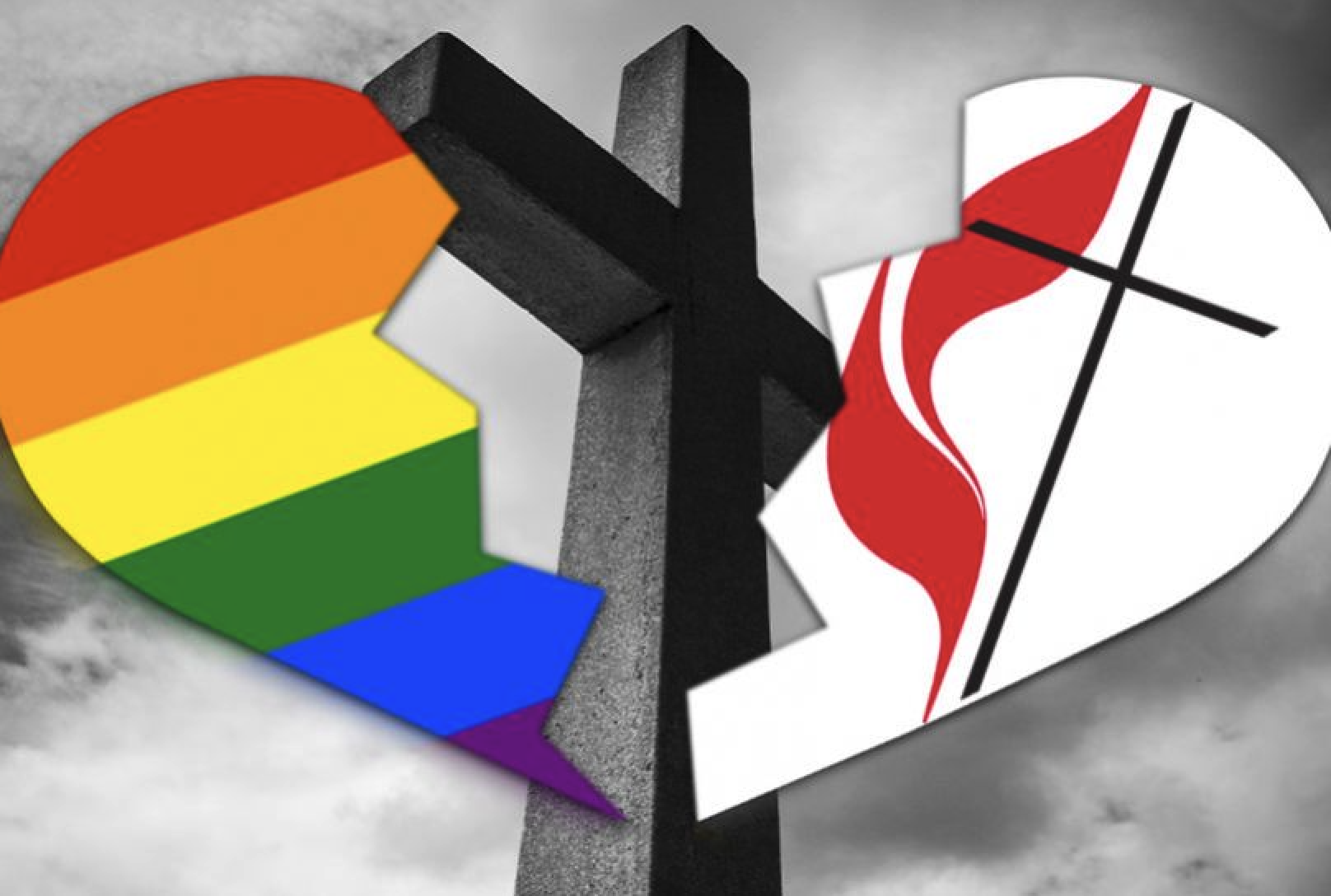
In terms of church history, should the United Methodist break-up be called a 'schism'?

In terms of church history, should the United Methodist break-up be called a 'schism'?

When I moved to Denver in 1984, Rocky Mountain News (RIP) my work plunged me into the ongoing United Methodist Church battles over creed-level doctrines, the Bible and, of course, homosexuality.

The region’s defining institution was the Iliff School of Theology, a UMC authorized seminary that a former professor there once told me was “the single most liberal school in America that still bothers to call itself ‘Christian.’ “ In the late ‘80s, an Iliff student said he had encountered one professor who believed that the resurrection of Jesus actually happened, as an event in real time. I would doubt this seminary has become more small-o “orthodox” in the past third of a century.

If you were in Denver back then it was clear that the United Methodists were in the midst of a very slow train wreck and that a parting of the ways was inevitable. The question: Who would leave and who would control the assets of this large, but shrinking, denomination?

This brings us to a recent story in The Nashville Tennessean with this dramatic double-decker headline (behind a fierce paywall):

Methodists focus on Easter amid denominational schism and the tough decisions ahead

A new, more conservative Methodist denomination is set to launch May 1 after a years-long debate centered largely over LGBTQ rights.

People have been using the word “schism” for decades, when describing this conflict. I would like to argue that this technical term is problematic, in this case, and that recent events — especially the proposed “Reconciliation and Grace Through Separation” protocol — have made it even more so. I propose using the word “divorce,” in this case. Hold that thought.

There is much to praise in this Tennessean story, especially the many quotes from regional church leaders on both sides of this battle. However, the “schism” lens is easy to see. I think that with two or three extra sentences, readers would have a better idea what is going on in this conflict. It’s also important to know that the Southeast is a crucial region in this conflict (along with the core Midwest), in which there are many doctrinally conservative churches paired with bishops who are more progressive.

But let’s start with the term “schism.” Here is a helpful Britannica reference:

schism, in Christianity, a break in the unity of the church.


Please respect our Commenting Policy

Liberal religion's sharp decline closes Reform Jewish seminary. How about some elite news ink?

Liberal religion's sharp decline closes Reform Jewish seminary. How about some elite news ink?

Organized American Judaism — not unlike other American faith traditions — is in the midst of a shakeup. The latest evidence of this was the recent announcement that Reform Judaism’s first rabbinic seminary, in Cincinnati, will soon cease ordinations at the end of the 2026 academic year.

Nothing about this strikes me as shocking or even unusual. I view religious bodies as bureaucratic extensions of living traditions in which evolutionary change is both normal and inevitable. They’re shapeshifters and those institutions that do not accommodate changes in worship style are bound to calcify over time.

This is not to deny that change can be wrenching. We tend to become deeply attached to the familiar. As a species, we anchor our livelihoods, identities and emotional equilibrium in what we like to think of as comforting routine. We want to know what’s expected of us so we may reap the rewards we think our efforts should bring.

The devil we know is preferable to the devil we do not know.

So as one might expect, the recent news from Hebrew Union College’s board of governors that its Ohio campus, opened in 1875, will cease ordaining new rabbis did not go down easy for those whose religious and professional lives are most directly impacted by the decision.

But what of ordinary North American Reform Jews (Canada is jurisdictionally connected to Reform’s U.S. institutions)? My sense is that most individual Reform congregants, if they’re even aware of the closing, are far less troubled.

Why? Because declining rabbinic student applications coupled with shrinking congregational memberships have been cited as the twin reasons for the HUC decision. The Israeli newspaper Haaretz explained this as follows:

The plan’s backers said it would help the school reorient itself amid its ongoing financial and enrollment crisis. Over the past 15 years, enrollment at HUC’s three American campuses fell by 37 percent, with the largest drop, 60 percent, coming in Cincinnati.


Please respect our Commenting Policy

Ukraine war savagery will loom over this year's World Council of Churches Assembly

Ukraine war savagery will loom over this year's World Council of Churches Assembly

If Russian invaders continue their current aggression, how much of Ukraine will be turned to rubble and how many innocent civilians will be dead by August 31?

That's opening day for the 11th global Assembly in the 74-year history of the World Council of Churches (WCC). COVID willing, the delegates from 352 Protestant and Orthodox church bodies will be joined by thousands of observers, including Catholic and evangelical Protestant representatives.

The WCC has gotten little media ink in North America during recent times, but 2022 sparks obvious news interest in how the organization deals with the Ukraine imbroglio at the Assembly, which runs through Sept. 8 in Karlsruhe, Germany.

Media that do original international reporting and have the money should be laying plans to staff the event, which The Guy knows from covering the 1975, 1983 and 1998 Assemblies supplies numerous trend stories and features alongside the spot news. Reporters unable to attend in person should be lining up contacts to help interpret the goings-on long distance.

This is a critical moment for the WCC, Orthodoxy and global Christian unity. The Russian Orthodox Church, some of whose leaders have made public statements hacking Vladimir Putin's war, is by far the WCC's biggest member — claiming 113.5 million parishioners plus another 30 million in its Ukraine jurisdiction and with ties elsewhere. That compares with the WCC's reported over-all church constituency of 580 million.

On Sunday, former Archbishop of Canterbury Rowan Williams all but demanded that the WCC expel the Russian Orthodox Church from membership:

“The riot act has to be read. When a church is actively supporting a war of aggression, failing to condemn nakedly obvious breaches in any kind of ethical conduct in wartime, then other churches have the right to raise the question and challenge it — to say, unless you can say something effective about this, something recognizably Christian, we have to look again at your membership.”

Also last week, Bishop Rob Schenck of America's Dietrich Bonhoeffer Institute in Washington, D.C., took to Religion News Service to promote a Ukraine petition campaign. It urges the WCC to expel the Russian Orthodox from membership over Moscow Patriarch Kirill's "unholy compact" with Russian dictator Putin.


Please respect our Commenting Policy

Podcast: Concerning the many religion-beat stories linked to that 'Don't Say Gay' bill

Podcast: Concerning the many religion-beat stories linked to that 'Don't Say Gay' bill

Let’s talk news-business realities for a moment.

If you do an online search for the following terms — “Parental Rights in Education,” Florida — you will get about 43,000 hits on Google News (as of Thursday afternoon).

Then again, if you run a search for these terms — “Don’t Say Gay,” Florida — you will get 6,820,000 hits on Google News and 24,100,000 hits on Google (period).

That’s a pretty big difference. What’s going on?

On this week’s “Crossroads” podcast (CLICK HERE to tune that in) I argued that the real name of this bill sounded way, way too much like a whatever it was that parents in Virginia wanted during that recent election that left the Democratic Party establishment in shock.

As it turns out, a new Public Opinion Strategies poll (.pdf here) found that registered voters — a majority of Democrats, even — liked the contents of this controversial Florida bill when shown its key, defining language:

“Classroom instruction by school personnel or third parties on sexual orientation or gender identity may not occur in Kindergarten through third grade or in a manner that is not age appropriate or developmentally appropriate for students in accordance with state standards.”

Clearly, “Don’t Say Gay” worked much better for political activists who wanted to keep the focus on LGBTQ-era sexual education for prepubescent children. The whole idea was that way too many parents are burdened with religious, moral and cultural beliefs that were on the wrong side of history. Thus, “parental rights” and classroom transparency are not helpful concepts.

What does this have to do with the many religion-angle stories that journalists could be chasing linked to this legislation and variations on this bill that are sure to show up in other states?


Please respect our Commenting Policy

No longer a Ukraine news sidebar: Pope Francis asks if combat can ever be moral

No longer a Ukraine news sidebar: Pope Francis asks if combat can ever be moral

As Russia's invasion sought to erase Ukraine from the map, Moscow's Orthodox Patriarch Kirill, a key ally of dictator Vladimir Putin, met via video last week with Pope Francis.

The Religion Guy had planned to propose a wartime sidebar about the theological justifications for combat that could run any time, but suddenly the theme has gained timely mainbar status.

That's because an official Vatican release reported that Francis stated this at the meeting: "There was a time, even in our churches, when people spoke of a holy war or just war. Today we cannot speak in this manner. A Christian awareness of the importance of peace has developed. Wars are always unjust, since it is the people of God who pay."

Francis' 2020 encyclical Fratelli Tutti declared similarly that "it is very difficult nowadays to invoke the rational criteria elaborated in earlier centuries to speak of the possibility of a 'just war'."

Francis deplores the bloodshed in Ukraine, but did not publicly castigate Putin or Russia by name, presumably in case a neutral papacy could help negotiate an end to the conflict. (That argument is used to explain Pope Pius XII's silence during Nazi Germany's Holocaust against European Jewry.)

Journalists can, at this point, ask several logical questions:

* Is Francis declaring dead the church's "just war" teaching, first formulated in the 5th Century by St. Augustine?

* Should 1.36 billion Catholics shift to pacifism, which excludes support for all wars?

* Is Ukraine wrong to take up arms to defend its existence as a sovereign and democratic nation?

Nearly all Christian commentators agree that Russia's aggression is evil and Ukraine's military defense against it is justified.


Please respect our Commenting Policy

Americans think highly of Jesus: But modern Christians get rather harsh reviews

Americans think highly of Jesus: But modern Christians get rather harsh reviews

When it comes to exploring what Americans think about Jesus, a new study offers Christian leaders both good news and bad news.

The good news is that 76% of Americans affirm the "historical existence" of "Jesus of Nazareth," although it's also interesting to note that if 89% of self-identified Christians embraced that statement, the implication is that 11% are not sure.

Meanwhile, 84% of participants in a new "Jesus in America" study -- conducted by the global Ipsos research company for the Episcopal Church -- agreed that "Jesus was an important spiritual figure."

The bad news? While 50% of "not religious" Americans accepted this "important spiritual figure" language, they were much less impressed with the believers who represent Jesus.

When asked, "What characteristics do you associate with Christians in general?", the nonreligious selected these words from the poll's options -- "hypocritical" (55%), "judgmental" (54%) and "self-righteous" (50%). Next up: "arrogant," "unforgiving" and "disrespectful."

It appears that one of the goals of this poll -- with questions about racism, social justice and last year's attack on the U.S. Capitol -- was to see if nonbelievers have different attitudes about liberal and conservative Christians, said political scientist Ryan Burge of Eastern Illinois University, author of the new book "20 Myths about Religion and Politics in America." He is co-founder of the Religion in Public website and a contributor at GetReligion.org, which I have led since 2004.

"This is the million-dollar question," said Burge, who is also a pastor in the progressive American Baptist Church. "If non-religious people are turned off by what they see as the stricter faith of many Christians, evangelicals in particular, then wouldn't it make sense for them to seek more flexible alternatives?

"If there's all kinds of room in mainline Protestant churches these days, and that's putting it mildly, then why aren't these kinds of people filling up some of those pews?"


Please respect our Commenting Policy

Never forget: There are more than two strategic camps in the global United Methodist war

Never forget: There are more than two strategic camps in the global United Methodist war

It’s time for another religion-beat journey beyond “whataboutism” and the basic assumption that all controversial subjects have “two sides,” and that’s basically that.

Of course, we live in an age in which many elite newsrooms decline to cover “one side” of a story if, according to newsroom doctrines, it’s already obvious which side is good and which side is bad. Here at GetReligion we have a term for this — “Kellerism,” a nod to candid remarks once made, on the record, by former New York Times editor Bill Keller.

In this case, we are looking at a religion-beat superstory at the local, regional, national and global levels — the break-up of the United Methodist Church, the second largest Protestant denomination in America.

To get the big picture, please see this recent GetReligion post by Richard Ostling: “The latest United Methodist bombshell will create news throughout 2022 and beyond.” To see how long this battle has been going on, check out this “On Religion” column that I wrote in 1998: “United Methodists — Breaking up is hard to do” and two more on a related topic, “Old fault lines can be seen in the ‘seven churches’ of divided Methodism” (and then part II).

Here are Three Big Ideas for today. Remember that I have, as a reporter, been wrestling with this ongoing story since the early 1980s.

(I) Never forget the unique element of this story, which is that the United Methodist Church has a GLOBAL structure that includes the growing churches of Africa and Asia, as well as the splintering (and usually shrinking) congregations in the United States. Readers should question news reports that fail to mention — or even stress — the racial and cultural diversity of the global conservative United Methodism coalition.

(II) While fights about LGBTQ issues make headlines, the United Methodist wars have — behind the scenes — included clear divisions on basic, even credal, issues in Christian theology. In addition to clashing views of biblical authority, we’re talking about splits on salvation, sin, heaven, hell, the Resurrection and the very nature of Jesus Christ. Reporters need to ask questions about issues other than sex.

(III) There are, at the very least, three major groups involved in this story. Let’s call them the “candid left,” the “establishment left” and then the “traditional” United Methodists, as in the defenders of the existing laws and doctrines in the United Methodist Book of Discipline. However, there are subgroups on the right. Never assume that the global conservatives have precisely the same views as their American counterparts.

To see that these issues look like “in the wild,” consider this recent Religion News Service story: “Vote delayed again, some United Methodists say they quit. Now what?”


Please respect our Commenting Policy

Beyond the Orthodox questions: How might the Ukraine war scramble world Christianity?

Beyond the Orthodox questions: How might the Ukraine war scramble world Christianity?

Russia's invasion of Ukraine has potential to be "the most transformational" European conflict since World War II, writes New York Times foreign policy columnist Thomas Friedman.

Will it be transformational for Christianity?

There's a slim chance peace could be restored, but at this writing Russian dictator Vladimir Putin appears committed to doing whatever it takes to demolish the independence of his once-friendly neighbor and its young democracy. We might see Russian military occupation, a puppet regime, persistent armed resistance by furious Ukrainians, ongoing aid by the West and at some future point a humiliating defeat and withdrawal -- a replay of the decade-long occupation of Afghanistan that played into the Soviet Union's collapse and therefore to Ukraine's independence.

Russia faces accusations of war crimes amid mass killings of innocent civilians, and bombardment of homes, hospitals, schools and infrastructure, with attendant suffering.

The contours of world Christianity could be scrambled, as a result of all of this. This religious aspect seems a mere sidebar for the news media just now.

But long term, the Russian Orthodox hierarchy has fused the church's stature with a regime hit by widespread moral condemnation, sagging influence and rising economic and diplomatic isolation. Opprobrium comes not just from the U.S. and western allies. In a United Nations vote, 141 nations denounced the "aggression" while only four problematic regimes backed Russia. Even China abstained.

The media should be alert to the following possible scenarios.

The starting point for discussion is a current church split within Ukraine, whose Orthodox population is second only to the massive church of Russia. See detail here in a previous Memo.

In 1686, the Ecumenical Patriarch, "first among equals" who lead Orthodoxy's independent "autocephalous" branches, granted the Moscow Patriarch the jurisdiction over Ukraine that it still exercises. But after national independence, a rival Orthodox Church of Ukraine now led by Metropolitan Epiphanius arose, and Ecumenical Patriarch Bartholomew — with the sympathy of western leaders — formalized its autocephalous status in 2019.


Please respect our Commenting Policy