Lawsuits

Why mainstream newsrooms can't be bothered to cover USCCB church vandalism report

Why mainstream newsrooms can't be bothered to cover USCCB church vandalism report

Abortion debates continue to dominate American politics. A Texas law banning most abortions after six weeks of pregnancy went into effect just three weeks ago, something that resulted in widespread national news coverage, with many of the stories showing familiar media-bias patterns.

Despite the 1973 Supreme Court decision that made abortion legal, this law makes attaining an abortion in Texas among the most restrictive in the country after the U.S. Supreme Court ruled 5-4 on Sept. 2 not to block it. This unleashed debate and further political animus between Democrats and Republicans as arguments over abortion in this country now stretch into a fifth decade.

The fallout from all this may have increased animosity against the Catholic church. The church’s stand — ancient and modern — against abortion has placed it at the forefront of this cause, along with many other traditional Christian denominations and organizations.

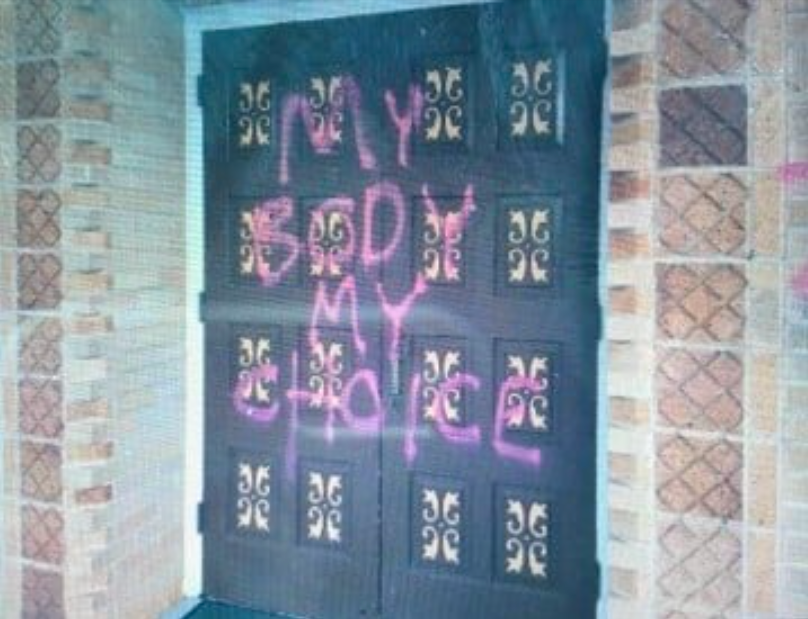
Some of this animosity has led to vandalism against U.S. churches. A Catholic church in Colorado was vandalized with graffiti showing support for legalized abortion days after the Supreme Court decision. This is how The Christian Post recently reported the story. This is long, but essential:

St. Louis Catholic Church, located in the Boulder suburb of Louisville, became the target of vandalism from abortion activists over the weekend. The doors to the church were spray-painted with the declaration “My body, My choice,” a common refrain among pro-choice activists. Church members discovered the graffiti when they gathered for worship on Sunday morning.

In addition to spraying the phrase “My body, my choice” on the church's doors, vandals targeted a marker on the property that read “Respect Life,” replacing the word “Life” with the phrase “Bodily Autonomy.” Additionally, the sign at the front of the church was defaced with the phrase “bans off our bodies.”

In a Facebook post on Monday, the Louisville Police Department noted that a surveillance camera recorded three individuals on the church property at 1:30 a.m. local time Sunday and asked the public for help with identifying them.

The Christian Post, as the name states, is a niche news source. The question here — once again — is why vandalism cases of this kind receive so little attention in the mainstream press.

Please respect our Commenting Policy

My Orthodox flashback to 9/11: When will St. Nicholas truly return to Ground Zero?

My Orthodox flashback to 9/11: When will St. Nicholas truly return to Ground Zero?

On one of my first visits to New York City to teach journalism — I spent 8-10 weeks a year in lower Manhattan — I went to the window of my room high in a long-stay hotel.

I was looking straight down on the construction project to rebuild St. Nicholas Greek Orthodox Church, the tiny sanctuary that was crushed by the 9/11 collapse of the south tower of the World Trade Center. It hit me at that moment that, at some point, my “neighborhood” Orthodox parish would be the shrine at Ground Zero.

I walked past that construction project for five years, including several years in which the work was stalled by a complex mix of mismanagement, exploding costs and, some would say, fraud. The sanctuary still isn’t finished, but it’s getting closer.

Let me stress — I was not in New York City on 9/11. I was, however, in West Palm Beach, surrounded by New Yorkers in the heart of the Seinfeldian “sixth borough” of South Florida. My family attended an Orthodox parish in which 80% of the members were Arab Christians of various kinds. My Palm Beach Atlantic University office was next to the Trump Plaza towers, the mini-World Trade Center used as a symbolic target during the training flights of Mohamed Atta and other 9/11 terrorists who spent time in South Florida.

My first 9/11-related national column was about the destruction of St. Nicholas Orthodox parish, build on an interview with its priest, Father John Romas. As an Orthodox believer, I was immediately struck by these details:

The members of St. Nicholas do not think that any parishioners died when the towers, a mere 250 feet away, fell onto their small sanctuary in an avalanche of concrete, glass, steel and fire.

Nevertheless, the Orthodox believers want to search in the two-story mound of debris for the remains of three loved ones who died long ago — the relics of St. Nicholas, St. Katherine and St. Sava. Small pieces of their skeletons were kept in a gold-plated box marked with an image of Christ. This ossuary was stored in a 700-pound, fireproof safe.


Please respect our Commenting Policy

This story has been hot for about 50 years: Religion do's and don'ts in public schools

This story has been hot for about 50 years: Religion do's and don'ts in public schools

THE QUESTION:

What are the do's and don'ts on religion in U.S. public schools?

THE RELIGION GUY'S ANSWER:

As U.S. public schools cope with in-person learning in the midst of another COVID-19 upsurge and argue about "critical race theory," let's remember some good news. Divisive past disputes about how schools handle religion have been substantially settled. Debates continue on certain church-and-state issues but most deal with religious schools and taxpayer funding, not public education.

There's widespread agreement on what federal court rulings require, and on what common sense commends in light of today's pluralistic student bodies. A remarkably broad alliance of groups has joined in a series of policy statements brokered by Senior Fellow Charles Haynes at the First Amendment Center. Click here to read the full texts for yourself or print them out.

The lists of those endorsing the policies vary somewhat but typically they involve all the relevant public school associations alongside major "mainline" and "evangelical" Protestant organizations; Reform, Orthodox and "communal" Jewish groups; religious liberty advocates; and the Council on Islamic Education. Though most lack official backing from the U.S. Catholic bishops' conference, no conflicts with church thinking have been raised.

Especially significant is "A Teacher’s Guide to Religion in Public Schools," issued in 2004. Others are "A Parent's Guide to Religion in the Public Schools," "The Equal Access Act: Questions and Answers," "Religion in the Public School Curriculum: Questions and Answers," "Religious Holidays in the Public Schools: Questions and Answers," "The Bible and Public Schools: A First Amendment Guide" and "Public Schools and Religious Communities: A First Amendment Guide."

The overriding agreed principle: "The First Amendment prohibits public-school teachers from either inculcating or inhibiting religion. Teachers must remain neutral concerning religion, neutral among religions and neutral between religion and non-religion."

Thus, schools are neither "religion-free zones" nor platforms for worship or evangelism.


Please respect our Commenting Policy

In the news media storm about the Texas abortion bill: Outrage -- 1, objectivity -- 0

In the news media storm about the Texas abortion bill: Outrage -- 1, objectivity -- 0

If I had to sum up last week’s media maelstrom on Texas’ new abortion regulations, it’s this: 95 percent of the quotes was from those who opposed it. Maybe 5 percent was from those who favored it. And of that 5 percent, how many of them were inserted near the top of the piece rather than strung together near the end?

We’re talking about the Texas Heartbeat Act, aka S.B. 8, which bans abortions after a fetal heartbeat can be detected (usually around six weeks). Individuals who learn of violations can sue the clinics involved and anyone who helps women get abortions.

Which could your friendly Uber or Lyft driver, which is why both companies, according to CNBC, have offered to cover legal fees for any driver caught transporting a woman to a clinic.

Probably the most thoughtful dispatch was Emma Green’s piece in The Atlantic. It was a Q&A more than an essay, but at least it was an interview with the Other Side, which has been lambasted everywhere else for introducing a real-life Handmaid’s Tale situation into the Lone Star state. The lead sentence began:

Sometimes, the Supreme Court does the most when it does nothing. Last night, the justices denied an emergency petition by abortion providers in Texas seeking to block S.B. 8, a law banning pregnancy terminations after roughly six weeks’ gestation.

A 5–4 majority of the justices argued that they had no power to stop the law from going into effect, since none of the citizens who are now empowered under the law to sue abortion clinics for providing the procedure has yet attempted to do so.

Hold that thought. What’s new in Texas is something called “private enforcement,” by which any citizen -– and I mean anyone –- can report -– or sue -– someone trying to sneak an abortion past them. It’s a stunning legal strategy that evades the lawsuits that groups like Planned Parenthood use to quash their opponents.

Some on the pro-life side, like conservative pundit David French, aren’t happy with it at all, feeling that it’s bad law that will end up biting pro-lifers in the end. He is not the only abortion opponent who feels this way but there was zero reporting out there on the mixed feelings in his camp. Back to The Atlantic:

Legal challenges likely lie ahead. But abortion opponents see this as a victory, however temporary. For now, at least, abortion clinics in Texas are largely suspending their work and abiding by the ban.

The article continues as an interview with John Seago, the legislative director of Texas Right to Life who, more than anyone, contributed to the success of this law. Right away, Green jumped to the crux of the law; people reporting on other people. His answer:

There are two main motivations. The first one is lawless district attorneys that the pro-life movement has dealt with for years. In October, district attorneys from around the country publicly signed a letter saying they will not enforce pro-life laws. They said that even if Roe v. Wade is overturned, they are not going to use resources holding the abortion industry to account. That shows that the best way to get a pro-life policy into effect is not by imposing criminal penalties, but civil liability.

The second is that the pro-life movement is extremely frustrated with activist judges at the district level who are not doing their job to adjudicate conflicts between parties, but who in fact go out of their way to score ideological points—blocking pro-life laws because they think they violate the Constitution or pose undue burdens.

For anyone wishing to understand why Texans went to this “private enforcement” stratagem is because they’ve tried everything else for the 48 years that Roe v. Wade has been in effect. And with a legal system set against them no matter what they do, it was time to come up with something else. And they did.


Please respect our Commenting Policy

Plug-In: Ida, abortion and Afghanistan: The best religion reads in stunning news week

Plug-In: Ida, abortion and Afghanistan: The best religion reads in stunning news week

I was in Waverly, Tenn., reporting on the aftermath of historic flooding that claimed 20 lives as Hurricane Ida — “one of the most powerful storms ever to hit the U.S.” — made landfall in Louisiana on Sunday.

On Monday afternoon, as I was boarding a flight in Atlanta to return home to Oklahoma City, The Associated Press sent a “flash” — its designation for “a breaking story of transcendent importance” — about the chaotic end of America’s 20 years of war in Afghanistan.

Guess what?

The big news week was just getting started.

By midnight Wednesday, a divided U.S. Supreme Court had provided “a momentous development in the decades-long judicial battle over abortion rights.” The court declined, at least for now, to overrule a new Texas law that bans most abortions in the state, raising hope among abortion opponents and concern among abortion-rights supporters that Roe v. Wade could be jeopardy.

Also, Ida’s “weakened remnants tore into the Northeast and claimed at least 43 lives across New York, New Jersey and two other states in an onslaught that ended Thursday and served as an ominous sign of climate change’s capacity to wreak new kinds of havoc.”

The news just keeps coming, and I haven’t even mentioned COVID-19 — which continues to rage with cases and hospitalizations “at their highest level since last winter.”

Mercy.

Power Up: The Week’s Best Reads

1. Afghanistan’s arc from 9/11 to today: once hopeful, now sad: This is a powerful read by Kathy Gannon, Afghanistan and Pakistan news director for The Associated Press.

“A country of 36 million, Afghanistan is filled with conservative people, many of whom live in the countryside,” Gannon explains. “But even they do not adhere to the strict interpretation of Islam that the Taliban imposed when last they ruled.”


Please respect our Commenting Policy

Devil is in the details, when covering battles inside the powerful McLean Bible Church

Devil is in the details, when covering battles inside the powerful McLean Bible Church

When I hear of a hostile takeover in a church, I think back to around 2006 when conservative Episcopalians were breaking free of their denomination, reclaiming the name “Anglican” and trying to take their church properties with them.

Usually they failed with conservative and liberal sides accusing each other of malfeasance. The lawyers got paid, of course.

This time around, the headlines are about conflict inside the largest evangelical church in the Washington, D.C., area and because it’s in northern Virginia, where so many inside-the-Beltway workers live, its problems have gotten a lot of press interest. It didn’t hurt that then-President Donald Trump visited the place on June 2, 2019, which stirred up lots of people.

Here’s a Washington Post piece that tries to explain what’s going on:

The leaders of McLean Bible, one of the D.C. region’s largest and most high-profile evangelical churches, are facing attempts from its own members to spread disinformation to take control of the church, Pastor David Platt warned the congregation in a sermon earlier this month.

Last month, the church was supposed to vote in new elders who oversee the church, and a group tried to shore up enough votes to block the appointed leaders. In a sermon on July 4, Platt said the group told other church members as they were walking into the meeting that the new elders would try to persuade church leadership to sell the church’s building in Vienna, Va. to local Muslims who would build a mosque.

McLean Bible — which is seen as a conservative evangelical congregation and once had more than 16,000 attendees — has long been an important church in Washington with four locations near the city. But threatening McLean now is a group that has spread all kinds of rumors, Platt said.

OK, so a local megachurch is having a catfight. How does one make such a story interesting to the rest of the world?

Simple: Make it about a greater issue, such as the generational conflict or politics, which is what NPR did in calling the place “a hub for Republican senators and Bush aides.”


Please respect our Commenting Policy

Once again, U.S. Supreme Court chooses to punt on a major religious liberty case

Once again, U.S. Supreme Court chooses to punt on a major religious liberty case

Florist Barronelle Stutzman and Robert Ingersoll have shared many details from the 2013 conversation that changed their lives and, perhaps, trends in First Amendment law.

For nine years, Ingersoll was a loyal customer at Arlene's Flowers in Richland, Wash., and that included special work Stutzman did for Valentine's Day and anniversaries with his partner Curt Freed. Then, a year after the state legalized same-sex marriages, Ingersoll asked her to design the flower arrangements for his wedding.

Stutzman took his hand, Ingersoll recalled, and said: "You know I love you dearly. I think you are a wonderful person, but my religion doesn't allow me to do this."

In a written statement to the Christian Science Monitor, Ingersoll wrote: "While trying to remain composed, I was … flooded with emotions and disbelief of what just happened." He knew many Christians rejected gay marriage but was stunned to learn this was true for Stutzman.

As stated in recent U.S. Supreme Court documents: "Barronelle Stutzman is a Christian artist who imagines, designs and creates floral art. … She cannot take part in or create custom art that celebrates sacred ceremonies that violate her faith."

This legal drama appears to have ended with Stutzman's second trip to the high court and its July 2 refusal to review a Washington Supreme Court decision the drew a red line between a citizen's right to hold religious beliefs and the right to freely exercise these beliefs in public life. Supreme Court justices Clarence Thomas, Samuel Alito and Neil Gorsuch backed a review, but lacked a fourth vote.

"This was shocking" to religious conservatives "because Barronelle seemed to have so many favorable facts on her side," said Andrew T. Walker, who teaches ethics at Southern Baptist Theological Seminary.

Stutzman is a 76-year-old grandmother and great-grandmother who faces the loss of her small business and her retirement savings. She has employed gay staffers. She helped Ingersoll find another designer for his wedding flowers. In the progressive Northwest, her Southern Baptist faith clearly makes her part of a religious minority.

"Barronelle is a heretic because she has clashed with today's version of progressivism," said Walker.


Please respect our Commenting Policy

That New Yorker #FreeBritany feature: It's all about a Baptist daddy and his wild daughter?

That New Yorker #FreeBritany feature: It's all about a Baptist daddy and his wild daughter?

One thing is clear, when you read the long, sad (but buzz-worthy) feature in The New Yorker entitled “Britney Spears’s Conservatorship Nightmare.”

Britney is a celebrity.

When she goes to court, she is a celebrity. When she escapes to a pub, she is a celebrity. When she fights to see her children, she is a celebrity. When she has a nervous breakdown (especially in public), she is a celebrity.

If and when she ever returns to church (there are rumors), she will do so as a celebrity. Ditto for any return to celebrity friendly Kabbalah classes.

But you get what you expect in this feature, written by Ronan Farrow and Jia Tolentino. There’s a huge cast of characters, some who speak on the record and some who do not. There are waves of details from court documents and testimony. There’s an endless survey of public scenes and paparazzi chases.

But the second line of the double-decker headline points to the heart of the story: “How the pop star’s father and a team of lawyers seized control of her life — and have held on to it for thirteen years.”

This is a story about a fight between a Baptist father (simply “Jamie” in most of the story) and his wild daughter — who has lived her entire teen and adult life in the glare of a media spotlight that burned her, even as it poured wealth on everyone around her, including members of her immediate family.

What about faith issues? There are fleeting glimpses of religion “ghosts” throughout this story. However, there is evidence that The New Yorker team realizes that, behind all of the talk about Britney’s mental health, the father and daughter are fighting about the moral choices she has made in her private life. Meanwhile, the daughter keeps trying to break free from this noose, in part through sex, love, marriage and children.

Consider the implications of this passage, referring to the legal drama that pulled the #FreeBritney social-media world back into the headlines:


Please respect our Commenting Policy

Lawsuits and scarce donors: Religious colleges could be facing tough years ahead

Lawsuits and scarce donors: Religious colleges could be facing tough years ahead

A narrowly-framed Supreme Court victory — the Fulton v. Philadelphia case — will allow Catholic Charities (at least for now) to preserve religious conscience and avoid placing foster children and children available for adoption with same-sex couples, despite the city's non-discrimination statute.

However, this does not settle the many similar legal disputes the media will be covering the next few years.

In particular, reporters will want to carefully monitor Hunter v. U.S. Department of Education, a potentially huge lawsuit filed in Oregon federal court March 29. This is a class action with 33 plaintiffs represented by Portland attorney Paul Southwick, director of the Religious Exemption Accountability Project or REAP (paul@paulsouthwick.com and 503-806-9517). Alliance Defending Freedom, a familiar participant in such matters, has filed a bid to defend the religious schools (media@adflegal.org or 480-444-0020). There are questions about the degree to which the current Justice Department will help in this defense.

The suit charges that LGBTQ students suffer "abuses and unsafe conditions" at "hundreds" of U.S. religious colleges with traditional doctrinal covenants so government should cut off their financial aid. Except for Brigham Young University and the Church of Jesus Christ of Latter-day Saints, REAP's targets are Protestant, led off by Oregon's George Fox University, a venerable Quaker campus attended by Herbert Hoover when it was a mere secondary school. George Fox's mission statement declares that "we desire the presence of Christ to be at the core of all we do."

Others include the likes of Azusa Pacific University, Baylor University, Bob Jones University, Dordt University, Eastern University, Fuller Theological Seminary, Liberty University, Messiah University, Moody Bible Institute, Seattle Pacific University, Union University and Westmont College. (Notably missing: Calvin, Gordon, Wheaton.)

Loss of aid for students would be a severe competitive blow in coming years when all colleges and especially private and religious ones expect to suffer declines in the student-age population and thus in applications, this on top of the institutional damage wrought by COVID-19. There are also prospective attacks on such schools' tax exemption and academic accreditation over sexuality. The status of athletic programs is also a hot-button issue.


Please respect our Commenting Policy