LGBTQ

New podcast: Rising tensions between religious liberty, pronoun wars, academic freedom, etc.

New podcast: Rising tensions between religious liberty, pronoun wars, academic freedom, etc.

My name is Terry Lee Mattingly. However, when I converted to Eastern Orthodoxy, I took the name of a patron saint — St. Brendan the Navigator.

Let’s pretend that I am young and attending a state university right now and that I have decided to require professors to address me as “Holy St. Brendan the Navigator.” It is, after all, my name. While we are at it, let’s say that all of the Catholic and Orthodox students take the same tack, if their saint names are different then the names they were given at birth.

Some professors would wince, but go along with this. But let’s say that one professor is very secular, a Marxist perhaps, and he refuses — stating that my request violates his personal convictions. I threaten to sue, along with other students in the same situation. Game on.

How would the leaders of this taxpayer-funded public university respond? Would this be treated as a natural request on my part, with the understanding that any refusal would attack my sense of identity? What if I requested that my university ID card state my name as “St. Brendan the Navigator”?

It’s a crazy question, of course. But it would — at a state university — raise issues about the First Amendment (free speech and religious liberty) and academic freedom. These questions were at the heart of this week’s “Crossroads” podcast discussion. Click here to tune that in. [This episode also includes a bizarre gaffe when — I’m wrestling with a painful medical condition right now — I messed up my own saint’s name, mixing St. Brendan’s title with that of St. Nicholas of Myra. Listen for it.]

At the heart of the podcast discussion is a timely question: Can the state force the professor to recognize and even affirm — with public speech — beliefs that violate his conscience?

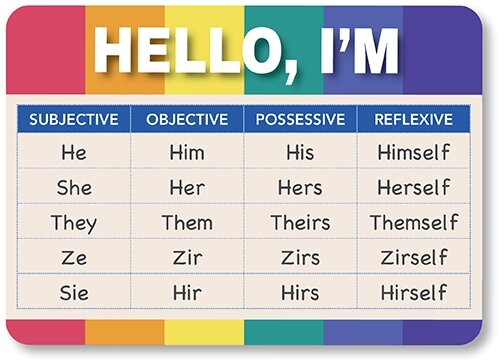
Now, as readers probably guessed right from the get go, this podcast focuses on another matter of personal identity — the degree to which professors can be forced to cooperate with students who chose to use any of the myriad and evolving gender pronouns linked to the LGBTQ+ movement. We looked at a Washington Post story with this headline: “A professor was reprimanded for refusing to use a transgender student’s pronouns. A court says he can sue.

Now, when these clashes take part in PRIVATE schools — left or right, religious or secular — it’s clear (pending passage of the Equality Act) that these doctrinally defined institutions have a right to create belief and lifestyle covenants that settle issues of this kind. Students can chose to affirm these beliefs, freely signing on the dotted line, or go to school somewhere else.

But what about state schools built and operated with tax dollars?

Please respect our Commenting Policy

Ex-gay Catholic, Muslim shooter, Orthodox Jewish writer: They just don't fit the narrative?

Ex-gay Catholic, Muslim shooter, Orthodox Jewish writer: They just don't fit the narrative?

An infamous gay personality known for his approving comments about pedophilia has had a 180-degree conversion, given up homosexual sex and has consecrated himself to St. Joseph.

Not a joke. The news broke about a month ago. Not read about it? Well, the story is out there, but mostly conservative sites are reporting on it.

Why is this? Well, it all has to do with narrative. Let’s start with the New York Post’s read on it:

Right-wing provocateur Milo Yiannopoulos has come out as “ex-gay” – announcing that he “would like to help rehabilitate what the media calls “conversion therapy” over the next decade, according to a report.

The 36-year-old British political commentator, whose speeches and writings often ridicule political correctness, social justice and feminism, declared himself no longer gay and “sodomy free,” he told LifeSite in an interview.

Yiannopoulos — who once said that sex between 13-year-olds and older men can be “life-affirming” — told the outlet that he is now leading a daily consecration online to St. Joseph.

“When I used to kid that I only became gay to torment my mother, I wasn’t entirely joking,” he said.

But what about his gay marriage?

As far as his personal life, Yiannopoulos said of his husband: “The guy I live with has been demoted to housemate, which hasn’t been easy for either of us. It helps that I can still just about afford to keep him in Givenchy and a new Porsche every year. Could be worse for him, I guess.”

Now we all know that if a major (or even not-so-major) evangelical figure can gone the opposite direction, the media would be all over it. Look at the coverage that Josh Harris, celeb author of “I Kissed Dating Good-bye,” got when he dumped his faith and was last seen marching in a gay pride parade in Vancouver, BC.


Please respect our Commenting Policy

Welcome to Holy Days 2021: How to handle the latest sensational claim about the Bible

Welcome to Holy Days 2021: How to handle the latest sensational claim about the Bible

The New York Times often ignores developments in religious scholarship, an especially serious deficiency of its Sunday Book Review (where Nash K. Burger, who was hired by fellow Mississippian Eudora Welty, long and carefully monitored the field until he retired in 1974).

Thus, hallelujahs should greet a huge article by culture reporter Jennifer Schuessler, posted March 10 and granted two full pages in the Arts & Leisure section of last Sunday's print edition.

The piece reports that young Israeli-American scholar Idan Dershowitz may have identified "the oldest known biblical manuscript by far," which offers "an unprecedented window into origins and evolution of the Bible" and, in particular, the Book of Deuteronomy. If substantiated, some say, this "will be the most consequential Bible-related discovery since the Dead Sea Scrolls in 1947."

Or not. Journalists assessing what's hot should consider that across the years, manuscript frauds and ill-supported speculations about the Bible have been rife.

The Times is known to sometimes "bury the lede," and in this case it buried the news peg. The piece was nicely timed for Jewish Passover and Christian Holy Week when media often dig into biblical mysteries and controversies. But the news here is the April publication of Dershowitz's book "The Valediction of Moses: A Proto-Biblical Book."

The book will fill in the missing element in the Times story and thus provide major fresh substance for reporters to develop: Which portions of Deuteronomy are involved in this discussion, and how do specific wordings and passages in today's Bibles compare with the purportedly ancient texts Dershowitz cites? On that basis, what do the agreements and contrasts tell us and why?

Dershowitz seeks to rehabilitate Wilhelm Moses Shapira, whose 19th Century Jerusalem shop sold both tourist trinkets and allegedly valuable ancient manuscripts. He tried to sell these Deuteronomy fragments to a regular customer, the British Museum, but its expert and others declared them forgeries in 1883, based on what Dershowitz considers slipshod study.

Shamed, Shapira soon committed suicide in Rotterdam. The leather fragments themselves then disappeared.


Please respect our Commenting Policy

Returning to Kamp Kanakuk: Is this new expose a work of journalism, theology or both?

Returning to Kamp Kanakuk: Is this new expose a work of journalism, theology or both?

Readers with long memories will recall that, when the Internet arrived it had an immediate impact on important subjects that rarely received adequate coverage in mainstream media.

Take religion, for example. The lower cost of publishing online led to an explosion of forums, listservs, newsletters, online “radio” channels, podcasts and weblogs. Some failed or evolved into new forms — consider the long and complicated histories of Beliefnet and Patheos — and others became, well, normal.

Now, in the “cancel culture” era, it’s clear that another example of online evolution is affecting serious coverage of religion, as well as other complicated topics.

I am referring to the controversies surrounding Substack and the myriad newsletters and alternative publications thriving there. For a sample of the fea paranoia surrounding Substack, click into this thread from a professor at the UCLA Center for Critical Internet Inquiry or read between the lines of this Washington Post column: “The Substack controversy’s bigger story.” Here is a sample of that:

Substack is a start-up for self-publishing email newsletters: Writers decide how often to write and whether and how much to charge; Substack sends the newsletters and collects any fees. The ease of use has made it popular with journalists. …

Some of the most prolific users are heterodox political writers who had found mainstream publications an increasingly poor fit. A number quickly rose to the top of the Substack leader boards. This attracted the gimlet eye of the cancelers: Other online writers — some of whom had their own Substack newsletters — have leveled accusations of transphobia and other offenses. A nascent boycott aims to pressure Substack into deplatforming the alleged offenders. Reportedly, their campaign is having some effect.

“Heterodox” is an interesting word. It appears, in this context, to define the work of various kinds of conservatives or, even worse, free thinkers (Andrew Sullivan and Bari Weiss, for example) who accuse many “liberals” or “progressives” of turning dangerously illiberal.

This brings me to this weekend’s must-read missive from Nancy and David French, care of The Dispatch, an alternative conservative online publication that is thriving in this new online environment. Here is the dramatic double-decker headline atop this long feature:

‘They Aren’t Who You Think They Are’

The inside story of how Kanakuk — one of America’s largest Christian camps — enabled horrific abuse.


Please respect our Commenting Policy

Catholic left seeks (and finds?) signs of hope after Vatican ruling on same-sex unions

Catholic left seeks (and finds?) signs of hope after Vatican ruling on same-sex unions

After a media firestorm ignited by a Vatican condemnation of same-sex unions -- because God "cannot bless sin" -- Catholic progressives immediately looked for hope in the words of bishops, President Joe Biden and even Pope Francis.

In his Sunday Angelus address after the March 15 ruling, the pope stressed that modern seekers want to "see Jesus" in acts of love, not persecution.

Catholics must promote "a life that takes upon itself the style of God -- closeness, compassion and tenderness," said the pope. "It means sowing seeds of love, not with fleeting words but through concrete, simple and courageous examples, not with theoretical condemnations, but with gestures of love. Then the Lord, with his grace, makes us bear fruit, even when the soil is dry due to misunderstandings, difficulty or persecution, or claims of legalism or clerical moralism."

While Pope Francis gave "his assent" to this ruling, the Jesuit publication America cited anonymous Vatican sources saying the Angelus remarks suggested that he was "distancing himself" from the work of the Congregation for the Doctrine of the Faith.

That document said God "does not and cannot bless sin: He blesses sinful man, so that he may recognize that he is part of his plan of love and allow himself to be changed." As for same-sex unions, it added: "The presence in such relationships of positive elements … cannot justify these relationships and render them legitimate objects of an ecclesial blessing, since the positive elements exist within the context of a union not ordered to the Creator's plan."

Bishop Johan Bonny of Antwerp -- who represented Belgium at the 2015 Vatican Synod on Marriage and the Family -- said those words left him "ashamed on behalf of my Church. … I want to apologize to all those for whom this 'responsum' is painful and incomprehensible: faithful and committed Catholic homosexual couples, the parents and grandparents of homosexual couples and their children, pastoral workers and counsellors of homosexual couples," he wrote on Facebook.

"I know homosexual couples who are legally married, have children, form a warm and stable family, and moreover, actively participate in parish life. A number of them are employed full-time in pastoral work or ecclesial organizations." Why, he added, deny the "similarity or analogy with heterosexual marriage here?"


Please respect our Commenting Policy

New podcast: Tensions with NCAA and Christian schools? That issue will not go away

New podcast: Tensions with NCAA and Christian schools? That issue will not go away

A decade or so ago, I had a chance to speak to journalism students at Oral Roberts University. My strongest memories — other than visions of the shiny modernist architecture — center on an unusual moment during a campus chapel service.

There’s nothing unusual about a Christian university having a full-house chapel service. There’s nothing unusual about a student-led praise-rock band blasting out Contemporary Christian Music songs that inspired lots of people to do their share of swaying and dancing.

But here’s the memory. My visit to the campus took place during a meeting of ORU’s board of trustees, who sat together near the front of the auditorium during chapel. Looking down from the balcony, I was surprised to see that (a) many of the trustees were rather young, (b) a much higher than normal number of them were Black or Latino and (c) several were enthusiastically dancing with the students, including at least one in an aisle (the current board doesn’t look quite as young).

All of this was a reminder that much of the racial and cultural diversity at ORU — a major factor in campus life — was and is linked to the school’s roots in charismatic and Pentecostal Christianity, a movement that as been highly multiracial since its birth. Founder Oral Roberts was a famous, and often controversial, leader among charismatic Christians, even though, as an adult, he aligned with the United Methodist Church (which is more conservative in Oklahoma than, let’s say, parts of Illinois and other blue zip codes).

I bring this up because of a recent USA TodayFor the Win” column that served as the hook for this week’s “Crossroads” podcast (click here to tune that in). Here’s the headline for that piece, which was written by the “race and inclusion editor” at USA Today sports: “Oral Roberts University isn't the feel good March Madness story we need.” Here is a crucial passage:

… As the spotlight grows on Oral Roberts and it reaps the good will, publicity and revenue of a national title run, the university’s deeply bigoted anti-LGBTQ+ polices can’t and shouldn’t be ignored.

Founded by televangelist Oral Roberts in 1963, the Christian school upholds the values and beliefs of its fundamentalist namesake, making it not just a relic of the past, but wholly incompatible with the NCAA’s own stated values of equality and inclusion.


Please respect our Commenting Policy

Keeping up with the times: If schools nix 'Mom and Dad,' is mainstream journalism next?

Keeping up with the times: If schools nix 'Mom and Dad,' is mainstream journalism next?

Reporters and editors want to be sensitive to personal and minority-group concerns alongside their professional duty to be clear, accurate and non-partisan.

How to handle this balancing act amid the West's fast-evolving verbiage to accommodate feminist or LGBTQ+ advocates? The media need to consider that proposed prohibitions now go well beyond replacement of "binary" pronouns with the singular usage of they-them-their (which breaks strict grammar in English and creates ambiguity on antecedents).

Grace Church School in lower Manhattan (sticker price $57,330 per year) provides a revealing rundown on new expectations for usage and diction in its "Inclusive Language Guide," enacted last September. It says e.g. that instead of "boys and girls," school personnel should now say "people, folks, friends," or specifics like "readers" or "mathematicians." Similarly, "husband, wife, boyfriend, girlfriend" give way to "spouse / partner / significant other." The Grace community is asked to say "grown-ups, folks or family" and shun the formerly acceptable "parents" or "Mom and Dad."

Some Moms and Dads were apparently upset upon learning about the guide when posted online in January. School leaders defended their new "inclusive" regimen but hastened to explain that wordings are "suggested," not "mandatory," and apply to the adult faculty and staff, not students.

The 12-page Grace guide, posted here under "Antiracism Resources" at is by no means unique in concept. It draws from such resources as the 2018 "language values" policy at New York City's Bank Street College of Education, which media policy-makers need to be monitoring.

The key disputes involve LGBTQ+ expectations and especially regarding gender identity and fluidity. Grace opposes "heteronormativity," that is, "the assumption that cisgender is the 'norm' or standard and transgender is the outlier or an abnormality." (Editors should ponder the "cisgender" neologism for labeling persons whose gender identity or gender expression matches their biology.)

"Language is constantly evolving," Grace correctly states, and the longstanding term "homosexual" should be eliminated. "More appropriate" designations include "queer,” formerly a derogatory equivalent of the N-word — but now rehabilitated as individuals' deliberate "political identification."


Please respect our Commenting Policy

Wait a minute: How is a sermon on the Second Coming linked to shootings in Atlanta?

Wait a minute: How is a sermon on the Second Coming linked to shootings in Atlanta?

The hellish shootings in Atlanta have unleashed fierce debates combining questions about sex, sin, salvation, repentance, race and various combinations of all of those hot-button topics.

The debates center, of course, of statements by Robert Aaron Long — the suspect in the killing of eight people, including six Asian women — and his complicated and troubled history as a young member of Crabapple First Baptist Church in Milton, Ga., a Southern Baptist congregation.

Eventually, court testimony will provide hard facts about this case. At this point, all the evidence is that Long was raised as a conservative Christian, was active in his church youth group and that he abandoned his faith and then, quite literally, all hell broke loose in his personal and family life. Long has said that a “sex addiction” drove him to frequent massage parlors and his family, apparently, sent him to a Christian counseling center for treatment. His conservative Christian parents “threw him out of the house” the night before the shootings, according to reports in the Washington Post and elsewhere.

Like I said, on-the-record details will emerge. Right now, I want to raise a journalism question or two about coverage of the SBC congregation that is involved in this story. What do we know about this church and, well, how do we know what we know? One Post story notes the following, quoting a solid, factual source:

The evangelical congregation’s minister, the Rev. Jerry Dockery, is an energetic preacher who advocated for a socially conservative brand of Christianity that, as the church bylaws put it, views “adultery, fornication, homosexuality, bisexual conduct, bestiality, incest, polygamy, pedophilia, pornography, or any attempt to change one’s sex, or disagreement with one’s biological sex” as “sinful and offensive to God.”

This isn’t shocking material, if you know anything about traditional forms of Christianity. It would be easy to find specific quotations from recent Catholic popes — including Pope Francis — condemning behaviors such as these, and more.

This congregation is also connected to several doctrinally conservative organizations or movements linked to SBC life, such as the Founders Ministries. All of this leads me to a specific sermon reference discussing the end of the world and Christian teachings about the second coming of Jesus Christ. Oh, and if you stop and think about it, this includes the church’s pastor — indirectly — offering a warning about Christians worshipping political leaders such as Donald Trump.

Say what?


Please respect our Commenting Policy

3D chess in Rome? Pope Francis approves Vatican decree affirming doctrines on marriage

3D chess in Rome? Pope Francis approves Vatican decree affirming doctrines on marriage

All together now: Is the pope Catholic?

Actually, in this age of conspiracy theories — on right and left — the question of the day appears to be: Is THIS pope Catholic? I am referring, of course, to the Vatican’s decision to affirm centuries of Christian doctrine stating that sex outside of marriage is (trigger warning) “sin” and that the sacrament of marriage is limited to the union of a man and a woman.

But, but, but, clearly Pope Francis must be playing some kind of three-dimensional chess with this action, moving the doctrinal pieces in some subtle way that will become clear in “reforms” at a later date? This was a case in which one could catch whiffs of disappointment and even conspiracy thinking on both the Catholic left and right (and in the press).

To see this in print, check out the overture in this Washington Post report: “Pope Francis says priests cannot bless same-sex unions, dashing hopes of gay Catholics.” The headline assumes, of course, that all gay Catholics oppose the church’s teachings on this matter but, well, nevermind.

ROME — Pope Francis has invited LGBT advocates to the Vatican. He has spoken warmly about the place of gay people in the church. He has called for national laws for same-sex civil unions.

But Monday, Francis definitively signaled the limits to his reformist intentions, signing off on a Vatican decree that reaffirms old church teaching and bars priests from blessing same-sex unions.

The pronouncement, issued at a time when some clerics were interested in performing such blessings, leans on the kind of language that LGBT Catholics have long found alienating — and that they had hoped Francis might change. It says that same-sex unions are “not ordered to the Creator’s plan.” It says acknowledging those unions is “illicit.” It says that God “cannot bless sin.”

The decree shows how Francis, rather than revolutionizing the church’s stance toward gays, has taken a far more complicated approach, speaking in welcoming terms while maintaining the official teaching. That leaves gay Catholics wondering about their place within the faith, when the catechism calls homosexual acts “disordered” but the pontiff says, “Who am I to judge?”

Let’s see. We have the standard use of the word “reform” to prejudge this matter. We have a sense of yearning that Pope Francis is taking a “more complicated approach” to this doctrinal issue.


Please respect our Commenting Policy