
Julia Duin

Anglican ordinariates: Crux explains it well; the Houston Chronicle, not so much

For those of us who follow the ins and outs of Episcopalians, Anglicans and Catholics, there was an interesting development recently when the Vatican appointed a bishop to oversee 42 Anglican-rite North American churches. They had converted as congregations to Catholicism but retained some of their Anglican liturgies and customs, such as married clergy.

This group of Anglican churches is called an ordinariate and a system of bringing them into the Catholic fold was created in 2009 by Pope Benedict XVI. The priest he originally tapped to head it up was the Rev. Jeffrey Steenson, the former Episcopal bishop of the Albuquerque-based Rio Grande diocese (which is New Mexico and a corner of far west Texas).

Steenson was elected bishop in October 2004 and consecrated in January 2005. Then less then two years later in September 2007, he shocked his diocese by announcing he was turning Catholic and resigning his position. More on Steenson in a bit, but first see how the Houston Chronicle covered the new bishop:

Days before the Catholic Church announced Steven Lopes’ impending appointment as bishop, the 40-year-old cleric had a brief conversation with Pope Francis.
Lopes reminded the pontiff of the instructions he had given to new bishops, urging them to “tend to the flock of God that is in your charge” and not become “airport bishops.”
“I asked for a little exception,” Lopes said Tuesday, as about 50 people gathered in the sunlit Great Hall of Our Lady of Walsingham burst into laughter. “I imagine I’ll be on the road a lot.”

Please respect our Commenting Policy

Washington Post misses multiple hints about faith in Eagles of Death Metal story

Washington Post misses multiple hints about faith in Eagles of Death Metal story

I’m not really a heavy metal fan but when I saw this piece posted in the Washington Post about the band that was playing during the terror attacks at the Bataclan concert hall in Paris, I had to take a second look.

I was swimming through this longish piece when I began noticing all sorts of hints about faith being dropped by Jesse Hughes, the lead singer of Eagles of Death Metal. Anyone who’s been in a Christian subculture could pick them up instantly. I am not sure the reporter was attuned to this at all, unfortunately, and Hughes wasn't really big on the God talk but he kept dropping hint after hing. It's obvious this man is one mixed-up guy, albeit quite entertaining.

Anyway, this piece has more ghosts (places where the reporter should have picked up on the spiritual element) than a Hogwarts Halloween party. Here’s how it started:

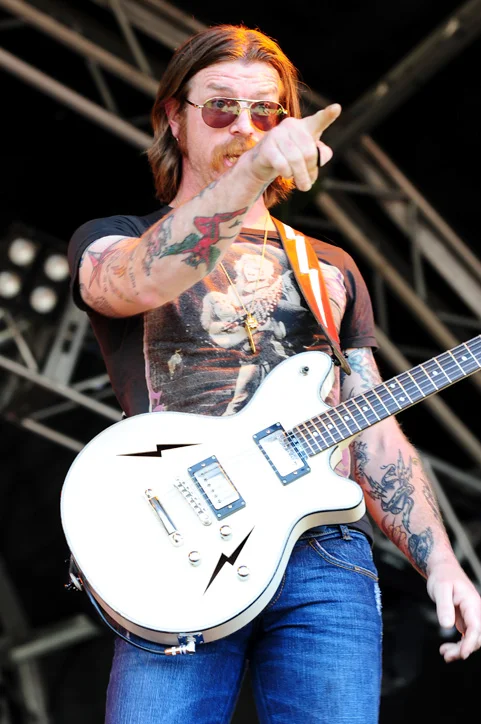
From head to toe, the Eagles of Death Metal lead singer is like a neon sign advertising the trappings of American rock. Tight jeans. Bright tattoos. Bold views. Wild hair. Several stints in drug rehab. And above all: sexually charged lyrics.
On Nov. 13, Hughes was belting those sexually suggestive lyrics on stage when three members of the Islamic State forced their way into the Bataclan concert hall in Paris. Hughes managed to escape but scores of his fans did not. Strapped with suicide vests and armed with Kalashnikovs, the gunmen slaughtered 89 people at the Bataclan. Across the city, coordinated attacks claimed 41 more lives.
In a statement, the Islamic State tried to paint the concert hall as a hedonistic pleasure palace “where hundreds of pagans gathered for a concert of prostitution and vice.”


Please respect our Commenting Policy

Holiday fare? National Geographic delivers a meandering mess on the Virgin Mary

Just in time for Christmas, National Geographic magazine has given us an article “How the Virgin Mary became the world’s most powerful woman” for its December issue. Sounds like a great story, I thought.  Then I saw the splashy graphics mapping Marian sightings around the world and the photos of various Marian devotees. I realized this article wasn’t about Mary, it was about the people who say they’ve seen Mary and those who pray to her. And sure enough, a story that promised so much failed to deliver in a big way.

Here’s how it begins:

It’s apparition time: 5:40 p.m. In a small Roman Catholic chapel in Bosnia and Herzegovina, in the village of Medjugorje, Ivan Dragicevic walks down the aisle, kneels in front of the altar, bows his head for a moment, and then, smiling, lifts his gaze heavenward. He begins to whisper, listens intently, whispers again, and doesn’t blink for ten minutes. His daily conversation with the Virgin Mary has begun.


Please respect our Commenting Policy

The New Yorker does amazing profile of former Westboro Church rising star

It’s been three years ago this month that the bad girl of the Westboro Church crowd deserted the group with her sister. This month, the New Yorker came out with a huge piece on how and why she left. The lead photo shows Megan Phelps-Roper posed in something with black straps with a tiny nose ring in one nostril. Obviously something’s changed big time.

We've reported on Westboro before, sometimes in the context of whether to cover their bizarre antics. One doesn’t decide to leave such a famous group – and one’s own family -- lightly, especially when you’ve been picketing the funerals of AIDS victims since age 5 and giving interviews since age 11. And lo and behold, we find that it was Twitter, of all things, that eased Phelps-Roper out the door.

From the middle of the story:

Phelps-Roper first considered leaving the church on July 4, 2012. She and (her sister) Grace were in the basement of another Westboro family’s house, painting the walls. The song “Just One,” by the indie folk group Blind Pilot—a band that C.G. had recommended—played on the stereo. The lyrics seemed to reflect her dilemma perfectly: “And will I break and will I bow / if I cannot let it go?” Then came the chorus: “I can’t believe we get just one.” She suddenly thought, What if Westboro had been wrong about everything? What if she was spending her one life hurting people, picking fights with the entire world, for nothing? “It was, like, just the fact that I thought about it, I had to leave right then,” she said. “I felt like I was going to jump out of my skin.”  …


Please respect our Commenting Policy

Houston Chronicle's effusive description of new Hines Center lacks critical distance

Back in the mid-1980s, I spent more than 3 ½ years working for the Houston Chronicle, which was situated downtown on Texas Avenue. A mere two blocks away was Christ Church Cathedral, which became quite the hangout for the lunchtime crowd during my years at the Chron, because of a restaurant on its premises. The cathedral had its share of programs and events, but the real energy center for the local Episcopalians was St. John the Divine, a parish several miles west of downtown.

Much has changed in the Diocese of Texas since then, including a recent innovation I just read about in the Chronicle about the new Bishop John E. Hines Center for Spirituality and Prayer. Here’s how it’s described:

Christ Church Cathedral, a fixture in the heart of downtown Houston, sits just 6 sprawling Houston miles from Joel Osteen’s Lakewood Church, the largest megachurch in the world.


Please respect our Commenting Policy

Describing new Mormon policy against baptizing children of gay parents is tough sell for most media

It was a tough religion story to write. A major religious group decided it would not baptize the children of its gay adherents and their decision was slidden unannounced past the church's rank and file. It ended up on Facebook and cause such a ruckus late last week, that reporters had to scramble to put something together just before a weekend, with the hopes of adding to it later on.

Probably the best summation of the newest Latter-day Saints policy was best summed up by Peggy Fletcher Stack in the Salt Lake Tribune:

No part of the new LDS policy on same-sex couples has generated more controversy — and criticism — than its prohibition against Mormon rituals for their children.
Stories flooding social media tell of canceled baby blessings, postponed baptisms, aborted priesthood ordinations and withdrawn missionary applications. Even many devout Mormons — including congregational and regional leaders — report distress, despondence and despair over the upheaval.


Please respect our Commenting Policy

Are most religious kids really 'jerks'? Depends on how you read a survey

Headline writers had a field day last week with a story about an international survey involving the attitudes of religious versus non-religious kids. They ranged from “Religious Kids are Jerks” from the Daily Beast to the Oregonian’s “Religious kids are harsher and less generous than atheist ones, study says.”

The survey came out of the University of Chicago, but involved scholars (and kids) from six countries: Turkey (Istanbul), South Africa (Cape Town), Canada (Toronto), Jordan (Amman), China (Guangzhou) and Chicago itself. It involved 1,170 5-to-12-year-olds.

Now for those of us whose experience of grade school was akin to "Lord of the Flies," the thought of interviewing first through sixth graders for proof of moral grounding is pretty laughable. Why not slightly older children who've had a few more years of formation in their family's religion?

Here is how the Oregonian report began:

When it comes to teaching kids the Golden Rule, Sunday school might not be the best bet.
A new study in the journal Current Biology found children in religious households are significantly less generous than their non-religious peers.
At the same time, religious parents were more likely than non-religious ones to consider their children empathetic and sensitive to the plight of others.

Now I took a graduate-level research methods class two years ago, which taught me a bit more about looking to see how studies are conducted. What I found wasn’t quite what certain media described the situation as being.


Please respect our Commenting Policy

Does the priest in this Los Angeles Times story have a reason for his season?

Once again, we’re reading one of those Los Angeles Times’ “great reads” stories from A1, in this case a long feature about an unusual individual who has some involvement with religion.

Such is this story on a Los Angeles priest who has mentored gang members for three decades. It sounds like a thankless job for someone with a deep calling to be in a difficult place. Here's the interesting question: It's a story about a priest, but is there a faith element in here somewhere?

We start here:

In a small mortuary in East Los Angeles, a mother wept over the silver casket holding her son. Behind the pews, photos of Roger Soriano showed a young man throwing up gang signs with friends, a tattoo reading "J13" for Jardin 13 etched into his scalp.
He had been killed at 21, shot dead as he allegedly tried to rob a shopkeeper.
Behind the pulpit on that July day, the priest betrayed no strain in conjuring up virtues from the short arc of a life that had ended so messily.
"I knew Roger when he was a little kid and later on when he was a teenager, and you could always see the goodness. Always," Father Greg Boyle said. "Where Roger is right now, he has the same perspective that God has. The same God that is too busy loving us to be disappointed."
For decades now, young men who died by the gun have gotten their final benediction from Boyle, who began as a fresh-faced, thirtysomething priest in an era when the City of Angels churned out gang carnage on an industrial scale, inspiring movies such as "Boyz n the Hood" and "Colors" and making "drive-by" part of the country's lexicon.


Please respect our Commenting Policy

Orthodox couple fights for 22-week-old son but the Seattle Times doesn't make the connection

I get news alerts from the Seattle Times, which is why I saw this piece posted Saturday afternoon. Sure enough, the story showed up smack in the middle of Sunday’s front page (here’s the PDF), which shows you that the editors must have thought it pretty important.

The headline: “Premature decisions?” It’s about how hospitals are struggling with whether to use drastic measures to save the lives of 22-week-old babies. We’re talking more than four months premature here.

At the center of this particular story is a couple who fought to have one local hospital recognize that their son deserved to live. Read further:

When Gabriel Ruthford was born at Seattle’s Swedish Medical Center in 2012, he was so premature that doctors seriously doubted they could save him -- and almost didn’t try.
The Maple Valley boy arrived at 22 weeks, six days -- one day shy of 23 weeks, then regarded as the lowest threshold at which medical crews should attempt resuscitation. He was so early that in some states, he legally could have been aborted.
Gabriel’s parents, Eric and Miri Ruthford, wanted intensive interventions to save their baby -- including help breathing and keeping his heart beating -- but say they encountered a medical system that actively discouraged such care.


Please respect our Commenting Policy