Journalism

Pope's preferred airline goes bust: Alitalia's demise way more than a business story

Pope's preferred airline goes bust: Alitalia's demise way more than a business story

I have many fond memories of family trips to Italy that took place each summer during my childhood. Those summer pilgrimages to visit family and friends also included connecting with the place of my parents’ birth as well as seeing some of the country’s stories sites.

Visiting Vatican City for the first time in 1990 (when I was 14) remains one of the best memories. I would visit there again numerous times — including as a news reporter — in the decades that ensued.

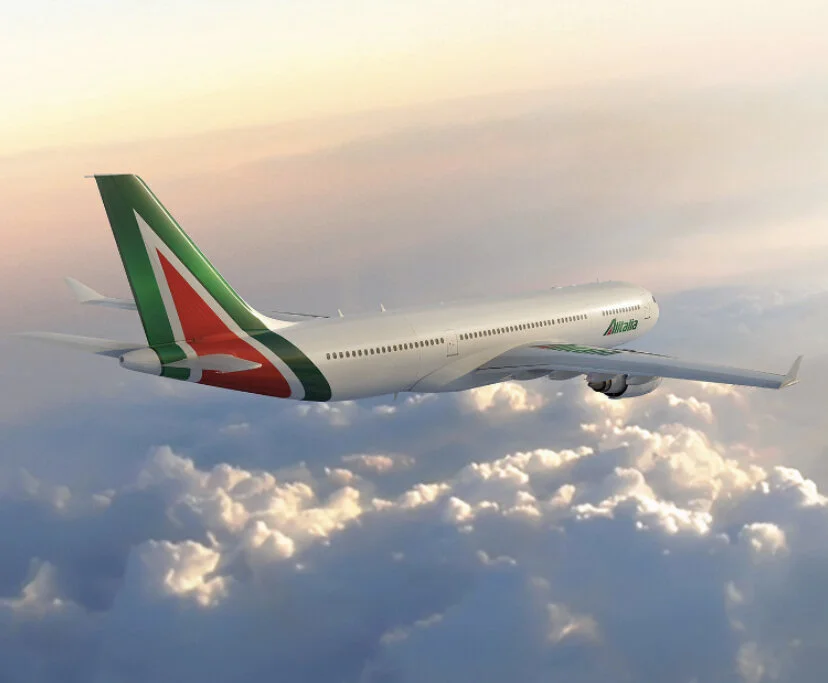
Those New York-Rome trips involved flying with Alitalia, Italy’s national carrier. The airline — known for its nearly-impeccable safety record and sometimes appalling customer service — will officially close on Oct. 15. The announcement, made this past summer, marks the end of an era for an airline founded in 1946. it also marked the end of an era for my family, who were loyal to this brand to a fault.

Why is this a topic for GetReligion?

The airline’s demise and the start of a new one named ITA is a business story with a religion angle that too many news organizations ignored over the past few weeks. There was plenty of coverage regarding ITA buying new planes, potential layoffs and Italian government subsidies that kept the airline afloat for decades.

That religion angle? You see, my family and I weren’t the only loyal Alitalia customers over the years. The most famous has been the pope. It was in 1964, when Pope Paul VI traveled to Israel, when Alitalia became the pontiff’s official airline.

Alitalia put on plenty of miles under the papacy of now-St. Pope John Paul II, who visited 129 countries during his 27 years as head of the Roman Catholic church. The plane used by the pope — known in the press as “Shepherd One” as a way to compare it to the president’s “Air Force One” — continued to be used by Pope Benedict XVI and now Pope Francis. It’s also aboard these flights that the pope holds a news conference and always makes news.

Alitalia and the papacy will forever be intertwined.


Please respect our Commenting Policy

Bonus podcast: 'What's next in Afghanistan?' Warning: this news topic involves religion

Bonus podcast: 'What's next in Afghanistan?' Warning: this news topic involves religion

Here is a truth claim that, over the years, I have heard (or seen) stated in a number of ways by journalists and mass-media professors: Without strong, or at least adequate, visual images a story doesn’t exist in television news.

Yes, there are exceptions. But the exceptions almost always take place when big stories break in print media and television producers are highly committed to getting them on air — somehow.

Now, in the smartphone era, there are lots of ways for visual images to emerge (ask Hunter Biden). However, in our era of partisan, niche news, it may not matter if images exist. What citizens cannot see (or read) will not hurt them?

This brings me back to a subject I addressed in this recent GetReligion essay: “What's next in Afghanistan? Press will have to face issues of religion, culture and gender.”

The big question: Where does the Afghanistan story go next and, frankly, will elite American media cover the religion elements of this story?

That question was at the heart of a recent Religion Unplugged podcast discussion that I had with a friend and, long ago, a former religion-beat colleague — Roberta Green. In recent decades, she is better known as the philanthropist and fine arts-maven Roberta Green Ahmanson (click here for a typical arts lecture).

This new podcast is entitled, “How Will Afghanistan's Next Chapter be Written?” Click here to head over to iTunes to tune that in. Meanwhile, here is a key chunk of the GetReligion essay linked to our discussion about religion, journalism, culture, politics and “nation building”:

Viewed through the narrow lens of Taliban doctrine, it doesn’t matter if Western governments were forcing open doors for the work of Planned Parenthood or Christian missionary/relief groups, the work of LGBTQ think tanks (or the American corporations that back them) or Islamic thinkers and clerics whose approach to the faith clashed with their own.


Please respect our Commenting Policy

New York Times dares to interview Stephen Strang, a major player in Pentecostal media

New York Times dares to interview Stephen Strang, a major player in Pentecostal media

On the Sunday I was returning to the United States from an international trip, the New York Times ran a surprising story on a religion beat insider that, frankly, I never thought they’d touch.

All sorts of folks were sending me links to a business story on Stephen Strang, someone who is widely known in the charismatic universe but not so well known in wider Christian circles.

Yet, Times freelancer Sam Kestenbaum swooped down and delivered an informative, timely piece, which started as follows:

This spring, the media mogul Stephen E. Strang made an unusual apology to readers in the pages of his glossy magazine.

Mr. Strang presides over a multimillion-dollar Pentecostal publishing empire, Charisma Media, which includes a daily news site, podcasts, a mobile app and blockbuster books. At 70, he is a C.E.O., publisher and seasoned author in his own right. Despite all that, Mr. Strang worried something had gone awry.

“I’ve never been a prophet,” he wrote in a pleading March editor’s note. “But there were a number of prophets who were very certain that Trump would be elected.”

This had not come to pass. Mr. Strang continued, “I hope that you’ll give me the grace — and Charisma Media the grace — of missing this, in a manner of speaking.”

That was a back entrance into a story on the “Trump prophets,” which were dozens of well-known Pentecostal personalities who falsely prophesied that President Donald Trump would win a second term. Although a few apologized when it was clear Joe Biden would be taking the oath of office on Jan. 20, many refused, succumbing to fantasy theories that the election had been stolen.

(I’ve been covering the prophets story since late last year and earlier this year for GetReligion here, here and here, plus begging other religion writers to get up to speed with modern-day Pentecostalism and the way Pentecostals and their sister movement, the charismatics, was the spirituality of choice in the Trump White House.

Kestenbaum specializes in religion-news-of-the-weird pieces for the Times , and maybe, to him, Strang is weird. Oddly, the story (whose news hook is Strang’s newest book) ended up in the business section. My fav quote in the whole piece:

Mr. Strang seems to have discovered that one way to handle being publicly wrong is to change the subject and to pray readers stick around.

Yes, that’s what the whole prophecy movement has been doing since January. The next chunk of copy is the why-you-should-read-this part:

Beyond the spiritual test of unrealized prophecies, there are very earthly stakes here: Under Mr. Strang’s stewardship, Charisma had grown from a church magazine to a multipronged institution with a slew of New York Times best sellers, millions of podcast downloads and a remaining foothold in print media, with a circulation of 75,000 for its top magazine.

It is widely regarded as the flagship publication of the fast-growing Pentecostal world, which numbers over 10 million in the United States. With its mash-up of political and prophetic themes, Charisma had tapped a sizable market and electoral force. In 2019, one poll found that more than half of white Pentecostals believed Mr. Trump to be divinely anointed, with additional research pointing to the importance of so-called prophecy voters in the 2016 election.

His numbers are way too low; Pew Forum says charismatics and Pentecostals comprise about 23 percent (you heard that right) of the American population, so we’re talking about 65 million people. If that sounds like a lot of people, remember, this number includes charismatic Catholics.

As I read through the piece, I thought Kestenbaum hit it square on the nose many times.


Please respect our Commenting Policy

New podcast: Covering a so-called 'religious liberty' story? Dig into religious liberty history

New podcast:  Covering a so-called 'religious liberty' story? Dig into religious liberty history

Believe it or not, America’s commitment to the First Amendment and religious liberty wasn’t dreamed up by the Religious Right.

However, at some point — mainly during press coverage of clashes between the Sexual Revolution and traditional forms of religion — religious liberty turned into “religious liberty” or even “so called ‘religious liberty’ ” and other language to that effect. America has come a long way since that 97-3 U.S. Senate vote to approve the Religious Freedom Restoration Act of 1993.

Now we are seeing waves of valid news coverage of religious liberty disputes linked to people seeking exemptions from mandates requiring COVID-19 vaccines. During this week’s “Crossroads” podcast (CLICK HERE to tune that in) I suggested that it would help for journalists to dig into the details of how courts have handled earlier religious liberty cases.

Consider this recent Washington Post headline, involving a White evangelical leader in Oklahoma: “This pastor will sign a religious exemption for vaccines if you donate to his church.” Here’s the overture:

A pastor is encouraging people to donate to his Tulsa church so they can become an online member and get his signature on a religious exemption from coronavirus vaccine mandates. The pastor, Jackson Lahmeyer, is a 29-year-old small-business owner running in the Republican primary challenge to Sen. James Lankford in 2022.

Lahmeyer, who leads Sheridan Church with his wife, Kendra, said Tuesday that in the past two days, about 30,000 people have downloaded the religious exemption form he created.

“It’s beautiful,” he said. “My phone and my emails have blown up.”

This minister isn’t alone in thinking this way. Here is a New York Daily News story about an African-American Pentecostal leader: “A Brooklyn preacher’s blessing is a pox upon his flock.”


Please respect our Commenting Policy

Why mainstream newsrooms can't be bothered to cover USCCB church vandalism report

Why mainstream newsrooms can't be bothered to cover USCCB church vandalism report

Abortion debates continue to dominate American politics. A Texas law banning most abortions after six weeks of pregnancy went into effect just three weeks ago, something that resulted in widespread national news coverage, with many of the stories showing familiar media-bias patterns.

Despite the 1973 Supreme Court decision that made abortion legal, this law makes attaining an abortion in Texas among the most restrictive in the country after the U.S. Supreme Court ruled 5-4 on Sept. 2 not to block it. This unleashed debate and further political animus between Democrats and Republicans as arguments over abortion in this country now stretch into a fifth decade.

The fallout from all this may have increased animosity against the Catholic church. The church’s stand — ancient and modern — against abortion has placed it at the forefront of this cause, along with many other traditional Christian denominations and organizations.

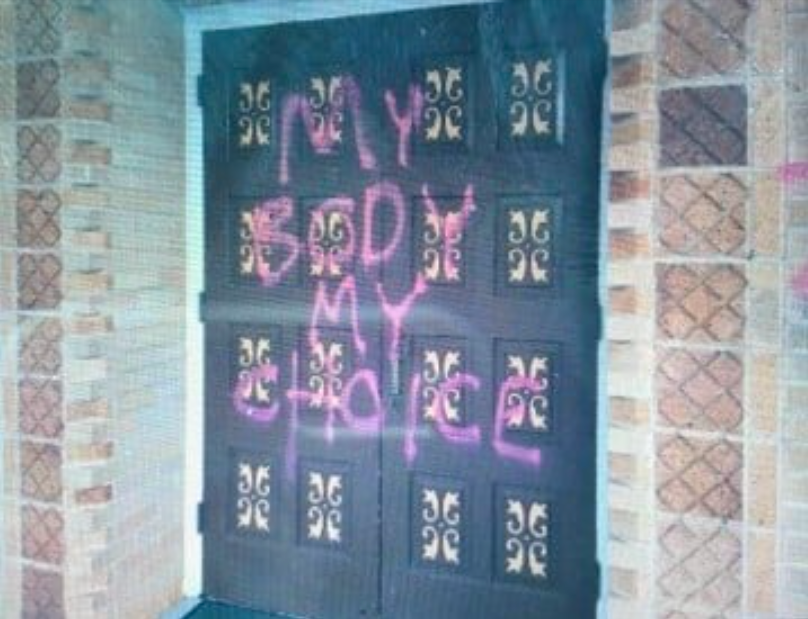
Some of this animosity has led to vandalism against U.S. churches. A Catholic church in Colorado was vandalized with graffiti showing support for legalized abortion days after the Supreme Court decision. This is how The Christian Post recently reported the story. This is long, but essential:

St. Louis Catholic Church, located in the Boulder suburb of Louisville, became the target of vandalism from abortion activists over the weekend. The doors to the church were spray-painted with the declaration “My body, My choice,” a common refrain among pro-choice activists. Church members discovered the graffiti when they gathered for worship on Sunday morning.

In addition to spraying the phrase “My body, my choice” on the church's doors, vandals targeted a marker on the property that read “Respect Life,” replacing the word “Life” with the phrase “Bodily Autonomy.” Additionally, the sign at the front of the church was defaced with the phrase “bans off our bodies.”

In a Facebook post on Monday, the Louisville Police Department noted that a surveillance camera recorded three individuals on the church property at 1:30 a.m. local time Sunday and asked the public for help with identifying them.

The Christian Post, as the name states, is a niche news source. The question here — once again — is why vandalism cases of this kind receive so little attention in the mainstream press.


Please respect our Commenting Policy

Pope Francis isn't resigning this summer: Here's a case study on media speculation

Pope Francis isn't resigning this summer: Here's a case study on media speculation

The U.S. mainstream press covers the Vatican very much like it does Washington, D.C. The parallels are similar, but there is a pope instead of a president, a College of Cardinals rather than Congress and believers, not voters.

The three — pope, cardinals and believers — are not political entities. Although there is overlap with politics, there is a lot more nuance to the Catholic church that many reporters often miss. As we say here at GetReligion, politics is the true faith in most newsrooms. Politics is real. Religion? Not really.

The press also gets very, very, very excited when it comes to the election of a new pope. It is, after all, a global news event and a type of power struggle the press thinks that it can cover like it does a political election. That’s something the press understands better than complicated things such as doctrine, tradition and history.

The big difference is that you never know when a pope will either die or, as of late, resign. In 2013, Benedict XVI did just that and gave up his post. It was a surprise, but not one that caught everyone off guard.

For example, U.S. newspapers and TV networks plan years ahead for a papal election. I wrote a feature that ran in the New York Post in 2001 on just that topic. Here’s how that story opened:

Ghoulish as it may sound, TV is already making elaborate – and expensive – plans for covering the funeral of Pope John Paul II and the selection of his successor.

The pontiff’s frail health was apparent during Easter Sunday services eight days ago – and it has pushed news organizations around the world to renew preparations for the inevitable.

Apartment-building roofs and hotel terraces surrounding the Holy See are suddenly a battle ground as dozens of news organizations try to outbid each other for places where they can be first to capture on camera the historic puff of white smoke from the Sistine Chapel – signaling the election of a new pope.

Italians are calling the jockeying for space the “War of the Terraces.”

Pope Francis’ colon surgery in July fueled speculation that he could be near death or contemplating to resign. Much of this speculation — indeed most of it when it comes to the papacy — comes from Italian newspapers.


Please respect our Commenting Policy

Here's a flashback into religion-beat history, with the help of the legendary Lou Grant

Here's a flashback into religion-beat history, with the help of the legendary Lou Grant

If anyone ever writes a book about the history of religion news in the mainstream press it will need to include a photo of the glowering, and often smirking, mug of Lou Grant.

Lou Grant was a TV character, of course, played by the Emmy-winning actor Ed Asner, who died on Sunday (August 29) at age 91. But for millions of Americans, he provided -- in "The Mary Tyler Moore Show" and the sequel "Lou Grant" -- an archetypal image of what old-school journalism was all about.

One 1977 "Lou Grant" episode certainly captured some of the attitudes I encountered while interviewing journalists for my 1982 graduate project at the University of Illinois in Urbana-Champaign, which focused on why few newsrooms made serious attempts to cover religion events and trends -- unless they were linked to politics.

Quite a few editors sounded like Lou Grant.

In this episode, entitled "Sect," the city editor of the mythical Los Angeles Tribune was wrestling with two problems at the same time. The problems seemed to be unrelated.

First, the Trib had lost its veteran religion editor. Grant searched and searched, but no one was interested in filling that empty desk. After all, what self-respecting journalist wanted to be stuck with the religion beat?

Problem number two was how to get rid of lazy, often-drunk, no-good reporter Mal Cavanaugh. All through this episode the newsroom's leaders had been searching for a way to get Cavanaugh to resign. Then came a spark of inspiration. The printed script is simple:

LOU: Well, Mal, you've been with this paper a mighty long time. As you say, this is your family.

CAVANAUGH: (All that humility) Aw, well, it's nice to be appreciated.

LOU: And I think I've found a place where we'll be able to use that special, sweet style that is Mal Cavanaugh.

CAVANAUGH: (Those eyes are getting moist; he sees himself getting a column) What's that, Lou?

LOU: Congratulations, Mal. You're the Trib's new religion editor.


Please respect our Commenting Policy

New podcast: Gray Lady prints some complex Ryan Burge insights on Democrats and religion

New podcast: Gray Lady prints some complex Ryan Burge insights on Democrats and religion

Something old, something new.

Something red, something blue.

We started with something new and something blue during this week’s “Crossroads” podcast (click here to tune that in). But, as you will see, the “something old” turned out to be blue, as well.

“Blue,” of course, refers to the liberal/progressive half of the starkly divided American political scene, which also reflects, of course, divisions on moral, social, cultural and religious issues.

Oceans of mass-media ink have been poured out in recent decades by journalists covering the Religious Right and its scary impact on the Republican Party. What about the religious left — no capital letters, of course — and its impact on the Democrats?

That isn’t an important story, of course. At the start of the podcast I quoted some numbers retrieved at mid-week from some Google searches. A basic search for “Religious Right” yielded 6.5 million hits and a Google News search found 77,500 items. Do the same thing for “religious left” and you get 196,000 in the first search and 3,680 in the news search. Amazing, that.

This brings us to a New York Times op-ed essay by the increasingly omnipresent (and that’s a good thing) political scientist Ryan Burge, who contributes charts and info here at GetReligion. The headline: “A More Secular America Is Not Just a Problem for Republicans.” Here’s an early thesis statement:

Today, scholars are finding that by almost any metric they use to measure religiosity, younger generations are much more secular than their parents or grandparents. In responses to survey questions, over 40 percent of the youngest Americans claim no religious affiliation, and just a quarter say they attend religious services weekly or more.

Americans have not come to terms with how this cultural shift will affect so many facets of society — and that’s no more apparent than when it comes to the future of the Republican and Democratic Parties.

The impact on the GOP is rather obvious. While conservative religious groups remain strong in America (evangelicals are not vanishing, for example), the number of religiously unaffiliated (“nones”) continues to rise and the vague middle of the religious spectrum continues to shrink. Meanwhile, conservatives face an increasingly “woke” corporate culture and fading support on the left for old-fashioned First Amendment liberalism (think “religious liberty” framed in scare quotes).

Things get interesting — especially in the context of the Times op-ed world — when Burge discusses complications now facing Democratic Party leaders.


Please respect our Commenting Policy

Afghanistan's Catholic 'hidden believers' and the underreported work of the church

Afghanistan's Catholic 'hidden believers' and the underreported work of the church

The news cycle in recent weeks has been dominated by the pullout in Afghanistan and the fallout that has taken place as a result of such a decision — especially the choice to remove most U.S. troops before evacuating American citizens and Afghans who worked with Western groups.

Much of the coverage has centered around the Taliban’s takeover and the tragic events unfolding at the Kabul airport. Meanwhile, others who are in danger — including Christians and members of other religious minorities — are in hiding.

I covered the 9/11 attacks in New York City that day. I can’t help but recall that morning with the 20th anniversary of those attacks approaching. The desperate actions of those stuck in the World Trade Center that day resulted in people jumping off those burning buildings. The very same thing happened just last week when Afghans looking to flee the Taliban grabbed onto military planes as they took off, only to fall out of the sky.

Those images served as a bookend to the U.S.’s involvement in Afghanistan. Rod Dreher, who covered the 9/11 attacks and was my colleague at the New York Post at the time, recently noted the following regarding the U.S.’s time in Afghanistan and the nation-building fiasco that took place:

We are such an unserious nation. I am a practicing Christian who hates the way Christians are treated in many Islamic countries. But I have enough common sense to know that it does not advance America’s national interest to give host countries the finger by displaying a symbol of Christianity to defy their local norms.

This isn’t a post about the culture wars or what the U.S. did right and wrong in Afghanistan since 2002. I will let others do that. Instead, I want to place a spotlight on the important work of Christian groups across Afghanistan over the years, the little mention they have received by the secular press and how one recent story illustrates both the plight of Afghan refugees and how those who converted to Catholicism who now live outside the country have been crucial in helping people get out.

What has largely been viewed as a military operation until now is quickly turning into a humanitarian mission, one that may yet require some military support. Nonetheless, the major newspapers and cable channels in this country still largely cover the Afghan crisis through a political lens — like they do most subjects — and have largely underreported the work of the church.


Please respect our Commenting Policy