

Journalism

New York Times' 20th anniversary piece on East Texas dragging death is powerful, yet disappointing

New York Times' 20th anniversary piece on East Texas dragging death is powerful, yet disappointing

The New York Times' front page Monday featured a "beautiful and powerful story" — as one top journalist described it — on the 20th anniversary of James Byrd Jr.'s racially motivated dragging death in the East Texas town of Jasper.

Emotional and compelling, the piece is expertly written and filled with riveting details.

It even contains several references to faith.

So why am I about to give this story — which I mostly liked and really hoped I could praise — a negative critique? The simple answer is that the Times, in an otherwise excellent piece of journalism, fails to answer basic questions tied to religion. 

Up high in the story, the newspaper hints strongly at a religion angle when it mentions church and notes that Byrd's family forgave his killers:

JASPER, Tex. — Sometime after church but before dinner, Sgt. James Carter of the Jasper County Sheriff’s Office knocked on the front door of James and Stella Byrd’s home. He stepped into the living room, removed his white cowboy hat and bowed his head. Then, with a somber look on his face that the Byrds still remember years later, he delivered the news that their son James Byrd Jr. was dead.

The horrific circumstances surrounding his death they would learn later: Chained by his ankles to a pickup truck by three men, he had been dragged three miles, murdered before the sun rose that Sunday morning 20 years ago.

“I just knew something was terribly wrong,” Betty Boatner, 63, one of Mr. Byrd’s younger sisters, whispered as she sat on a picnic bench at a memorial park now named in his honor. “It’s such a small town that we had already heard the rumors that a black man was found dead, but we didn’t know who it was. Until the knock on our door.”

The family forgave Mr. Byrd’s three killers long ago and made peace with Jasper, the small East Texas town where they have lived for three generations. But as the nation faces a spread in bias crime incidents, the family wants to ensure the public remembers one of the worst hate crimes of the 20th century. In the years since Mr. Byrd’s death, both state and federal hate crime laws bear his name.

As I kept reading, I expected — or at least hoped — that the Times would elaborate on the family's forgiveness of the killers and the reasoning, which I suspected would include religion, behind it. But that explanation never comes.

Please respect our Commenting Policy

Separating religious belief from cultural tradition. In real world it's no easy journalistic task

Separating religious belief from cultural tradition. In real world it's no easy journalistic task

Is it possible to separate out religious influences from centuries-old societal customs? And if so, just how does a journalist go about doing this?

This is not an easy task. That goes double for journalists -- perhaps most journalists -- with little exposure to the principles of group dynamics or the psychology of institutional religion.

This may sound like hubris on my part, but I believe that the wide experience gained on the religion beat prepares journalists to better understand humanity’s complex social and psychological formulations -- allowing religion writers and editors to (potentially) better parse the differences.

This recent New York Times story on the semi-isolation of menstruating women in remote western Nepal, causing the death of some, provides a platform for exploring the question.

But first, a quick return to Brazil.

You may recall that a few weeks ago I posted here on the custom of some indigenous Brazilian tribes to murder unwanted children. I tried to explain how from their tribal perspective the practice made sense.

I noted that in their rain forest environment, where food is surprisingly difficult to come by, the children -- fatherless or physically impaired -- were in the tribes’ view being sacrificed for a greater good. That's because they could not contribute to the group's food supply, which tribal leaders deemed an unacceptable burden that threatened the entire group's survival.

I also noted how outrageously obscene the practice seems when considered from a Western mindset rooted in the Abrahamic religious traditions. My point was to illustrate how difficult it is for journalists to put aside their deepest values when covering groups with a vastly different belief set.

The late Huston Smith, the renowned scholar of comparative religion, once wrote, I’m paraphrasing now, that every civilization -- and by every civilization he even included small, semi-nomadic jungle tribes -- is influenced by some spiritual vision of how life is best lived.

I take that to mean that in the Brazilian case, the tribes were following some inner sense of their own notion of right and wrong, even if they did not articulate it in spiritual or religious terms.


Please respect our Commenting Policy

'Church vs. Church': New York Times delves into the biblical debate over immigration in Iowa town

"Church vs. Church in a Town Split by an Immigration Raid," said the headline on a front-page article in Wednesday's New York Times.

That certainly sounds like a religion story.

To its credit, the Times highlights the faith angle right up top and devotes a fair amount of ink to it. There's much to like about this in-depth report. But for a reason I'll explain in a moment — a reason not entirely the newspaper's fault — the piece failed to satisfy me completely.

Before I get into that, though, let's start with the strong lede:

MOUNT PLEASANT, Iowa — In the days after immigration agents raided a dusty concrete plant on the west side of town, seizing 32 men from Mexico and Central America, the Rev. Trey Hegar, pastor of the First Presbyterian Church, got into an impassioned argument on his Facebook page.

“The Bible doesn’t promote helping criminals!!!!” a Trump supporter wrote.

Mr. Hegar answered with Leviticus: “When a stranger resides with you in your land, you shall not do him wrong. The stranger who resides with you shall be to you as the native among you, and you shall love him as yourself, for you were aliens in the land of Egypt.”

The Trump supporter came back with the passage in the Gospel of Mark about rendering unto Caesar the things that are Caesar’s, and added for good measure: “Immigration laws are good and Godly! We elected our leaders and God allowed it.”

President Trump’s immigration crackdown has been promoted with biblical righteousness by senior members of his administration, including Attorney General Jeff Sessions. And in heartland communities where the president is popular, the crackdown is often debated — by supporters and critics alike — through the lens of Christian morality.

After offering background both on the Iowa town and the national immigration debate, the Times returns to the Bible question:

Mr. Hegar, a Texan who served four years in the Marines before attending a Presbyterian seminary, finally asked the Trump supporter he was debating on Facebook: “Which Scripture do we obey?”

He answered himself: “The one from Jesus to ‘Do unto others’ is what we choose.”

That's good stuff — the kind of excellent detail found in the best journalism.

But here's what kept me from loving this story: There was no strong voice on the other side.


Please respect our Commenting Policy

Why do so many 'woke' activists on cultural left know little or nothing about religion?

For years -- decades even -- I have been active in the whole "media literacy" cause, trying to help Americans (especially in religious circles) understand more about the role that mass media play in our culture.

During these same decades, I've heard journalism educators -- on the cultural left and right -- argue that the same thing needs to be happening in elite newsrooms and even educational institutions, only in reverse.

Let's stick with the journalism angle: One of the main reasons that pros in our newsrooms often do such a lousy job of covering religion is that there are so few editors and managers who know any thing about religion. Let me stress that the issue is not whether these journalists are religious believers. The issue is whether they know crucial information about the lives, traditions and scriptures linked to the lives of millions and millions of believers who reside in this culture and often play roles in public life.

I've mentioned this before: I'll never forget the night when an anchor at ABC News -- faced with Democrat Jimmy Carter talking about his born-again Christian faith -- solemnly looked into the camera and told viewers that ABC News was investigating this phenomenon (born-again Christians) and would have a report in a future newscast.

What percentage of the American population uses the term "born again" to describe their faith? Somewhere between 40 and 60 percent back then? I mean, Carter wasn't telling America that he was part of an obscure sect, even though many journalists were freaked out by this words -- due to simple ignorance (or perhaps bias).

This brings me to this weekend's think piece in The American Conservative, a magazine defined by cultural conservatism not conservative partisan politics (thus the presence of several big-league #NeverTrump scribes). The double decker headline on this piece asks:

Woke Progressivism’s Glaring Religion Gap

Identity politics demands that we "educate ourselves." So why are its practitioners so often ignorant of religious belief?

Here is Georgetown University graduate student Grayson Quay's overture, which ends with a stunning anecdote:


Please respect our Commenting Policy

Bondage, death, sex and Hollywood spirituality: Why avoid religion hook in life of Master Skip?

Before I get into this strange and troubling post, let me stress what this post is NOT about.

Back in the 1980s, when I worked the Denver religion beat, I did several stories that involved a local congregation in the Metropolitan Community Church. The MCC is a denomination that is best known as a home for LGBTQ Christians and their families.

What I learned was that -- at that stage of its development -- the MCC was a complex institution, in terms of the theological orientations of its members. Yes, there were some New Age-style people, but there were way more clergy and members whose background was in liberal Protestantism (think United Methodists or old-line Presbyterians). And there were evangelicals and charismatics who remained evangelicals and charismatics, other than their views on sex.

So this post is not about a news report slamming the MCC. It is also not a post claiming that it is normal, somehow, for a MCC member/leader to have a secret life involving dangerous sex. Alas, anyone who follows the news knows that "double life" sin can be found, every now and then, in lots of conservative flocks (think Catholics, Orthodox Jews, Baptists).

Now, to the story itself, with kinky details left out. For The Hollywood Reporter, this story is a window into the life of a major "player" in the movie industry, a senior vice president at William Morris Endeavor Entertainment.

The religion angle isn't important. My question: Could journalists do justice to the religion angle, without smearing this man's church? Here's the dramatic double-decker headline. Note the word "ritual."

Death in a Hollywood Sex Dungeon:

How a Top Agency Executive's "Mummification" Ritual Ended in Tragedy

Here is the story's overture, with no religion angle in sight:

For nearly three decades, Skip Chasey, one of Hollywood's top dealmakers, led a delicate balancing act of an existence. One Sunday last November, it all came tumbling down around him.


Please respect our Commenting Policy

Side question re: viral story about baby Jesus, Mary and Joseph in a cage: Which Bible to quote? (updated)

Side question re: viral story about baby Jesus, Mary and Joseph in a cage: Which Bible to quote? (updated)

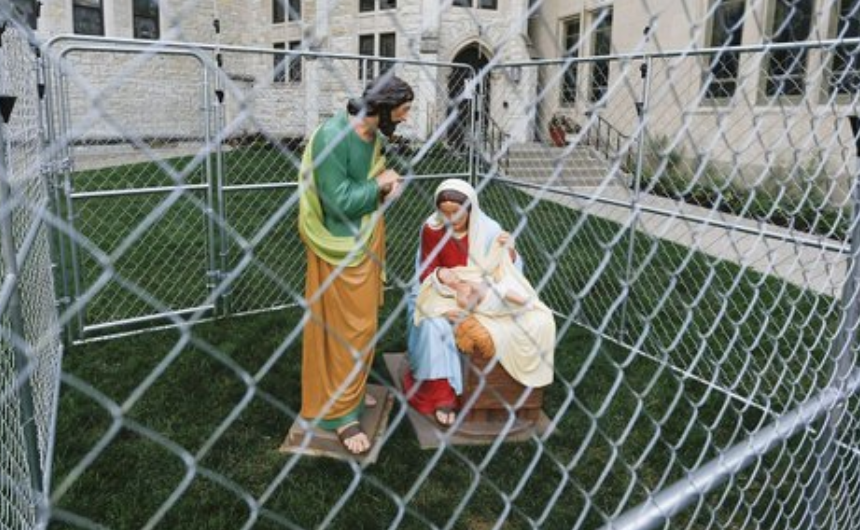
Baby Jesus, Mary and Joseph in a cage?

Everyone seems to talking about that viral religion story, as The Tennessean faith reporter Holly Meyer points out. 

In case you missed it, the Indianapolis Star reports that the three biblical figures "were incarcerated behind a barbed wired-topped, chain link fence on the lawn of Monument Circle's Christ Church Cathedral on Tuesday."

The reason:

The Rev. Stephen Carlsen, dean and rector of Christ Church, said the caged Holy Family is a protest to President Donald Trump's zero-tolerance policy that is holding families in detention centers at the U.S.-Mexico border.

"I know what the Bible said," Carlsen said. "We're supposed to love our neighbors as ourselves."

It's a fascinating story, and I'd urge you to check it out. But for the purposes of this post, I have a side question: Which version of the Bible should a news organization quote in a story such as this?

I'll admit surprise at the one the Gannett newspaper chose to quote:

The Rev. Lee Curtis, who came up with the idea for the demonstration, said the Biblical trio was a family of refugees seeking asylum in Egypt after Jesus' birth. 

"An angel of the Lord appeared to Joseph in a dream, saying, 'Arise, take the young Child and His mother, flee to Egypt, and stay there until I bring you word; for Herod will seek the young Child to destroy Him,'" the Message Bible says in Matthew 2:13-14. "When he arose, he took the young Child and His mother by night and departed for Egypt."

"This family is every family, and every family is holy," Curtis said. 

For those not familiar with The Message, it's a contemporary version in modern English. The religion satire news site Babylon Bee has published stories such as "‘The Message’ Now Available In Popular Comic Sans Font" and "7 Updates ‘The Message’ Totally Needs." Among the proposed updates: Substituting all references to Jesus with "The J-Man." That gives some indication of how seriously (read: not) some take that translation.

I'm not sure I've ever seen The Message be the go-to version quoted in a news story. (I'll eagerly await all the links proving me wrong.) My first thought was perhaps the Star was trying to put the verses in language readers could understand.


Please respect our Commenting Policy

Rainforest thoughts: Considering news coverage of Orthodox ecumenical patriarch's views on climate

I’m writing this sitting on the deck of a rainforest lodge in a remote corner of southwest Costa Rica just a few miles north of Panama. And I’m wondering; when will today’s afternoon tropical downpour begin?

They don't call them rainforests for nothing.

The forest surrounding the Golfo Dulce is thick and seriously humid, filled with a dazzling variety of climbing, slithering, flying, and just plain-old walking wildlife doing what they can to survive and multiply. (My wife would be happy to do without the gazillions of insects, but it just ain't a rainforest without them. Sorry.) And the best part?

Virtually all the hills and mountains here are government protected. No hunting, no logging -- no human habitations other than a few widely scattered, and small, lodges along the gulf’s shoreline and reachable only by small boat.

Given where I am, is it any wonder that the following two stories caught my attention the day previous to my arrival here last week?

The first was from The New York Times, detailing the rapid loss of rainforest environments around the globe -- and their importance to slowing the growing planetary upheaval we call climate change. Click here for that story. If you happen to know little about how critical rainforests are to the global environment, or how fast they're disappearing, please read this piece in full. Consider it a crash course.

The second piece is from the Washington Post. It carries the enchanting dateline, “ABOARD THE SHIP MORE SPACIOUS THAN THE HEAVENS.” That’s the name of a ship commanded (not literally; I'm sure he didn't steer it) by the Orthodox Ecumenical Patriarch Bartholomew I, one of the world's most environmentally oriented global religious leaders.

Just goes to show you that while you may be a staunch theological traditionalist -- is there any Christian body more traditionalist in form than the Orthodox churches? -- you can still be quite progressive on other issues. This is one reason the GetReligion team is not fond of journalists pinning shallow labels on people with complex beliefs.

Here’s the top of the story written by Juliet Eilperin, who deserves a shoutout for her prolificacy and ability to toggle between being the Post’s senior national affairs correspondent chronicling the Trump administration’s policy changes, and global environmental stories.

(Wait. Maybe that’s how she stays sane in today’s Washington.)


Please respect our Commenting Policy

Beyond Roe, Bork and Trump: Can Americans find a way to discuss hot moral issues?

I am old enough that I can -- if I focus my mind really hard -- remember what our public discourse was like before the Supreme Court became the only issue in American politics that really, ultimately, mattered.

How did America become a nation in which dialogue and compromise is impossible? Why is the U.S. Supreme Court always ground zero on all of this? What role is the mainstream press playing in this painful equation, especially when covering news linked to religious, moral and cultural clashes?

These kinds of questions are at the heart of this week's "Crossroads" podcast (click here to tune that in), which focuses on the painful state of political life in this age of Donald Trump, an age in which the status of the high court is even more controversial than ever, with Kennedy's retirement serving as another fuse on this bomb. 

But let's back up a minute, to when old folks like me were young. 

Yes, the 1960s were wild times, of course. The war in Vietnam was incredibly divisive and the nation was rocked by assassinations. Tragic divisions over race were real and could not be ignored. 

Still, everything changed for millions of Americans on Jan. 22, 1973. From that moment on the status of Roe v. Wade -- political wars over defending or overturning that decision -- loomed over every nomination to the U.S. Supreme Court and every presidential election, as well. 

Then came October 23, 1987 and the vote on the nomination of Judge Robert Bork to the high court. Bork was a former Yale Law School professor (former students included Bill Clinton and Hillary Rodham) who embraced and taught originalism -- the legal theory that the U.S. Constitution should be interpreted as written by the founders.

If you want to catch the flavor of the debate over Bork, here is the famous statement by Sen. Ted Kennedy: 


Please respect our Commenting Policy

Friday Five: Capital Gazette journalists, SCOTUS news, an unsung hero's passing and more

"I’m just undone by what happened at the Capital Gazette," said my friend Carla Hinton, religion editor at The Oklahoman. "These are strange and heartbreaking times we are living in. Praying for my fellow journalists and their families."

"It's especially traumatic because so many of us started our careers at newspapers like the Capital Gazette," responded my friend Steve Lackmeyer, a longtime business reporter at The Oklahoman. "We know these people, we know these newsrooms..."

Amen and amen.

No, the senseless slaying of journalists isn't any more tragic than the mass shootings — at schools, churches and other businesses — that keep making headlines in America.

But for those of us in this profession, the Capital Gazette tragedy hits especially close to home.

Want to understand the heart and passion that make many journalists tick? Read this Twitter thread by Nyssa Kruse, an intern at the Hartford Courant.

Now, let's dive into the Friday Five:


Please respect our Commenting Policy