Evangelicals

Behind #MeToo headlines: Denhollander keeps advising church leaders about sexual abuse

Behind #MeToo headlines: Denhollander keeps advising church leaders about sexual abuse

In this age of small-group ministries, most pastors would know how to handle a crisis that affected significant numbers of believers in their pews.

"If you had one in four members of your congregation actively battling cancer or one in four members … experiencing being widowed or losing a spouse, chances are that you would have some level of intentional ministry to those individuals," said Rachel Denhollander, in a recent Trinity Forum event focusing on how churches respond to sexual abuse. "Maybe you would have a support group or a Bible study for them. You would have meal trains to help provide for their physical needs."

But many sexual-abuse victims hesitate to speak out, she said, because churches act as if they don't exist. Thus, they have little reason to believe the sins and crimes committed against them will be handled in a way that offers safety and healing. Far too many religious leaders act as if they haven't grasped the magnitude of this crisis.

"There is an astonishing perception gap and it's really inexcusable at this point in time," she said, speaking to victims, clergy and activists online -- including participants in 24 nations outside the United States. "We've had the data, literally, for decades. … Even what we know is dramatically undercounted.

"The statistic has stayed right around one in four women, for sexual violence, by the time they reach age 18. … The rate continues to rise and there really isn't any excuse, at this point in time, for not knowing that data. But sometimes, it's emotionally easier to not know that data and all of us have that intrinsic desire to not have to see the darkness that's around us."

Sexual abuse is a hot-button issue everywhere, from small fundamentalist flocks to the Roman Catholic Church. Revelations from #MeToo scandals have rocked the careers of A-list players in entertainment, politics, sports, academia and business.


Please respect our Commenting Policy

That word always gets surprising media attention. What does biblical 'inerrancy' mean?

That word always gets surprising media attention. What does biblical 'inerrancy' mean?

THE QUESTION:

What does biblical "inerrancy" mean?

THE RELIGION GUY'S ANSWER:

A February article by Stephen Young of Appalachian State University in North Carolina pulls the "inerrancy" of the Bible into a surprising media spotlight.

Writing in the liberal ReligionDispatches.org, Young blames this concept for American Christian racism and "white patriarchy" that subjugates women. By coincidence, days before Young's posting Michael F. Bird of Ridley College, an Anglican seminary in Australia, contended via the interfaith Patheos.com that his fellow evangelicals in the U.S. advocate a version of inerrancy that's a bit skewed.

Hold those thoughts while the Memo sketches some background.

Merriam-Webster defines inerrancy as "exemption from error," with "infallible" as a synonym. However, the modern debate distinguishes between those two words, as we'll see below.

Churchgoers may simply view the Bible as trustworthy because, after all, it's the Word of God, but "inerrancy" is a more sweeping contention meant to cover every detail of the events depicted in the Bible.

Inerrancy came to the fore, especially among U.S. Protestants, through Princeton Theological Seminary professors such as B.B. Warfield (1851-1921) who believed Christianity had always taught the Bible is error-proof.

As theological "modernism" made inroads, the largest Presbyterian denomination in 1910 defined five tenets as "essential doctrine" required of clergy candidates. The first one stated that "the Holy Spirit did so inspire, guide and move the writers of the Holy Scriptures as to keep them from error." The 1910 platform evolved into the "five points of Fundamentalism," embraced by that militant new movement even as the Presbyterians themselves moved away from their requirement.


Please respect our Commenting Policy

Podcast: What's the SCOTUS story? New Colorado case focuses on free speech, not religious liberty

Podcast: What's the SCOTUS story? New Colorado case focuses on free speech, not religious liberty

Here we go again?

That’s a logical question, in light of the news that — once again — church-state activists on left and right are preparing for more U.S. Supreme Court arguments involving the state of Colorado, a traditional Christian believer, LGBTQ rights and the First Amendment.

That was the news hook for this week’s “Crossroads” podcast (CLICK HERE to tune that in). But to understand that conversation, it really helps to dig into a key passage or two in the majority decision in that 2019 SCOTUS case focusing on Masterpiece Cakeshop and the Colorado Civil Rights Commission (full text .pdf here).

So, all rise. The writer is, of course, then Justice Anthony Kennedy:

The laws and the Constitution can, and in some instances must, protect gay persons and gay couples in the exercise of their civil rights, but religious and philosophical objections to gay marriage are protected views and in some instances protected forms of expression. While it is unexceptional that Colorado law can protect gay persons in acquiring products and services on the same terms and conditions as are offered to other members of the public, the law must be applied in a manner that is neutral toward religion.

The result was one of those narrow decisions much beloved by Chief Justice John Roberts.

Then, what you hear in this next passage is the sound of Kennedy punting the crucial religious-liberty decision in this First Amendment case into the mists of the future:

The outcome of cases like this in other circumstances must await further elaboration in the courts, all in the context of recognizing that these disputes must be resolved with tolerance, without undue disrespect to sincere religious beliefs, and without subjecting gay persons to indignities when they seek goods and services in an open market.


Please respect our Commenting Policy

When ancient texts meet high tech, behold, will we get near-instant Bibles? 

When ancient texts meet high tech, behold, will we get near-instant Bibles? 

The Religion Guy has touted the investigative chops of the Ministry Watch website and its usefulness as a story source for journalists. Let’s re-up that message.

Along with assorted financial and moral scandals, President Warren Cole Smith has been examining what he calls the "Bible translation industry" (which prefers to call itself a "ministry"). This is a very popular cause among U.S. Protestants, with revenues of around $500 million a year. The biggest group, Wycliffe Bible Translators, took in $227 million in 2020.

In articles here (“Outsourcing Bible Translation?”), here (“Translation Service Providers Could Be Paradigm-Changing For Bible Translation Industry”) and finally here (“Just How Broken Is the Bible Translation Industry?”) Smith has been criticizing translation groups for taking so long and spending so much money to produce a Bible translation in a new language when the need is so great.

To force a massive speedup, Smith promotes the fascinating idea of applying the technology used widely by businesses and governments for necessary rapid translations of contracts, diplomatic exchanges, scientific articles, movie scripts and the like. Such biblical projects are already under way, and that provides a solid feature idea for reporters to pursue.

A consortium of traditional Bible translation organizations, illumiNations, figures the planet has around 7,000 languages currently being spoken, of which 3,700 have little or no scripture. It seeks to fill that gap by 2033, and states that it typically takes seven years to render the New Testament and 16 years for a complete Bible. At the present rate, Smith comments, the task will take till at least A.D. 2150.

As a former business executive, Smith argues that Christian donors should reasonably expect 10 times the new Bibles than are actually being produced and, while chiding groups for lack of financial transparency, estimates it takes not only many years but many millions of dollars to produce a new translation. He says the current experimental phase of the new high-tech scheme indicates radically shortened time frames are possible at a cost of a mere $350,000 per new Bible.

Big, if true. That’s a news story.


Please respect our Commenting Policy

Podcast: Religion News Service offers new story about an old trend called 'Sheilaism'

Podcast: Religion News Service offers new story about an old trend called 'Sheilaism'

One of the problems with covering the same religion-beat topics for multiple decades (in other words, I am old) is that you tend to see many “new” news stories as pieces of puzzles that are actually quite old.

Consider, for example, the Religion News Service feature that was the hook for this week’s “Crossroads” podcast (CLICK HERE to tune that in).

The headline on that RNS piece stated: “A 300-year-old church hopes to connect with spiritual but not religious neighbors.” Here is the overture from this story by religion-beat veteran Bob Smietana:

For three centuries, Trinity Episcopal Church has tried to meet the spiritual needs of the small community of Southport, Connecticut, about an hour and a half outside of New York.

As more and more of the church’s neighbors ditch organized religion but not faith, leaders at Trinity hope a new initiative will help them find meaning and purpose in life even if they never attend a Sunday service.

The church recently launched the Trinity Spiritual Center, which offers lectures, classes on meditation and contemplation, and a sense of community during a trying time, said the Rev. Margaret Hodgkins, the rector of Trinity Church.

We will come back to some of the specifics of this piece — details that link it to several trends that are (#SIGH) decades old in the aging, shrinking world of mainline Protestantism and, to a lesser extent, parts of Roman Catholicism, Eastern Orthodoxy, liberal Judaism and other established religious “brands.”

The Big Idea in this RNS piece is that an Episcopal parish that has some resources to spend has decided to help spiritual seekers find their own paths to the top of Mt. Eternity without proclaiming any of those narrow, tacky doctrines linked to 2,000 years of Christian faith and practice. You know, all that stuff about the Resurrection of Jesus, eternal salvation or moral theology (warning: veiled reference to the “tmatt trio”).

In other words, the goal appears to be a sort-of parish in honor of St. Sheila, the patron saint of “Sheilaism.”


Please respect our Commenting Policy

Here we go again: What ails U.S. evangelicalism and where is this movement headed?

Here we go again: What ails U.S. evangelicalism and where is this movement headed?

It's hard to imagine a print article more eye-catching than a lead item in The New York Times Sunday Review that sprawls over three pages, or to imagine a more prominent scribe than columnist David Brooks. The February 6 Brooks opus lionized "the dissenters trying to save evangelicalism."

Save from what? "Misogyny, racism, racial obliviousness, celebrity worship, resentment, and the willingness to sacrifice principle for power" — that last phrase targeting disciples of Donald Trump.

We're at the publicity apex for what Brooks, and movement outsiders and insiders, are calling a "crisis" for this conservative Protestant movement. In recent months The Guy has, less elegantly, pondered a "crack-up. Thus:

* “Are we finally witnessing the long-anticipated (by journalists) evangelical crack-up?

* “Latest angles on Trump-era 'evangelicals,' including questions about the vague label itself.”

* “Concerning evangelical elites, Donald Trump and the press: The great crack-up continues.”

* “Journalism tips on: (1) Evangelical crack-ups, (2) campus faith fights, (3) COVID exemptions.”

This struggle will continue to need fair-minded journalistic attention, simply because this loosely-organized and variegated movement remains the largest and most dynamic segment of American religion. To a considerable extent, as evangelicalism goes, so goes the nation. Both are polarized, troubled and scandal-ridden.

On this topic it's always necessary to remember we're talking about WHITE evangelicals because Black Protestants, though often evangelical in style and substance, form a distinctly separate subculture (which "mainstream" media typically ignore alongside their fixation on the white variety).

A related preliminary point: What is an "evangelical" anyway?


Please respect our Commenting Policy

Maybe angry Christians should try chanting 'Pray for Biden' instead of 'Let's go Brandon'?

Maybe angry Christians should try chanting 'Pray for Biden' instead of 'Let's go Brandon'?

In the beginning, there was an obscene chant at the Talladega Superspeedway that NBC producers urgently needed to ignore during a live broadcast.

Interviewing winner Brandon Brown, reporter Kelli Stavast pretended the NASCAR crowd was chanting, "Let's go Brandon!" -- not cursing President Joe Biden.

The rest is history, as the wink-wink slogan soaked into political jargon and mass media. What shocked the Rev. Seth Carter -- a young Southern Baptist pastor in Kentucky -- was when church people began baptizing "Let's go Brandon!" into common speech.

"To be clear, I am no supporter of our president's actions or policies. In no way do I feel support for him welling up inside of me," he wrote, in a Baptist Press commentary.

"However, I recognize that my feelings can never be the proper guide of the attitude I am to have toward him. As a Christian and a believer in the inspired, inerrant and infallible Word of God contained in the Bible, the truth of God's Word is what ought to guide my attitude toward President Biden (or any other leader for that matter)."

Christians could try chanting, "Pray for Biden," he said. They need to see Biden the way the apostles Peter and Paul viewed "the evil emperor of their day, Nero."

Carter noted this First Peter passage: "Submit yourselves for the Lord's sake to every human institution, whether to a king as the one in authority, or to governors as sent by him for the punishment of evildoers and the praise of those who do right." Writing to the Colossians, Paul said: "Walk in wisdom toward outsiders, making the best use of the time. Let your speech always be gracious, seasoned with salt."

In response, the conservative Capstone Report website published an editorial claiming that "Baptist Pravda, err, Press" had demanded "submission to regime's lies."


Please respect our Commenting Policy

Once again, why avoid religious questions in the 2017 Sutherland Springs church massacre?

Once again, why avoid religious questions in the 2017 Sutherland Springs church massacre?

Consider, for a moment, a hypothetical case in which an angry anti-abortion activist massacres worshippers gathered at a liberal church known for its advocacy of abortion rights.

What about a radicalized Muslim attacking a synagogue? A gunman decked out in Make America Great Again clothing attacking a mosque?

Would facts about the identities of these shooters, as well as their previous statements and actions, be considered relevant in follow-up stories? We are, of course, wrestling — again — with the “Why?” component in the journalism mantra, "Who," "What," "When," "Where," "Why" and "How."

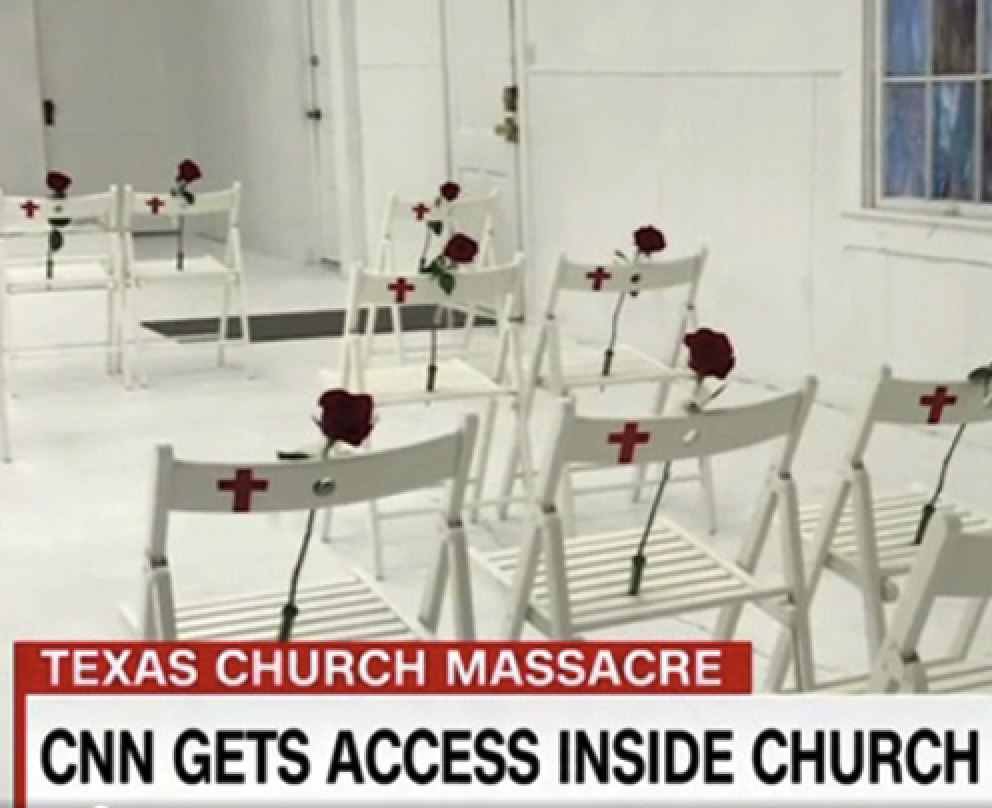
In this case, we are dealing with background materials in media coverage of a development in the 2017 massacre at the First Baptist Church in Sutherland Springs, Texas. Here’s the New York Times headline: “Air Force Ordered to Pay $230 Million to Victims of 2017 Church Shooting.” The overture states:

A federal judge ordered the U.S. Air Force … to pay more than $230 million to the survivors and the families of the victims of a 2017 shooting at a Texas church because the Air Force had failed to report the gunman’s criminal history.

In his ruling, Judge Xavier Rodriguez of the U.S. District Court for the Western District of Texas wrote that the Air Force could have blocked the gunman, Devin P. Kelley, who had served on an Air Force base in New Mexico, from buying the rifle he used to kill 26 people on Nov. 5, 2017, at the First Baptist Church in Sutherland Springs, Texas.

For its failure to report Mr. Kelley’s 2012 conviction for domestic assault, the Air Force must pay damages to the victims for their “pain and suffering, mental anguish, disfigurement, impairment and loss of companionship,” the judge wrote. He added that the case was “unprecedented in kind and scope.”

After previous commentary on this massacre, some readers noted that — reacting to detailed coverage in European newspapers — it wasn’t automatically relevant that Kelley was an outspoken atheist.

That is a valid point. However, my question is whether it is worthy of discussion (perhaps one or two sentences in news reports) that he had, in arguments on social media, expressed virulently anti-Christian beliefs and made remarks that suggested he was unstable.


Please respect our Commenting Policy

In Afghanistan, believers in religious minorities have every reason to go underground

In Afghanistan, believers in religious minorities have every reason to go underground

There's a logical reason that Taliban forces have not been accused of destroying any churches in Afghanistan.

"That's the dirty little secret. There were no churches before the Taliban returned to power," said Nina Shea, director of the Hudson Institute's Center for Religious Freedom and a human-rights activist for 30 years. "Christians were already underground because of the constant threats to their lives, so they didn't have any church buildings to blow up."

Everyone remembers the shocking videos when desperate Afghans chased a U.S. military plane on a Kabul runway, pleading to be among those evacuated. At least two people fell to their deaths after clinging to a plane during takeoff.

Ever since, there have been reports about the dangers faced by those left behind, especially Afghans with ties to the U.S. military, the fallen government or workers in secular or religious non-profit groups that remained behind to continue humanitarian work.

Christians, Hindus, Sikhs, Ahmadis, Shia Muslims and members of other religious minorities are also living in fear.

"They are all on the run. They are all in hiding," said Shea, reached by telephone. "People are being hunted down and beaten and are threatened with death if they don't betray members of their families who are considered apostates" by the Taliban.

It's impossible not to discuss religious freedom during this crisis, she added. "Everything the Taliban does is about religion. Religion is involved when they hang people for violating their approach to Islamic law or when they attack women and girls who want to go to school. For the Taliban, this is all connected."

The problem is that religious freedom concerns are often drowned out during debates about politics, economics, climate change and other issues in violent flashpoints around the world.


Please respect our Commenting Policy