Evangelicals

Podcast: Reporters who ask the right questions will find lots of NFL religion stories

Podcast: Reporters who ask the right questions will find lots of NFL religion stories

Several days before former Miami Dolphin head coach stunned the National Football League with his class-action lawsuit alleging racial discrimination and other sins, I read a very interesting profile at The Athletic about one of my sports heroes.

The headline summed things up: “Bears Hall of Famer Mike Singletary is hungry for a second chance to be an NFL head coach, but will it ever come?”

Singletary was a legend in Chicago and, before that, at Baylor University — where I met him because of a mutual friend. Singletary was a highly articulate preacher’s kid from Houston with a voice that sounded like he was auditioning to be the next James Earl Jones. He was a leader from Day 1 at Baylor and demonstrated all the characteristics that made him the face, brain and soul of the greatest defensive unit in NFL history.

This is where the Singletary feature became relevant during this week’s “Crossroads” podcast (CLICK HERE to tune that in), which focused on why journalists struggle to spot “religion ghosts” in so many sports stories, such as the life of Los Angeles Rams superstar Cooper Kupp (“Emerging NFL superstar — Cooper Kupp — puts his faith on his hat, not that reporters notice”) and the beliefs that appear to be putting the steel in the spine of Flores.

Why hasn’t Singletary had a second shot at being an NFL head coach, after his tumultuous tenure in San Francisco (not the best city for his views on faith and culture)? It may have something to do with Singletary trying to “stand for what he had been preaching” with the 49ers. Read this long passage carefully:

… 49ers owner John York, CEO Jed York, director of player personnel Trent Baalke and other executives called Singletary to a meeting. They had a trade in place with the Steelers for Ben Roethlisberger, who had recently been accused of sexual assault. Singletary vetoed the deal. …

“I had been telling the team I wanted a team of character,” he says.

Please respect our Commenting Policy

Saving urban churches: Associated Press feature dances around several important issues

Saving urban churches: Associated Press feature dances around several important issues

When I arrived at The Rocky Mountain News (RIP) in the fall of 1984, one of the first things I did was take a long walk in downtown Denver — taking notes about the religious sanctuaries that were nearby.

Most of the urban churches were, as you would expect in a Western city, linked to Mainline Protestant denominations and there were several Roman Catholic parishes, as well.

All of the mainline churches were in decline, with shrinking and aging congregations housed inside large buildings dating back to the glory days of previous decades. The one exception was a United Methodist congregation led by an evangelical pastor who was reaching out to families, single adults and all kinds of people in nearby neighborhoods — Blacks, Latinos, Asians, etc.

Meanwhile, conservative churches were growing in the suburbs, with a mixture of nondenominational, Baptist, Pentecostal and alternative Presbyterian flocks leading the way.

My point is that there were several stories going on in downtown Denver at the same time. But it was already clear — four decades ago — that lots of those old, big churches would eventually be empty or up for sale. It was also obvious that some of them would seek income from other sources to help keep their doors open, renting space to other flocks or social ministries.

Major news organizations keep bumping into stories linked to these trends, in part because big newsrooms tend to be in central urban zones and, in my experience, quite a few journalists (religion-beat pro included) have liberal Protestant or Catholic backgrounds or remain active in those traditions. Thus, here at GetReligion, it’s common to see posts with headlines such as these: “More news about old churches being sold and flipped: Does it matter why this is happening?”, “Churches for sale: New York Times visits a sexy former Catholic sanctuary in Quebec” and “Wait just a minute: Fading Lutherans (ELCA) in Waco sold their lovely building to Anglicans?” Or how about this one? “Why is a church shrinking or closing? Reporters: Brace for complex and heated debates.”

This brings me to a new Associated Press report about this old topic: “Historic city churches find new life as neighborhood centers.” Once again, there are glimpses of the trends behind this news hook, but very little information examining the larger issues looming in the background.


Please respect our Commenting Policy

Reporting on white Christian nationalists? Try talking with some of these Americans in person

Reporting on white Christian nationalists? Try talking with some of these Americans in person

“White Christian nationalism” (WCN) has become quite the bogeyman in contemporary religion coverage, even though few reporters seem to have spent much time actually engaging with people in the flocks led by said nationalists.

Instead, journalists read their social media, watch their YouTube videos and talk with sources drawn from a rather predictable list of activists and experts who oppose the bogeyman.

But that does not a complete story make. Readers end up with, at best, half of a debate.

One outlet that’s building or staking its reputation on WCN continuing to be a thing is Religion News Service, which has been rolling out stories on the topic since last September, thanks to a grant from the Pulitzer Center. The latest story in its “White Christian Nationalism since the Jan. 6 Attack” series ran Jan. 26 here. It began:

When supporters of former President Donald Trump rallied near the White House on Jan. 6 of last year, a boisterous pocket of young men waving “America First” flags broke into a chant: “Christ is King!” It was one of the first indications that Christian nationalism would be a theme of the Capitol attack later that day, where insurrectionists prayed and waved banners that read “Proud American Christian.”

It also announced the presence of followers of Nick Fuentes, a 23-year-old white nationalist and former YouTube personality who was subpoenaed this month by the U.S. House of Representatives committee investigating the Capitol attack. …

“Christ is King” is not controversial in itself: The phrase is rooted in Christian Scripture and tradition. But Fuentes’ supporters have given it a different connotation. They have chanted it at anti-vaccine protests and the anti-abortion March for Life, some of them holding crucifixes aloft. It was heard in March, at an America First conference, where Fuentes delivered a speech saying America will cease to be America “if it loses its white demographic core and if it loses its faith in Jesus Christ.” Fuentes also declared the country “a Christian nation.”

There are a bunch of academics and other sources quoted here but what appears to be the central thesis –- that WCN is bleeding into the mainstream institutions and life of conservative Christianity –- was not proven by a long shot.


Please respect our Commenting Policy

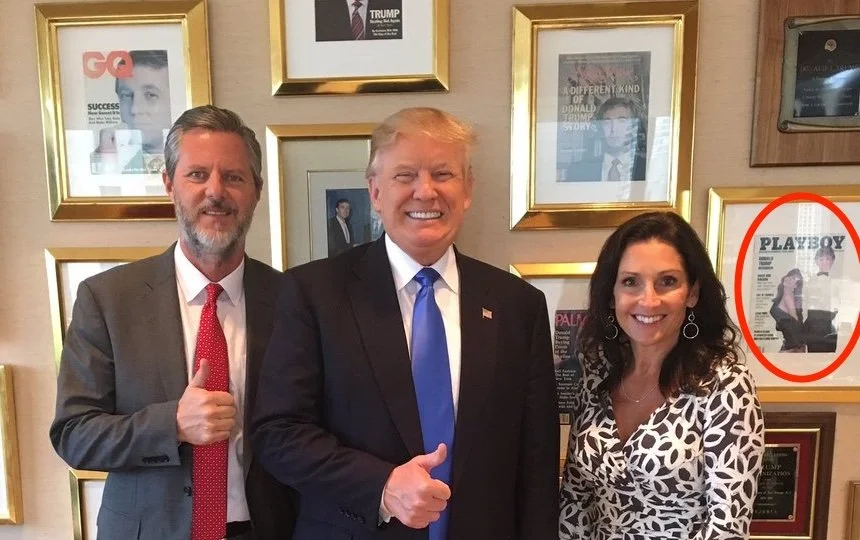
Podcast: As it turns out, it was totally logical for Jerry Falwell, Jr., to embrace Donald Trump

Podcast: As it turns out, it was totally logical for Jerry Falwell, Jr., to embrace Donald Trump

When reading That. Vanity. Fair. Article, it will help to focus on the obvious answer to the big question that will immediately pop into your head (especially if you happen to be a journalist).

The question: Why did Jerry Falwell, Jr., choose to talk to a magazine with a solid footprint on the American cultural and journalistic left?

The answer: Falwell is a lawyer who, at the moment, has a number of pressing legal issues in his life. To put this in D.C. Beltway lingo, he appears to be “hanging a lantern” on his problems. Here is one online definition of that term:

"Hang a lantern on your problem” was entered into the political lexicon in the 1980s by Chris Matthews, a former chief of staff to Speaker of the House of Representatives Tip O’Neill. Matthews explained “hang a lantern on your problem” to the New York (NY) Times in 1987: “The first step is, admit you have a problem; that gives you credibility. The second step is to use that credibility to redefine your problem, or use the problem for your own purposes.”

As I explained during this week’s “Crossroads” podcast (CLICK HERE to tune that in), it is interesting to read the Vanity Fair piece and, with a mental highlighter pen (a real one if you get the analog magazine), mark the questions that Falwell chooses to answer and the ones that he declines to answer. Then, repeat the process with the questions that are answered and rejected by other key voices — think Giancarlo “pool boy” Granda and legal representatives for Liberty University.

This process will yield insights into two of the most obvious plot lines in this soap-opera mess, as in its steamy Miami-angle sex scandal and the ugly legal wars between Jerry Falwell, Jr., and the shamed leaders of Liberty University.

Once you’ve done that, you’re read to dig into the deeper elements of this story, which are clearly visible in the long, long, long second deck of it’s double-headline:


Please respect our Commenting Policy

In post-pandemic America, will sagging church health damage public health? 

In post-pandemic America, will sagging church health damage public health? 

America's religious congregations have, over all, suffered steady erosion in attendance, membership and vitality since around 2000.

Analysts fret that worse may occur after the current COVID-19 emergency finally subsides because myriads of members are now accustomed to worshiping online rather than in person or they may skip services altogether.

At the same time, there is evidence that, while decline is common, a majority of congregations report that they have survived or even grown during the past two years. This is a complex subject. As a recent Associated Press story noted:

Gifts to religious organizations grew by 1% to just over $131 billion in 2020, a year when Americans also donated a record $471 billion overall to charity, according to an annual report by GivingUSA. Separately, a September survey of 1,000 protestant pastors by the evangelical firm Lifeway Research found about half of congregations received roughly what they budgeted for last year, with 27% getting less than anticipated and 22% getting more.

This is an important news topic, no matter what. Even secularized news consumers should be interested when social science researchers tell us that sagging participation could not just damage religious institutions but create a public health "crisis." In our age of solitary, do-it-yourself forms of spirituality, research indicates, regular in-person attendance at worship services is central to the well-being of children, adults and society.

This important assertion does not come from religious propagandists but Harvard's Institute for Quantitative Social Science. Building upon two decades of scholarship, the institute in 2016 launched its distinctive "Human Flourishing Project" to focus on the impact the family, workplace, education and religion have on peoples' well-being. Their survey samples are large and they say their methodology improves upon past research.

Key findings document differences between Americans who regularly attend worship versus those who never attend.


Please respect our Commenting Policy

New podcast: Sex, marriage and babies are now topics too hot for preachers to handle?

New podcast: Sex, marriage and babies are now topics too hot for preachers to handle?

Hey religion-beat reporters (and even pros who cover politics): Want to find some really interesting stories?

Ask this question: What are the subjects that clergy are afraid to address in the pulpit? This was the big idea looming in the background during this week’s “Crossroads” podcast (CLICK HERE to tune that in).

For example, lots of people interpreted the silence of many super-preachers on the ethics and affairs of Donald Trump as evidence of support for him. It is much more likely (see some of the info in this “On Religion” column) that they knew the people in their pews were divided on this topic.

Thus, they were afraid to discuss it. They didn’t want to start a war.

Here’s another case study, one so old that my reporting on it predates the Internet. But I addressed the topic in this 2016 post here at GetReligion. Remember the “True Love Waits” phenomenon?

Anyway, I realize that for many people the whole "True Love Waits" thing was either a joke or an idealistic attempt to ask young people to do the impossible in modern American culture. …

What fascinated me was that, according to key "True Love Waits" leaders, they didn't struggle to find young people who wanted to take vows and join the program. What surprised them was that many church leaders were hesitating to get on board because of behind-the-scenes opposition from ADULTS in their congregations.

The problem was that pastors were afraid to offend a few, or even many, adults in their churches — even deacons — because of the sexual complications in many lives and marriages, including sins that shattered marriages and homes. Key parents didn't want to stand beside their teens and take the program's vows.

This brings me to some amazing Gallup Poll data that —as far as I can tell — didn’t receive any news coverage when it came out in 2020. There was a Twitter flurry about it the other day, which led to some people re-upping this “story” that wasn’t a “news story.”

The headline on the feature at Gallup: “Is Marriage Becoming Irrelevant?” Here is a chunk of the information that should have raised eyebrows, for reporters and preachers — including clergy who face people sitting in “red,” “conservative” pews.


Please respect our Commenting Policy

Ask this: Why did many flocks survive or thrive in pandemic, while others were hit hard?

Ask this: Why did many flocks survive or thrive in pandemic, while others were hit hard?

Does anyone remember typewriters?

Long ago, I took my very first reporting class at Baylor University. The legendary Jprof David McHam ran this lab as a mini-newsroom. McHam would sit in the “slot” of a U-shaped desk, working with students as we turned in our rough drafts.

I heard him say this many times: “The story is all here, but you wrote it in the wrong order,” or words to that effect. McHam would take his copy-desk pica pole (the birthday cake cutter of choice in newsrooms) and rip our typewriter copy into multiple horizontal pieces, before putting them in a new order, secured with a long strip of clear tape. Then he would say: “Go write the story in that order.”

More often than not, the wise Jprof found crucial information and pulled it higher in the story — if not into the lede itself. In many cases, this was information that created a tension with a simple version of the “news” in the lede. In other words, he was pushing us to acknowledge that many stories were more complex than we wanted to think they were.

With that in mind, let’s look at an important COVID-tide story from the Associated Press: “At many churches, pandemic hits collection plates, budgets.”

Note the word “many” in that headline. I think many readers would assume that the coronavirus pandemic has caused disasters in pews and pulpits and that is that. The evidence, in this story, is more complex than that — especially with a little bit of cutting and pasting. Here is the overture:

Biltmore United Methodist Church of Asheville, North Carolina, is for sale.

Already financially strapped because of shrinking membership and a struggling preschool, the congregation was dealt a crushing blow by the coronavirus. Attendance plummeted, with many staying home or switching to other churches that stayed open the whole time. Gone, too, is the revenue the church formerly got from renting its space for events and meetings.


Please respect our Commenting Policy

Is America really threatened by civil war? What is religion's role in these tensions?

Is America really threatened by civil war? What is religion's role in these tensions?

American Civil War talk is all the rage this New Year.

No, not that war, the one that cost 620,000 lives and was evoked by President Biden to castigate Senate Democrats and Republicans who are blocking passage of new election-ballot rules. Rather, The Guy refers to the drumbeat of warnings that the disunited United States may in the near future face an internal legal and economic cold war or some kind of hot war.

National Public Radio's Ron Elving reports that "not long ago the idea of another American Civil War seemed outlandish. These days, the notion has not only gone mainstream, it seems to suddenly be everywhere." He summarized anxiety-producing polls that show a polarized nation, and noted that 434,000,000 firearms are in civilian hands.

Then there's New Yorker Editor David Remnick's article "Is a Civil War Ahead?" New York Times columnist Michelle Goldberg likewise wonders, "Are We Really Facing a Second Civil War?" A Times op-ed by former National Security Council staffers Jonathan Stevenson and Steven Simon offers "the worst case scenario" in which "the United States as we know it could come apart at the seams" with "insurrection, secession, insurgency and civil war."

New January books include "The Next Civil War: Dispatches From the American Future" by novelist Stephen Marche, who sees virtually inevitable doom, and the slightly more upbeat "How Civil Wars Start and How to Stop Them" by Barbara F. Walter of the University of California San Diego. (Is it mere coincidence that The Atlantic's London writer Tom McTague is just out with "How Britain Falls Apart"?)

One typical forecaster is all the more interesting because he's Canadian. Thomas Homer-Dixon of Royal Roads University issued a New Year's Eve alarm in the influential Globe and Mail. He believes that as soon as 2025 "American democracy could collapse, causing extreme domestic political instability, including widespread civil violence. By 2030, if not sooner, the country could be governed by a right-wing dictatorship."

Outlandish?


Please respect our Commenting Policy