Catholicism

Catholic left seeks (and finds?) signs of hope after Vatican ruling on same-sex unions

Catholic left seeks (and finds?) signs of hope after Vatican ruling on same-sex unions

After a media firestorm ignited by a Vatican condemnation of same-sex unions -- because God "cannot bless sin" -- Catholic progressives immediately looked for hope in the words of bishops, President Joe Biden and even Pope Francis.

In his Sunday Angelus address after the March 15 ruling, the pope stressed that modern seekers want to "see Jesus" in acts of love, not persecution.

Catholics must promote "a life that takes upon itself the style of God -- closeness, compassion and tenderness," said the pope. "It means sowing seeds of love, not with fleeting words but through concrete, simple and courageous examples, not with theoretical condemnations, but with gestures of love. Then the Lord, with his grace, makes us bear fruit, even when the soil is dry due to misunderstandings, difficulty or persecution, or claims of legalism or clerical moralism."

While Pope Francis gave "his assent" to this ruling, the Jesuit publication America cited anonymous Vatican sources saying the Angelus remarks suggested that he was "distancing himself" from the work of the Congregation for the Doctrine of the Faith.

That document said God "does not and cannot bless sin: He blesses sinful man, so that he may recognize that he is part of his plan of love and allow himself to be changed." As for same-sex unions, it added: "The presence in such relationships of positive elements … cannot justify these relationships and render them legitimate objects of an ecclesial blessing, since the positive elements exist within the context of a union not ordered to the Creator's plan."

Bishop Johan Bonny of Antwerp -- who represented Belgium at the 2015 Vatican Synod on Marriage and the Family -- said those words left him "ashamed on behalf of my Church. … I want to apologize to all those for whom this 'responsum' is painful and incomprehensible: faithful and committed Catholic homosexual couples, the parents and grandparents of homosexual couples and their children, pastoral workers and counsellors of homosexual couples," he wrote on Facebook.

"I know homosexual couples who are legally married, have children, form a warm and stable family, and moreover, actively participate in parish life. A number of them are employed full-time in pastoral work or ecclesial organizations." Why, he added, deny the "similarity or analogy with heterosexual marriage here?"

Please respect our Commenting Policy

New podcast: Tensions with NCAA and Christian schools? That issue will not go away

New podcast: Tensions with NCAA and Christian schools? That issue will not go away

A decade or so ago, I had a chance to speak to journalism students at Oral Roberts University. My strongest memories — other than visions of the shiny modernist architecture — center on an unusual moment during a campus chapel service.

There’s nothing unusual about a Christian university having a full-house chapel service. There’s nothing unusual about a student-led praise-rock band blasting out Contemporary Christian Music songs that inspired lots of people to do their share of swaying and dancing.

But here’s the memory. My visit to the campus took place during a meeting of ORU’s board of trustees, who sat together near the front of the auditorium during chapel. Looking down from the balcony, I was surprised to see that (a) many of the trustees were rather young, (b) a much higher than normal number of them were Black or Latino and (c) several were enthusiastically dancing with the students, including at least one in an aisle (the current board doesn’t look quite as young).

All of this was a reminder that much of the racial and cultural diversity at ORU — a major factor in campus life — was and is linked to the school’s roots in charismatic and Pentecostal Christianity, a movement that as been highly multiracial since its birth. Founder Oral Roberts was a famous, and often controversial, leader among charismatic Christians, even though, as an adult, he aligned with the United Methodist Church (which is more conservative in Oklahoma than, let’s say, parts of Illinois and other blue zip codes).

I bring this up because of a recent USA TodayFor the Win” column that served as the hook for this week’s “Crossroads” podcast (click here to tune that in). Here’s the headline for that piece, which was written by the “race and inclusion editor” at USA Today sports: “Oral Roberts University isn't the feel good March Madness story we need.” Here is a crucial passage:

… As the spotlight grows on Oral Roberts and it reaps the good will, publicity and revenue of a national title run, the university’s deeply bigoted anti-LGBTQ+ polices can’t and shouldn’t be ignored.

Founded by televangelist Oral Roberts in 1963, the Christian school upholds the values and beliefs of its fundamentalist namesake, making it not just a relic of the past, but wholly incompatible with the NCAA’s own stated values of equality and inclusion.


Please respect our Commenting Policy

Catholic journalists are must-read sources for those seeking reality of Cuomo scandals

Catholic journalists are must-read sources for those seeking reality of Cuomo scandals

It was just two months ago, in the aftermath of the U.S. Capitol riot, that an idea was floated that could help stop all the misinformation in our society: a “reality czar.”

It was a New York Times piece by tech columnist Kevin Roose (his new book “Futureproof is a must read if you’re interested in automation replacing you at work) on Feb. 2 that quoted experts who floated ideas to stop what the paper called the “scourge of hoaxes and lies.”

Roose’s piece threw out some interesting solutions — although “reality czar” is Orwellian, a Soviet-style solution to misinformation.

The harsh reality is that news consumers will need to read a wider variety of news sources if they are interested in finding solid facts, on-the-record sources and some sense of balanced reporting. On issues linked to religion, culture and politics, that will mean paying more attention to independent religious publications — including Catholic websites — that are now punching way above their weight. Hold that thought, because we will come back to it.

The truth is reality used to be what journalism purported to report on.

That’s no longer true given how polarized the news media has become over the past decade, a progression that sped up during the Donald Trump years and following the proliferation of partisan news sources during the internet age.

From a political standpoint, this brand of one-sided journalism has allowed politicians to earn cover from many mainstream newsrooms for alleged wrongdoings. On the left, New York Gov. Andrew Cuomo, embroiled in dual scandals regarding nursing home deaths during COVID-19 and growing claims of sexual harassment, is a prime example of this phenomena.

At this time last year, professionals at news organizations were fawning all over his press conferences as the country plunged into the pandemic. Many journalists considered Cuomo the coronavirus reality czar.

Why? Cuomo, a Democrat, served as the counterweight to then-President Trump.


Please respect our Commenting Policy

A police officer's calling and sacrifice: What about that sanctuary across from King Soopers?

A police officer's calling and sacrifice: What about that sanctuary across from King Soopers?

If you have lived in the Denver area, you know that King Soopers grocery stores are a familiar part of the urban and suburban landscape.

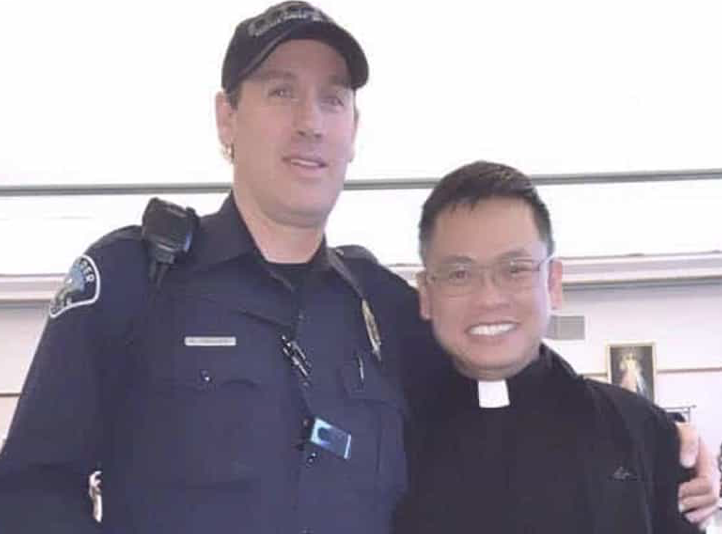
As the details emerged from the hellish shootings in Boulder that claimed 10 lives, it was clear that the fallen first responder — 51-year-old Officer Eric Talley — was an unusual man whose career in law enforcement had unusual roots. He came to the job, people said over and over, with a sense of “calling.” That is, of course, a word with strong faith overtones.

There were many pieces of information to assemble, in portraits of Talley. He was the father of seven children — ages 7 to 20 — who were being homeschooled by his wife. He bought a 15-passenger van to make family travel easier. Another officer told the Denver Post that Talley was a “devout Catholic.” This is a case where that all-too-common adjective fits the evidence.

Some news-media reports mentioned Talley’s faith, others did not. It was hard to miss this quotation, picked up by Washington Post:

His father, Homer Talley, told Denver TV station KMGH in a statement that his son was working to become a drone operator, a job he thought would be safer.

“He loved his kids and his family more than anything,” his father wrote. “ …He didn’t want to put his family through something like this and he believed in Jesus Christ.”

However, I was struck by another detail in a statement from Archbishop Samuel J. Aquila of the Archdiocese of Denver. As it turns out, there was a reason that Talley was familiar with this particular King Soopers location.

We do know that Officer Eric Talley was Catholic, and has been described as a man of character and strong faith, a loving father to seven children, a husband who cared deeply for his family, and a soldier for Christ. …

We also know that Officer Talley regularly stopped by St. Martin de Porres in Boulder and participated in its events, even though he wasn’t a parishioner there. For those unfamiliar with the area where the shooting occurred, St. Martin de Porres is just across the street from King Soopers.


Please respect our Commenting Policy

Prayers and bloodshed during Lent: Catholic bishops cry out for help in Nigeria

Prayers and bloodshed during Lent: Catholic bishops cry out for help in Nigeria

Another day, with yet another funeral.

Catholics in Nigeria had buried many priests and believers killed in their country's brutal wars over land, cattle, honor and religion. But this was the first time Bishop Matthew Hassan Kukah of the Sokoto Diocese had preached at the funeral of a seminarian.

A suspect in the crime said 18-year-old Michael Nnadi died urging his attackers to repent and forsake their evil ways.

"We are being told that this situation has nothing to do with religion," said Kukah, in remarks distributed across Nigeria in 2020. "Really? … Are we to believe that simply because Boko Haram kills Muslims too, they wear no religious garb? Are we to deny the evidence before us, of kidnappers separating Muslims from infidels or compelling Christians to convert or die?"

The bishop was referring to fierce debates -- in Nigeria and worldwide -- about attacks by Muslim Fulani herders on Christian and Muslim farmers in northern and central Nigeria. The question is whether these gangs have been cooperating with Boko Haram, Al-Qaeda and the Islamic State.

The conflict has claimed Catholics, Anglicans, Pentecostal Christians and many others, including Muslims opposed to the violence. Prominent Muslim leaders have condemned Boko Haram and church leaders have condemned counterattacks by Christians. In recent years it has become next to impossible to keep track of the number of victims, including mass kidnappings of school children and the murders of clergy and laypeople, including beheadings.

"Religion is not the only driver of the mass atrocities," said Nina Shea of the Hudson Institute's Center for Religious Freedom, in December testimony before members of the House Foreign Affairs Committee. "Not all 40 million members of the Fulani ethnic group in the region are Islamic extremists. However, there is evidence that some fraction of the Fulani have an explicit jihadist agenda. …

"A mounting number of attacks in this region also evidence deep religious hatred, an implacable intolerance of Christians, and an intent to eradicate their presence by violently driving them out, killing them or forcing them to convert."

In a sobering Feb. 23 statement (.pdf here), the Catholic Bishop's Conference of Nigeria warned that the "nation is falling apart."


Please respect our Commenting Policy

Local news? Tricycle's Western Buddhism essay shows how religions adapt to new environs

Local news? Tricycle's Western Buddhism essay shows how religions adapt to new environs

Religions evolve and accommodate as they migrate around the globe. What works in one time and place may not in another for a host of cultural and political reasons, forcing adjustments that facilitate their establishment or survival.

Historical examples abound. Not the least of which are the monumental transformations that occurred within early Christianity as it migrated across the Roman world from the Levant, and within early Islam as it spread from the Arabian Peninsula west to the Atlantic coast and east across Asia.

Here are two more recent examples of religious accommodation.

The first occurred in the late 19th Century when the Church of Jesus Christ of Latter-day Saints made a corporate decision to jettison its public practice of polygamous marriage to smooth the way for Utah’s full acceptance into the expanding United States. This despite plural marriage remaining part of the church’s scriptural doctrine to this day. The practice, though illegal under secular law, is still followed by some breakaway Mormon sects.

The second example was the melding of Roman Catholicism and West African tribal beliefs in the Caribbean and South America by Black slaves and their descendants. This gave rise to syncretic faiths such as Santeria and Voodoo. They persist today side by side with the church in ways that would scandalize the hierarchy, were it happening on a similar scale in the United States.

It’s not unusual for Mass-going Cuban, Haitian and Brazilian Catholics to also draw meaning from West African-derived rituals that to outsiders might appear hard to reconcile with core church beliefs.

A contemporary religious travel story is the Westernization of Asian Buddhism. Tricycle, a leading American Buddhist publication, deconstructed the phenomenon in its Spring 2021 issue.

The piece is well worth the time of journalists interested in moving beyond today’s often superficial religion headlines. To understand a group’s sociology is to better understand why members act as they do in the public square, journalism’s primary purview.

I suggest you view the Tricycle essay — which weighs in at more than 3,600 words — as a sort of crash course in the adaptation of religions to new circumstances. This will help reporters spot stories in the communities served by their newsrooms.


Please respect our Commenting Policy

3D chess in Rome? Pope Francis approves Vatican decree affirming doctrines on marriage

3D chess in Rome? Pope Francis approves Vatican decree affirming doctrines on marriage

All together now: Is the pope Catholic?

Actually, in this age of conspiracy theories — on right and left — the question of the day appears to be: Is THIS pope Catholic? I am referring, of course, to the Vatican’s decision to affirm centuries of Christian doctrine stating that sex outside of marriage is (trigger warning) “sin” and that the sacrament of marriage is limited to the union of a man and a woman.

But, but, but, clearly Pope Francis must be playing some kind of three-dimensional chess with this action, moving the doctrinal pieces in some subtle way that will become clear in “reforms” at a later date? This was a case in which one could catch whiffs of disappointment and even conspiracy thinking on both the Catholic left and right (and in the press).

To see this in print, check out the overture in this Washington Post report: “Pope Francis says priests cannot bless same-sex unions, dashing hopes of gay Catholics.” The headline assumes, of course, that all gay Catholics oppose the church’s teachings on this matter but, well, nevermind.

ROME — Pope Francis has invited LGBT advocates to the Vatican. He has spoken warmly about the place of gay people in the church. He has called for national laws for same-sex civil unions.

But Monday, Francis definitively signaled the limits to his reformist intentions, signing off on a Vatican decree that reaffirms old church teaching and bars priests from blessing same-sex unions.

The pronouncement, issued at a time when some clerics were interested in performing such blessings, leans on the kind of language that LGBT Catholics have long found alienating — and that they had hoped Francis might change. It says that same-sex unions are “not ordered to the Creator’s plan.” It says acknowledging those unions is “illicit.” It says that God “cannot bless sin.”

The decree shows how Francis, rather than revolutionizing the church’s stance toward gays, has taken a far more complicated approach, speaking in welcoming terms while maintaining the official teaching. That leaves gay Catholics wondering about their place within the faith, when the catechism calls homosexual acts “disordered” but the pontiff says, “Who am I to judge?”

Let’s see. We have the standard use of the word “reform” to prejudge this matter. We have a sense of yearning that Pope Francis is taking a “more complicated approach” to this doctrinal issue.


Please respect our Commenting Policy

Does President Joe Biden need 'Catholic safe spaces' in order to receive Communion?

Does President Joe Biden need 'Catholic safe spaces' in order to receive Communion?

Whether some Catholic politicians can receive Holy Communion has been a matter of debate for decades.

The election of Joe Biden — a man constantly identified as as a “devout Catholic” by his staff and, thus, the mainstream press — has put a hot spotlight on this familiar issues. The key is whether his Catholic piety is compatible with his statements and actions that are rooted in progressive politics.

This issue has come into greater focus during Biden’s first 100 days in office. The Atlantic, in a piece written by Emma Green, detailed how some key U.S. bishops — and “many conservative laypeople” — think the president should be denied access to Holy Communion.

Green’s well-reported feature detailed the ongoing battle between Catholics across this country and the current occupant of the Oval Office, a fight that’s expected to worsen over the next four years. Here’s the thesis:

If some Catholic leaders had their way, Biden wouldn’t be able to take Communion at all. A committee of bishops recently gathered to examine the “difficult and complex situation” of a Catholic president who publicly supports expanding abortion rights, contrary to the faith’s teachings. Later this year, a representative of that group will likely offer guidance on Biden’s future ability to take Communion. For now, the cardinal who oversees Washington, D.C., Wilton Gregory, has said the president is welcome to attend any Mass in his archdiocese. “I don’t want to go to the table with a gun,” Gregory told Religion News Service.

Biden, the second Catholic president in American history, is a man of faith who cites Saint Augustine and hymns in his speeches and carries a rosary that belonged to his son Beau. His presidency is a historic opportunity for the Catholic Church. But he’s also a symbol of a Church at political war with itself; Catholic voters are nearly evenly divided between the parties, and the bishops have been squabbling in public over how to deal with his administration. Sinners abound in politics. The question facing the Catholic hierarchy is whether to offer the most famous Catholic sinner in America an invitation to closeness with God, or to withhold Communion until the president falls fully in line with his Church’s teachings.

The story opened with Biden’s arrival at Holy Trinity Catholic Church in Washington, D.C. to attend Mass, the same place he attended when vice president.

A key detail: Father Kevin Gillespie “checked with Gregory” to make sure he had the cardinal’s backing.


Please respect our Commenting Policy

Christians, Jews, Muslims and lobbyists left and right fret over SCOTUS 'donor privacy' case  

Christians, Jews, Muslims and lobbyists left and right fret over SCOTUS 'donor privacy' case   

What cause could ever possibly unite Christian Right activists, the Council on American-Islamic Relations, the Zionist Organization, "pro-family," "pro-life," "pro-choice" and gun-rights lobbies, Mitch McConnell, the American Civil Liberties Union, Chamber of Commerce, Judicial Watch, NAACP, People for the Ethical Treatment of Animals, Planned Parenthood, Southern Poverty Law Center, Columbia University's First Amendment institute and religious-liberty advocates?

Answer: These and many more are allied in the Americans for Prosperity Foundation v. Becerra case (#19-251), which the U.S. Supreme Court put on its upcoming docket January 8.

Yes, that Becerra is Xavier, as in President Biden's controversial pick for secretary of Health and Human Services, acting in his previous role as California's attorney general. Moreover, this situation implicates the track record of his predecessor as A.G., Kamala Harris — now U.S. vice president and a major 2024 presidential prospect.

At issue is "donor privacy." Non-profit groups cannot operate or raise money in the state of California unless they give its attorney general the names and addresses of their major donors, the same list that's required as an appendix to their federal IRS returns. The non-profits argue that this violates their right to freedom of association under the Constitution's First Amendment.

Obviously this is something for alert media eyes, including pros on the religion beat.

Adding to news interest, this case displays contrasting beliefs of the U.S. Department of Justice in its Trump Administration brief filed last November (.pdf here) versus its revised stance under the new Biden Administration (.pdf here). The Trump brief strongly backs non-profit interest groups. The Biden brief dodges the question and asks the court to bounce the case for further investigation.

Religion specialists note: The Supreme Court consolidated the Americans for Prosperity case, raised by the libertarian political foundation established by the Koch brothers, with a second appeal from the Thomas More Law Center. This second agency provides free legal representation for "people of faith" to uphold "the religious freedom of Christians, time-honored family values and the sanctity of human life."


Please respect our Commenting Policy