Bobby Ross Jr.

U.S. mission groups stranded by Haiti unrest, and CNN — to its credit — reports on it

Summer is prime time for faith-based mission trips.

Many U.S. church groups — often including teens and college students — travel all the world this time of year.

I just returned from a Christian Chronicle reporting trip to Puerto Rico, where I followed a Kentucky congregation helping with Hurricane Maria relief work. While there, I noticed the news about unrest in Haiti, a country I visited just a few months ago to report on water well drilling. 

Just weeks ago, I reported on political violence prompting the cancellation of dozens of church mission trips to Nicaragua. Not so many years ago, of course, ongoing concerns over drug cartels began curtailing mission work in Mexico. 

Not too often, though, do major news organizations cover the impact of the dangerous world on church mission trips, even though there's frequently a compelling story there.

That's why I was so pleased to see CNN tackle that angle amid the Haiti unrest:

(CNN) A number of US missionary groups are stranded in Haiti after protesters took to the streets following a fuel price hike ordered by the government.

One group described burning barricades preventing them from reaching the airport in the nation's capital, Port-au-Prince.

The US Embassy in Haiti warned its citizens Saturday to stay inside amid continued demonstrations in Port-au-Prince and a northern city.

Prime Minister Jack Guy Lafontant on Saturday announced a temporary stop to the price increases and appealed for calm. Prices for gasoline were to rise 38% while diesel prices were to go up 47% and kerosene 51%, the Haitian daily newspaper Le Nouvelliste reported.

Keep reading, and CNN offers several specific examples of groups caught in the conflict.


Please respect our Commenting Policy

New York Times' 20th anniversary piece on East Texas dragging death is powerful, yet disappointing

New York Times' 20th anniversary piece on East Texas dragging death is powerful, yet disappointing

The New York Times' front page Monday featured a "beautiful and powerful story" — as one top journalist described it — on the 20th anniversary of James Byrd Jr.'s racially motivated dragging death in the East Texas town of Jasper.

Emotional and compelling, the piece is expertly written and filled with riveting details.

It even contains several references to faith.

So why am I about to give this story — which I mostly liked and really hoped I could praise — a negative critique? The simple answer is that the Times, in an otherwise excellent piece of journalism, fails to answer basic questions tied to religion. 

Up high in the story, the newspaper hints strongly at a religion angle when it mentions church and notes that Byrd's family forgave his killers:

JASPER, Tex. — Sometime after church but before dinner, Sgt. James Carter of the Jasper County Sheriff’s Office knocked on the front door of James and Stella Byrd’s home. He stepped into the living room, removed his white cowboy hat and bowed his head. Then, with a somber look on his face that the Byrds still remember years later, he delivered the news that their son James Byrd Jr. was dead.

The horrific circumstances surrounding his death they would learn later: Chained by his ankles to a pickup truck by three men, he had been dragged three miles, murdered before the sun rose that Sunday morning 20 years ago.

“I just knew something was terribly wrong,” Betty Boatner, 63, one of Mr. Byrd’s younger sisters, whispered as she sat on a picnic bench at a memorial park now named in his honor. “It’s such a small town that we had already heard the rumors that a black man was found dead, but we didn’t know who it was. Until the knock on our door.”

The family forgave Mr. Byrd’s three killers long ago and made peace with Jasper, the small East Texas town where they have lived for three generations. But as the nation faces a spread in bias crime incidents, the family wants to ensure the public remembers one of the worst hate crimes of the 20th century. In the years since Mr. Byrd’s death, both state and federal hate crime laws bear his name.

As I kept reading, I expected — or at least hoped — that the Times would elaborate on the family's forgiveness of the killers and the reasoning, which I suspected would include religion, behind it. But that explanation never comes.


Please respect our Commenting Policy

'Church vs. Church': New York Times delves into the biblical debate over immigration in Iowa town

"Church vs. Church in a Town Split by an Immigration Raid," said the headline on a front-page article in Wednesday's New York Times.

That certainly sounds like a religion story.

To its credit, the Times highlights the faith angle right up top and devotes a fair amount of ink to it. There's much to like about this in-depth report. But for a reason I'll explain in a moment — a reason not entirely the newspaper's fault — the piece failed to satisfy me completely.

Before I get into that, though, let's start with the strong lede:

MOUNT PLEASANT, Iowa — In the days after immigration agents raided a dusty concrete plant on the west side of town, seizing 32 men from Mexico and Central America, the Rev. Trey Hegar, pastor of the First Presbyterian Church, got into an impassioned argument on his Facebook page.

“The Bible doesn’t promote helping criminals!!!!” a Trump supporter wrote.

Mr. Hegar answered with Leviticus: “When a stranger resides with you in your land, you shall not do him wrong. The stranger who resides with you shall be to you as the native among you, and you shall love him as yourself, for you were aliens in the land of Egypt.”

The Trump supporter came back with the passage in the Gospel of Mark about rendering unto Caesar the things that are Caesar’s, and added for good measure: “Immigration laws are good and Godly! We elected our leaders and God allowed it.”

President Trump’s immigration crackdown has been promoted with biblical righteousness by senior members of his administration, including Attorney General Jeff Sessions. And in heartland communities where the president is popular, the crackdown is often debated — by supporters and critics alike — through the lens of Christian morality.

After offering background both on the Iowa town and the national immigration debate, the Times returns to the Bible question:

Mr. Hegar, a Texan who served four years in the Marines before attending a Presbyterian seminary, finally asked the Trump supporter he was debating on Facebook: “Which Scripture do we obey?”

He answered himself: “The one from Jesus to ‘Do unto others’ is what we choose.”

That's good stuff — the kind of excellent detail found in the best journalism.

But here's what kept me from loving this story: There was no strong voice on the other side.


Please respect our Commenting Policy

Side question re: viral story about baby Jesus, Mary and Joseph in a cage: Which Bible to quote? (updated)

Side question re: viral story about baby Jesus, Mary and Joseph in a cage: Which Bible to quote? (updated)

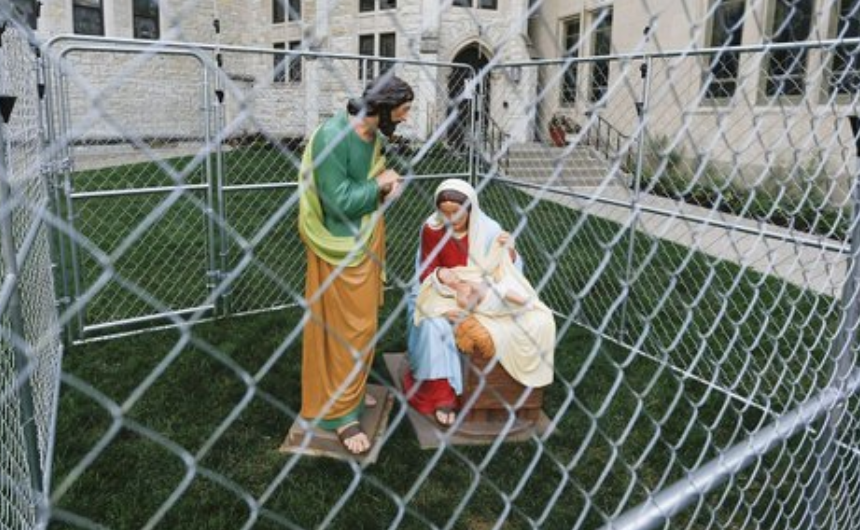
Baby Jesus, Mary and Joseph in a cage?

Everyone seems to talking about that viral religion story, as The Tennessean faith reporter Holly Meyer points out. 

In case you missed it, the Indianapolis Star reports that the three biblical figures "were incarcerated behind a barbed wired-topped, chain link fence on the lawn of Monument Circle's Christ Church Cathedral on Tuesday."

The reason:

The Rev. Stephen Carlsen, dean and rector of Christ Church, said the caged Holy Family is a protest to President Donald Trump's zero-tolerance policy that is holding families in detention centers at the U.S.-Mexico border.

"I know what the Bible said," Carlsen said. "We're supposed to love our neighbors as ourselves."

It's a fascinating story, and I'd urge you to check it out. But for the purposes of this post, I have a side question: Which version of the Bible should a news organization quote in a story such as this?

I'll admit surprise at the one the Gannett newspaper chose to quote:

The Rev. Lee Curtis, who came up with the idea for the demonstration, said the Biblical trio was a family of refugees seeking asylum in Egypt after Jesus' birth. 

"An angel of the Lord appeared to Joseph in a dream, saying, 'Arise, take the young Child and His mother, flee to Egypt, and stay there until I bring you word; for Herod will seek the young Child to destroy Him,'" the Message Bible says in Matthew 2:13-14. "When he arose, he took the young Child and His mother by night and departed for Egypt."

"This family is every family, and every family is holy," Curtis said. 

For those not familiar with The Message, it's a contemporary version in modern English. The religion satire news site Babylon Bee has published stories such as "‘The Message’ Now Available In Popular Comic Sans Font" and "7 Updates ‘The Message’ Totally Needs." Among the proposed updates: Substituting all references to Jesus with "The J-Man." That gives some indication of how seriously (read: not) some take that translation.

I'm not sure I've ever seen The Message be the go-to version quoted in a news story. (I'll eagerly await all the links proving me wrong.) My first thought was perhaps the Star was trying to put the verses in language readers could understand.


Please respect our Commenting Policy

As Jahi McMath — girl at center of life-support controversy — dies, coverage still haunted by ghosts

GetReligion first commented on the story of Jahi McMath back in 2014 in a post titled "God, faith and church (or not)" by my wife, Tamie Ross.

More recently, my colleague Julia Duin delved into a magazine piece on McMath in a post titled "To die or not to die: The New Yorker probes the case of a 13-year-old girl."

Each of those posts lamented the lack of specific details concerning religion and the family's theological reasons for wanting to keep the teen on life support.

So it's little surprise to find much of the recent news coverage of McMath's death haunted by holy ghosts.

Let's start with a big chunk of CNN's report:

(CNN) Jahi McMath, an Oakland teenager whose brain-death following a routine tonsil surgery in 2013 created national headlines, died on June 22, according to the family's attorney.

She was 13 when she underwent surgery to treat pediatric obstructive sleep apnea, a condition that made her stop breathing in her sleep and caused other medical problems.

Nearly five years later, "Jahi died as the result of complications associated with liver failure," the statement from attorney Christopher Dolan said.

She underwent surgery on December 9, 2013 at the Children's Hospital & Research Center Oakland. After the procedure to remove her tonsils, adenoids and extra sinus tissue Jahi was alert and talking to doctors and even requested a Popsicle.

According to her family, Jahi was in the intensive care unit when she started to bleed and went into cardiac arrest. On December 12, 2013 she was declared brain-dead. Her family disagreed with the declaration.

This launched a months-long battle between the hospital, which sought to remove Jahi from a ventilator after doctors and a judge concluded she was brain-dead, and her relatives, who fought in court to keep her on the ventilator and contended she showed signs of life.

See any missing words there?


Please respect our Commenting Policy

Friday Five: Capital Gazette journalists, SCOTUS news, an unsung hero's passing and more

"I’m just undone by what happened at the Capital Gazette," said my friend Carla Hinton, religion editor at The Oklahoman. "These are strange and heartbreaking times we are living in. Praying for my fellow journalists and their families."

"It's especially traumatic because so many of us started our careers at newspapers like the Capital Gazette," responded my friend Steve Lackmeyer, a longtime business reporter at The Oklahoman. "We know these people, we know these newsrooms..."

Amen and amen.

No, the senseless slaying of journalists isn't any more tragic than the mass shootings — at schools, churches and other businesses — that keep making headlines in America.

But for those of us in this profession, the Capital Gazette tragedy hits especially close to home.

Want to understand the heart and passion that make many journalists tick? Read this Twitter thread by Nyssa Kruse, an intern at the Hartford Courant.

Now, let's dive into the Friday Five:


Please respect our Commenting Policy

After Kennedy retirement, you'll find thousands of the nation's happiest people in ... Wichita, Kan.

After Justice Anthony Kennedy's retirement announcement Thursday, CNN political analyst Jeffrey Toobin tweeted that abortion will be illegal in 20 states in 18 months.

The Twitter post, expressing the worst fears of abortion-rights supporters, quickly went viral.

But if there is weeping and gnashing of teeth — on the pro-choice side — over the future of Roe v. Wade, the mood is something entirely different among thousands of pro-life advocates gathering in Wichita, Kan., this weekend.

Coincidentally, the National Right to Life committee's three-day national convention started this morning — the day after the Kennedy news shook the nation's political and legal landscape.

This post mainly serves as a public service announcement that regional newspapers — including the Kansas City Star and the Wichita Eagle — are following the convention and have produced some excellent coverage already. 

Today's in-depth preview of the convention by the Star mixes crucial details and relevant context both on the National Right to Life Committee and red-state Kansas itself:

For the first time in its 50-year history, the nation’s largest anti-abortion organization is holding its annual convention in Kansas, a state seen by many in the movement as a model for passing tough abortion restrictions.

The National Right to Life Committee, which has affiliates in every state and more than 3,000 chapters across the country, will open its convention Thursday morning at the Sheraton Overland Park with 90 minutes of speeches by Gov. Jeff Colyer and others.

“There’s a lot of enthusiasm and optimism in the pro-life base right now,” said National Right to Life President Carol Tobias. “We are seeing a lot of young people getting involved. We have a president who is issuing great pro-life orders and actions. And he’s appointing judges to the courts that we believe will strictly interpret the Constitution and not make it up as they go along.”

And yes, the Star notes the significance of Kennedy's retirement:


Please respect our Commenting Policy

Double standard? Religious animus? Five links to help dissect SCOTUS ruling on Trump's travel ban

How does the much-discussed Masterpiece Cakeshop case relate to this week's long-awaited U.S. Supreme Court ruling on President Trump's ban on travel from five Muslim-majority countries?

Astute journalists — including Godbeat pros — immediately tackled that key question after the court's 5-4 decision Tuesday. 

Two key words in the best coverage: religious liberty.

More on that in a moment. But first, a little background: Speaking at the Religious Freedom Annual Review at Brigham Young University in Provo, Utah, last week, law professor Thomas Berg drew a connection between the two recent cases.

These days, many support some people's religious freedom — be it that of conservative Christians or Muslim immigrants — but the same folks tend not to have sympathy for the other side, said Berg, who teaches at the University of St. Thomas in Minnesota.

He added on Twitter:


Please respect our Commenting Policy

Trump-loving evangelicals at it again, showing affection for 'self-styled top U.S. pimp' — but really?

Is it clickbait?

Or is it quality journalism?

I'm talking about Reuters' viral story — surely it came across your social media feed — with the tantalizing headline "In age of Trump, evangelicals back self-styled top U.S. pimp."

Wait, all evangelicals support the pimp!? Well, maybe not all of them. But the international wire service reports as fact that "many conservative Christian voters" do:

PAHRUMP, Nev. (Reuters) — He styles himself as America’s best-known pimp, a strip-club owner who runs multiple brothels and looks set to win a seat as a Republican in the Nevada legislature with the blessing of many conservative Christian voters.

Meet Dennis Hof, whose political rise reflects fundamental changes in electoral norms that have roiled the Republican Party and upended American politics during the era of President Donald Trump.

“This really is the Trump movement,” Hof, 71, told Reuters in an interview at Moonlite BunnyRanch, his brothel near Carson City in northern Nevada that was featured on the HBO reality television series “Cathouse.”

“People will set aside for a moment their moral beliefs, their religious beliefs, to get somebody that is honest in office,” he said. “Trump is the trailblazer, he is the Christopher Columbus of honest politics.”

What evidence — besides the quotes from Hof himself — does Reuters offer that "many conservative Christian voters" back the pimp?

The news organization quotes one pastor who voted for Hof:

When news broke that Hof had won the nominating contest for a state Assembly seat on June 12, evangelical pastor Victor Fuentes said he closed his eyes and prayed.

He did not ask God to deliver Nevada and the Republican Party from Hof, the thrice-divorced author of “The Art of the Pimp” who campaigned as the “Trump of Pahrump.” Although Christian groups have long rallied against the state’s legal brothel industry, Fuentes was willing to overlook Hof’s history as a champion of the flesh trade and gave thanks for his victory.

“People want to know how an evangelical can support a self-proclaimed pimp,” Fuentes said in an interview at his home in Pahrump, an unincorporated town of 36,000 people that is the largest community in the sprawling, rural district where Hof is favored to win in November’s general election.

He said the reason was simple. “We have politicians, they might speak good words, not sleep with prostitutes, be a good neighbor. But by their decisions, they have evil in their heart. Dennis Hof is not like that.”

The pastor said he felt Hof would protect religious rights, among other things.

Besides Fuentes, Reuters names two other evangelicals — a married couple — identified as willing to overlook Hof's profession.


Please respect our Commenting Policy