Baptists

New podcast: Yes, cover RFRA; but Equality Act coverage has also been quiet on local stories

New podcast: Yes, cover RFRA; but Equality Act coverage has also been quiet on local stories

What we have here is a logical question that journalists (and news consumers) should be asking at this point in coverage of debates about the Equality Act. It’s also one of the questions that “Crossroads” host Todd Wilken and dissected during this week’s podcast (click here to tune that in).

That question: How many religious health organizations, schools, recreation centers, homeless shelters, campgrounds, day-care centers and other forms of faith-driven ministries and nonprofit groups are located in the zip codes covered by the newsrooms of your local media outlets?

Earlier this week, I wrote a post (“Puzzle: Many reporters ignoring Equality Act's impact on this crucial Schumer-Kennedy legislation”) noting that a few mainstream news organizations have covered the ways in which the Equality Act would edit or even crush the Religious Freedom Restoration Act (RFRA) of 1993, which passed in the U.S. Senate vote of 97-3. That vote symbolized both the bipartisan nature of that legislation and stunning left-right coalition of sacred and secular groups that supported it.

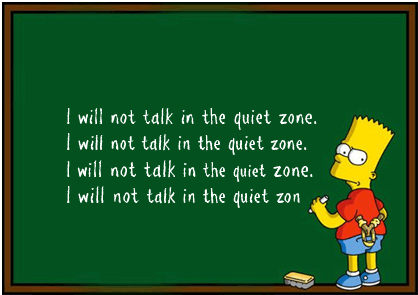
That remains a valid angle for coverage. However, the more I thought about this topic, and the more Equality Act reports that I read, the more I focused in on another “quiet zone” in the mainstream news coverage — including at the local and regional levels.

For starters, let’s look at two pieces of a major New York Times report on the Equality Act:

It was the second time the Democratic-led House had passed the measure, known as the Equality Act, which seeks to amend the Civil Rights Act of 1964 to add explicit bans on discrimination against lesbian, gay, bisexual and transgender people in both public and private spaces.

Now, that’s remarkably broad language. What kinds of groups and institutions, pray tell, are included under “both public and private places”? And remember this old journalism mantra: All news is local.

Later on, the story adds:

In a landmark decision in June, the Supreme Court ruled that the 1964 civil rights law protects gay and transgender people from workplace discrimination, and that the language of the law, which prohibits discrimination on the basis of sex, also applies to discrimination based on sexual orientation and gender identity. House Democrats sought to build on that ruling with the Equality Act, which would expand the scope of civil rights protections beyond workers to consumers at businesses including restaurants, taxi services, gas stations and shelters.

Please respect our Commenting Policy

Yo, Nashville Tennessean: What does 'people of faith' mean in a political argument?

Yo, Nashville Tennessean: What does 'people of faith' mean in a political argument?

When I arrived at the Rocky Mountain News (RIP) long ago — think early ‘80s — I quickly learned that the city-desk team had an informal way of checking the Colorado pulse on religious issues.

Basically, they were interviewing clergy at the churches in downtown Denver. That was pretty much it. They would also call the Denver Catholic archdiocese (rather progressive at that time) and the “local seminary,” as in the already “woke” Iliff School of Theology, nationally known as an edgy United Methodist campus. It appeared no one knew about the larger Denver Seminary (evangelical) only a few blocks from Iliff.

What kind of churches were downtown? Almost all of them were mainline Protestant congregations and very few of them were showing any sign of life, in terms of attendance and growth. But they were nearby and most were progressive, so that was that. Why talk to folks at the region’s growing megachurches?

Hang in there with me. I am working toward a recent Nashville Tennessean article that ran with this headline: “Hundreds of people of faith call on Tennessee's Republican congressional delegation to repudiate lies about election fraud.” The key question: Define “people of faith”?

Back to Denver, for one more comment. Early on, I attended a press conference linked to the Colorado Council of Churches. Here is how I described what happened in a post back in 2013:

The key was that the organization … was claiming that it spoke for the vast majority of the state's churches. The problem was that, by the 1980s, the conversion of the Colorado Front Range into an evangelical hotbed (including evangelicals in many oldline Protestant bodies) was well on its way. Also, a more doctrinally conservative Catholic archbishop had arrived in town, one anxious to advocate for Catholic teachings on public issues on both sides of the political spectrum. …

Still, it was an important press conference that helped document one side of a religious debate in the state.

Near the end of the session, I asked what I thought was a logical question: Other than the Roman Catholic Archdiocese of Denver, did any of the CCC leaders present represent a church that had more members at that moment than during any of the previous two or three decades?

Well, hey, I thought it was a fair question.


Please respect our Commenting Policy

Puzzle: Many reporters ignoring Equality Act's impact on this crucial Schumer-Kennedy legislation

Puzzle: Many reporters ignoring Equality Act's impact on this crucial Schumer-Kennedy legislation

I have been following the Equality Act coverage and, so far, a crucial piece in this puzzle has been missing.

Thus, here is a one-question pop test. That question: Name the piece of stunningly bipartisan legislation — vote was 97-3 in U.S. Senate — from the Bill Clinton era that will be gutted by passage of the Equality Act? Hint: It was introduced in the House by Rep. Chuck Schumer (D-NY) on March 11, 1993, and in the Senate on the same day by the late Sen. Ted Kennedy (D-MA).

We are, of course, talking about the Religious Freedom Restoration Act (RFRA). In today’s advocacy-media age that would, of course, be the “Religious Freedom” Restoration Act, complete with “scare quotes.”

The key is the impact the Equality Act would have on religious parachurch groups, social ministries, hospitals and educational institutions, from preschools to universities.

Now, does everyone agree on how the Equality Act would impact the First Amendment rights of religious believers and their doctrine-defined ministries?

Of course not. There are strong, credible voices on both sides of that debate that deserve serious, accurate, informed coverage by the mainstream press. However, this process — let’s call it “journalism” — would require newsroom managers to admit that this issue exists.

That’s why Andrew Sullivan — one of the world’s best-known gay public intellectuals — called the introductory Washington Post Equality Act story a “press release” (think PR) for the Human Rights Campaign. Here is that story’s description of the legislation’s impact:

The Equality Act would amend existing civil rights laws, such as the Civil Rights Act of 1964 and the Fair Housing Act, to explicitly ban LGBTQ discrimination in the workforce, housing, education, credit, jury service and other areas of American life.

If passed, the legislation would provide the most comprehensive LGBTQ civil rights protections in U.S. history, advocates say, significantly altering the legal landscape in a country where more than half of states lack explicit legal protections on the basis of sexuality or gender identity. …


Please respect our Commenting Policy

Keep the Bible in one hand, a newspaper in the other: Tips for stressed-out preachers

Keep the Bible in one hand, a newspaper in the other: Tips for stressed-out preachers

“You preach with the Bible in one hand and the newspaper in the other.”

That’s what Bishop Timothy Clarke, an Ohio senior pastor, said in a recent front-page feature by Danae King, the Columbus Dispatch’s religion writer.

It’s an idea that originated with the late Karl Barth, one of the most influential theologians of the 20th century. Barth put it this way: “Take your Bible and take your newspaper, and read both. But interpret newspapers from your Bible.”

Barth’s concept was a prominent theme of a Facebook Live panel discussion organized this week by the Siburt Institute for Church Ministry at Abilene Christian University in Texas.

“We used to think the hard part was interpreting the Bible, but now we've decided the hard part is interpreting the newspaper,” quipped Randy Harris, one of the co-hosts, along with Carson Reed, of the discussion on “Light, Truth and Fake News.”

The panel — on which I was honored to speak — aimed to help stressed-out ministers make sense of the news in a time of polarization and conspiracy theories.

“Read broadly. Value truth,” urged Cheryl Mann Bacon, a Christian Chronicle correspondent and retired journalism chair at Abilene Christian. “Be compassionate when you share it, but be courageous when you share it.”

Co-host Harris is a longtime preacher and spiritual director who works with the Siburt Institute.

He advised: “Pay attention to local news. We can get caught up with what's happening in Washington, but there's stuff that's happening in your town that needs a response. The second thing is, to ministers: You've made a commitment to read the news through a certain lens, and that's the lens of a crucified and risen Messiah.”


Please respect our Commenting Policy

Which issue drew more ink? SBC on Trump-era rifts, race, #ChurchToo abuse, gay marriage

Which issue drew more ink? SBC on Trump-era rifts, race, #ChurchToo abuse, gay marriage

Here’s a question for GetReligion readers, including journalists: Are you surprised that the Southern Baptist Convention still believes sex outside of marriage is sin and, yes, that marriage is defined — by two millennia of Christian teaching — as the union of man and woman?

All of you who are surprised, please raise your hands.

There shouldn’t be many hands in the air on that one.

Now, would you say that SBC action on that question is, well, sexier than the decision by the national convention’s executive committee to oust two congregations for violating guidelines on sexual abuse, following in the wake of many #ChurchTwo revelations (especially in major Texas newspapers)?

Meanwhile, SBC President J.D. Greear offered up a blistering speech to the executive committee in which he addressed what he called demonic attacks on SBC unity, attacks centering on two hot-button topics — racism and (to be blunt) Donald Trump-era politics.

Of these four issues, want to guess which drew mainstream-press headlines? That’s the question that host Todd Wilken and I discussed during this week’s “Crossroads” podcast. Click here to tune that in or head over to iTunes to subscribe.

According to the Associated Press, the biggest news was that totally predictable decision linked to marriage and sex. Meanwhile, I am happy to report that The New York Times produced a story that, while the headline was predictable (“Southern Baptists Expel 2 Churches Over Sex Abuse and 2 for L.G.B.T.Q. Inclusion”), was updated to become a solid look at the tensions surrounding Greear and some of these issues. We will come back to both of those stories.

But first, I think GetReligion readers need to read a large chunk of the (edited) text from the Greear broadside. (Click here for Baptist Press coverage and, most of all, here for a file that includes the full video.)

The key: Greear sets out to affirm the 1980s SBC move to the right on issues of biblical authority, while repudiating what he calls the “leaven of the Pharisees” emerging on the SBC’s right flank. The following is long, I know, but essential to understanding what is happening right now in America’s largest Protestant flock:


Please respect our Commenting Policy

What's new about Joe Biden's White House faith office and why this story bears watching

What's new about Joe Biden's White House faith office and why this story bears watching

Not to anyone’s huge surprise, President Biden has resurrected a faith-based office as the religious face of the Biden White House.

Don’t yawn yet. There are some intriguing differences between what President Obama’s faith-based office was like and what Biden is proposing. The office’s most recent incarnation includes discussion about race, Covid, pluralism and “constitutional guarantees.” From Religion News Service:

President Joe Biden signed an executive order on Sunday (Feb. 14) reestablishing the White House Office of Faith-Based and Neighborhood Partnerships, undoing former President Donald Trump’s efforts to reshape an agency that went largely unstaffed for most of his tenure.

I do need to take some issue with the top paragraph. Trump did have a faith-based office called the Faith and Opportunity Initiative, and it was headed up by Paula White-Cain, a Florida-based televangelist with no government experience.

However, her connections among evangelicals and charismatics were second to none, and those were the folks who Trump saw as essential to his surprise 2016 victory. They got well-publicized visits to the White House and photo ops in the Oval Office. What’s not as well known is there were Jewish groups who also had access through White-Cain; something I learned when I was researching this 2017 profile on Paula.

In a statement accompanying the announcement of the executive order, Biden echoed his recent remarks to the National Prayer Breakfast, bemoaning widespread physical and economic suffering due to the coronavirus pandemic, racism and climate change. He added that those struggling “are fellow Americans” and are deserving of aid.

“This is not a nation that can, or will, simply stand by and watch the suffering around us. That is not who we are. That is not what faith calls us to be,” he said. “That is why I’m reestablishing the White House Office of Faith-Based and Neighborhood Partnerships to work with leaders of different faiths and backgrounds who are the frontlines of their communities in crisis and who can help us heal, unite, and rebuild.”

I still think White-Cain let in more folks than most people knew but she got no credit for it.

The White House announced the appointment of Melissa Rogers, a First Amendment lawyer and senior fellow at the Brookings Institution, to oversee the office, as she did in former President Barack Obama’s second term. Rogers will also serve as senior director for faith and public policy in the White House Domestic Policy Council.

I interviewed Rogers for my Paula piece and she was helpful and knowledgeable. She was also accessible to the press and not above taking a few pot shots with how the Trump administration was running its faith-based office in recent years. Clearly, White-Cain either didn’t read or didn’t listen to Rogers’ critiques.


Please respect our Commenting Policy

Behind the headlines: As winter storm cripples Texas power grid, people of faith rally to help

Behind the headlines: As winter storm cripples Texas power grid, people of faith rally to help

Texans like to brag that they live in “a whole other country.”

I don’t suppose, though, that whoever came up with that slogan had Siberia in mind.

As a severe winter storm crippled the state’s energy grid this week, my parents were among 4 million residents who lost electricity. Mom and Dad endured a really chilly night before going to stay at my sister’s house for a few days.

Heroes (think “Mattress Mack”) and villains (#FlyingTed) have emerged, while people of faith — as they tend to do during disasters — rally to help.

Here at Religion Unplugged, Jillian Cheney tells the inspiring story of a church that partnered with a Jeep club to rescue snowed-in families.

Houses of worship losing power themselves hampered some efforts to provide reliable sanctuary, but “leaders are doing all they can to connect and comfort their communities,” Christianity Today’s Kate Shellnutt reports.

Churches and other faith groups teamed up to help open an emergency warming center for the homeless at a Dallas convention center, Religion News Service’s Bob Smietana notes.

Catholic churches in San Antonio and Fort Worth opened their doors, according to the Catholic News Agency’s Jonah McKeown.

Among others mobilizing to help: Southern Baptists, Churches of Christ and Episcopalians.

Power Up: The Week’s Best Reads

1. A congregation of avatars: A few pastors minister “to the wild universe of virtual reality, or VR for short,” this fascinating feature by World magazine’s Juliana Chan Erikson explains.


Please respect our Commenting Policy

Ryan Burge day: Black church believers and Black ‘nones’ show little Ideological divide

Ryan Burge day: Black church believers and Black ‘nones’ show little Ideological divide

There are a number of narratives that have emerged from the 2020 election season, many of which will take years to fully unpack.

One of the most important actually began to take root in December 2017 when Alabama held a special election to fill the Senate seat vacated by Jeff Sessions who became Attorney General in the Donald Trump administration. Alabama, one of the most conservative states in the nation, elected a Democrat — Doug Jones — to a statewide office for the first time in 25 years.

The reason for the victory was quickly attributed to the African-American community who turned out in large numbers for the Democrats. This same thread has run through coverage of the 2020 presidential election, when Joe Biden bested Trump in Georgia. Observers noted that the deep history of civil rights activism in the state energized the African-American base to repudiate the Trump presidency.

That bore out again on Jan. 5, 2021 when the Democrats won both Senate run-off elections in the state, defeating two Republican incumbents.

The Rev. Raphael Warnock’s win has garnered the most headlines. The pastor of one of America’s most historic churchesEbeneezer Baptist — Warnock’s sermons featured prominently in the campaign. One of the results of this coverage is that it pulled back the curtain a bit on the Black church experience for many White Americans who have never had a lot of exposure to other religious traditions.

Yet, despite the fact that a lot of the chatter about the Black vote has centered on people of faith — it’s important to recognize that the Black community is not a religious monolith. While the largest share of African-Americans identify as Christian (63.5%), nearly a quarter indicate that they have no religious affiliation (22.1%) and another 15% identify as part of another faith group (Muslims, Buddhists, Hindus, etc.)

While these religious differences generate huge political divides among the White community, is the same true for Black Americans? The data indicates that race generates a unifying identity for Black Americans much more so than it does for White America, and religious differences at the ballot box are often small or non-existent when comparing Black Americans of different faith traditions.

In terms of political partisan and ideology — the differences between Black Christians, Black Nones and those of other faith traditions is relatively small. However, it’s worth pointing out that Black Christians are clearly the most likely to identify with the Democratic Party.


Please respect our Commenting Policy

Early arrests after U.S. Capitol riot: So were there evangelical leaders in the attack or not?

Early arrests after U.S. Capitol riot: So were there evangelical leaders in the attack or not?

If you’ve worked as a reporter for any amount of time, you know what it’s like to return from covering a Big Story. Then you face your editor and get THAT LOOK.

Here is the religion-beat version of this scene. The editor asks a question that sounds something like this: “So what happened? Did (insert name of ecclesiastical group) finally make a decision about (insert hot-button topic, usually involving sex and/or politics) or not? We need to know how big a story this is.”

The reporter answers that this or that religious group passed a vague resolution calling for more study, dialogue and prayer, but the text contains slight hints — often involving scripture references — that one side or the other is making progress toward achieving this or that goal (maybe). They’ll be arguing about this newsy issue again next year (or whenever the assembly has its next legal gathering), as they have been arguing about it for 25 years.

The editor gives the reporter THAT LOOK. It says, “You have got to be kidding” (or stronger words) and/or “Why did we spend money to send you to cover this national meeting? You said this was a Big Story.” Trust me: Reporters can detect THAT LOOK in an editor’s voice, even if this encounter is on the telephone.

Editor’s don’t like to wait. They like clear results that produce a BOLD headline over a Big Story.

With that in mind, let’s look at a recent New York Times story about the slowly unfolding legal process surrounding rioters who were arrested for attacking the U.S. Capitol during the Jan. 6 “Stop the Steal” protests. The headline stated, “Arrested in Capitol Riot: Organized Militants and a Horde of Radicals.”

My question: Did the 14 reporters involved in covering this story get THAT LOOK when their reporting revealed that the kinds of people facing federal charges (as of Jan. 31) were pretty much what careful news consumers would have expected? In particular, why isn’t there evidence — at this point — linking the violent rioters with (wait for it) evangelical networks and institutions?

To dig a bit deeper into that question, I think readers should read a Tony Carnes essay — “Mysteries about the Mob in the Capitol cleared up“ — at the website called “A Journey Through NYC Religions.” (That’s a deep website that GetReligion reader should include in their “favorites” lists in online browsers.) Carnes explores lots of logical religion questions about this story.


Please respect our Commenting Policy