
Whoops!
Sorry, looks like something is missing.
Try a quick search to find what you're looking for, or see the latest articles from the GetReligion team below:

It was a piece of great luck for me that the “publish” button was clicked on the new GetReligion blog in 2004 just before I received the unlikeliest assignment of my career — the faith beat at The New Yorker.
I had been writing for the magazine for more than a decade, following my fancy on subjects ranging from politics and war to horse racing and hurricanes. I was a generalist, with the blessed (to me) freedom of
thoroughly exhausting my interest in a particular subject and then, once my piece was published, leaving it behind forever.
This suddenly changed in November 2004, with the re-election of President George W. Bush. The election had been a Republican wipeout, with Bush not only retaining the White House but Republicans strengthening their hold on the House and Senate — the biggest across-the-board GOP sweep since Ronald Reagan’s blowout in 1980.
The result, to say the least, had come as a shock to many in the news business, including (perhaps especially) those populating the corridors of The New Yorker. The magazine had claimed a stake in the election, having published an endorsement of a presidential candidate — the Democrat John Kerry — for the first time in its 80-year history. The lengthy editorial framed the Bush presidency as a creature of a Supreme Court “fiat,” and decried its “record of failure, arrogance and … incompetence.”
To his credit, editor David Remnick thought our readers deserved an explanation of the unexpected (to them) Republican wave. Polling suggested that Republicans owed their victory to a cohort that the media quickly labeled “values voters,” people who supported the War on Terror and believed that John Kerry and the Democrats didn’t represent their values.
At the core of this group, of course, were people of faith who regularly attended worship services. My assignment: Go out among these voters, and explain their motivations to the insular world the New Yorker represents.
I used to joke that I was assigned the faith beat because I was the guy at the New Yorker who’d been to church, and I am, indeed, a believer. But I was anything but an expert on religion, and I quickly learned that very few (of any) reporters in the mainstream media were.
Happily, I quickly discovered GetReligion.org, a website founded on the recognition that the mainstream press didn’t “get” religion.

During World War II, when I was a young boy in the Belgian Congo, Dad would turn on the large radio console and listen to BBC News.
Years later, he explained to me that Charles DeGaulle, a French general, was in exile in Brazzaville, the capital of French Congo, across the river from what was then Leopoldville, now Kinshasa. We were upriver, in the Ubangi Territory, the extreme northwest corner of Belgium’s largest African colony.
My father said that many ex-patriates and Congolese were worried that Adolph Hitler was going to send troops to Central Africa to capture General DeGaulle and occupy the region. North Africa already had been occupied by the Axis powers.
So, the BBC provided our family with important news for our daily lives. When we moved to the United States, Dad and I would listen to World News Roundup with Winston Burdett as we ate breakfast.
Because of this, I realized how important accurate news is, and that shaped everything that I did while working at newspapers and magazines and eventually teaching journalism at three universities.
The goal was to pass on to students the significance of accurate and complete reporting, and many have distinguished themselves in community and regional journalism as well as elite media.
To help students prepare for media careers, we often brought outstanding journalists and scholars (especially those who also wrote for mass media) to campus. One of these events helped inspire the creation of GetReligion.
After the tragedy of September 11, 2001, our journalism team at the University of Nebraska invited the legendary Martin Marty, Fairfax M. Cone Distinguished Service Professor Emeritus of the History of Modern Christianity at the University of Chicago. In many polls, Marty had been named as one of America’s most trusted religious leaders. He was a legend among religion-beat professionals — leading to the old saying that the formula for a front-page feature was a national study or poll, several local anecdotes and “a quote from Martin Marty.”
Marty, a native of Nebraska, came to lecture about religion in the mainstream press. We asked Terry Mattingly, a journalism professor and syndicated religion columnist, to respond to Marty’s presentation.

The Religion Guy wishes to underscore increasingly obvious aspects of 21st Century America:
One: Religion is in crisis.
Two: The media are in crisis.
Three: Media treatment of religion is in crisis.
Therefore, as GetReligion.org disbands this week, something like this website has never been more needed.
Will anyone again provide informed running assessments of this complex and emotion-laden journalistic beat? Please note that my question has also been raised this week by Kenneth Woodward, The Guy’s toe-to-toe competitor for two decades as the Newsweek and Time religion writers during the newsmagazines’ heyday.
Starting February 13, The Guy will be posting new analytical articles at Religion Unplugged, but on the way out the door feels urgency to reflect on the three points above.
The third, how the media handle — and mishandle — religion, has been amply documented most every day on this very website, so we turn to the realities facing the other two. Feel free to explore the 20 years of that work in the GetReligion archive in the future.
On number one, U.S. religion’s Great Depression is apparent anywhere you look, whether survey data on the rising unaffiliated “nones” or church groups’ own yearly counts on Sunday School enrollment, weddings, baptisms and funerals. Fellow religion writers can add many more particulars.
Gallup has invaluable data on cultural mood swings from polls that have posed the same questions across so many years. Since 1973, Gallup has asked Americans whether they have “a great deal” or “quite a lot” of confidence in a wide list of social institutions. Public trust has been tumbling across the board in the 21st Century, so that only the military and small business now command confidence from majorities (and the military numbers are now headed down).

Twenty years is a good run.
Unfortunately, GetReligion should run for at least another 20 more years because the need is still there, and under the circumstances that Terry Mattingly has described of the current state of journalism, one could easily argue that the need is even greater now than it was when this weblog was born.
But alas and alack, it seems that those with the charge of doing actual journalism have not been listening to the wisdom emanating from the authors on this brave site.
Instead of a revival of the classic American style of objective reporting, the owners of the Fourth Estate have denominated themselves into camps according to their respective narratives. That leaves them completely closed to the possibility of learning something new, including how to cover the religion beat.
As a Catholic media pro, this has been especially hard to watch because it makes me believe that there’s an agenda here, whether journalism executives want to admit it or not. When USA Today sends out a breaking news alert that links to a story reporting what is old news on the clergy sex-abuse crisis, that makes a reader wonder why they are so uninformed about basic facts.
Clemente Lisi’s latest of many GetReligion posts about attacks on Catholic churches shows that it’s not getting any better.
We are talking about basic information, here.

A free press is part of the American identity. It’s also one of our essential institutions. A responsible press and a faith shaped by the God of charity and justice share two things in common: a concern for human dignity, and an interest in truth.
This is why — to be specific — journalism coverage of religion is so important.
Believers and non-believers might define that word “truth” differently, and the differences might be serious. But an honest search for it creates a kind of maturity. And that maturity enables us to build a decent, common future through our choices here and now.
Freedom means that our choices matter. And our mistakes have consequences. That’s why so many people, increasingly today, seem to want a rescue from the burden of personal responsibility; deliverance from the work of thinking critically about themselves, their world, their mortality and the purpose of their lives.
We all struggle with these temptations. Americans as a people are no exception.
So I can imagine an America without a genuinely free and fair press. And I can imagine an America with much less religious faith. We’re well on the way to getting both. But in either case, the result will be a very different America and a betrayal of the generations that built it.

It’s been almost nine years since that day in February 2015 when Terry called me in Alaska to ask if I’d join the GetReligion team starting March 1.
(We already had a reminder of the Mattingly family sitting in our home; an enormous lion gifted by Terry and Debra to my daughter Veeka when she was 6 1/2, about the time she stayed with them for several days while I was on a reporting trip. I’ve included a photo of the Aslan-like creature with her delighted face just after she received it. The lion still keeps vigil by her window).
The GetReligion assignment, Terry told me, was that I’d concentrate on West Coast media and culture wars coverage.
Since then, my writing has ranged w-a-y beyond that, from John Allen Chau to Josh Harris. I have picked up a lot about analytical writing, hopefully have not made too many enemies and have shown some light into dark corners.
Sometimes I hit it out of the park. With the election of President Donald Trump and the ascendancy of his pastor, Rev. Paula White, I spread word of an ascendant Pentecostal/charismatic movement that was way more powerful than its non-charismatic evangelical counterpart.
This was years ahead of the curve. Not a whole lot of folks were listening until Jan. 6, 2021.
But you, dear readers, were seeing it here first, starting my Nov. 10, 2020, column that begins with the frantic prayers in White’s Florida church in the face of a Trump loss. By the time my Dec. 15, 2020, column about the “Jericho March” in DC surfaced, there were prophets nationwide saying Trump would win no matter what and other disturbing trends that not enough reporters were tracking.
Why? These prophets were considered wackos by most.
My Jan. 11, 2021, column, about the aftermath of Jan. 6 (when some of those ‘wackos’ showed up on the streets of Washington) and the resulting “civil war” among charismatics got a lot more ears — and a ton of hits. By this time, the “Trump prophets” who had erroneously prophesied that the 45th president would win a second consecutive term were in the middle of a theological maelstrom. The day of Biden’s inauguration, I penned one last column on the topic here.
I count the work I did on the prophets and my coverage on Cardinal Theodore McCarrick as among the best work I did for this blog.

“What do you mean by blog?” I asked my friend Terry Mattingly nearly a quarter of a century ago in Jerusalem as we attended a conference on religion in the news, which took place just before Pope John Paul II's millennial visit.
“The style is informal and conversational,” tmatt explained. “And,” he promised, “It won't take you as long to write a blog post as it does a news story or a column.”
Terry's vision was to create an online place — we didn't use the word platform then — for journalists to write what he called orphaned religion stories. You know, religion ghost stories, stories with missing in action religion hooks, buried in plain sight.
I was fascinated and sceptical.
I was fascinated because I was writing and producing CBC radio's “spirituality” show and steering it towards the kind of unembarrassed religion coverage I'd grown up with on the BBC. As a career-long public broadcasting staffer who assuaged my writing itch by freelancing, I loved talking to unusual,thoughtful people. As a baptised Catholic turned Anglican via British Evangelicalism, I knew the religion beat was full of unheard voices. L'Abri and Os Guinness had taught me that journalism was as worthwhile a vocation as being a vicar or an academic or a mother. You could even combine them!
How I longed to be part of Terry's vision. But I was sceptical because as a full-time staffer at Canadian Broadcasting, I couldn't take on a regular commitment outside the Mothership. Worse still would be management perceiving my association with — God-Buddha-Allah forbid — a “religious” outfit of some kind making judgments about journalism.

To be honest, I still can’t remember how I found GetReligion.
Thanks to Google, I was able to find what I’m guessing what my first GetReligion shout-out — it was a post by Julia Duin some seven years ago about the Southern Baptist megachurch leader Robert Jeffress claiming that God had given the once and potentially future President Donald Trump the authority to kill North Korean Supreme Leader Kim Jong-Un.
To be honest, Jeffress’ comments were made in 2017, which was an era whose troubles I now view with a kind of nostalgia. Sigh, I used to worry about COVID-19.
The tip I’d submitted to this weblog about that story reveals that I had only begun learning to critically view the media and the world in the way GetReligion taught to me and many other readers and listeners. Back then, I thought it was funny to point out the New York Daily News’ editorial incompetence for having published the sentence “though shalt not kill.” You know, as opposed to “thou shalt not kill.” It’s part of that whole Ten Commandments thing.
I never went to journalism school or took a journalism course. I learned on the job under a superb editor who never finished college.
Reading Terry Mattingly and his crew of smart contributors at GetReligion over the years was like that on-the-job training.
I especially relished the here’s-what’s-missing pieces pointing out the religion gaps in stories (“ghosts,” in GetReligion-speak), including essential questions that were not asked, core facts that were omitted and perspectives not sought.
Then there were the many can-you-hear-the-axes-grinding stories pointing out where ideology got in the way of basic reporting.
Also, there were the atta-boy pieces, too, that showered measured appreciation on work well done, angles found that no one else had noticed. That was the other side of the equation.
At Newsweek, where I labored for more years than Job had boils, once a story had been written and survived three layers of editors, we writers still had fact-checkers to answer to: Where’d you get that? Who was your source?
GetReligion did some of that too. But gently. More gently than I am inclined to do.
Mattingly and his mates could do all this because they think religion is an important dimension of public life and affairs, especially on matters tied to the First Amendment.
This would make them outliers in most newsrooms. I have the feeling that most of the folks who have written for GetReligion are religiously formed and convicted themselves, in various traditions. Which makes sense: I’ve always thought that those take their own religion seriously are better able than the religiously indifferent to grasp religions not their own.

Terry Mattingly had been my faithful friend of about a decade when he invited me to help him launch GetReligion.org at the start of February, 2004.
The timing was right. I had reached a point of uncertainty about what new direction my journalism career would take.
GetReligion became a rewarding place to continue writing and learning basic skills in working with World Wide Web platforms. For any platform nerds who are keeping score, my favorite software remains WordPress.
I was never quite at ease as a religion-beat critic, but I found a niche of critiquing heavily flawed material and praising articles that reflected an understanding of religion’s importance in journalism.
Looking back, I think these posts best represent moments of enjoying my work with GetReligion.
* Johnny Cash’s table fellowship (Sept. 22, 2004)
* Jimmy Swaggart and the hairy swamp monkey (Sept. 23, 2004)
* NASCAR, Cabela’s — and Catholicism? (Feb. 18, 2005)
* Rick Warren’s tipping point (Sept. 10, 2005)
* Esquire explains it all for you (Nov. 6, 2005)
* Gangster of love (Nov. 13, 2008)
* Covering Rep. Gabbard’s American path to Hinduism, including some complex, tricky details (June 18, 2019)
QUESTION:
Will the Catholic Church allow married priests in the Western Latin rite? Should It?
THE RELIGION GUY’S ANSWER:
The new year began with the surprise revival of this perennial issue by a prominent Catholic insider who asserted that the mandate for priests to be unmarried and celibate “was optional for the first millennium of the Church’s existence and it should become optional again.”
This came in a media interview with Archbishop Charles Scicluna, 63, named by Pope Francis in 2015 to lead the church in the nation of Malta. As he indicated, celibacy for all priests, not just those under vows in religious orders, was not made an absolute rule till the Second Lateran Council in A.D. 1139. Back then, one reason was to stop corrupt bishops from handing sons their lucrative posts.
Catholicism is the only branch of Christianity that imposes this requirement.
Sciclina is an especially influential figure due to his 2018 appointment by Francis to a second post as Adjunct Secretary of the Vatican’s all-important agency on doctrine. Over the years, the Vatican has also entrusted the archbishop, who holds doctorates in both secular and canon law, to prosecute delicate cases of sexual abuse by priests.
As Scicluna noted, the Catholic Church has long welcomed priests who marry prior to ordination in its Oriental and Eastern Rite jurisdictions, centered in Ukraine, India, Lebanon and in the Mideast. Such is also the tradition in Eastern Orthodoxy, which ordains married men, but requires celibacy for bishops. (Catholicism occasionally ordains married Protestant ministers who convert, such as Anglicans and Lutherans.)
The archbishop asked, “Why should we lose a young man who would have made a fine priest just because he wanted to get married? And we did lose good priests just because they chose marriage.” He said “experience has shown me this is something we need to seriously think about.” For one thing, some priests cope with the rule “by secretly engaging in sentimental relationships” and “we know there are priests around the world who also have children.” Therefore “if it were up to me I would revise the requirement.”
Was Scicluna nudging delegates who next October will attend the second and final session of Pope Francis’s Synod of Bishops at the Vatican?

Questions. Yes, we have some final (sort of) questions about journalism and religion news.
One one level, this week’s “Crossroads” podcast (CLICK HERE to tune that in) focused on all those headlines about the red ink and devastating layoffs in elite newsrooms such as Sports Illustrated, the Los Angeles Times and the Washington Post. For a quick summary of the drama, see this mini-report at Axios.
The news is staggering for people like me who have spent decades in journalism education — encouraging students to seek careers in traditional and online newsrooms at the local, regional and national level.
Thus, it’s hard to cheer about these disasters in the lives of many professionals. However, millions of millions of Americans — especially in red zip codes — have given up on the mainstream press. What about them? Should they cheer as major news organizations implode?
This week’s podcast is the last one that will be featured here at GetReligion, as we close a week from today, on this weblog’s 20th birthday. However, future episodes of Crossroads will continue to be available through the podcast page at the GetReligion.org archive, at my own Tmatt.net, the Religion Unplugged website, Lutheran Public Radio and the Apple podcasts page.
In this (sort of) finale, it was obvious to ask: Does the current newsroom employment crisis have anything to do with decades of journalism leaders failing to, you know, “get” religion when covering one of the most complex religious cultures in the Western world?
After recording the podcast, I had a flashback to a story that Rod “Live Not By Lies” Dreher shared about his years at the Dallas Morning News. Then, lo and behold, Dreher retold key parts of the story in a new Substack post (“Journalism Continues To Crash, Burn”).
A few of his colleagues were worried about the increasingly liberal — in terms of religion, culture and politics — product that the News was producing for the region it served.
“It aggravated us to no end that our readers were mostly conservatives — they really were; we had the audience research to prove it — but too many in the newsroom were bound and determined to act as if that wasn’t true.”

There have been many big stories on the Catholic beat since I started contributing to GetReligion in November 2018.
Over the last five years, I have written about Catholicism as it related to doctrinal fights, politics, education and even sports. In between, we had a pandemic. Brother, has it been a busy time.
Over that time, I looked at mainstream news coverage regarding these issues and the growing importance of Catholic news media in the digital age. Catholic media is crucial, in large part, because of the many important religion stories that way too many elite mainstream newsrooms are ignoring.
No story has been bigger — in terms of both importance and reader interest — than church fires.
Churches have been targeted in the United States and around the world in what has easily been one of the most underreported (in some cases not reported at all) stories of the last decade. The problem? When it comes to press coverage, not all religious sanctuaries are created equal.
In my final post here at GetReligion, let’s take a look back at this trend.
In terms of news, the biggest was not an act of arson, according to authorities, but an accident. It was on April 15, 2019 that a structural fire broke out in the roof space of Notre Dame in Paris, a medieval Catholic cathedral and one of the biggest symbols of Christianity throughout the world.
By the time the fire was extinguished, the 12th century gothic house of worship’s spire had collapsed, its famed rose window destroyed, most of its roof wiped out and its upper walls severely damaged.
I was in my office at The King’s College in New York City when I saw the news alerts. I had already filed a post for GetReligion — ironically! — regarding a rash of fires at churches across France during Lent.
That new post — with quick rewriting by me and speed editing by tmatt (who was across the hall on that day) — went online while the fire was still burning. It instantly went viral.
Here’s how that went down, as recounted by a tmatt post the following day:
Here at GetReligion, my colleague Clemente Lisi had, days earlier, written a feature about the recent series of fires and acts of vandalism at French churches. Lisi and I quickly rewrote the top of that post and put it up about 3 p.m. EDT yesterday. The headline: “If churches keep getting vandalized in France, should American news outlets cover the story?”

One more time.
For years, Bobby Ross, Jr., and I have written lots of posts about religion-shaped holes in mainstream sports coverage. Apparently, very few GetReligion readers were interested in this topic (as opposed to, let’s say, the American audience for a prime NFL game).
But we soldiered on. This brings me — one last time — to a curious case study involving my Baltimore Ravens (who are still in the Super Bowl hunt, at this point).
Recently, a commentator on one of the dozens of NFL commentary shows asked an interesting question: Why don’t we talk more about the ongoing success of John Harbaugh, the Ravens head coach since 2008? No one had a good answer.
But I will ask a related question: After the Raven’s 34-20 playoff victory over the Houston Texans, which video clip was easier to find? The one (a) with Harbaugh showing his dad-style dancing moves in the joyful locker room or the one (b) in which he opened his press conference, with a very serious tone of voice, with a favorite Bible quote?
Click those Google links and you will see that, once again, the role that Christian faith (Catholic, to be specific) plays in the life and work of this future Hall of Fame coach is a “conservative” news story. Period. The viral dancing moves are much more important.
Which element of these two elements of Harbaugh’s personality is the most important in his life and work? The most accurate answer is “BOTH.”
However, I suspect that Harbaugh would say that his faith is more important. This brings me to the point that Ross and I have tried to make about the faith-shaped hole in most sports news coverage (and Clemente Lisi has noted this in global soccer coverage, as well). We are not stating that it is automatically news when sports personalities talk about their faith. It is new when they consistently cite their faith as a crucial factor how and why they do what they do in their career and life.
In this case, Fox News (naturally) went with the basic facts: “Ravens head coach John Harbaugh recites Bible verse to open press conference after playoff win.”
In nine-plus years of these weekly Memos, the Religion Guy has sometimes complained that the news media pay too little attention to e.g. the “Mainline” Protestant denominations or to white Catholics as all-important swing voters who decide elections.
Nonetheless, as GetReligion.org prepares to close down February 2, it’s understandable that this next-to-last Memo would send fellow journalists a few notations about the U.S. Evangelical Protestant movement. (Full disclosure: This is The Guy’s own private, lifelong home, even though he was raised in a “Mainline” denomination, worshipped for years in another and currently belongs to a third one.)
Evangelicalism, in one form or another, was analyzed in 43 prior Memos. Why so much attention?
Evangelicalism may be confusing in terms of organizations and fiefdoms, but since World War II has developed into the largest and most dynamic force in American religion, striding into the hole in the public square created by the decline of the old Mainline. Also evangelicalism has been the most disruptive, and certainly one of the evident influences within the Republican Party.
Something odd is happening to this movement in the 21st Century. The Memo has dealt with relentless politicking, conflicts over race and women’s role, squalid scandals and has discerned signs of a “crack-up.”
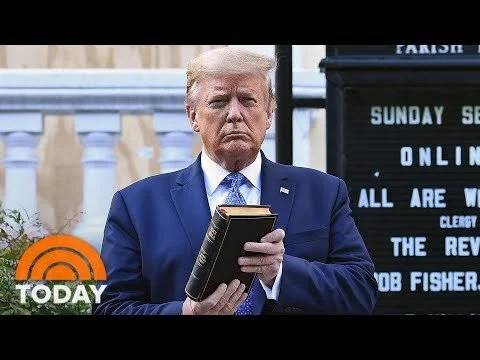
Pundits regularly tell us that in the Donald Trump era we’re no longer even sure what an “evangelical” is, that it’s as much a socio-political label as a religious one and that this redefinition damages churches’ spiritual appeal to outsiders. Maybe so, but despite the media focus on outspoken agitators on the national level, local evangelicals are the least politicized faith grouping, according to noteworthy Duke University data at pages 52-58 in this (.pdf) document.
Then there’s that ongoing head-scratcher: Why have fat majorities of white evangelicals supported Trump, a morally bewildering politician and now a criminal and civil court defendant? For one thing, they automatically give lopsided support to Republican nominees, whether Romney, McCain or Bush, just like Black Protestant, Jewish, non-religious and anti-religious Americans have done for Democrats. Many truly believe that they have no choice.

May I have a brief moment, please, to ask a question to my fellow religion-beat reporters?
I have a style question for you folks. Has the ever-evolving Associated Press stylebook addressed the issue of whether the news beat on which we work is also called the “God beat,” the “Godbeat,” the “godbeat” or maybe the “gods beat”?
Just asking. I asking that question because many GetReligion readers may have seen the Religion News Service piece by Bob Smietana that ran with this double-decker headline:
After 20 years, Terry Mattingly bids farewell to GetReligion
Religion reporting still matters, Mattingly says, but the internet’s ‘preaching to the choir’ algorithms have won out
In that news piece for mainstream newspapers, Smietana went with “ ‘God beat’ specialists” when describing religion-beat professionals. That’s interesting, since I have always seen “Godbeat” as the official nickname (at least for old-timers like me).
I should stress that Smietana and I talked for 90 minutes for this piece, after quite a few long conversations over the years. It’s a remarkably kind piece, although I really wished some other GetReligionistas had been quoted.
I was glad that Smietana did this story. Last year, the media-ethics pro Aly Colon of Washington and Lee University asked me to nominate some speakers for a pair of Poynter seminars to help journalists who, while they don’t work on the religion beat, their work frequently veers into religion territory. Smietana was one of the first reporters I mentioned, stressing that “while Bob and I have argued about lots of things for many years” he is a “pro’s pro on the beat who knows his stuff and he needs to be there.”
In this RNS feature, Smietana wrote:
A proud curmudgeon, Mattingly is known for his outspoken opinions and blunt criticism, as well as his loyalty and willingness to make friends with people he disagrees with.

A new report covered by Christianity Today’s Jayson Casper highlights “the 50 countries where it’s hardest to follow Jesus in 2024.”
Last week’s Plug-in focused on Iowa evangelicals and Donald Trump ahead of the caucuses.
After the former president’s big win in that state, The Associated Press’ Josh Boak and Linley Sanders, CT’s Harvest Prude and the Washington Post’s Dan Keating, Adrian Blanco and Clara Ence Morse analyze the critical role evangelicals played.
The New Hampshire primary is Tuesday, and Clemente Lisi details “everything you need to know about the candidates” at Religion Unplugged.
This is our weekly roundup of the top headlines and best reads in the world of faith.
What To Know: The Big Story
What motivates pro-lifers: The crowd at today’s annual March for Life in the nation’s capital could top 100,000, organizers predict.
Fifty-one years after Roe v. Wade — and a year and a half after its overturning — “evangelical activists see a bigger fight to change Americans’ minds on abortion.” That’s the synopsis from Christianity Today’s Harvest Prude.
A different mood: If last year’s rally marked a celebration for the anti-abortion movement, the 2024 event reflects “formidable challenges that lie ahead in this election year.”
So notes The Associated Press’ David Crary, who quotes a leading activist:
“We have undeniable evidence of victory — lives being saved,” said John Seago, president of Texas Right to Life. “But there is also a realization of the significant hurdles that our movement has right now in the public conversation.”
Crary explains:
As America's second-oldest Lutheran college, Roanoke College in Virginia's Shenandoah Valley proclaims that it is "never sectarian" in outlook, while maintaining that "critical thinking and spiritual growth" are essential.
The online spiritual-life page also offers this advice: "We encourage you to follow your own personal spiritual path while here at Roanoke." The collage "honors its Christian heritage" and its affiliation with the progressive Evangelical Lutheran Church in America by stressing "dialogue between faith and reason," according to its "Mission & Vision" statement. "Diversity, inclusion and belonging" are strategic goals.
These commitments are "so informal that it's hard to call them doctrinal commitments at all," said Robert Benne, a retired Roanoke College professor who founded its Benne Center for Church and Society. "This is what you see in many Christian colleges. … These vague commitments go along with efforts to embrace whatever is happening in modern culture."
This isn't unusual, he stressed, after studying trends in Christian higher education for decades. In the post-pandemic marketplace, an increasing number of small private schools -- religious and secular -- face economic and enrollment challenges that threaten their futures.
Leaders of many Christian colleges and universities face a painful question as they try to stay alive: When seeking students and donors, should administrators strengthen ties to denominations or movements that built their schools or weaken the ties that bind in order to reach outsiders and even secular students?
If the goal is to remain committed to traditional Christianity doctrines -- in classrooms and campus life -- academic leaders need to take specific steps to build academic communities that can survive and thrive, said Benne, in a new essay for the interfaith journal First Things.
Any "serious Christian school" has to "have an explicit, orthodox Christian mission and it has to hire administrators, faculty, and staff for that mission," he wrote. "It has to have a fully informed and committed board that insists on those things happening. Without that there will be a slow accommodation to secular, elite culture. Indeed, if a college or university has swallowed that ideology whole, orthodox Christianity will move out as it moves in."

Editor’s note: While preparing for this week’s podcast (“Carefully entering the hall of mirrors created by the 'God Made Trump' video”) I emailed a former GetReligionista who is way smarter than me about the Byzantine Beltway world. That would be “Mark — Mark Hemingway.” If you get that reference, you know that @Heminator knows a few things about mass-media satire. Here is his response, with slight editing.
—————
I haven't seen anything that establishes it's satire; but it's so over the top I also can't imagine anyone took it seriously.
I would only note that there's a very, very fine line for the "meme magic" online right between satire and stuff calculated to "trigger the libs." Basically, if the left is outraged by something, the idea is that they're going to lean so hard into it so as to make the issue pervasive enough that the criticism for doing what is unacceptable loses its sting.
Why? Because the left holds tremendous cultural power in setting the boundaries for what is acceptable and unacceptable discourse. That was always a power that the left abused by applying double standards and political correctness to their advantage; but it was mostly done around the margins because of a general consensus on the First Amendment as an important value.
However, in the last decade or so with critical theory/wokism/cancel culture finally obtaining some sort of critical mass in among institutional leadership that the First Amendment consensus is really no more, at least among a lot of cultural gatekeepers, and they've just been moving the goalposts randomly as it suits their purposes.
If you know anything about world religions, then you know that Easter is a big deal in Christianity.
In Eastern Orthodox churches, the Big Idea is stated this way, over and over, in rites for Pascha (Easter): “Christ is risen from the dead, trampling down death by death, and upon those in the tombs bestowing life” (see this flash mob celebration in Lebanon).
I don’t bring this up as a matter of evangelism or some other #triggerwarning behavior. I am noting that this is an essential fact about Christianity, the world’s largest religious faith. Easter isn’t a “bunny” thing.
This brings us to one of the more unusual “religion ghosts” we spotted several times during the 20-year history of GetReligion. Here’s a case study at Newsweek and another at Facebook news. However, the classic version of this ghost appeared in the holy (in journalism terms) pages of The New York Times in this 2014 feature: “Hoping War-Weary Tourists Will Return to Israel.” Here is the key passage:
Now, what’s unusual about that? Well, it helps to know that the printed version said:
It’s all about the word “is,” isn’t it?
Inquiring minds wanted to know: Was there anyone in the editorial chain at the world’s newspaper of record who knew the essential fact that traditional Christians don’t believe Jesus is buried anywhere? It’s that whole “Easter” thing.