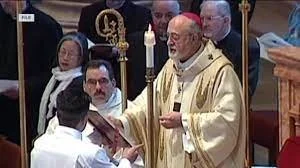
Do the math: Was Archbishop Rembert Weakland a flawed hero or an erudite heretic?

Do the math: Was Archbishop Rembert Weakland a flawed hero or an erudite heretic?

Writing obituaries about controversial — but to many people beloved — public figures is a difficult task that involves some complicated mathematics.

The death of former Catholic Archbishop Rembert Weakland of Milwaukee is a classic example and, here is the crucial point in this post, this was not a simple matter of “left” vs. “right.”

That said, there is no question that for decades — during the papacies of St. Pope John Paul II and Pope Benedict XVI — Weakland was a liberal Catholic superstar, with the word “liberal” in this case defined in political, cultural and doctrinal terms. But then there were revelations about his ethics and private life.

Thus, it was not surprising to see a double-decker New York Times headline with this kind of content:

Archbishop Rembert Weakland, Critic of Vatican Orthodoxy, Dies at 95

In his long career, he was an intellectual touchstone for progressive Catholic reformers. But he resigned after the disclosure of a long-ago love affair.

The Gray Lady’s obit also included this block of background material:

In the 1980s and ’90s, Archbishop Weakland had been a thorny problem for the Vatican. Addressing issues that troubled many of America’s more than 60 million Catholics, he championed new roles for women; questioned church bans on abortion, birth control and divorce; and challenged the Vatican’s insistence on celibacy for an all-male priesthood.

He also became a leading critic of America’s economic and social policies during the administration of President Ronald Reagan, drafting a landmark 120-page pastoral letter on the economy that called for reordering the nation’s priorities to cut military spending and attack poverty and inequality.

However, let me stress that the Times placed that salute to Weakland AFTER a pretty solid, accurate look at his scandalous fall and other revelations that emerged about his behavior and decisions, for decades, during the Church of Rome’s hellish clergy sexual abuse crisis.

If you want to dig into the hard facts about Weakland’s role in that crisis, click here for crucial material — “Deposition of Archbishop Emeritus Rembert G. Weakland, O.S.B.” — by the independent Bishop Accountability organization. That is an organization that defied a simple “left” or “right” tag.


Please respect our Commenting Policy

Plug-In: Why faith still matters -- Bob Smietana on how religion is getting reorganized

Plug-In: Why faith still matters -- Bob Smietana on how religion is getting reorganized

Religion reporter Bob Smietana’s “aha!” moment came a few years ago while covering a hurricane.

When a tornado, flood or other disaster occurs, so-called faith-based FEMA organizations typically play a crucial role in the relief effort.

“Usually, a bunch of church folks and other religious folks show up,” explained Smietana, a Religion News Service national reporter. “They cook meals, they clear trees, and they help people rebuild their houses and put their lives back together.”

But given the decline of organized religion in America, might those helpers — at some point — disappear? And if so, what might that mean for the nation’s social fabric? Such questions came to Smietana during his “aha!” moment.

“Something in my head went, ‘Oh, wait. All those people doing this faith-based disaster relief are usually older church folks, and most of them are White,’” he told me, noting the shrinking proportion of White Christians in America.

Reflecting on the hurricane volunteers, he realized, “There’s no one in the pipeline to replace those folks when they’re gone.”

The veteran Godbeat pro shared that anecdote as we talked about the ideas behind his insightful new book, “Reorganized Religion: The Reshaping of the American Church and Why It Matters”, which releases tomorrow.

Here’s how Worthy Publishing describes Smietana’s book: “A look at the ways the Christian church has changed in recent years — from the decline of the mainline denominations to the megachurchification of American culture to the rise of the Nones and Exvangelicals — as well as a hopeful vision for reimagining what the church might look like going forward.”

My own take: The 200-plus pages of “Reorganized Religion” certainly are timely, delving into long-term demographic trends while exploring challenges such as the COVID-19 pandemic and post-2020 political division.


Please respect our Commenting Policy

Hillbilly Thomists: Dominican brothers singing about the Americana ties that bind

Hillbilly Thomists: Dominican brothers singing about the Americana ties that bind

With its sobering lyrics and a droning country-blues riff, "Holy Ghost Power" by the Hillbilly Thomists is a song with zero chance for Christian radio success.

The jilted protagonist has been "living off of grits, whiskey and Moon Pies." His man cave offers no refuge: "A hundred channels of nothing on the TV at 10. It's like Diet Coke and original sin. … Now it's a zombie town, there's a lot of undead. They wander around looking underfed."

But the chorus offers hope: "He makes a rich man poor; He makes a weak man strong. No more going wrong just to get along. I felt the force of the truth when they pierced His side. I saw the war eagle dive and I could not hide."

It wouldn't shock old-school country fans if this was a Johnny Cash song. But it was written by a banjo-playing Dominican from Georgia who has an Oxford theology doctorate and now leads the Pontifical University of Saint Thomas Aquinas. Writing to the National Reso-Phonic Company, Father Thomas Joseph White said he likes to play this classic blues guitar "in my office looking out at the Roman Forum that's 2,700 years-old."

That makes sense in the Hillbilly Thomists, a "musical collective" of Dominicans, most of whom have Bible-belt roots. The band recently staged a concert in the Grand Ole Opry and, over the past decade, has recorded three albums of music that would sound at home at Appalachian fairs, but not in most church halls.

There's a vital tie linking these songs to the life and work of this band of priests and brothers, said Father Simon Teller (who plays fiddle). Whether singing Appalachian hymns or their own original songs, the Hillbilly Thomists -- dressed in the white habits of their order -- keep returning to images of suffering, sorrow, eternity, hope, grace and redemption.

"We're priests in the Dominican order and that kind of states our vision of the world and the faith and everything we do," he said. "In our day job, we're working a lot with people who are dealing with very concrete situations and have a lot of very concrete questions."

"Holy Ghost Power," for example, is "not sung from the voice of a clergyman. It's sung with the voice of a man who's living a very ordinary life that is going off the rails in a very ordinary way," said Teller. "There's a malaise there and he's unsatisfied by the things of this world."


Please respect our Commenting Policy

Bonus podcast: Clemente Lisi on news about 'good' Catholics, as opposed to 'bad' ones

Bonus podcast: Clemente Lisi on news about 'good' Catholics, as opposed to 'bad' ones

Here is a question from the news, sort of, that cuts to the heart of this bonus GetReligion podcast by Clemente Lisi, taken from his on-air visit this week with Todd Wilken at Lutheran Public Radio (CLICK HERE to tune that in).

If Gov. Ron DeSantis started carrying a rosary, and talking about it quite a bit in the context of his Catholic faith (think President Joe Biden), would journalists in major newsrooms see this as a good thing or a bad thing? Possible answers: “Yes,” “No” and “You need to ask?”

Go ahead, if you want to, and think about it in the context of these recent posts: “Concerning the right-wing rosary attack — was that Atlantic feature really 'news'?” and “Tip for reporters — Don't assume what Catholics believe based on politics or Internet memes.”

In reality, the spark for this podcast came from Religion Dispatches piece the other day, by exevangelical trans scribe Chrissy Stroop, with this headline: “Media fail to acknowledge that 2024 hopeful Ron DeSantis is as Catholic as Biden.” Hold that thought.

The Religion Dispatches piece included commentary on a March 22 GetReligion post with this headline: “As Florida's DeSantis wages culture war, his Catholic faith isn't news — unless it's used to attack him.” By the way, editors there failed to note that Lisi is Catholic, as opposed to evangelical, which seems relevant.

Here is the key passage from the Lisi post:

The two things that lots of people don’t want to read about these days is the coronavirus pandemic and Donald Trump, part of a larger trend regarding news fatigue in this country. Unfortunately, this post will mention both and only because it is about Ron DeSantis.

The Florida governor has been in the news the past few years because of his connection to the former president and a virus that paralyzed the planet for two years. A hero to the right and bogeyman to the left, DeSantis has received plenty of mainstream news coverage — much of it one-sided — because of his use of so-called culture war issues to push legislation.

DeSantis, who is running for re-election and among the favorites to run for the White House in 2024, has been a lightning rod for Democrats and a focus of criticism from the mainstream press. … While the coverage has predictably focused on politics, the religion-news hooks in these stories have largely been ignored — unless they were highlighted to be used against him.


Please respect our Commenting Policy

Podcast: Journalists should ask if faith-based schools clearly state their doctrines on sexuality

Podcast: Journalists should ask if faith-based schools clearly state their doctrines on sexuality

I forget who originally came up with the term “Romeaphobia.”

This can be defined as the hatred or fear of all things that can be viewed as links to Roman Catholicism or the early church in general. Obviously, this affects issues linked to worship and church governance. However, in my experience (I grew up in Texas), many evangelicals (especially Baptists) have a fear of clear, authoritative doctrinal statements that, you know, might be interpreted as “Roman” creeds. All together now: We are “Bible Christians” and that’s that.

I am not saying this to take a shot at my heritage (I am very thankful for the deep faith and examples of my family and my father was a Southern Baptist pastor). The reason I mention this up is because, in my opinion, this anti-creedal Romeaphobia is playing a major role in an important news story all over America. This was the hook for this week’s “Crossroads” podcast (CLICK HERE to tune that in).

Does this USA Today headline sound familiar? It should, for readers from sea to shining sea: “Christian Florida school tells parents gay and transgender students must 'leave immediately'.”

My goal here is to offer advice to reporters who want to do accurate, fair-minded coverage of these church-state skirmishes (let’s hope there are some out there). I’m also offering press-relations advice to terrified leaders of Christian schools at all levels, from kindergartens to colleges. The Romeaphobia angle? That takes us into legal nuts-and-bolts questions about these conflicts.

Let’s start with the rather familiar USA Today overture:

A Florida-based Christian school sent out an email informing parents that LGBTQ-identifying students "will be asked to leave the school immediately."

According to the email obtained by NBC News, the top administrator of Grace Christian School in Valrico, Florida, Barry McKeen, sent the email to the families for the kindergarten-grade 12 school on June 6. He later confirmed and doubled down on the policy in an Aug. 18 video on the school's official Facebook page.

The June email read: "We believe that any form of homosexuality, lesbianism, bisexuality, transgender identity/lifestyle, self-identification, bestiality, incest, fornication, adultery and pornography are sinful in the sight of God and the church. Students who are found participating in these lifestyles will be asked to leave the school immediately."

For starters, private schools — liberal and conservative — have First Amendment rights, including the right to clearly state their foundational doctrines and, thus, disciplines that apply to staff, faculty and students. Tip No. 1 for reporters and church leaders: Get to know the details of the UNANIMOUS 2011 U.S. Supreme Court decision commonly referred to as the Hosanna Tabor case.

But we need to figure out what actually happened in this Florida case.


Please respect our Commenting Policy

Relevant fact? The great broadcaster Vince Scully had a rosary and he knew how to use it

Relevant fact? The great broadcaster Vince Scully had a rosary and he knew how to use it

OK, here we go again. Sports and God. God and sports, and that old question: Why do many journalists ignore the faith component in the lives of some sports heroes and celebrities?

If you read GetReligion, you know that Vin Scully — the greatest sports broadcaster ever (click here for a collection of his greatest hits) — was a faithful Catholic and that this was a big part of his life, that is if you paid attention to the actions of the man himself. Bobby Ross, Jr. — one of several baseball fanatics who have written for GetReligion — has written about Scully’s faith several times (click here and then here).

It also helps to click on this YouTube link and then close your eyes as you listen to that famous Scully voice speak these words, probably from memory:

Hail, Mary, full of grace, the Lord is with thee.
Blessed art thou amongst women and blessed is the fruit of thy womb, Jesus.
Holy Mary, Mother of God, pray for us sinners, now and at the hour of our death. Amen.

I don’t know about you, but I think that the whole “pray for us sinners, now and at the hour of our death” thing might have been relevant when writing a mainstream media obituary for Scully.

Sure enough, readers who dig into the lengthy New York Times obit for the legendary Dodgers broadcaster — Brooklyn before Los Angeles, of course — will learn that Scully went to a Catholic prep school, played for a Catholic baseball team and graduated from a Catholic University. All of that, without a single mention of the word “Catholic.” How did the Gray Lady pull that off? Here’s a hint:

For all the Dodgers’ marquee players since World War II, Mr. Scully was the enduring face of the franchise. He was a national sports treasure as well, broadcasting for CBS and NBC. He called baseball’s Game of the Week, All-Star Games, the playoffs and more than two dozen World Series. In 2009, the American Sportscasters Association voted him No. 1 on its list of the “Top 50 Sportscasters of All Time.”

Mr. Scully began broadcasting at Ebbets Field in 1950, when he was a slender, red-haired 22-year-old graduate of Fordham University and a protégé of Red Barber.

Ah, the word “Fordham” stands in for “Catholic,” in several crucial references. That’s the ticket.


Please respect our Commenting Policy

What if mass media can't get rid of misinformation (or agree on what the term means)?

What if mass media can't get rid of misinformation (or agree on what the term means)?

Panelists on the final episode of the media-analysis show “Reliable Sources,” axed after three decades by CNN’s incoming management, gave voice to widespread angst about America’s news and information environment.

Rampant misinformation is among the top concerns these days. Social media have blocked COVID discussions regarded as misleading. The Biden Administration launched an Orwellian-sounding Disinformation Governance Board under the Department of Homeland Security, but quickly shelved the effort.

By the way, “misinformation” means incorrect knowledge of any sort, whereas “disinformation” is false knowledge that’s spread deliberately.

One commentator recommends that we all chill.

Only sheer “arrogance” could create “confidence that we can accurately and productively root out misinformation,” contends Isaac Saul, who heads up www.ReadTangle.com, an online newsletter that offers non-partisan summaries of the best arguments from various sides of political issues. (Check it out.) He titled a July article “Misinformation Is Here To Stay (And That’s OK).

The Guy does not necessarily embrace all of Saul but considers his contentions important for media toilers, critics and consumers to ponder. Thus this Memo condenses the essence as follows.

For starters, Saul cleverly notes that many things each of us believes right will prove “utterly wrong” and history proves it. As recently as a century ago, doctors believed in bloodletting cures using leeches or scalpels. U.S. women had just obtained the vote over against the common belief they were too emotional. The Milky Way was the outer limit of the universe.

Only two decades ago, experts were telling us mass opioid prescriptions were safe and that switching from paper to plastic bags would save trees and thus help the environment. More recently, Twitter and Facebook barred accurate New York Post reportage on Hunter Biden’s loaded (in several senses of that word) laptop, and established sources branded as a conspiracy theory COVID’s origin in a China lab leak, now regarded as possible or even likely. Add your own examples.


Please respect our Commenting Policy

Tip for reporters: Don't assume what Catholics believe based on politics or Internet memes

Tip for reporters: Don't assume what Catholics believe based on politics or Internet memes

There are moments in journalism that stand out more than others. One of those moments is when a certain piece — whether it’s a news story, analysis or opinion — gets a lot of attention by a large group of people for good and/or for bad reasons.

For a set of bad reasons, The Atlantic piece on the weaponization of the rosary was that piece for many Catholics and those who keep a watchful eye on media coverage of matters pertaining to the largest Christian denomination in the United States.

The piece — not necessarily a news story, but it was not labeled as commentary or even analysis — became a viral conversation topic among many family and friends over the last week. While the issue of Christian nationalism is important to understand, the bigger discussion — and questions I had to field — was more like this: What’s wrong with journalism these days?

That’s the central preoccupation of many — especially those of us who have been doing this for decades. (For more on that, please check out tmatt’s post and podcast from this past Friday. This view of what was going on in this piece may shock you.)

There were many lines from the Atlantic piece that stood out, but one that did most was this one:

The theologian and historian Massimo Faggioli has described a network of conservative Catholic bloggers and commentary organizations as a “Catholic cyber-militia” that actively campaigns against LGBTQ acceptance in the Church. These rad-trad rosary-as-weapon memes represent a social-media diffusion of such messaging, and they work to integrate ultraconservative Catholicism with other aspects of online far-right culture. The phenomenon might be tempting to dismiss as mere trolling or merchandising, and ironical provocations based on traditionalist Catholic symbols do exist, but the far right’s constellations of violent, racist, and homophobic online milieus are well documented for providing a pathway to radicalization and real-world terrorist attacks.

There’s the thesis of the piece, the connect-the-dots language linking strange behavior to current tensions in Catholic life in America.

There’s plenty to unpack here, but the reality is that citing a few political websites claiming to represent Catholic thought and then adding a smattering of social media memes is no way to gauge for what anyone really thinks and believes.


Please respect our Commenting Policy

Look at a United Methodist timeline: Why are conservatives going nuclear with lawsuits?

Look at a United Methodist timeline: Why are conservatives going nuclear with lawsuits?

The slowly evolving trainwreck that is the disunited United Methodist Church is an unbelievably complicated story and I have lots of sympathy for journalists who are being asked to cover it — week after week — in normal-length news reports.

I have some right to say this, since I have been covering this story since 1984 or earlier.

For starters, there is no one United Methodist Church and there hasn’t been one for decades. See this flashback column that I wrote a few years ago: “Old fault lines can be seen in the ‘seven churches’ of divided Methodism,” which was followed by “Doctrinal debates that define the divided United Methodists.

The bottom line, once again: This war has always been about biblical authority and a host of other doctrinal clashes, with battles about homosexuality grabbing the headlines.

Anyway, I was reading another update from The Nashville Tennessean the other day — “United Methodists grapple with schism as 300-plus churches leave across U.S.” (high paywall) — and something hit me (other than the fact that “schism” still isn’t an accurate word for what is happening here). The key was looking at several key events on a timeline.

First, let’s plug in a key fact from a recent Religion News Service report about the doctrinally conservative UMC congregations who are trying to hit the denominational exit doors in Western North Carolina and Florida. The lawyers trying to sue the UMC establishment are, you see, are working on a deadline

A lawyer for the Western North Carolina Annual Conference, which has more than 1,000 congregations, responded … saying it would not comply since the request does not follow the disaffiliation plan approved by a special session of the United Methodist Church’s General Conference in 2019.

That plan allows churches to leave the denomination through the end of 2023. They can take their properties with them after paying two years of apportionments and pension liabilities.

Tick, tick, tick.

That 2019 General Conference was, of course, the watershed event in which a coalition of growing Global South churches and some conservative Americans infuriated the shrinking UMC establishment by passing the “Traditional Plan,” while also (#TriggerWarning) urging enforcement of “Book of Discipline” doctrinal stands on marriage and sexuality.


Please respect our Commenting Policy