
Sky-high journalism: A new look at old, old story of whether we're alone in the universe?

Are there other intelligent beings somewhere out there in the cosmos? Forget science fiction. Recent news said level-headed U.S. Navy pilots reported seeing what seemed like UFOs, so classified military protocol deals with how to handle such incidents. Meanwhile, scientists, aided by new technology, have spent decades seeking to contact alien life.

Nonetheless, “perhaps humanity is truly alone,” contends Ethan Siegel, an astrophysics theorist and college teacher turned science writer, in a cover story for the June Commentary magazine. This old, old story is ever new, and perhaps it’s time for journalists to run it past some quotable theologians for an off-the-news if not off-the-wall feature.

Siegel himself offers no insights on the obvious religious implications. That’s not surprising, since he’s an atheist, albeit a Jewish one, who preaches that “everything that has ever happened in this universe requires nothing more than the laws of nature to explain them.”

Still, the questions nag. Did God, or intelligent design's Designer, create beings like us on Earth and nowhere else?

If so, why? Or, if there is intelligent life in other realms, what is God’s purpose with mere earthlings? Are those extraterrestrials “sinful” and “fallen” like us? What would this mean for Christianity’s belief that God was uniquely incarnated on Earth in Jesus Christ? And so forth.

Darwin’s theory of evolution becomes probable when vast stretches of time allow vast accumulations of genetic mutations that can undergo vast selection to yield the origin of vast species. (The Guy, no science whiz, senses that the sudden emergence of countless advanced life forms during the “Cambrian Explosion” half a billion years ago is hard to fully comprehend in such simple terms).

Probabilities also seem to tell us there just have to be many forms of intelligent life beyond those on Earth.

Please respect our Commenting Policy

Kick 'em out? Southern Baptists seek ways to fight sexual abuse in autonomous local churches

Before we take a look at what appears to have been the key development at this year’s Southern Baptist Convention, let’s pause and discuss a few matters linked to how America’s largest non-Catholic flock does business.

One of the first things reporters learn (.pdf here), when they show up at national SBC gathering, is that the people attending are not “delegates” — they are “messengers” from local churches. Again, this is a sign of the degree to which Baptist identity is built on church authority residing in autonomous local congregations. The Southern Baptist Convention is a convention that exists when it is in session. It can vote to create a publishing house, or mission boards or an “executive committee” to do specific tasks in between conventions.

But SBC folks get testy when reporters assume that Southern Baptists are supposed to be organized like Presbyterians, Methodists or, heaven forbid, Episcopalians. What makes SBC meetings so wild is that all kinds of people in that big room can grab a floor microphone. With that in mind, let’s look at a crucial part of a New York Times story, focusing on efforts to handle sexual-abuse issues:

Thousands of pastors voted late Tuesday afternoon to address the problem in a concerted way for the first time, enacting two new measures they say are a first step to reform. Outside the arena where they were gathered, victims and their families protested what they considered an inadequate response.

The pastors voted to create a centralized committee that would evaluate allegations against churches accused of mishandling abuse. They also approved an amendment to their constitution that would allow such churches to be expelled from the convention if the allegations were substantiated.

“Protecting God’s children is the mission of the church,” the denomination’s president, J.D. Greear, said on Tuesday morning as he addressed the gathering. “We have to deal with this definitively and decisively.”

Wait a minute. SBC “pastors” voted to take these steps? Since when are all of the SBC “messengers” pastors?

The Times should correct that error immediately. It appears that the same mistake showed up in a 2018 Times story and I missed it at that time. As in:


Please respect our Commenting Policy

Vatican 'wags the dog' on McCarrick and the American press is powerless against it

Vatican 'wags the dog' on McCarrick and the American press is powerless against it

Journalism isn’t what it used to be.

You hear a lot of people in the business — most of them over 40 — say things like that either in a newsroom or afterwards at the nearest bar at the end of a very busy day. The internet and layoffs are the two biggest culprits. The internet radically altered newsgathering methods and distribution of information. That “disruption” — as some have called it — led to financial loses and smaller staffs. That and digital advertising that drives many news consumers crazy.

Smaller newsrooms and dwindling budgets means fewer journalists. More importantly, it means fewer of them can travel. The ability to actually be in the place where something is taking place — rather than thousands of miles away in an office — does make a major difference. It’s why The New York Times and Washington Post produce such quality work from foreign correspondents.

This leaves most U.S. newsrooms reliant on wire services, most notably The Associated Press and Reuters, for international coverage. This brings us to the Vatican, which is located across the Atlantic from most newsrooms and Pope Francis, like pontiffs before him, has a penchant for traveling, it means having to rely on these news organizations for what’s going on/being said so far away.

Pope Francis is a great example of an international leader whose handlers like to control the message. Not too different from the White House press office, where access can often be very limited. That makes the papal news conference, the one that takes place aboard the pope’s flight on the way to Rome at the end of very trip, very important. President Donald Trump and his press shop get plenty of heat, and deservingly so, for sparring with reporters. He isn’t alone. Sadly, the slow death of local journalism in many once-thriving market across the United States has made it easier for town boards, mayors and even governors to get away with more.

Covering the pope is on a global scale, but some of the same problems afflicting local journalism can also be found here. The papal news conference, it turns out, isn’t what it used to be. What is it like these days? Here’s one recent observation from John Allen, a veteran Vatican reporter, in a piece for Crux. He noted that the most-recent news conference on June 2 after the pope’s return from Romania, was an example of how these gatherings “have been considerably less spicy, often serving up little more than reiterations of things Francis already has said, or excuses to allow the pope to say things that he or his advisers want on the record for one reason or another.” Here’s what Allen’s piece is about:


Please respect our Commenting Policy

USA Today: Can a state allow an adoption agency to discriminate on the basis of religion?

I’m always amazed how, once news organizations discover an ultra-conservative religious group, they treat it as so much fresh meat to be chomped on again and again.

Such is Miracle Hill, a Christian foster care and adoption agency in South Carolina that is getting endless coverage about how biased and crazy it is to only allow Protestants to adopt kids through this organization.

I wrote about them last fall when other media were going after Miracle Hill and how the local paper, The Greenville News, explained there are 10 other adoption agencies in the state that take all comers.

Yet, in USA Today, we’re hearing about Miracle Hill again, this time the target of the ire of a Catholic mom.

Aimee Maddonna, 34, a South Carolina mother of three, was turned away by a state-funded foster care agency because she is Catholic.

Maddonna went to Miracle Hill Ministries in Greenville, the state’s largest foster care outlet, asking to volunteer in hopes of one day becoming a foster parent. But the initial screening was cut short after she was asked the name of her church.

“I said, ‘Our Lady of the Rosary,’ and her exact words were, ‘You sound like you’d be the perfect mentor, but we only accept Protestant Christians.”

“Saying that the majority of the population is not suitable only because of their religion ... that’s archaic,” Maddonna said.

There are serious church-state issues here, since state funds are involved. It’s one thing to operate as a nonprofit and something else to be a nonprofit that gets tax dollars. The question is whether there are other state-assisted nonprofits with policies that affect who can, and who cannot, use their services. Are religious doctrines uniquely bad?

Reading further down, we get to the trends the article is most concerned about. This passage is long, but stay with me.

There are at least nine other states that have passed laws allowing child placement agencies to turn away anyone who doesn’t match their religious beliefs or moral convictions, including same-sex couples.


Please respect our Commenting Policy

'Why do you want Bishop Olson to be removed?' Yes, Texas newspaper's survey seems, um, one-sided

The Fort Worth Star-Telegram has a somewhat lengthy story out today reporting that “Hundreds of parishioners from across the Diocese of Fort Worth have begun the process to ask Pope Francis to remove Bishop Michael Olson.”

The story quotes in quite a bit of detail a canon lawyer named Philip Gray, who is president of The St. Joseph Foundation. The Star-Telegram says he “is advising the groups, gathering evidence and writing the petition.”

Strangely enough, though, the piece doesn’t quote a single upset parishioner.

So it’s only a minor surprise that the paper has a form at the bottom of the report asking for feedback from readers:

Do you want the Vatican to investigate Bishop Michael Olson or the Fort Worth Diocese? We want to hear your story.

But the wording of one of the questions in particular doesn’t seem entirely, um, impartial.

Here it is:

Why do you want Bishop Olson to be removed?

Not do you want Bishop Olson to be removed? But why do you want Bishop Olson to be removed?

That won’t skew the submissions at all, will it?


Please respect our Commenting Policy

That strong New York Times #ChurchToo horror story -- with clues pointing to big SBC issues

Throughout the 16-plus years that GetReligion has been around, I have received emails asking why the mainstream press has focused on clergy sexual abuse cases in the Church of Rome, but not abuse cases in liberal and conservative Protestant flocks.

That’s an important question and one that looms over the intense media coverage we are currently seeing — with good cause — at the Southern Baptist Convention meetings in Birmingham (click here for Bobby Ross Jr. round-up on preliminary coverage).

That is also the subject at the heart of a gripping #ChurchToo feature at The New York Times — “Her Evangelical Megachurch Was Her World. Then Her Daughter Said She Was Molested by a Minister” — linked to SBC debates about sexual abuse. It’s a solid, deep story about one controversy in a powerful congregation and it contains clues pointing toward larger issues that will, eventually, have to be covered in the national press.

You see, there are reasons that SBC leaders — the ones who truly want to act — have struggled to come up with a one-plan-fits-all proposal to crack down on the monsters in their midst. To understand why, I want to flash back to an important Joshua Pease essay that ran a year ago at The Washington Post. Here’s my commentary about that: “ 'The Sin of Silence' in The Washington Post: It's easy to hide sin in an independent-church maze.”

The following chunk of the Pease essay is long, but essential for those who want to understand the larger issues that lurk in the painful new piece at the Times.

Without a centralized theological body, evangelical policies and cultures vary radically, and while some church leaders have worked to prevent abuse and harassment, many have not. The causes are manifold: authoritarian leadership, twisted theology, institutional protection, obliviousness about the problem and, perhaps most shocking, a diminishment of the trauma sexual abuse creates – especially surprising in a church culture that believes strongly in the sanctity of sex. ...

The problem in collecting data stems, in part, from the loose or nonexistent hierarchy in evangelicalism. Catholic Church abusers benefited from an institutional cover-up, but that same bureaucracy enabled reporters to document a systemic scandal. In contrast, most evangelical groups prize the autonomy of local congregations, with major institutions like the Southern Baptist Convention having no authority to enforce a standard operating procedure among member churches.

Journalists: Please read that passage two or three times. The Southern Baptists have a real problem, here, and it’s not going to go away. It’s a theological problem, as well as a legal one.


Please respect our Commenting Policy

Dispatch from the Island of Misfit Toys: it’s payback time for pagans on the far left

There’s a simple reason for the recurring pop-culture theme about being the last kid chosen for the sports team, or fearing dodgeball, or being called a cruel nickname: nearly everyone feels the weight of being an outcast, usually by the ninth grade.

Yes, some carry that weight much longer than others, and often for reasons beyond their control. But some outcasts speak with such frequency about being outcasts that it appears to become central to their identity and actions. That brings us to “The Rise of Progressive Occultism,” a deeply researched longform report by Tara Isabella Burton in The American Interest.

You may remember that some witches joined in a collective hex against Brett Kavanagh, associate justice of the U.S. Supreme Court, when he was but a nominee. You win some and you lose some.

The most serious practitioners of the dark arts are not mere political dilettantes, but people who believe a counter-narrative to Christianity (which they consider patriarchal) and who call on their ancient spiritual forces for supernatural assistance. This being the age of Donald Trump, well of course the 45th president serves as the bête noire (or bête blanc, if you prefer) in all of this:

In one Brooklyn zine, author and non-binary witch Dakota Bracciale — co-owner of Catland Books, the occult store behind the Kavanaugh hexing — celebrates the potential of traditional “dark magic” and outright devil-worship as a levying force for social justice.

“There have been too many self-elected spokespersons for all of witchcraft,” Bracciale writes, “seeking to pander to the masses and desperately conform to larger mainstream religious tenets in order to curry legitimacy. Witchcraft has largely, if not exclusively, been a tool of resilience and resistance to oppressive power structures, not a plaything for bored, affluent fools. So if one must ride into battle under the banner of the Devil himself to do so then I say so be it. The reality is that you can be a witch and worship the devil and have sex with demons and cavort through the night stealing children and burning churches. One should really have goals.”

As with the denizens of The Satanic Temple, Bracciale uses the imagery of Satanism as a direct attack on what he perceives as Christian hegemony. So too Jex Blackmore, a self-proclaimed Satanic feminist (and former national spokesperson for the Satanic Temple) who appeared in the Hail Satan? documentary performing a Satanic ritual involving half-naked worshippers and pigs’ heads on spikes, announcing: “We are going to disrupt, distort, destroy. … We are going to storm press conferences, kidnap an executive, release snakes in the governor’s mansion, execute the president.”

Thank you for the heads up.


Please respect our Commenting Policy

Ready, set, go! The much-anticipated Southern Baptist Convention annual meeting starts in 3, 2, 1 ...

Sex abuse. Women’s roles. Abortion.

All could make headlines at the Southern Baptist Convention’s annual meeting, which starts Tuesday in Birmingham, Ala.

But as The Associated Press notes, the sex abuse scandal that has rocked the nation’s Protestant denomination for months is expected to dominate the yearly gathering.

That scandal started, of course, with a bombshell investigation by the Houston Chronicle and the San Antonio Express-News. The Texas papers have kept at the investigation and delivered a final piece of their series Sunday. That front-page report focused on “Baptist abuse victims’ battle: silence, survival, speaking out.” It’s certainly a worthy read in advance of the SBC meeting.

Just two years ago, someone (OK, maybe it was me) whined about reporters’ seeming lack of interest in the SBC’s meeting. But in 2019, the gathering is, no doubt, the journalistic place to be.

GetReligion’s own Richard Ostling offered a tip sheet last week for news writers covering the Baptist extravaganza, as he put it. And on Sunday, GR editor Terry Mattingly featured a think piece by the SBC’s Russell Moore.

Already, The Tennessean’s Holly Meyer — who is covering the meeting with her Gannett colleague Katherine Burgess of Memphis’ Commercial Appeal — has filed her first story from Birmingham.

Meyer reports from a pre-convention meeting of the denomination’s executive committee:

BIRMINGHAM, Ala. — The Southern Baptist Convention's executive committee took steps Monday to make it clear that it can kick out churches that show a disregard for sexual abuse. 

While the ability to sever ties with such churches already exists, the executive committee voted to enshrine in the convention's constitution that addressing sexual abuse is part of what it means to be a Southern Baptist church

"In the culture, situations and issues arise from time to time where we need to make explicit what has already been implicit," said Pastor Mike Stone, chairman of the executive committee. "These actions are a confirmation of what Southern Baptists have always believed."

The top administrative body, which acts on behalf of the convention when it is not in session, also supported a bylaw change on Monday that would form a special committee to address misconduct allegations, including sexual abuse, against churches. 

The new panel would conduct inquiries — not investigations — into the allegations and make a recommendation to the executive committee about whether the convention should be in fellowship with the church in question. 


Please respect our Commenting Policy

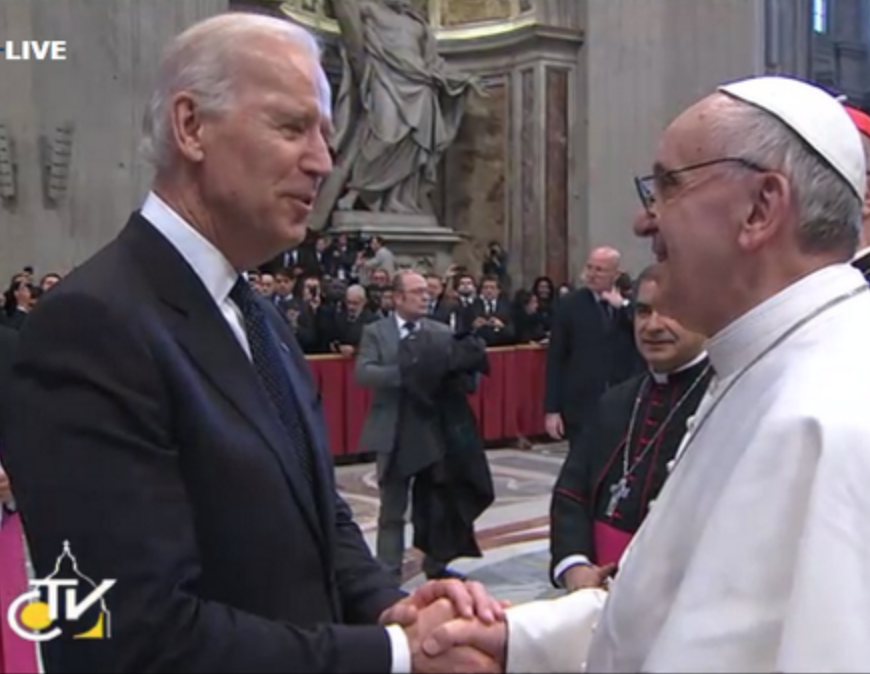
Yo, New York Times editors: There are several Catholic angles linked to Joe Biden's abortion flip

Yo, New York Times editors: There are several Catholic angles linked to Joe Biden's abortion flip

As many pro-life Democrats and others have noted in social media: That didn’t take long.

After years of opposing the use of taxpayer dollars to fund abortion — supporting the Hyde Amendment — former Vice President Joe Biden bowed the knee to primary-season realities in this “woke” era of Democratic Party life and reversed himself on this issue. Thus, he erased one of his few remaining ties to his old role as a centrist, compromise figure in his party on moral, cultural and religious issues.

Needless to say, the word “Catholic” may have something to do with this story. That term even made it into the New York Times coverage of this policy flip. See this all-politics headline: “Behind Biden’s Reversal on Hyde Amendment: Lobbying, Backlash and an Ally’s Call.

The overture focused on the political forces that yanked Biden’s chain, from members of his staff to rivals in the White Race. The Planned Parenthood team called early and often. Then, down in the body of the story, there was this:

A Roman Catholic, Mr. Biden has spent decades straddling the issue of abortion, asserting his support for individual abortion rights and the codification of Roe v. Wade, while also backing the Hyde Amendment, arguing that it was an inappropriate use of taxpayer money.

But Mr. Biden, his allies acknowledge, had plainly misread what activists on the left would accept on an extraordinarily sensitive issue. For all his reluctance to abandon his long-held position on federal funding for abortion, Mr. Biden ultimately shifted in order to meet the mood of emergency within his party’s electoral base.

The big word, of course, is “base” — which usually means “primary voters.” The question is whether the “base” that turns out in primary season has much to do with the mainstream voters that are crucial in the Rust Belt and the few Southern states that a Democrat has a chance to steal in a general election.

So where, in this Times report, were the voices from pro-life Democrats and progressive and centrist Catholics who wanted to see Biden try to reclaim blue-collar and Catholic votes that, in 2016, ended up — #LesserOfTwoEvils — going to Donald Trump? I would imagine they are hiding between the lines in the following material:


Please respect our Commenting Policy