
That strong New York Times #ChurchToo horror story -- with clues pointing to big SBC issues

Throughout the 16-plus years that GetReligion has been around, I have received emails asking why the mainstream press has focused on clergy sexual abuse cases in the Church of Rome, but not abuse cases in liberal and conservative Protestant flocks.

That’s an important question and one that looms over the intense media coverage we are currently seeing — with good cause — at the Southern Baptist Convention meetings in Birmingham (click here for Bobby Ross Jr. round-up on preliminary coverage).

That is also the subject at the heart of a gripping #ChurchToo feature at The New York Times — “Her Evangelical Megachurch Was Her World. Then Her Daughter Said She Was Molested by a Minister” — linked to SBC debates about sexual abuse. It’s a solid, deep story about one controversy in a powerful congregation and it contains clues pointing toward larger issues that will, eventually, have to be covered in the national press.

You see, there are reasons that SBC leaders — the ones who truly want to act — have struggled to come up with a one-plan-fits-all proposal to crack down on the monsters in their midst. To understand why, I want to flash back to an important Joshua Pease essay that ran a year ago at The Washington Post. Here’s my commentary about that: “ 'The Sin of Silence' in The Washington Post: It's easy to hide sin in an independent-church maze.”

The following chunk of the Pease essay is long, but essential for those who want to understand the larger issues that lurk in the painful new piece at the Times.

Without a centralized theological body, evangelical policies and cultures vary radically, and while some church leaders have worked to prevent abuse and harassment, many have not. The causes are manifold: authoritarian leadership, twisted theology, institutional protection, obliviousness about the problem and, perhaps most shocking, a diminishment of the trauma sexual abuse creates – especially surprising in a church culture that believes strongly in the sanctity of sex. ...

The problem in collecting data stems, in part, from the loose or nonexistent hierarchy in evangelicalism. Catholic Church abusers benefited from an institutional cover-up, but that same bureaucracy enabled reporters to document a systemic scandal. In contrast, most evangelical groups prize the autonomy of local congregations, with major institutions like the Southern Baptist Convention having no authority to enforce a standard operating procedure among member churches.

Journalists: Please read that passage two or three times. The Southern Baptists have a real problem, here, and it’s not going to go away. It’s a theological problem, as well as a legal one.

Please respect our Commenting Policy

Dispatch from the Island of Misfit Toys: it’s payback time for pagans on the far left

There’s a simple reason for the recurring pop-culture theme about being the last kid chosen for the sports team, or fearing dodgeball, or being called a cruel nickname: nearly everyone feels the weight of being an outcast, usually by the ninth grade.

Yes, some carry that weight much longer than others, and often for reasons beyond their control. But some outcasts speak with such frequency about being outcasts that it appears to become central to their identity and actions. That brings us to “The Rise of Progressive Occultism,” a deeply researched longform report by Tara Isabella Burton in The American Interest.

You may remember that some witches joined in a collective hex against Brett Kavanagh, associate justice of the U.S. Supreme Court, when he was but a nominee. You win some and you lose some.

The most serious practitioners of the dark arts are not mere political dilettantes, but people who believe a counter-narrative to Christianity (which they consider patriarchal) and who call on their ancient spiritual forces for supernatural assistance. This being the age of Donald Trump, well of course the 45th president serves as the bête noire (or bête blanc, if you prefer) in all of this:

In one Brooklyn zine, author and non-binary witch Dakota Bracciale — co-owner of Catland Books, the occult store behind the Kavanaugh hexing — celebrates the potential of traditional “dark magic” and outright devil-worship as a levying force for social justice.

“There have been too many self-elected spokespersons for all of witchcraft,” Bracciale writes, “seeking to pander to the masses and desperately conform to larger mainstream religious tenets in order to curry legitimacy. Witchcraft has largely, if not exclusively, been a tool of resilience and resistance to oppressive power structures, not a plaything for bored, affluent fools. So if one must ride into battle under the banner of the Devil himself to do so then I say so be it. The reality is that you can be a witch and worship the devil and have sex with demons and cavort through the night stealing children and burning churches. One should really have goals.”

As with the denizens of The Satanic Temple, Bracciale uses the imagery of Satanism as a direct attack on what he perceives as Christian hegemony. So too Jex Blackmore, a self-proclaimed Satanic feminist (and former national spokesperson for the Satanic Temple) who appeared in the Hail Satan? documentary performing a Satanic ritual involving half-naked worshippers and pigs’ heads on spikes, announcing: “We are going to disrupt, distort, destroy. … We are going to storm press conferences, kidnap an executive, release snakes in the governor’s mansion, execute the president.”

Thank you for the heads up.


Please respect our Commenting Policy

Ready, set, go! The much-anticipated Southern Baptist Convention annual meeting starts in 3, 2, 1 ...

Sex abuse. Women’s roles. Abortion.

All could make headlines at the Southern Baptist Convention’s annual meeting, which starts Tuesday in Birmingham, Ala.

But as The Associated Press notes, the sex abuse scandal that has rocked the nation’s Protestant denomination for months is expected to dominate the yearly gathering.

That scandal started, of course, with a bombshell investigation by the Houston Chronicle and the San Antonio Express-News. The Texas papers have kept at the investigation and delivered a final piece of their series Sunday. That front-page report focused on “Baptist abuse victims’ battle: silence, survival, speaking out.” It’s certainly a worthy read in advance of the SBC meeting.

Just two years ago, someone (OK, maybe it was me) whined about reporters’ seeming lack of interest in the SBC’s meeting. But in 2019, the gathering is, no doubt, the journalistic place to be.

GetReligion’s own Richard Ostling offered a tip sheet last week for news writers covering the Baptist extravaganza, as he put it. And on Sunday, GR editor Terry Mattingly featured a think piece by the SBC’s Russell Moore.

Already, The Tennessean’s Holly Meyer — who is covering the meeting with her Gannett colleague Katherine Burgess of Memphis’ Commercial Appeal — has filed her first story from Birmingham.

Meyer reports from a pre-convention meeting of the denomination’s executive committee:

BIRMINGHAM, Ala. — The Southern Baptist Convention's executive committee took steps Monday to make it clear that it can kick out churches that show a disregard for sexual abuse. 

While the ability to sever ties with such churches already exists, the executive committee voted to enshrine in the convention's constitution that addressing sexual abuse is part of what it means to be a Southern Baptist church

"In the culture, situations and issues arise from time to time where we need to make explicit what has already been implicit," said Pastor Mike Stone, chairman of the executive committee. "These actions are a confirmation of what Southern Baptists have always believed."

The top administrative body, which acts on behalf of the convention when it is not in session, also supported a bylaw change on Monday that would form a special committee to address misconduct allegations, including sexual abuse, against churches. 

The new panel would conduct inquiries — not investigations — into the allegations and make a recommendation to the executive committee about whether the convention should be in fellowship with the church in question. 


Please respect our Commenting Policy

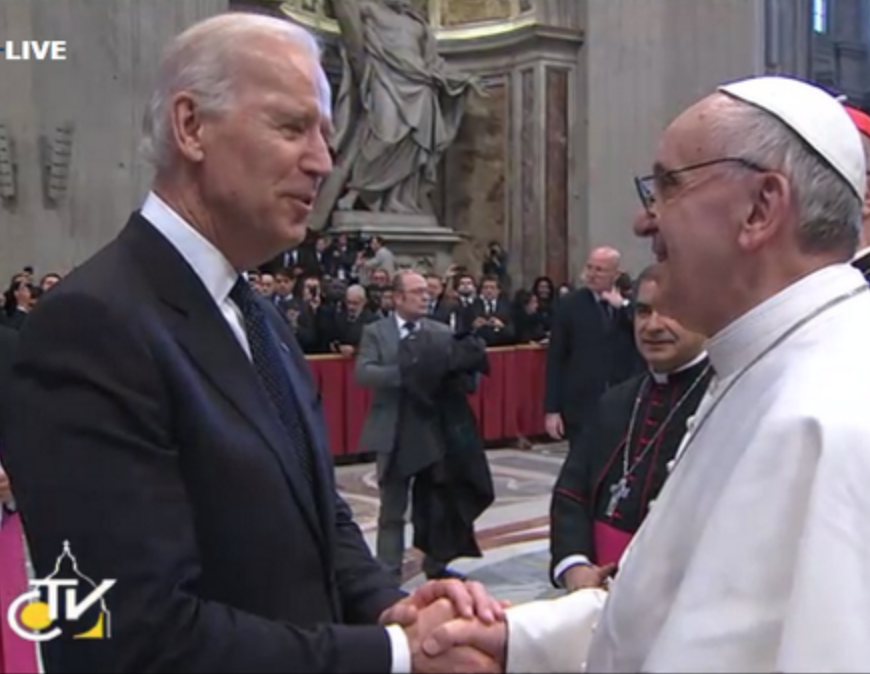
Yo, New York Times editors: There are several Catholic angles linked to Joe Biden's abortion flip

Yo, New York Times editors: There are several Catholic angles linked to Joe Biden's abortion flip

As many pro-life Democrats and others have noted in social media: That didn’t take long.

After years of opposing the use of taxpayer dollars to fund abortion — supporting the Hyde Amendment — former Vice President Joe Biden bowed the knee to primary-season realities in this “woke” era of Democratic Party life and reversed himself on this issue. Thus, he erased one of his few remaining ties to his old role as a centrist, compromise figure in his party on moral, cultural and religious issues.

Needless to say, the word “Catholic” may have something to do with this story. That term even made it into the New York Times coverage of this policy flip. See this all-politics headline: “Behind Biden’s Reversal on Hyde Amendment: Lobbying, Backlash and an Ally’s Call.

The overture focused on the political forces that yanked Biden’s chain, from members of his staff to rivals in the White Race. The Planned Parenthood team called early and often. Then, down in the body of the story, there was this:

A Roman Catholic, Mr. Biden has spent decades straddling the issue of abortion, asserting his support for individual abortion rights and the codification of Roe v. Wade, while also backing the Hyde Amendment, arguing that it was an inappropriate use of taxpayer money.

But Mr. Biden, his allies acknowledge, had plainly misread what activists on the left would accept on an extraordinarily sensitive issue. For all his reluctance to abandon his long-held position on federal funding for abortion, Mr. Biden ultimately shifted in order to meet the mood of emergency within his party’s electoral base.

The big word, of course, is “base” — which usually means “primary voters.” The question is whether the “base” that turns out in primary season has much to do with the mainstream voters that are crucial in the Rust Belt and the few Southern states that a Democrat has a chance to steal in a general election.

So where, in this Times report, were the voices from pro-life Democrats and progressive and centrist Catholics who wanted to see Biden try to reclaim blue-collar and Catholic votes that, in 2016, ended up — #LesserOfTwoEvils — going to Donald Trump? I would imagine they are hiding between the lines in the following material:


Please respect our Commenting Policy

Washington Post Magazine gives voice to unsung evangelical whistleblowers/bloggers

I’ve written for the Washington Post Magazine more than a dozen times, but I’ve never known it to be all that interested in certain inside baseball aspects of American religious culture. Stories always had to connect with a larger issue –- usually politics -– to get in.

Which is why I was happily surprised to see this recent feature on the corps of bloggers who’ve been going after Protestant churches that have tolerated — if not outright encouraged — sexual and spiritual abuse. And there’s a bunch of them out there and many of these congregations are quite large.

Those of us who are insiders on the beat have known about the Wartburg Watch, the most famous of these blogs, for years.

After an opening anecdote about one whistleblower, the Post continues:

(Recent exposes) are thanks to the Wartburg Watch and Watch Keep, blogs that are part of a larger constellation of “Christian watchdog” outlets. While clergy sex abuse within the Catholic Church has been in the headlines for years, it’s only more recently that abuses within Protestant churches have started to draw mainstream media attention. Much of the credit for this quickening churn goes to a circle of bloggers — dozens of armchair investigative journalists who have been outing abuse, one case and one congregation at a time, for over a decade now, bolstering their posts with court records, police reports, video clips of pastors’ sermons, and emails, often provided to them by survivors.

Most of these bloggers are women; many come from churches that teach women’s submission and deny women’s spiritual authority. “Investigative blogger women started a revolution at their kitchen tables,” says pastor Ashley Easter, who hosts the Courage Conference, a Christian, survivor-focused gathering. They have advocated “for victims of abuse from where they were, where they could find a platform — blogs and social media.”

Recently, a younger cohort of “ex-vangelicals” and online activists have joined the fold, and in late 2017 #ChurchToo started to trend on Twitter. In turn, a wave of secret-smashing tweets blossomed into reported pieces at publications like Mother Jones and the New Yorker. Yet the bloggers who built the foundation for this activist network are known mainly to church abuse survivors and reporters covering these stories. To the rest of the world, their efforts have mostly blended into the joint backgrounds of the clergy sex abuse scandal and #MeToo.

You know what I really liked about this piece? It gave the ‘little people,’ who are so often ignored by their pastors, a vote.


Please respect our Commenting Policy

Baptists and bishops: Must-read pair of weekend thinkers from Russell Moore and J.D. Flynn

Back in the religion-beat Good Old Days — roughly 1985-95 or hereabouts — religion-beat professionals in most American newsrooms could count on getting travel-budget money to cover at least two major events every year.

That would be the annual summer meeting of the national Southern Baptist Convention — prime years in the denomination’s civil-war era — and a meeting of the U.S. Conference of Catholic bishops, where some progressives were wrestling with Pope St. John Paul II and there were rumblings about a massive sexual-abuse scandal among priests and bishops.

Along with meetings of the Religion Newswriters Association, these were the dates on the calendars when the pros could get together and talk shop over a few modest meals/drinks on the company dime.

Well, those meetings roll on, of course, and continue to make news. A few reporters get to attend these major events, since they represent newsrooms that are (a) still quite large, (b) led by wise editors or (c) both. Lots of others scribes (speaking for a friend) catch key moments via streaming video, smartphone connections and transcripts of major speeches and debates.

With that in mind, here is a double-dose of weekend think-piece material linked to these two events which will take place in the next week or so in Birmingham, Ala., and Baltimore. Some people get barbecue and some get crab cakes.

First up, an essay by a key SBC voice, the Rev. Russell Moore of Beltway land, entitled: “10 Things I Wish Everyone Knew About Southern Baptists.” There are some important topics early on (“Westboro Baptist Church isn’t one of us” and “There are some things in our past we’re ashamed of”) but the most important info comes near the end, in terms of topics currently in the news. For example:

#8. We’re more ethnically diverse than you might think.

Among the fastest growing demographics in the Southern Baptist life are African-American, Hispanic, and Asian-American congregations. The most vibrant of our churches often include many languages and ethnic groups.


Please respect our Commenting Policy

Populist surge continues in Europe: Was Pope Francis a big loser in these complex results?

After elections gave right-wing populists sweeping victories in the Catholic nations of Italy, Poland and France in the European elections, it seemed clear that the biggest loser wasn’t the political left or moderate political parties.

The side that suffered the biggest defeat was Pope Francis.

In Italy, The League party snagged 33 percent of the vote, a remarkable achievement given the country’s fragmented political system. The pro-European Democratic Party could only muster 22 percent of the vote, while the left-wing populist Five Star Movement finished third at 18 percent. The League victory highlighted the divisions within Roman Catholicism. Party leader Matteo Salvini — known for his nationalistic and anti-immigration rhetoric — didn’t shy away from his faith. On the contrary, he used church symbols to win seats.

It isn’t the first time in European history that the Catholic church, and the papacy, has been viewed with disdain. Over the past few years, the political populism that has enveloped Europe has sought to blame much of its social and economic misfortune on elites. While many of these elites traditionally hail from the political left, the doctrinal left — and with it the current Vatican hierarchy headed by Pope Francis — has also become a target in recent elections.

The election results capped off a bad week for the pontiff. While having to deal with populism undercutting Catholic social teaching, Pope Francis denied he knew about former Cardinal Theodore McCarrick’s history of sexual misconduct with seminarians in an interview with Mexican TV network Televisa. The scandal has plagued the papacy since last summer.

The European election, contested every five years, firmly places populism among the continent’s most powerful political forces. Never shy about brandishing a rosary or invoking God’s help, Salvini has provided Italians with an alternative to the pro-migrant stance and the church’s traditional social teachings put forth by the pope.

“I thank the man up there — with no exploitations,” Salvini told reporters, while kissing a rosary he was clutching in his hand, as results came in on May 26.


Please respect our Commenting Policy

Podcast puzzle: Why do editors send political reporters to cover complex religion stories?

It was the key moment in this week’s “Crossroads” podcast-radio session. Host Todd Wilken asked a relatively simple (you would think) question about mainstream news coverage of the Rev. David Platt’s decision to pray for President Donald Trump during a worship service at McLean Bible Church, a very influential D.C. Beltway megachurch.

This turned into a hot mess on Twitter (#NoSurprise). I wrote a GetReligion piece about the online controversy with this headline: “Praying for presidents? That's normal. Praying for Donald Trump? That fires up Twitter.

The initial coverage, of course, focused on the true religion in most American newsrooms — politics.

This brings me to the substance of Wilken’s question.

Toward the end of the first wave of coverage, Emma Green off The Atlantic wrote an essay — “On Praying for the President” — that paused and examined what actually happened at McLean Bible Church. She considered the history of pastors praying for presidents. She looked at the record of this particular minister. She also (#Amen) wrote about the actual contents of the prayer. In the body of the piece Green concluded:

What’s remarkable about this prayer is not that it happened, but that it shows how thoroughly the Trump era has opened the way for cynicism and outrage over even mundane, predictable Christian behavior. Within the world of evangelicalism, Platt does not roll with the hard-core Trump supporters; his prayer was studiously neutral, clear of boosterism and partisanship. While Trump has certainly amplified divisions among evangelicals over race, gender, and the rightful relationship between Christianity and politics, the choice to pray for a person in leadership is not a meaningful symbol of evangelicalism’s transformation under the 45th president.

Wilken asked this question: Why was Emma Green able to write that? Why did she “get” this story when many others did not?

The short answer is that Green is a religion-beat professional.

I could add, of course, that she is talented, works really hard and tries to accurately report the views of a wide range of religious believers, while working at a mainstream, left-of-center magazine of news and opinion. At this point, all of that goes without saying and Green consistently draws praise from religious conservatives as well as progressives. Anyone who reads GetReligion knows that, while we may debate with Green every now and then, this blog consistently praises her work. She often does more factual reporting in analysis pieces than others do in “hard-news” reports.

That’s the easy answer to Wilken’s question. In the podcast I used a rather long and complex sports metaphor (getting somewhat emotional in the process) that, I hope, went a bit deeper.


Please respect our Commenting Policy

Friday Five: Abortion, Catholic and Baptist scandals, Emanuel AME, disaster deacon, The Bachelorette

Anybody seen any abortion-related headlines lately?

I kid. I kid.

They keep coming fast and furious — some stories better than others.

Here’s three that have come across my screen just today. I haven’t had time to read them yet:

Southern Baptists descend on Alabama, epicenter of abortion debate, by Holly Meyer of The Tennessean

Biden reverses long-held position on abortion funding amid criticism, from CNN

Poll: Majority Want To Keep Abortion Legal, But They Also Want Restrictions, from NPR

At the only abortion clinic left in Missouri, doctors live and work in uncertainty, from the Los Angeles Times

Now, let’s dive into the Friday Five:

1. Religion story of the week: It’s been a week of big exposés concerning major religious institutions.

We highlighted the Washington Post’s bombshell investigative report on the lavish spending of West Virginia’s former Catholic bishop.


Please respect our Commenting Policy