Worship

Podcast: Thoughts on a third of a century as a columnist (and a symbolic SCOTUS ruling)

Podcast: Thoughts on a third of a century as a columnist (and a symbolic SCOTUS ruling)

This week marked a rather symbolic anniversary for my national “On Religion” column, which I have been writing now for (#GULP) a third of a century.

As you would imagine, I spend some time thinking about the subject for this week’s column: “Why 'religious liberty' has ended up inside quotation marks.” This column was also the hook for this week’s “Crossroads” podcast (CLICK HERE to tune that in).

Anyone who has followed my work with GetReligion and “On Religion” will not be surprised that I chose to write about the First Amendment and and a highly symbolic religious liberty case (no scare quotes there) at the U.S. Supreme Court.

But hold that thought. I’d like to walk through what are, for me, four symbolic columns I have written in the past, as I head into year No. 34.

That first column in 1988 was rather newsy: “Pat Robertson, evangelicals and the White House.” Here’s the lede on that:

On the morning before Easter, Pat Robertson stood in a pulpit under an American flag and a banner that read, "King of Kings, Lord of Lords."

Alas, change the name of the candidate and that still sounds rather relevant, considering the state of warfare inside American evangelicalism these days (see this must-read Richard Ostling post).

On the 10th anniversary of the column — that seemed like a long time, back then — I focused on a classic book by sociologist James Davison Hunter (“Culture Wars: The Struggle to Define America”) that has greatly influenced my work as a journalist and as a professor. The column opened by describing an interesting trend at political and religious rallies at that time:
Please respect our Commenting Policy

White evangelicals, again: New York Times urgently probes praise music on political right

White evangelicals, again: New York Times urgently probes praise music on political right

At this point, it’s safe to say that some New York Times editors are still engaged in a passionate quest to find a large group of Americans to blame for the 2016 general-election victory of Donald Trump of Queens.

There’s an obvious answer: White evangelicals. And it’s certainly true that independent and, especially, Pentecostal Protestants played a strategic role in the shocking rise of Orange Man Bad. It’s also true that independent evangelicals, fundamentalists, charismatics and Pentecostal believers have played high-profile roles in video-friendly pro-Trump events, including the January 6th attack on the U.S. Capitol to hunt down Vice President Mike Pence — a mainstream White evangelical if there ever was one.

However, White evangelical voters were not the crucial Rust Belt voters that put Trump in the White House, although Latino evangelicals and charismatics were a major force in Florida

Therefore, what are discerning religion-beat readers supposed to make of that long, vague Times sermon that ran the other day with this dramatic double-decker headline? (Sorry for the delay getting to this piece, but surgery slowed me down last week.)

The Growing Religious Fervor in the American Right: ‘This Is a Jesus Movement’

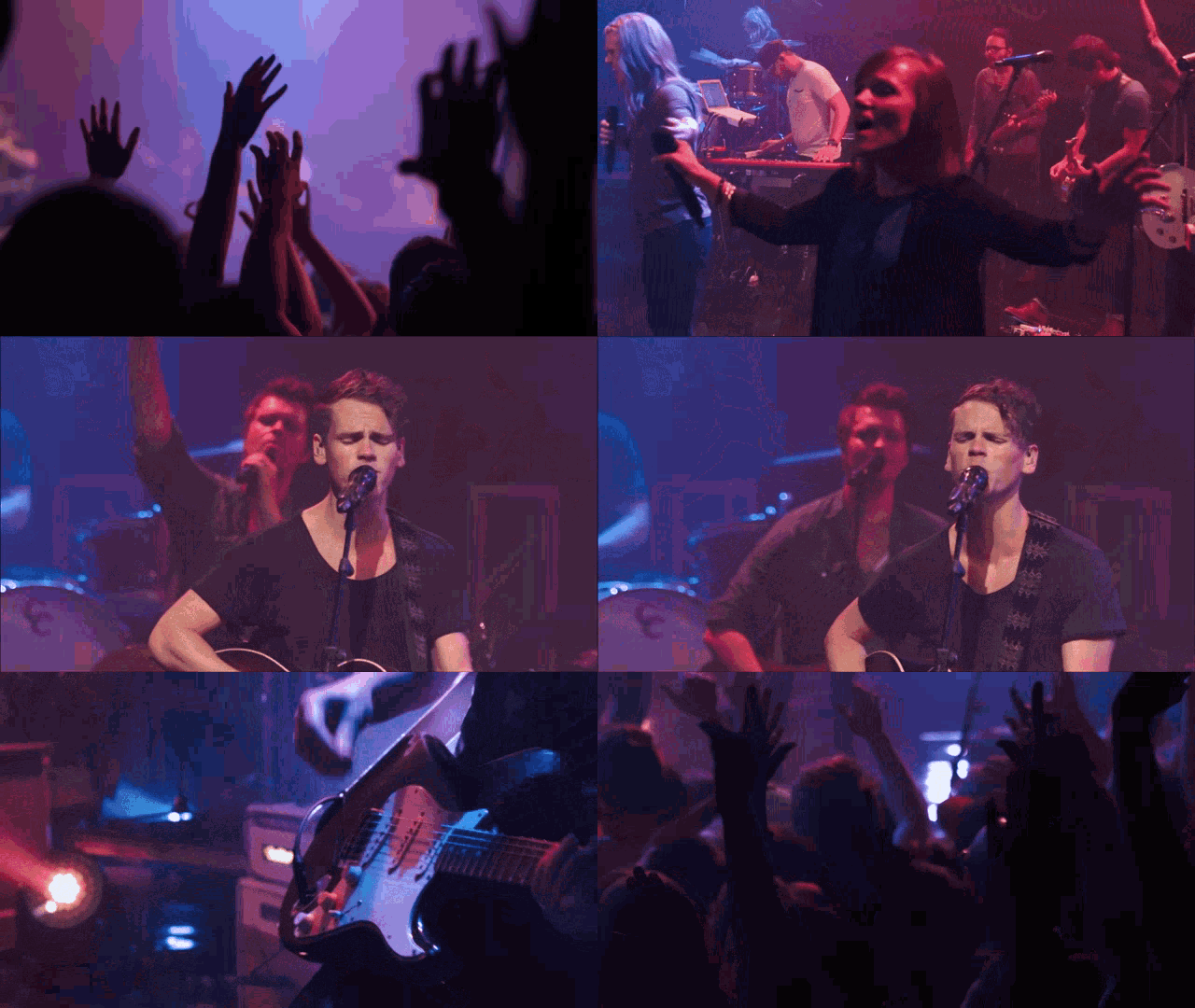
Rituals of Christian worship have become embedded in conservative rallies, as praise music and prayer blend with political anger over vaccines and the 2020 election.

Here is one strong opinion that is drawn — with his permission — from an email I received from Kenneth Woodward, for decades the religion-beat pro at Newsweek and the author of “Getting Religion: Faith, Culture, and Politics from the Age of Eisenhower to the Ascent of Trump.”

This is the most naive religion story I’ve read in decades and illustrates precisely why the Times still does not get religion. … Only the Times could publish a piece as misinformed as this one.

Why does Woodward think that? To some degree, he is blaming a newspaper story for lacking the kind of depth seen in interpretive magazine pieces produced during the glory years of religion-beat work at Newsweek and at Time by GetReligion patriarch Richard Ostling. For a short period of time, Emma Green was allowed to do similar work at the Atlantic.

Depth is an issue here. But this Times feature is quite long and has lots of room for anecdotes, when what is missing is a hard skeleton of facts that link (if this is possible) these vague trends and illustrations to actual denominations, publishing houses, parachurch groups, think tanks and academic institutions at the heart of American evangelicalism.


Please respect our Commenting Policy

Bishops meet in secret about 'culture war' stuff: What does this mean for Catholics?

Bishops meet in secret about 'culture war' stuff: What does this mean for Catholics?

While Pope Francis was presiding over a ceremony at the Vatican to consecrate Ukraine and Russia on March 25, a group of high-ranking American bishops met in Chicago.

That could be a news story.

The gathering at Loyola University — entitled “Pope Francis, Vatican II and the Way Forward” — was co-sponsored by Boston College’s Boisi Center for Religion and American Public Life and Fordham’s Center on Religion and Culture. Its aim was, according to what news coverage there was, to create a dialogue between theologians and bishops.

“We want to show that opposition to Pope Francis — not universally, but to a large extent — is opposition to Vatican II,” said Father Mark Massa, a priest and historian of the American Catholic Church, to describe the goal of the meeting. “Francis is trying to cash the check that Vatican II wrote — synodality was the big thing.”

Synodality is an invitation to build deeper communion within the body of Christ, according to the Vatican, and part of a process the pope has embarked on this year to create dialogue between Catholic believers and clergy. Or a certain type of clergy.

In other words, moving forward into the spirit of Vatican II. That is a big news story.

The two-day meeting, by invitation only, didn’t appear to fit the description of synodality. Rather, as Massa said, it was meant to see “how we can move the American church away from these culture wars divided between conservatives and liberals … to a united position where it’s possible to be on a spectrum of positions and still be considered a good Catholic and not be called names by people who disagree with you.”

Critics in the conservative Catholic press read that statement to mean how the 70 prelates in attendance — with help from progressives within the American church in the form of academics, journalists and theologians — could bolster this pope’s agenda. Those on the Catholic left in the National Catholic Reporter billed it as a way bishops “can better support the agenda of Pope Francis.”

I reported at the end of 2021 that this year would “be the one where the battle between this pontiff and doctrinal traditionalists intensifies even further.” The culture war that is dominating our politics at the moment has spilled over into our religious institutions and the Catholic church’s hierarchy.


Please respect our Commenting Policy

What do the latest statistics really tell us about the worldwide Catholic Church?

What do the latest statistics really tell us about the worldwide Catholic Church?

THE QUESTION:

What do the latest statistics tell us about the worldwide Catholic Church?

THE RELIGION GUY'S ANSWER:

The Vatican's Central Office of Church Statistics issued a summary report in February that says as of December 31, 2020, Catholicism had 1.36 billion adherents worldwide. That equals an impressive 17.7% of the world's people and keeps pace with over-all population growth. The church's gain of 16 million members over 2019 exceeds the combined populations of New York City, Los Angeles and Chicago.

The Guy would note, however, that the church counts as members all baptized infants, who as adults will not necessarily be active parishioners.

John L. Allen Jr., the editor of CruxNow.com and a go-to guy on Catholic trends, writes that these numbers counter western perceptions that "the church is shrinking" in the wake of sexual abuse scandals and other problems. Also see this tmatt post here at GetReligion on this topic: “Thinking about world Christianity, as Crux digs deep into many overlooked Catholic details.”

But Catholic expansion is centered in Africa and Asia, not western nations, and the church faces a personnel problem. The Vatican office admits that yet again there's an "obvious imbalance" in the geographical distribution of the slowly decreasing ranks of priests, currently totaling 410,219 worldwide. There's also declining enrollment in seminaries, now totaling just under 112,000, with only Africa showing an increase. Remarkably, Africa plus Asia produce 60% of the globe's seminary students. Here is another tmatt post on that trend: “Thinking about the Catholic vocations 'crisis': The Pillar asks if this is truly a global problem.

Let's drill down on the numbers.


Please respect our Commenting Policy

What happened when this 2022 Final Four hero was asked to explain his heart, mind and soul?

What happened when this 2022 Final Four hero was asked to explain his heart, mind and soul?

OK, faithful GetReligion readers, you know the drill.

Especially those of you who are among the small circle of our readers who join millions and millions of ordinary Americans in caring about sports news and personalities. In this case, we are talking about March Madness, the NCAA hoops festival that — taken as a whole — is a much more symbolic and emotional sports event than that whole SuperBowl thing.

Sure enough, the final act of this year’s tournament features a sports hero-coach who wasn’t supposed to be there, at least not this year, at this stage of his career. Here is the top of a typical news story about him, care of the always secular USA Today team:

NEW ORLEANS — Kansas coach Bill Self had a positive opinion of Hubert Davis long before North Carolina staged a thrilling run to the national championship game.

Self ran into Tar Heels' All-American big man Armando Bacot when both teams were in Fort Worth two weeks ago for the first two rounds of the NCAA Tournament.

"I went up to Armando and said, 'congratulations: are you having fun?' And the first thing he said: 'I love playing for Coach Davis.' That's the first thing he said to me," said Self, who had a relationship with Bacot from coaching him on the FIBA U18 team back in 2018. "So I think right there is a testament to how good (Davis) is, how special, and the relationship he has with his guys."

On April 5 of last year, Davis was named as the replacement to legendary UNC coach Roy Williams. For parts of 2021-22, it looked as if it would take time for Davis to transform the blue-blood back into a perennial power. Then the Tar Heels found another gear – starting with a March 5 road upset of rival Duke, an outcome they replicated in this Final Four to send Blue Devils coach Mike Krzyzewski into retirement.

So what makes this man unique? What does he have to say when he is asked to explain who he is, why he does what he does and what Makes. Him. Tick. as a man and a coach?

Consider this quote, in one of those high-profile press conferences before the Final Four:

"My faith and foundation is firmly in my relationship with Jesus. It just is.


Please respect our Commenting Policy

Thinking about the Catholic vocations 'crisis': The Pillar asks if this is truly a global problem

Thinking about the Catholic vocations 'crisis': The Pillar asks if this is truly a global problem

When journalists are covering a truly global religion — take the Catholic Church, for example — it really helps to pay attention to the fine details in statistics.

What is true in America may not be true in Africa. What’s true in the shrinking churches of Western Europe may not be true, literally, anywhere else.

I brought this up in a recent think piece — “Thinking about world Christianity, as Crux digs deep into many overlooked Catholic details” — pointing readers to an interesting Crux essay by John L. Allen, Jr. (of course). Here’s a key bite of commentary from Allen:

… Catholicism added 16 million new members in 2020, the latest year for which statistics are available. Granted, that meant the church did no more than keep pace with overall global population growth, but it’s still significant at a time when most western perceptions are that the church is shrinking due to the fallout from the sexual abuse crisis, various scandals at senior levels, bitter political infighting, increasing irrelevance to younger generations, and any number of other alleged failures.

For sure, if you live in western Europe or in some parts of the United States, where parishes are closing or consolidating and Mass attendance seems in free fall, those perceptions are understandable. Yet the reality is that on a global level, Catholicism enjoyed the greatest expansion in its history over the past century, more than tripling from 267 million in 1900 to 1.045 billion in 2000 and 1.36 billion today.

Basically, Catholicism is growing wherever it’s churches, to be blunt, have plenty of children, converts and clergy.


Please respect our Commenting Policy

Podcast: Concerning the many religion-beat stories linked to that 'Don't Say Gay' bill

Podcast: Concerning the many religion-beat stories linked to that 'Don't Say Gay' bill

Let’s talk news-business realities for a moment.

If you do an online search for the following terms — “Parental Rights in Education,” Florida — you will get about 43,000 hits on Google News (as of Thursday afternoon).

Then again, if you run a search for these terms — “Don’t Say Gay,” Florida — you will get 6,820,000 hits on Google News and 24,100,000 hits on Google (period).

That’s a pretty big difference. What’s going on?

On this week’s “Crossroads” podcast (CLICK HERE to tune that in) I argued that the real name of this bill sounded way, way too much like a whatever it was that parents in Virginia wanted during that recent election that left the Democratic Party establishment in shock.

As it turns out, a new Public Opinion Strategies poll (.pdf here) found that registered voters — a majority of Democrats, even — liked the contents of this controversial Florida bill when shown its key, defining language:

“Classroom instruction by school personnel or third parties on sexual orientation or gender identity may not occur in Kindergarten through third grade or in a manner that is not age appropriate or developmentally appropriate for students in accordance with state standards.”

Clearly, “Don’t Say Gay” worked much better for political activists who wanted to keep the focus on LGBTQ-era sexual education for prepubescent children. The whole idea was that way too many parents are burdened with religious, moral and cultural beliefs that were on the wrong side of history. Thus, “parental rights” and classroom transparency are not helpful concepts.

What does this have to do with the many religion-angle stories that journalists could be chasing linked to this legislation and variations on this bill that are sure to show up in other states?


Please respect our Commenting Policy

Elite American super-cities are bleeding people: Any religion ghosts in this big story?

Elite American super-cities are bleeding people: Any religion ghosts in this big story?

It’s hard to imagine any corner of American life that has not been touched by the coronavirus pandemic.

Obviously, there have been plenty of religion stories — along with the obvious angles linked to politics, business and technology.

Then you have stories that combine all of these elements. That is, they combine all of these themes if reporters are willing to look at the numbers and trends through multiple lens. However, as any GetReligion reader knows, not all lens are created equal.

One of the most important stories has been the impact of COVID-19 realities on some of the most important zip codes — “important” from an elite-news perspective — on the blue coasts. That brings us to that massive headline the other day in The New York Times, a paper that has, for the most part, treated evidence of New York City woes as part of a vast a right-wing conspiracy theory. Here’s that double-decker headline:

Cities Lost Population in 2021, Leading to the Slowest Year of Growth in U.S. History

Although some of the fastest growing regions in the country continued to grow, the gains were nearly erased by stark losses in New York, Los Angeles and San Francisco.

This is, of course, an almost totally religion-free story. I was pleased to notice that the Times team took demographic issues — including birth-rate slumps — rather seriously, even if the editors didn’t (as usual) connect the dots and see the religious, cultural and moral elements of that important angle (please see this earlier GetReligion piece — “New York Times asks this faith-free question: Why are young Americans having fewer babies?” — for background).

Am I arguing that the flight from several important American super-cities is essentially a religion story? Of course not. Am I saying that issues linked to faith, family and culture are playing a role in this very, very important story? Yes, I am.


Please respect our Commenting Policy

Updates in the journalism style bible: Appropriate 'cult' advice and other tweaks

Updates in the journalism style bible: Appropriate 'cult' advice and other tweaks

If you know anything about the nuts and bolts of reporting and editing, then you know that the Associated Press Stylebook is the bible — that’s with a lower-case “b” — of journalism.

It’s also a great place to chart tensions inside the news business. Consider, for example, the decades of debate about “pro-life” and “pro-choice,” as opposed to “anti-abortion” and “pro-abortion rights.” Will the next major revision of the AP manual need to include an updated definition for the suddenly controversial word “woman”?

Our GetReligion patriarch, Richard Ostling, recently sent me an interestingly list of some of the religion-beat terms in the latest revisions to this AP bible. He served as a consultant on that revision project and, thus, doesn’t want to make any comments about the results. Here is one of the updates that is sure to lead to newsroom discussions:

cult (new)

A loaded term to be used with caution.

Yes, indeed — proceed with caution. I totally agree that this is a “loaded term” that journalists should avoid whenever possible.

The problem, however, is that this is a term that religious leaders, activists and even scholars are going to use every now and then and it will be hard to avoid the term when it is used in important direct quotations. Thus, editors need to know the various ways that informed people use the word — the key is sociology vs. theology — so that these loaded quotes can be placed in context for readers. Then there are activists of various kinds who throw this term around like a verbal hand grenade.

Readers can tell, with a quick glance at the venerable Merriam-Webster dictionary, that this is a complicated subject. Here are several of the definitions:

cult

noun, often attributive …

Definition of cult

1: a religion regarded as unorthodox or spurious (see SPURIOUS sense 2) also : its body of adherents


Please respect our Commenting Policy