Surveys & polls

Podcast: America is splitting, says trending Atlantic essay. This is news? Actually, it's old news

Podcast: America is splitting, says trending Atlantic essay. This is news? Actually, it's old news

In case you haven’t heard, controversial Supreme Court decisions are causing dangerous divisions in the United States of America.

Yes, I know. If you’re old enough you have been hearing people say that since 1973. And there is, of course, an element of truth in these statements, then and now. SCOTUS has become the only branch of government that matters when it comes to forcing one half of America to accept the legal, cultural and moral changes sought by the other half. Study several decades worth of presidential elections.

However, when it comes to mainstream media coverage, not all controversial Supreme Court decisions are created equal. If you have followed Twitter since the fall of Roe v. Wade, you know that large numbers of professionals in major newsrooms are freaking out.

Is this “new” news or old news? Truth is, arguments about red America (“Jesusland”) and blue America (“The United States of Canada”) have been getting louder and louder for several decades. This was the topic that dominated (once again) this week’s “Crossroads” podcast (CLICK HERE to tune that in), which focused on this Ronald Brownstein essay at The Atlantic: “America Is Growing Apart, Possibly for Good.”

What’s interesting about this piece is that it says America’s divisions have nothing to do with traditional forms of religion, culture, the First Amendment or the U.S. Constitution (especially Federalism). No, this is a war about racism, period. SCOTUS has been seized by the enemies of reason and freedom and, thus, America’s future is at risk. This is a concept with serious implications for news coverage.

IT MAY BE TIME to stop talking about “red” and “blue” America. That’s the provocative conclusion of Michael Podhorzer, a longtime political strategist for labor unions and the chair of the Analyst Institute, a collaborative of progressive groups that studies elections. In a private newsletter that he writes for a small group of activists, Podhorzer recently laid out a detailed case for thinking of the two blocs as fundamentally different nations uneasily sharing the same geographic space.

“When we think about the United States, we make the essential error of imagining it as a single nation, a marbled mix of Red and Blue people,” Podhorzer writes. “But in truth, we have never been one nation. We are more like a federated republic of two nations: Blue Nation and Red Nation. This is not a metaphor; it is a geographic and historical reality.”

The bottom line:

To Podhorzer, the growing divisions between red and blue states represent a reversion to the lines of separation through much of the nation’s history. The differences among states in the Donald Trump era, he writes, are “very similar, both geographically and culturally, to the divides between the Union and the Confederacy.


Please respect our Commenting Policy

Gen Z and trends in religious faith and practice: Looking at 2021 and beyond

Gen Z and trends in religious faith and practice: Looking at 2021 and beyond

It’s been nearly two years since I’ve written a post about the precarious religious position of Generation Z (those born after 1995), and with data from late 2021 available it seems like a prime opportunity to update what we know about their religious inclinations.

Because almost all surveys only contact adult Americans (18+), we can’t get a full picture of the entirety of Gen Z, but just the oldest members of this generation. Thus, here I am analyzing those between the ages of 18 and 25 years old.

Let’s start broadly, comparing the religious composition of different generations beginning with the Silent Generation (who were born between 1925 and 1945).

In this generation, half of all respondents indicated that they were Protestant, while 22% said that they were Catholic. Just 8% of the Silent Generation say that they were atheists or agnostics and nearly the same share describe their religion as “nothing in particular” (10%). In sum, the oldest Americans are 72% Christian and 18% none.

Now, for Generation Z things are much different.

Just 22 % of the youngest adults describe themselves as Protestant — a more than 50% decline from the Silents. Catholics make up 14% of Gen Z, an eight percentage-point dip from the Silent Generation.

Of course, the share of nones is much larger. Seventeen percent of young people describe their religion as atheist or agnostic, and 31% say that they are attached to no religion in particular. Taken together, 36% of Gen Z are Christians, while 48% are nones.

For journalists, there is the news hook: This is the first generation in history in which the nones clearly outnumber the Christians.


Please respect our Commenting Policy

Once again, secular science commends a religious instinct and outlook (think compassion)

Once again, secular science commends a religious instinct and outlook (think compassion)

Here’s new secular social science research that’s drenched with religious significance just waiting for examination by journalists.

Over the years, a substantial body of evidence from blue-ribbon universities and medical schools has demonstrated the physical and psychological benefits of regular religious involvement. A January Guy Memo here at GetReligion featured one such new study and then there’s that pioneering Mayo Clinic report from 2001 (.pdf here).

Note to journalists: The impact on life outcomes of youths who are raised in religious homes is especially striking.

Consider the 2019 book “Compassionomics: The Revolutionary Scientific Evidence That Caring Makes a Difference” by physicians Anthony Mazzarelli and Stephen Trzeciak, who are administrators and researchers at New Jersey’s Cooper University Health Care and Cooper Medical School. They reported evidence that health care staffers’ compassion toward patients has a powerful impact on improving both patient outcomes and the workers’ own well-being.

No kidding.

A new book by the same co-authors, going on sale June 21, dramatically extends the concept: “Wonder Drug: 7 Scientifically Proven Ways That Serving Others is the Best Medicine for Yourself” (St. Martin’s Essentials; contact publicity@stmartins.com). The Guy has not read the book but the news potential is obvious from a CNN interview with Mazzarelli last Saturday (click here for transcript).

Think of it as doing well by doing good.

From biblical times to the present, people have been urged to be helpful to others because (1) your Creator requires it and (2) it’s the right thing to do. The two clinicians tell us that a consistent commitment to helping other people is great for you in all kinds of medically provable ways and is thus the “wonder drug” of their title.


Please respect our Commenting Policy

As Roe clock ticks, press avoids news about another big story -- attacks on Catholic churches

As Roe clock ticks, press avoids news about another big story -- attacks on Catholic churches

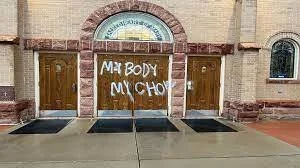
There have been at least 41 incidents of attacks against churches and crisis-pregnancy facilities since the May 2 leak of the Supreme Court draft decision that revealed the potential fall of Roe v. Wade.

The attacks have included property theft, vandalism, arson and property destruction.

How do we know this? A front page New York Times investigation this past Sunday?

No.

A round-up story in The Washington Post, USA Today, the Associated Press? Coverage on CBS, CNN or another major network?

No, no, no and, alas, no.

We know this because of The Washington Stand, which is described as the Family Research Council’s “outlet for news and commentary from a biblical worldview.” In other words, these events are “conservative” niche news (as opposed to, let’s say, attacks on “sanctuary movement” churches because of their activism on immigration).

This awful trend should come as no surprise. At least it wasn’t to me. I wrote a story recently at Religion Unplugged on the rash of vandalism — especially acts against Catholic churches — throughout this spring. I opened my news account with the theft of a tabernacle at a Brooklyn, N.Y., church (see this related GetReligion piece). Here’s an excerpt from my piece:

The desecration was the latest in a string of incidents across the United States, triggering fears of future vandalism given the supercharged political climate around abortion, LGBTQ rights and bishops denying politicians Communion.

The vandalism may not necessarily be tied to one or more of these factors — rising crime rates is also a possibility in the wake of the pandemic — but church officials remain vigilant as the summer approaches. While the motivations remain a mystery, the outcome has rattled Catholic churches across the country. Some have resorted to increased security measures, like locking doors when Masses aren’t taking place, installing security cameras and even erecting barbed wire and fences to avoid being targeted.

As we await a final Supreme Court ruling, we could be in for a long summer of violence and vandalism.

My criticism here is not in the news coverage this issue has received. Instead, it’s the lack of coverage.


Please respect our Commenting Policy

Thinking about that 'Define evangelical' thing, with Andrew Walker, Ryan Burge (and Mark Noll)

Thinking about that 'Define evangelical' thing, with Andrew Walker, Ryan Burge (and Mark Noll)

If you search for “define evangelical” in the 18 years worth of material stored here at GetReligion you will find about four screens worth of information. Here’s what that looks like in a Google search.

Believe it or not, this was a hot topic before the advent of Orange Man Bad and the dreaded “81% of White evangelicals” mantra.

Debates about the meaning of the church-history term “evangelical” are so old that I once asked the Rev. Billy Graham for his take. Here’s some information about his answer, drawn from this “On Religion” column: “Define 'evangelical' – please.”

… You might assume that the world's most famous evangelist has an easy answer for this tricky political question: "What does the word 'evangelical' mean?" If you assumed this, you would be wrong. In fact, Graham once bounced that question right back at me.

"Actually, that's a question I'd like to ask somebody, too," he said, during a 1987 interview in his mountainside home office in Montreat, N.C. This oft-abused term has "become blurred. ... You go all the way from the extreme fundamentalists to the extreme liberals and, somewhere in between, there are the evangelicals."

Wait a minute, I said. If Billy Graham doesn't know what "evangelical" means, then who does? Graham agreed that this is a problem for journalists and historians. One man's "evangelical" is another's "fundamentalist."

That leads us to the topic of this quick, and rather rare, Monday “think piece” (I’m traveling right now and rather unplugged, so I wrote this several days ago).

Thus, at the top of this post you will see a video feature from The Gospel Coalition in which two academics — political scientist Ryan Burge ( a GetReligion contributor) and ethicist-apologist Andrew Walker — debate this topic: “Is ‘Evangelical’ a Political or Theological identity?” (Careful readers may have noticed that, a few lines earlier, I called it a “church-history term” and I’m sticking to that.)

I will let Burge and Walker speak for themselves.


Please respect our Commenting Policy

Should religion influence U.S. public policy? It always has, on both the left and right

Should religion influence U.S. public policy? It always has, on both the left and right

THE QUESTION:

Should religion influence U.S. public policy? For instance, look at Protestants.

THE RELIGION GUY’S ANSWER:

The media occasionally press this question upon us as, as with a timely May article by Religion News Service columnist Jeffrey Salkin titled “Should religion influence abortion policy?

He thinks not. Salkin acknowledges that “religious ideas are part of the public discourse” but even so “those ideas cannot determine policy. Public policy must be open to rational discourse, with provable data, and not merely rely on beliefs, however sacred their sources.” (Naturally, pro-lifers would reply that they rely on “rational discourse” and “provable data” from biology.)

He continues, “America does not allow you to turn your own religion’s theological ideas into public policy. ... This way lies chaos, and worse — holy wars between religious groups. This way lies a return to the Middle Ages. It is time for all religious people to call: Time out.” For Salkin, this approach is required by freedom of religion — or perhaps should we say freedom from religion?

Salkin champions the pro-choice public policy advocated by this own faith, Reform Judaism, which puts this among 17 causes on the agenda of its Washington lobby.

The pro-lifers believe laws should protect the tiny human life growing in the womb. Faiths such as Reform Judaism oppose such protection, believing that women must exercise unimpeded abortion choice. To a journalist, religious alliances on both sides seek to impose their belief as public policy.

Whether America’s religious groups should try to influence policy, they’ve in fact done so since Plymouth Rock and will continue to under the Bill of Rights. Reminders. As much as anything it was Christian zeal that led to abolition of slavery — and 620,000 Civil War deaths. Similarly with the colonists’ rebellion against Britain, women’s vote and, in a remarkable demonstration of Protestant power now mostly regretted, nationwide alcohol Prohibition written into the Constitution.

Which brings us to very important but oft-neglected history depicted convincingly in the new book “Before the Religious Right: Liberal Protestants, Human Rights, and the Polarization of the United States” (University of Pennsylvania Press) by University at Buffalo historian Gene Zubovich.


Please respect our Commenting Policy

Podcast: Americans have long been divided (and often confused) on abortion issues

Podcast: Americans have long been divided (and often confused) on abortion issues

When people ask me to list some must-read books — if the goal is understanding religion and the news — the first one I mention is “Culture Wars: The Struggle to Define America” by sociologist James Davison Hunter.

Pundits love to toss “culture wars” around as a kind of journalism hand grenade, but few bother to flash back to this 1991 classic and note how Hunter defined that term. In 1998 I wrote a column — “Ten years of reporting on a fault line” — in which I noted Davison’s description of America’s ongoing legal and political wars about religion, morality and culture.

The key: Americans were no longer debating specific religious beliefs or traditions. Instead, he said they were fighting about “something even more basic — the nature of truth and moral authority.”

… America now contains two basic worldviews, which he called "orthodox" and "progressive." The orthodox believe it's possible to follow transcendent, revealed truths. Progressives disagree and put their trust in personal experience, even if that requires them to “resymbolize historic faiths according to the prevailing assumptions of contemporary life."

The book Hunter wrote in 1994, right after “Culture Wars”? It was called “Before the Shooting Begins: Searching for Democracy in America's Culture Wars.” Hold that thought.

All of this brings me to this week’s “Crossroads” podcast (CLICK HERE to tune that in) focusing on a new Lifeway Research study — on behalf of the Land Center for Cultural Engagement at Southwestern Baptist Theological Seminary — probing how religious faith and practice affect what Americans believe about abortion. The survey took place days before the leak of the draft opinion by Justice Samuel Alito indicating that the U.S. Supreme Court is poised to overturn Roe v. Wade.

The survey results are complex and will provide little comfort for those committed to a consistent pro-life stance or. on the other side, the defense of America’s pro-abortion-rights legal structures built on Roe.

In the podcast, I argued that this survey deserves mainstream media coverage — but I sincerely doubt that this will happen. Why?


Please respect our Commenting Policy

Journalists might ask: Did fundamentalists actually win their debate with modernists?

Journalists might ask: Did fundamentalists actually win their debate with modernists?

Countless sermons each weekend may prove inspiring for American churchgoers, but historians “will little note nor long remember” most of them.

One great exception, titled “Shall the Fundamentalists Win?,” was delivered 100 years ago this spring by the Rev. Harry Emerson Fosdick at New York City’s First Presbyterian Church.

Fosdick threw a bright spotlight on the “Fundamentalist-Modernist controversy,” both predicting and demanding that his fellow modernists would win the era’s theological war. The Presbyterian Church had been debating whether to expel biblical liberals since 1892 and in 1910 mandated what later became known as the “five points of Fundamentalism.”

Yes, some of the pioneers of the “fundamentals of the faith” were part of the old Protestant mainline.

Fosdick’s oration attacked three of these beliefs, including the necessity of belief in Jesus Christ’s literal Virgin Birth and Second Coming. But his third target was pivotal, the contention that as the inspired Word of God, the Bible is free of error on history as well as spiritual and moral teachings. Fosdick conveyed the canard that this meant God “dictated” the words to earthly stenographers and then championed “progressive” revelation as promoted by scholarly biblical criticism. (Along the way he remarked that rigid interpretation of the Quran was a similar “millstone about the neck” for Islam.)

A dictionary note is required here. Fosdick defended what he called “evangelical” religion, using the word to broadly signify Protestants of whatever theology. In the 1940s, conservative Protestant foes of the modernists began embracing that same word to distinguish themselves from the unpopular hard-line “fundamentalists.”

Got that? The label has stuck ever since, though some contend it now signifies a Republican political bloc more than a theological movement.


Please respect our Commenting Policy