Surveys & polls

'I Love Jesus, But I Want to Die' -- A sobering message to church leaders on mental health

'I Love Jesus, But I Want to Die' -- A sobering message to church leaders on mental health

The first time Sarah J. Robinson tried to kill herself was eight months after she became a born-again Christian.

She had struggled with suicidal thoughts since elementary school. She would imagine jumping into highway traffic or fill her hand with pills and consider swallowing them. But her depression only deepened after she was baptized as a teen and poured herself into Bible studies and upbeat youth-group projects.

She felt like a failure. Finally, she pressed a knife harder and harder into her skin -- but she couldn't force herself to end it all on the kitchen floor. Looking back, she wrote: "I didn't want my family to find me there, so I got up and put the knife away. I climbed into bed, put on a worship CD, cursed God and went to sleep."

Robinson kept stacks of journals and they provided crucial material for "I Love Jesus, But I Want to Die," a book written during three years of struggle and research. Her battles with depression have continued, even during her years working as a youth minister.

Images of handwritten pages appear in the book, including this 2007 plea: "Lord, I'm struggling. I need your help. This week has been really rough -- I've been sad & lonely & angry & numb. I cut myself and berated myself, wished for the end, tried so hard to hide it. I'm not just empty -- I've become a vacuum, taking on more and more of the absence of your presence. … God, please don't let me be lost."

It was hard to be that vulnerable, said Robinson, reached by telephone in Nashville. But including actual journal pages "seemed like a no-brainer" if the goal was to "let other people who are hurting know they are not alone. I wanted them to know that I've been there -- in that kind of midnight."

Among secular researchers, it's common to find two views of mental-health issues, said Robinson, citing the work of Stanford University researcher Carol Dweck. The first is a "fixed mindset" that assumes these conditions are predetermined and unchangeable. Thus, "setbacks and failures reveal who we really are and will always be," said Robinson." The second is a "growth mindset" that says individuals can adapt and change.

In pews and pulpits, many believers simply assume all mental-health struggles represent a lack of faith. Strugglers will be healed if they dedicate themselves to Bible study and prayer, while turning away from their sins. Church-based "pastoral counseling" is an option.

"The idea is that if I put the right things into the spiritual vending machine, then I'll get the right things out," said Robinson.

Please respect our Commenting Policy

Spot the theology issue: Top hymns of a year in which COVID-19 touched everything

Spot the theology issue: Top hymns of a year in which COVID-19 touched everything

It's a hymn that the faithful start singing whenever a Baptist church organist plays the opening chords -- because everyone knows it by heart.

All together now: "When peace like a river attendeth my way. When sorrows like sea billows roll. Whatever my lot, Thou hast taught me to say. … It is well, it is well, with my soul."

Chicago attorney Horatio Spafford wrote those words after losing his son to scarlet fever and then, a few years later, all four of his daughters in an 1873 shipwreck. His wife, Anna, survived and her telegram home from England began: "Saved alone. What shall I do?"

No one should be surprised that worship leaders frequently turned to "It Is Well With My Soul" as their people wrestled with the coronavirus pandemic, said the Rev. Roger O'Neel, who teaches in the worship and music program at Cedarville University in Ohio.

"People were feeling their way in 2020," he said. "It wasn't just the pandemic and people being locked down worshipping in (online) streamed services. We were also facing all the bitter political conflicts in our nation and the racial divisions that we were experiencing. …

"People were trying to find hymns that would speak to all of that, to the pain that everyone felt last year."

Faithlife, a Bellingham, Wash., company that publishes online worship and Bible study tools, recently released a report covering 2020 trends spotted in its Proclaim software. "It Is Well With My Soul" topped the hymns list, with usage increasing 68% after the pandemic hit.

The classic hymn "Great Is They Faithfulness" came next, with a 64% increase. It begins: "Great is Thy faithfulness, O God my Father, there is no shadow of turning with Thee; Thou changest not, Thy compassions, they fail not. As Thou hast been, Thou forever wilt be. Great is Thy faithfulness! … Morning by morning new mercies I see; All I have needed Thy hand hath provided -- great is Thy faithfulness, Lord, unto me."


Please respect our Commenting Policy

This is a religion question: How many kinds of 'nones' are there and what do they believe?

This is a religion question: How many kinds of 'nones' are there and what do they believe?

THE QUESTION:

How do the three main categories differ among America’s rising non-religious “nones”?

THE RELIGION GUY’S ANSWER:

Political scientist Ryan Burge of Eastern Illinois University (a contributor here at GetReligion) has lately emerged as the most prolific analyst of the religion factor in U.S. politics, The Religion Guy contends. He’s now out with a book examining the biggest trend of our times within U.S. religion: “The Nones: Where Thy Came From, Who They Are, and Where They Are Going.”

“Nones” refers to Americans who say they have “none” when pollsters ask about their religious affiliation or religious identity. Since the turn of the century they’ve grown rapidly and make up around a fourth of the U.S. adult population, so this book is highly recommended for anyone interested in contemporary American religion.

Burge is an interesting figure. On the one hand, he’s a hard-nosed, objective observer of poll-driven facts, while on the other a religious practitioner as a long-serving, part-time pastor of a American Baptist congregation. His local flock typifies our era’s second major trend, the unprecedented membership decline in aging white “mainline” Protestant denominations that in former times dominated the national culture, as distinguished from conservative “evangelical” Protestantism.

The most revelatory material in this data-rich survey of all things “none” is the distinctions among the three subcategories of non-religious people carefully marked out by Pew Research Center surveys. Atheists are those who are certain God does not exist, and the same for all supernatural aspects. Agnostics say we do not or cannot know such things. By far the largest segment of nones, however, choose Pew’s third option of “nothing in particular” (NIP).

Burge thinks the NIPs “might be the most consequential religious group in the United States, and no one is talking about them the way they talk about atheists or agnostics.” NIPs are one-fifth of the population and “the fastest-growing religious group in the United States.” On point after point, they are notably different from both atheists and agnostics. Lumping all the non-religious together as the same “glosses over vast differences in the lifestyles, occupations and political worldviews.”


Please respect our Commenting Policy

Why are Latinos veering into GOP? It's all about money, money, money (and zero faith)

Why are Latinos veering into GOP? It's all about money, money, money (and zero faith)

I know, I know. If you have read GetReligion for the past four-plus years, you know that we’re convinced that the rise of the Latino evangelical voter (often paired with traditional Catholic Latino voters) is an emerging story in American public life.

Part of this story is the rise of Pentecostalism in the Spanish-speaking world (classic Pew Research Center study here) and another part is linked to the defense of Latino family values (to use a loaded phrase).

There’s much more to this story than the role these voters played in Donald Trump’s surprising (to some) showings in some Florida and Texas zip codes. Click here (“New York Times listens to Latino evangelicals: 'Politically homeless' voters pushed toward Trump”) and then here (“Concerning Hispanic evangelicals, secret Trump voters and white evangelical women in Georgia”).

To be blunt about it, it appears that political-desk reporters are struggling with this issue, in part because it undercuts some themes in long-predicted demographic trends backing Democrats. You can see that in the recent, oh-so-predictable New York Times story that ran with this massive double-decker headline:

A Vexing Question for Democrats: What Drives Latino Men to Republicans?

Several voters said values like individual responsibility and providing for one’s family, and a desire for lower taxes and financial stability, led them to reject a party embraced by their parents.

The story is getting some Twitter attention because of this magisterial statement of woke Times doctrine:

Some of the frustrations voiced by Hispanic Republican men are stoked by misinformation, including conspiracy theories claiming that the “deep state” took over during the Trump administration and a belief that Black Lives Matter protests caused widespread violence.

But it’s more important to focus on the bigger picture, which is that this trend is all about Latino men wanting to get rich by being part of the American dream. The overture is long, but essential:


Please respect our Commenting Policy

Polls apart: Pew Research switching methodologies with its much-used U.S. religious surveys

Polls apart: Pew Research switching methodologies with its much-used U.S. religious surveys

Political journalists give lavish attention to polls and often slide past those footnotes about a "95 percent level of confidence" and "margin of error plus or minus 4 percentage points."

Thus, numbers are never exact and a three-point edge could actually be seven points ahead or one point behind. Not to mention that even the best poll is merely a time-bound snapshot of reality (and it always pays to check how questions are worded).

After Election Day 2020, complaints about misleading political polls were as loud as usual, perhaps even louder. Take the bizarre Maine Senate race data. Polls consistently showed incumbent Susan Collins would lose, and she was behind 6% in the one closest to Election Day. She won easily by an 8.6% margin.

Or consider recent surveys about whether Americans plan to get COVID-19 shots. The Wall Street Journal notes that "yes" answers have ranged from 20% to 63% depending on the methodology, the wording and, especially, whether respondents were offered more than two options.

These days the "response rates" among those in randomly selected samples are so low it's tough to tell how representative the people are.

That's among the major problems raised by eminent Princeton sociologist Robert Wuthnow in his 2015 book "Inventing American Religion: Polls, Surveys, and the Tenuous Quest for a Nation's Faith.”

Gallup data about U.S. religion are important because the firm has asked consistent questions across so many decades. But 21st Century religion writers rely heavily upon the Pew Research Center (where Alan Cooperman, a former Washington Post colleague, is director of religion research). Pew's expertise often provides all-important distinctions between white "mainline" and white "evangelical" Protestants, and between white and Hispanic Catholics.

Pew is changing the way it surveys religious behavior and attitudes, so the media will want to be aware of why and how.

Of major importance is how this affects writing about trend lines over time that uses past surveys.


Please respect our Commenting Policy

Ryan Burge day: Political tensions rise as secularism grows (yet faith numbers stay strong)

Ryan Burge day: Political tensions rise as secularism grows (yet faith numbers stay strong)

Anyone who has followed GetReligion for nearly two decades knows that we have — over, and over, and over — stressed that the safe middle ground in American life seems to be vanishing.

This is true in religion and it is certainly true in politics.

Now, journalists and news consumers can prepare to dig into two books related to these trends — both linked to the work of names that will be familiar to GetReligion readers.

The first, by GetReligion contributor Ryan Burge, is entitled, “The Nones: Where They Came From, Who They Are, and Where They Are Going.” It will hit the market March 9th. We will come back to Burge in a moment, with links to some of his omnipresent charts and commentary.

The second book is entitled, “Secular Surge: A New Fault Line in American Politics,” and it was written by David Campbell, Geoffrey C. Layman and (here’s the familiar name to most GetReligion readers) John C. Green.

Yes, that John C. Green, the man from the 2007 seminar at the Washington Journalism Center who told a circle of journalists from around the world about emerging research about “religiously unaffiliated” Americans and how this would impact politics and, in particular, the shape of the Democratic Party. The line-graph he sketched on our write-on-wall that day was a foretaste of the stunning 2012 Pew study on the rapid rise of the “nones.”

The key was that the “nones” were the natural political partners of secular voters and believers in the shrinking world of the Religious Left. At some point, however, he said there would be tensions with moderate and even conservative Democrats in the Black church and in Hispanic pews, both Catholic, evangelical and Pentecostal. As I wrote in an On Religion column:

The unaffiliated overwhelmingly reject ancient doctrines on sexuality with 73 percent backing same-sex marriage and 72 percent saying abortion should be legal in all, or most, cases. Thus, the “Nones” skew heavily Democratic as voters — with 75 percent supporting Barack Obama in 2008. The unaffiliated are now a stronger presence in the Democratic Party than African-American Protestants, white mainline Protestants or white Catholics.

“It may very well be that in the future the unaffiliated vote will be as important to the Democrats as the traditionally religious are to the Republican Party,” said Green, addressing the religion reporters. “If these trends continue, we are likely to see even sharper divisions between the political parties.”


Please respect our Commenting Policy

Ryan Burge day: Black church believers and Black ‘nones’ show little Ideological divide

Ryan Burge day: Black church believers and Black ‘nones’ show little Ideological divide

There are a number of narratives that have emerged from the 2020 election season, many of which will take years to fully unpack.

One of the most important actually began to take root in December 2017 when Alabama held a special election to fill the Senate seat vacated by Jeff Sessions who became Attorney General in the Donald Trump administration. Alabama, one of the most conservative states in the nation, elected a Democrat — Doug Jones — to a statewide office for the first time in 25 years.

The reason for the victory was quickly attributed to the African-American community who turned out in large numbers for the Democrats. This same thread has run through coverage of the 2020 presidential election, when Joe Biden bested Trump in Georgia. Observers noted that the deep history of civil rights activism in the state energized the African-American base to repudiate the Trump presidency.

That bore out again on Jan. 5, 2021 when the Democrats won both Senate run-off elections in the state, defeating two Republican incumbents.

The Rev. Raphael Warnock’s win has garnered the most headlines. The pastor of one of America’s most historic churchesEbeneezer Baptist — Warnock’s sermons featured prominently in the campaign. One of the results of this coverage is that it pulled back the curtain a bit on the Black church experience for many White Americans who have never had a lot of exposure to other religious traditions.

Yet, despite the fact that a lot of the chatter about the Black vote has centered on people of faith — it’s important to recognize that the Black community is not a religious monolith. While the largest share of African-Americans identify as Christian (63.5%), nearly a quarter indicate that they have no religious affiliation (22.1%) and another 15% identify as part of another faith group (Muslims, Buddhists, Hindus, etc.)

While these religious differences generate huge political divides among the White community, is the same true for Black Americans? The data indicates that race generates a unifying identity for Black Americans much more so than it does for White America, and religious differences at the ballot box are often small or non-existent when comparing Black Americans of different faith traditions.

In terms of political partisan and ideology — the differences between Black Christians, Black Nones and those of other faith traditions is relatively small. However, it’s worth pointing out that Black Christians are clearly the most likely to identify with the Democratic Party.


Please respect our Commenting Policy

In the age of COVID-19, it's impossible for clergy to avoid wrestling with the internet

In the age of COVID-19, it's impossible for clergy to avoid wrestling with the internet

Even before the coronavirus crisis, this question haunted pastors: What in God's name are we supposed to do with the internet?

American clergy aren't the only ones wrestling with this puzzle. Consider this advice -- from Moscow -- about online personality cults.

"A priest, sometimes very young, begins to think that he is an experienced pastor -- so many subscribers! -- able to answer the many questions that come to him in virtual reality," noted Patriarch Kirill, leader of the Russian Orthodox Church, at a recent diocesan conference. "Such clerics often lose the ability to accept any criticism, and not only on the internet, or respond to objections with endless arguments."

Pastors eventually have to ask, he added, if their online work is leading people through parish doors and into face-to-face faith communities.

"That is the question of the hour, for sure," said Savannah Kimberlin, director of published research for the Barna Group. Recent surveys have convinced Barna researchers that "the future church will be a blend of digital and in-person work. But it's up to us to decide what that will look like. …

"But isn't that true of our society as a whole? There are digital solutions for so many issues in our lives, right now. … But we can also see people yearning for more than that -- for experiences of contact with others in a community."

In a recent survey, 81% of churchgoing adults affirmed that "experiencing God alongside others" was very important to them, she said. At the same time, a majority of those surveyed said they hoped their congregations would continue some forms of online ministry in the future.

Similar paradoxes emerge when researchers studied evangelistic efforts to reach people who are "unchurched" or completely disconnected from religious institutions.

Half of all unchurched adults (52%), along with 73% of non-Christians, said they are not interested in invitations to church activities. However, a new Barna survey -- cooperating with Alpha USA, a nondenominational outreach group -- found that 41% of non-Christians said they were open to "spiritual conversations about Christianity" if the setting felt friendly.

Online forums and streamed events -- experienced at home, with viewers in control -- may offer some newcomers the flexibility and "safety" that they want.


Please respect our Commenting Policy

Did the January 6th riot at the U.S. Capitol involve Christian 'heresy' or was it 'apostasy'?

Did the January 6th riot at the U.S. Capitol involve Christian 'heresy' or was it 'apostasy'?

THE QUESTION:

Did the January 6th Capitol riot involve Christian “heresy” or “apostasy”?

THE RELIGION GUY’S ANSWER:

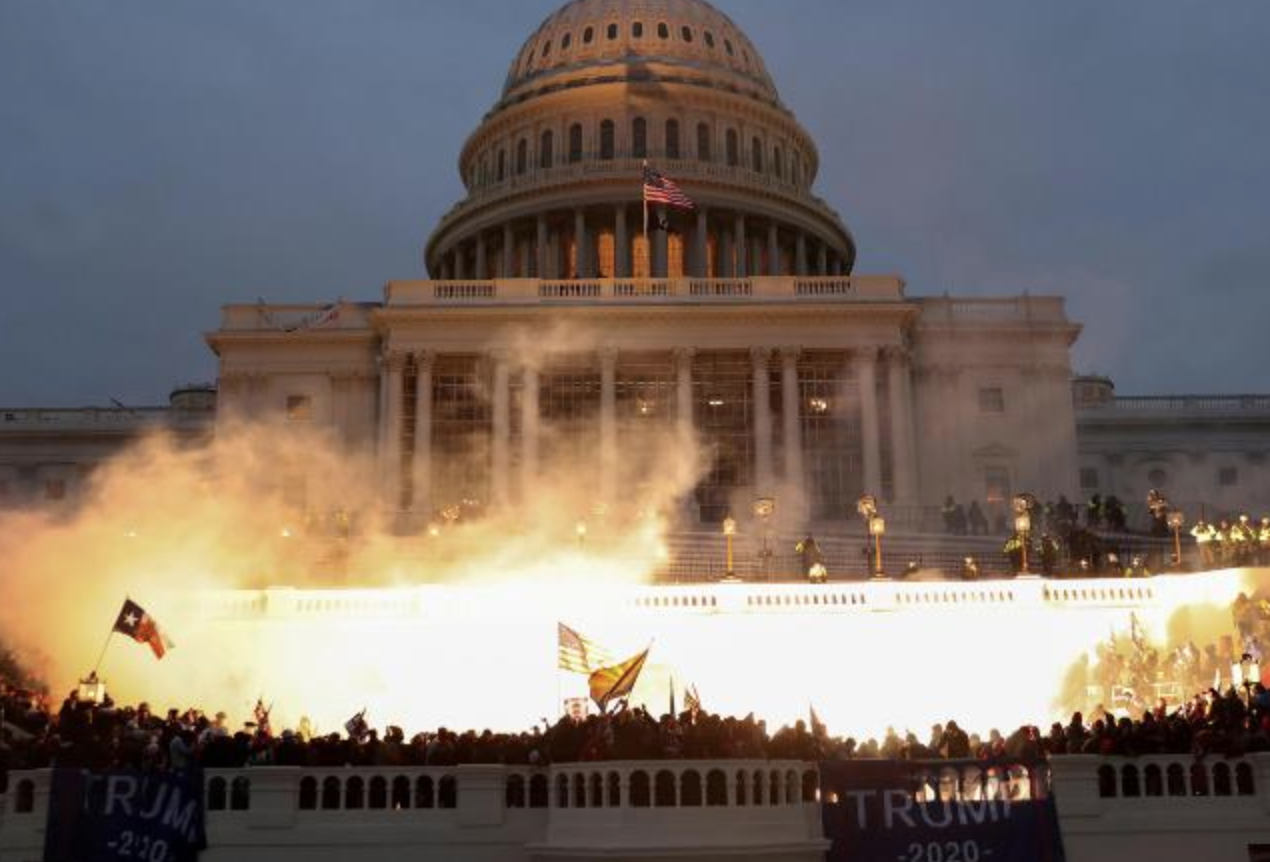
The U.S. Senate may have debated whether ex-President Donald Trump bears responsibility for the Jan. 6 riot at U.S. Capitol, but certain conservative Christians focused instead on his followers. They propose that the final day of Trump’s campaign to overturn President Biden’s December 14 Electoral College victory involved religious “heresy” or “apostasy.”

Those leveling this charge are not #NeverTrump politicians or pundits but devout and conservative Christians. That may seem surprising because in the media and the public mind the “religious right” fuses with devotion to Trump. But such thinkers take doctrine and biblical teaching seriously (unlike religious liberals who define political sins while ignoring theological errors).

A survey by the conservative American Enterprise Institute shows 63% of white evangelicals think Biden’s win was illegitimate, despite the numerous federal and state court rulings that found no evidence for Trump’s claim of a “sacred landslide.” But to what extent were Christians implicated in the Capitol mayhem?

As weeks roll on, we’re learning how a radical fringe planned the Capitol attack in advance and energized the crowd that Trump assembled and addressed.

Terry Mattingly of GetReligion.org distinguishes among four groups: The horde that Trump assembled to hear his demand that Congress and Vice President Mike Pence somehow overthrow Biden’s election; those who obeyed Trump’s plea to march on the Capitol; the militant marchers who broke into the security zone, but only protested outside the Capitol; and the smaller, violent, and foul-mouthed mob that desecrated this potent symbol of democracy across the globe.

Regarding that fourth group, Tony Carnes, editor of the A Journey Through NYC Religions website observed that, “no pastors, priests, or other organized religious leaders have been identified so far as part of the riot.” Mattingly wondered where’s the evidence that links a legal protest that evolved into insurrection with “evangelical networks and institutions.” And yet, videos do capture some incongruous Christian symbols and prayers that mingled with the homicide, threats to kill national leaders, injuries to 138 police, vandalism and theft.


Please respect our Commenting Policy