Surveys & polls

New podcast: 'Screen' culture tied to loneliness; can clergy build bridges with same tech?

New podcast: 'Screen' culture tied to loneliness; can clergy build bridges with same tech?

The coronavirus pandemic has created a wide variety of religion-beat stories — from empty local pews to the U.S. Supreme Court debating how many people can occupy local pews. And sometimes it feels like all roads during this crisis, for better or worse, lead to the internet.

Yes, we had lots of ground to cover in this week’s “Crossroads” podcast (click here to tune that in).

Empty local pews have, in some cases, led to near-empty offering plates. Leaders in religious groups that were struggling before COVID-19 — look for closing congregations, seminaries, colleges and even cathedrals — are now hearing the demographics clock tick, tick, tick even louder.

We’re talking about huge stories, but they are also stories that are hard for journalists to cover, simply because they require information at the local, regional and national levels.

It was easy to cover local clergypersons as they learned to mount smartphones atop camera tripods and stream worship services to their locked-down flocks (as opposed to megachurches that already had cameras and massive websites). It was also easier to cover black-sheep clergy that rebelled against social-distancing guidelines than it was to report on the remarkable efforts of leaders in entire denominations and religious traditions seek ways for their people to worship as best they could within constantly evolving (and often hostile) government guidelines.

Journalists, of course, were also being affected by lockdowns and, in some cases, budget cuts. This was an equal-opportunity crisis.

Let me give you an example of an important story that everyone knows is unfolding right now. Consider this Baptist Press headline: “Pandemic division causing pastors to leave ministry, pastoral mentor says.” Here is the overture:

Brian Croft jokes that masks are the new “color of the carpet argument” in churches, with similarly poor outcomes. Pastors are resigning from the stress “kind of in a way I’ve never really seen.”

The founder of Practical Shepherding transitioned from fulltime pastoring to lead the shepherding outreach fulltime in January, pulled by a need for coaching and counseling that has steadily increased among pastors over the past decade.

Then came COVID-19.


Please respect our Commenting Policy

Welcome to New York Times 'religion' feed? A kissy-kissy chat with exiting NARAL boss

Welcome to New York Times 'religion' feed? A kissy-kissy chat with exiting NARAL boss

Does anyone else remember RSS feeds?

The whole idea of RSS — Really Simple Syndication — is that websites can allow you can set up an automated feed that feeds you updates on specific topics in a standardized, computer-readable format.

The key is that computer algorithms are supposed to detect when stories address issues that interest a specific reader.

Anyway, I received this item the other day in my RSS feed devoted to New York Times stories about religion. In this case, the Times defines the RSS criteria, not me.

In terms of religion news, this one is pretty weird — even for today’s Times. The headline: “Ilyse Hogue, Influential Abortion Rights Advocate, Will Step Down as NARAL Chief — In an interview, Ms. Hogue discussed a tumultuous era for abortion rights and the future of Roe v. Wade.”

In other words, this is a kissy-kissy Q&A marking Hogue’s exit after eight years as leader of NARAL Pro-Choice America. The Times informs readers that “abortion rights are at something of a crossroads, with Democrats facing the choice of whether to try to deliver on their promise of codifying Roe v. Wade.”

All right, says I, let’s see the many points in this report that touch on religion. After all, the RSS algorithms put this in the “religion” feed.

I found three, and even that it is stretching it. Can you spot the religious content in the following three bites from this news feature? The questions, obviously, are in bold type:

Let’s start with perhaps the biggest question: Is Roe v. Wade safe?


Please respect our Commenting Policy

Protestants in pulpits say that the QAnon era is creating tension in many pews

Protestants in pulpits say that the QAnon era is creating tension in many pews

Having reached the vice president's chair in the U.S. Senate, the self-proclaimed QAnon shaman, UFO expert and metaphysical healer removed his coyote-skin and buffalo horns headdress and announced, with a megaphone, that it was time to pray.

"Thank you, Heavenly Father … for this opportunity to stand up for our God-given inalienable rights," proclaimed Jake "Yellowstone Wolf" Angeli (born Jacob Chansley), his face painted red, white and blue and his torso tattooed with Norse symbols that his critics link to the extreme right.

“Thank you, divine, omniscient, omnipotent, omnipresent Creator God for filling this chamber with your white light and love," he added, in a prayer captured on video by correspondent working for The New Yorker. "Thank you for filling this chamber with patriots that love you and that love Christ. …

"Thank you, divine Creator God for surrounding and filling us with the divine, omnipresent white light of love and protection, of peace and harmony. Thank you for allowing the United States of America to be reborn. Thank you for allowing us to get rid of the communists, the globalists and the traitors within our government."

Many phrases in this rambling prayer would sound familiar to worshippers in ordinary churches across America, said Joe Carter, an editor with The Gospel Coalition and a pastor with McLean Bible Church near Washington, D.C. But the prayer also included strange twists and turns that betrayed some extreme influences and agendas.

"This is a man who has described himself as pagan, as an ordained minister, in fact," said Carter, reached by telephone. "The alt-right has always included some pagan influences. But now it's obvious that leaders with QAnon and other conspiracy theorists have learned that if they toss in some Christian imagery, then they'll really expand their base and their potential reach 100-fold."

Law-enforcement officials will soon present evidence attempting to prove who planned key elements of the illegal riot that crashed into the U.S. Capitol on Jan. 6, after the legal "March to Save America" backing former President Donald Trump's claim that fraud cost him the White House.

This is just the latest example of how conspiracy theories, on the left and right, have soaked into public discourse about COVID-19 vaccines, Big Tech monopolies, sinister human-trafficking networks and, of course, alleged illegal activities in the 2016 and 2020 elections.

There is no way to deny that this digital tornado has shaken many Protestant churches, according to a new Lifeway Research survey that asked clergy to respond to this statement: "I frequently hear members of my congregation repeating conspiracy theories they have heard about why something is happening in our country."


Please respect our Commenting Policy

Happy birthday (I guess): GetReligion will keep highlighting 'religion ghosts' in the news

Happy birthday (I guess): GetReligion will keep highlighting 'religion ghosts' in the news

Growing old is complicated.

This is especially true during these bizarre COVID-19 days in which one day runs into another and sometimes it’s hard to remember what is what and when is when.

Oh well, whatever, nevermind. I being this up because GetReligion.org launched on Feb. 2, 2004 (even though the first post was written a day earlier). I think that means we just turned 17 and are headed into year No. 18, but my aging mind goes rather numb just thinking about it.

This blog has always had two essential goals.

The first is to highlight what we call “ghosts” in mainstream news coverage, as in essential facts and themes about religion that journalists — on lots of beats — frequently miss when covering news stories, big and small. A side effect of that task has been urging newsroom managers to hire experienced religion-beat reporters to strengthen their newsrooms.

Goal No. 2 is related to that. We have tried, year after year, to defend what is frequently called the American Model of the Press (see this .pdf) — with its emphasis on accurate, fair-minded, even balanced coverage of stories in which there are competing, or even clashing, viewpoints. For a taste of what that sounds like, check out this famous 2003 memo by the late, great, Los Angeles Times editor John Carroll. Here’s a crucial chunk of that, after his critique of a one-sided story:

The reason I'm sending this note to all section editors is that I want everyone to understand how serious I am about purging all political bias from our coverage. We may happen to live in a political atmosphere that is suffused with liberal values (and is unreflective of the nation as a whole), but we are not going to push a liberal agenda in the news pages of the Times.

I'm no expert on abortion, but I know enough to believe that it presents a profound philosophical, religious and scientific question, and I respect people on both sides of the debate. A newspaper that is intelligent and fair-minded will do the same.

In recent years, economic, cultural and political forces have greatly weakened the American Model of the Press (see this recent Celemente Lisi post on that topic). Some people say this model is outdated, in a digital age in which opinion is cheap and information is expensive and the safest business model — producing mouse-clicks and loyal subscribers — is to tell your niche audience what it wants to hear.


Please respect our Commenting Policy

Skeptical thinking (from left) about role of religion in President Joe Biden's big day

Skeptical thinking (from left) about role of religion in President Joe Biden's big day

Back in the early days of GetReligion (we launched on Feb. 2, 2004) I urged reporters not to forget the old Religious Left and, when covering believers in those flocks, not to forget that there is more to their stories than politics. The left is the left because of doctrinal and worship traditions, as well as convictions that align with the New York Times editorial page.

Then something happened that modified my thinking on this subject. Hang in there with me, because I am working my way to an interesting think piece, care of Religion Dispatches. The headline: “The Inauguration’s Beautiful Call for Unity Was Undermined by the Invocation of Religion.”

Faithful readers of GetReligion will remember that, in the summer of 2007, political scientist and polling maven John C. Green spoke at a Washington Journalism Center seminar to a international circle of journalists who came to Capitol Hill to discuss press freedoms in their homelands. But the hot topic of the day was the rise of Sen. Barack Obama of Illinois and whether he could reach the White House. As I wrote in a previous post about that:

The bottom line: Obama was speaking directly to Democrats in the black church, but he was also reaching out to an emerging power bloc in his party — a group Green called the “religiously unaffiliated.” These so-called “nones” were poised to form a powerful coalition with atheists, agnostics and liberal believers.

Green made a prediction that was years ahead of schedule, in terms of the conventional thinking of Beltway politicos. At some point in the future, that growing coalition of secularists and religious liberals was going to cause tensions inside the Democratic Party.

Five years later, when the Pew Forum released its groundbreaking report on religiously unaffiliated Americans, Green raised that issue once again in a public event. Here’s a bite of the “On Religion” column that I wrote at that time.

[The] unaffiliated overwhelmingly reject ancient doctrines on sexuality with 73 percent backing same-sex marriage and 72 percent saying abortion should be legal in all, or most, cases. Thus, the "Nones" skew heavily Democratic as voters — with 75 percent supporting Barack Obama in 2008. The unaffiliated are now a stronger presence in the Democratic Party than African-American Protestants, white mainline Protestants or white Catholics.

"It may very well be that in the future the unaffiliated vote will be as important to the Democrats as the traditionally religious are to the Republican Party,” said Green, addressing the religion reporters. "If these trends continue, we are likely to see even sharper divisions between the political parties."

This brings us to Biden, today’s Democratic Party and some of the challenges he faces, when dealing with moral, cultural and religious issues in American life.


Please respect our Commenting Policy

New podcast: Conspiracy theory news isn't going away, so how will religious leaders respond?

New podcast: Conspiracy theory news isn't going away, so how will religious leaders respond?

Here we go again. This week’s “Crossroads” podcast (click here to tune that in) offers yet another journey into the world of QAnon and its impact in American pews.

All the evidence is that this subject is not going away, even as it gets more complex. See this week’s post entitled, “The New York Times looks at QAnon leader who is, wait, a Manhattan mystic from Harvard?” Some interesting court trials loom ahead, no doubt, after the January 6th riot at the U.S. Capitol.

Still, if you were looking for a thesis statement that captures how elite American newsrooms view QAnon, and the red-hot topic of conspiracy theories in general, it would be a bite of revealed truth drawn from the must-read “Shadowlands” package published last June by The Atlantic. In “The Prophecies of Q,” author Adrienne LaFrance claimed that QAnon is an emerging sect that is defined by its evangelical hopes and dreams, since the “language of evangelical Christianity has come to define the Q movement.”

In a GetReligion post at the time (“The Atlantic probes QAnon sect and finds (#shocking) another evangelical-ish conspiracy“) I offered my own opinion on that:

There are times, when reading the sprawling “Shadowland” package … when one is tempted to think that the goal was to weave a massive liberal conspiracy theory about the role that conservative conspiracy theories play in Donald Trump’s America.

At the center of this drama — of course — is evangelical Christianity. After all, evangelical Christians are to blame for Trump’s victory, even if they didn’t swing all those crucial states in the Catholic-labor Rust Belt.

It’s almost as if evangelicals are playing, for some strategic minds on the left, the same sick, oversized role in American life that some evangelicals assign to Hillary Clinton, George Soros, Bill Gates and all those liberal Southern Baptist intellectuals who love Johnny Cash and Jane Austen.

That’s still half of what I think on this topic.

It is certainly true that (a) leaders of the “political cult” called QAnon — to use a term from a must-read Joe Carter FAQ on this topic — speak fluent evangelical and that (b) the gospel according to Q and similar conspiracy heresies have influenced many people in pews (including some who traveled to the National Mall for Trump’s March to Save America rally).

That’s an important, ongoing story that must be covered.


Please respect our Commenting Policy

These ratings and tips on media bias can help news consumers and journalists (updated)

These ratings and tips on media bias can help news consumers and journalists (updated)

On Inauguration Day last week, CNN was newly proclaimed to be politically on the "Left," joining rival MSNBC. Previously, the cable news net was in the softer "Lean Left" category that includes news coverage by The New York Times, The Washington Post, Time magazine, The Economist, The Atlantic, Bloomberg, Politico, ABC, CBS and NBC.

Meanwhile, Fox News, New York Post, Washington Examiner, Washington Times, Christianity Today, ChristianPost.com and Salt Lake City's Latter-day Saint Church-owned Deseret News are considered to "Lean Right." Breitbart, Daily Caller, Daily Wire, Federalist and Fox News opinion shows are straight-up "Right," as is the Rev. Pat Robertson's Christian Broadcasting Network.

Not many major news organizations are positioned in the less partisan "Center." They include The Associated Press (though its Fact Check feature "Leans Left"), Axios, BBC, Christian Science Monitor, Forbes, NPR news (though its opinion fare "Leans Left"), Reuters, The Hill, USA Today and The Wall Street Journal's news copy.

Who sez?

The team at Allsides.com, whose continually updated "Media Bias Ratings" compiled from readers and viewers judge 800 outlets on the five-point scale, ranging from BiblicalSexology.com (!) to ZeroHedge.com. The site also posts current media examples that demonstrate ideological slant, as well as articles of interest to reporters such as a history of "wokeness" picked up from Vox.com (rated "Left").

The judgments are debatable, of course, but worth considering.

The bias-o-meter assesses only online media postings, not what's issued in print or broadcast. We're told that ratings "do not reflect accuracy or credibility; they reflect perspective only."

Though "bias" sounds negative, this site doesn't oppose point-of-view journalism but seeks to fairly characterize news organizations and inform consumers accordingly.

Allsides boasts that its three co-founders are "a proud, active Republican" and former party operative, "a proud, active Democrat" who co-founded MoveOn.org, and the tech guy who's "more centrist and less active politically." The operation lives off donations, which have included groups linked with the likes of Tom Steyer on the left and Charles Koch on the right.

The Guy especially calls attention to this site's memo on "How to Spot 11 Types of Media Bias."


Please respect our Commenting Policy

America remains bitterly divided: But is this country veering closer to another civil war?

America remains bitterly divided: But is this country veering closer to another civil war?

Call it the "Texit" parable.

America's new civil war begins with the Supreme Court overturning Roe v. Wade, creating an abortion-free zone in the Bible Belt and most heartland states.

Enraged Democrats pledge to end the U.S. Senate filibuster and expand the number of high-court justices. After restoring Roe, they seek single-payer health care, strict gun control and sweeping changes in how government agencies approach the First Amendment, with the IRS warning faith groups to evolve -- or else -- on matters of sexual identity. Big Tech begins enforcing the new orthodoxy.

Conservatives rebel and liberals soon realize that most of America's military, including nuclear weapons, are in rebel territory. Then federal agents kill Alabama's pro-life, Black governor -- while trying to arrest him as a traitor. That's too much for Gov. Francisco Gonzalez of Texas, who decides that it's time for a new republic.

David French fine-tuned this "Texit" vision early in 2020, while finishing "Divided We Fall: America's Secession Threat and How to Restore Our Nation." Best-known as a #NeverTrump conservative pundit, most of the Harvard Law graduate's career has focused on old-school First Amendment liberalism -- which in recent decades has meant defending conservative religious believers in religious liberty cases.

The book's first lines are sobering, especially after recent scenes on Capitol Hill.

"It's time for Americans to wake up to a fundamental reality: the continued unity of the United States cannot be guaranteed," wrote French. Right now, "there is not a single important cultural, religious, political, or social force that is pulling Americans together more than it is pulling us apart."

Americans are divided by their choices in news and popular culture. America remains the developing world's most religious nation, yet its increasingly secularized elites occupy one set of zip codes, while most traditional religious believers live in another. In politics, more and more Democrats are Democrats simply because they hate Republicans, and vice versa.

Ironically, cultural conservatives now find themselves hoping that the Supreme Court will protect them, said French, reached by telephone. Conservatives know they have lost Hollywood, academia, America's biggest corporations, the White House and both houses of Congress.

"I constructed the Texit scenario around court packing because that has become their last firewall," said French.


Please respect our Commenting Policy

On the agenda until Inauguration Day 2025: Whither Trumpism and, thus, evangelicalism? 

On the agenda until Inauguration Day 2025: Whither Trumpism and, thus, evangelicalism? 

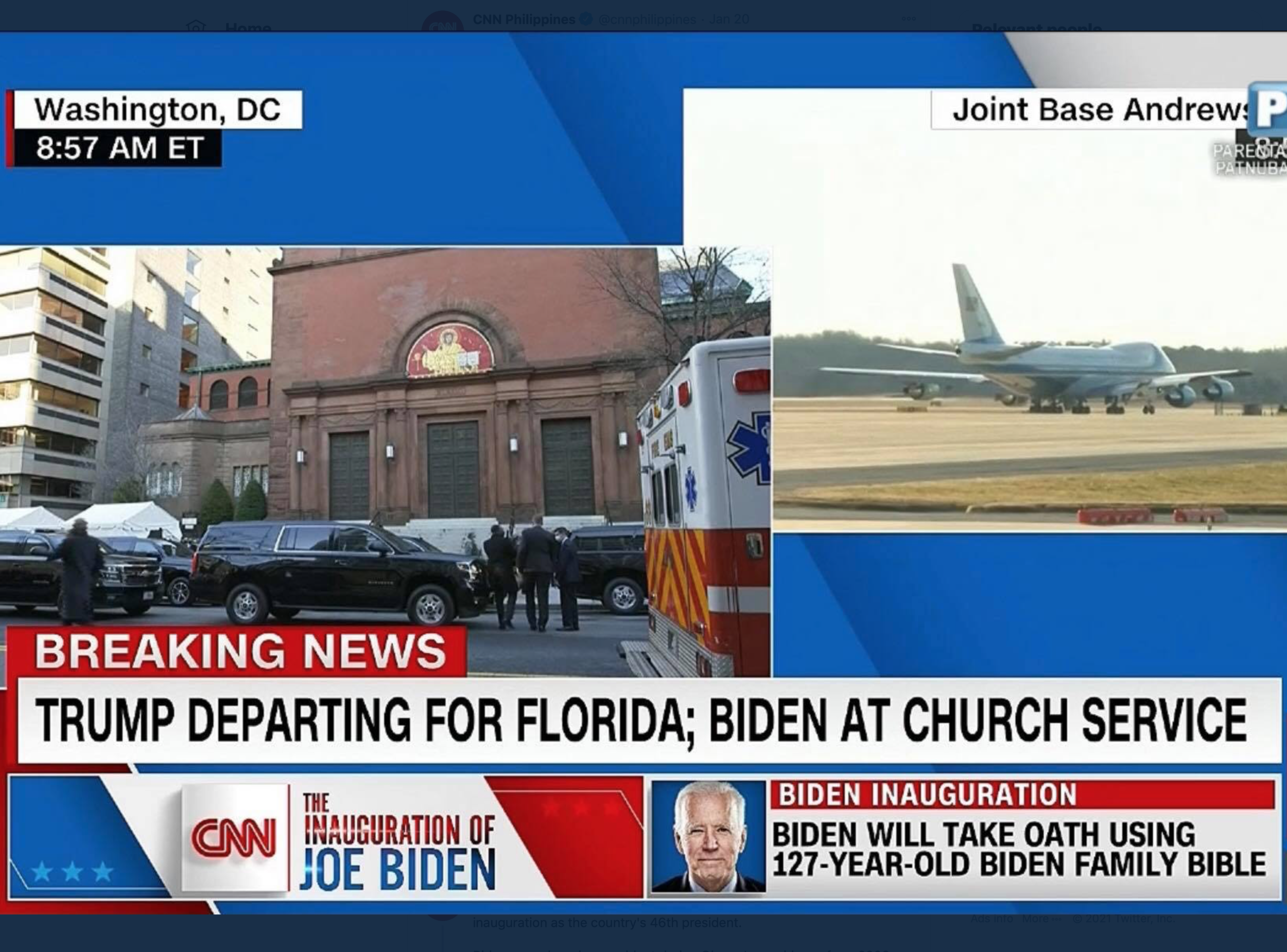
In a city locked down as an armed encampment, Joseph Biden and Kamala Harris were inaugurated without the disruptions many feared. There were prayers and familiar political calls for healing and unity.

References to the January 6th riot at the U.S. Capitol came early and often.

Regarding that historic day, much remains to be investigated but Wall Street Journal veteran Gerald Seib offered a brisk summary: "Mr. Trump sent a crowd of his supporters to the Capitol to stop the constitutional transfer of power to his elected successor. That crowd turned into a mob that ransacked the seat of American democracy and tried to hunt down its elected leaders." Senate Republican leader Mitch McConnell stated much the same Tuesday.

Seib added that in the melee, "mainstream Trump supporters were overshadowed by those swinging fire extinguishers at cops and a man wearing a 'Camp Aushwitz' sweatshirt." That is, the fringe dwellers, unhinged devotees and insurrection plotters emerged from a larger throng that obeyed the president's summons to attend his "Stop the Steal" rally and march upon the Capitol.

The same with a certain number of evangelical-style Protestants at the "Steal" protest and explicitly religious "Jericho" march. They were swept into the criminal rampage alongside violent extremists who trashed the symbolic citadel, spewed F-bombs, assaulted police (battering one to death) and chanted threats to assassinate America's #1 evangelical office-holder, Vice President Mike Pence.

Several top religion reporters publicized this unnerving aspect of the fray. In response, GetReligion editor Terry Mattingly questioned whether the rioting rabble truly represented elements of the power structures of the evangelical movement and its leadership, as some claimed.

The evangelical elite does not control many among the proletariat, as The Guy noted while pondering evangelicalism's future last July 29, and the gap has grown since then. Revulsion over Trump's words and deeds provoked some evangelical leaders to favor Biden but evangelical voters gave Trump a healthy margin (as always with Republican nominees, witness Romney, McCain, Bush). This is especially true among nondenominational, independent churches and among some self-proclaimed Pentecostal prophets (see this important Julia Duin post)

Whatever the numbers and stature of the those who waved Jesus banners, the day sullied evangelical Protestantism, and perhaps even religious faith in general, for the vast American citizenry that believes Trump and his disciples tried to steal the election from Biden.

Fairly or not, in the public mind and in the media, evangelicalism is now fused not just with the Republican Party but its dominant Trumpite wing.


Please respect our Commenting Policy