Richard Ostling

Do American evangelicals suffer 'second class' status among political conservatives?

Do American evangelicals suffer 'second class' status among political conservatives?

One reason the media often fail to “get” American Evangelical Protestantism is that it’s a complex mashup of elements, not simply an alliance of conventional church bodies.

This overlapping empire of nondenominational “parachurch” agencies, colleges, freelance personalities, seminaries, publishing houses and, often, independent congregations is important and over the decades it rallied prominently at trade shows for retailers and broadcasters and the annual National Prayer Breakfast.

The first Prayer Breakfast occurred when President Dwight D. Eisenhower spoke just after his 1953 inauguration. Every president has appeared each year since, joined by politicians and powerbrokers. The idea emerged from private prayer meetings for members of Congress organized by a Methodist minister, but the sponsoring organization evolved into the Evangelical-toned International Foundation, a.k.a. “the Family” or “the Fellowship.”

Though pious participants luxuriated in mingling with the Washington elite at the large prayer assemblage, in Evangelical movement work what mattered most was the networking and punditry at assorted workshops the foundation sponsored in and around the big draw of the Prayer Breakfast itself.

Last week that setup disappeared.

A new sponsoring foundation had President Joe Biden address a cozy gathering for bagel-munching members of Congress who were allowed only one guest apiece. Simultaneously, the older foundation mounted its glitzy gathering where 1,600 enjoyed a ballroom breakfast, watched Biden’s talk by streamed video, then attended the usual array of Evangelical breakout sessions. Here's some Religion News Service background on this awkward two-way split.

The new arrangement symbolizes efforts to limit Evangelical influence upon political leadership. By coincidence, the competing breakfasts occurred as new debate emerges on whether Evangelicals actually have the political impact endlessly attributed to them by fearful opponents.

Pundit Rod “Benedict Option” Dreher raised that newsworthy question in a January 30 post, and in doing so highlighted a highly debatable but significant 2021 article that most journalists missed, including The Guy.

Please respect our Commenting Policy

News hooks abound: How will religious faith shape the 'birth dearth,' and vice versa?

News hooks abound: How will religious faith shape the 'birth dearth,' and vice versa?

Two January headlines a week apart signal that the past generation’s “population explosion” worries have reversed.

Observers fretted as China announced its population began to shrink last year as its birth rate reached a record low. Japan’s Prime Minister Fumio Kishida warned parliament that a declining birth rate means the rapidly aging nation is “on the verge of whether we can continue to function as a society.”

Then last Saturday a New York Times op-ed asserted that unfair burdens on wives and mothers created a “birth strike” and “marriage strike” that are “killing South Korea.” The nation has posted the world’s lowest fertility rate the past three years and deaths now outnumber births.

Such realities provoked the ever-interesting Times columnist Ross Douthat to ask whether “the defining challenge of the 21st Century” will be climate change decried by so many analysts or, instead, the globe’s accumulating “birth dearth” a.k.a. “baby bust” or “population implosion.”

The second trend could well undercut societies’ “dynamism and innovation” and pit “a swollen retired population” against the “overburdened young,” he warned, while listing geopolitical factors in the coming “age of demographic decadence.”

Attention newsroom managers: This is an apt time for media to consider U.S.-focused big-think pieces on how religious communities are shaping population trends and, vice versa, how those trends affect religion.

Pro-procreation government programs appear to have limited impact in boosting birth rates, which instead reflect cultural values regarding marriage and children, and complex individual decision-making. . Articles might examine related abortion policy.

Traditionally, all religions cherish children and favor reproduction, notably in the case of the Catholic Church, as The Guy discussed here a year ago (though today there’s little difference in fertility between U.S. Catholics and Protestants). On the other side of that equation, there’s universal acknowledgment that married couples raising children have been a pivotal constituency drawn to religious involvement.


Please respect our Commenting Policy

Tradition, custom, religious law: How should worn-out Bibles or Qurans be disposed of?

Tradition, custom, religious law: How should worn-out Bibles or Qurans be disposed of?

THE QUESTION:

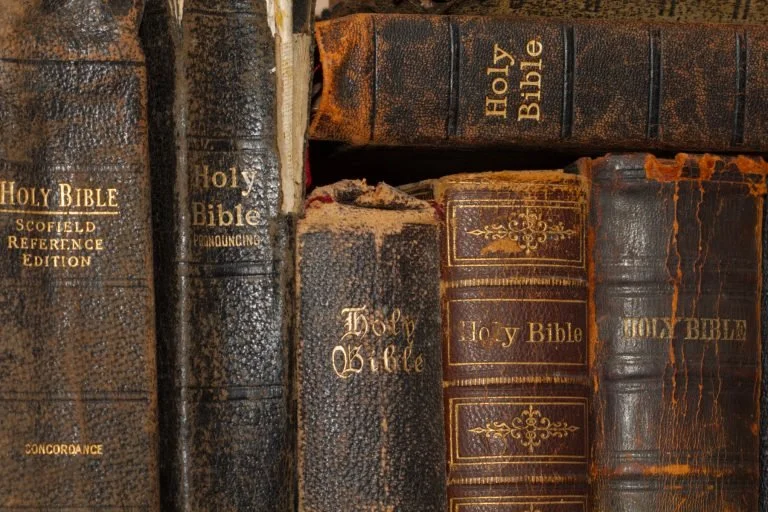
How should worn-out Bibles or Qurans be disposed of?

THE RELIGION GUY’S ANSWER:

Due to occasional news about Muslim riots when a copy of the Quran is believed to be mistreated, you’re probably aware that Islam takes very seriously the way its sacred book is handled, about which more below.

But The Guy has rarely if ever heard of such discussion about a printed Bible and therefore was intrigued this past week when Joe Carter (a GetReligion alumnus) responded online on behalf of the Gospel Coalition to a reader who asked, “How do you dispose of a worn-out Bible? Is there a protocol like with a flag?”

As the question indicated, federal law states that an American flag “in such condition that it is no longer a fitting emblem for display should be destroyed in a dignified way, preferably by burning.” Patriotic groups often provide public boxes to collect discarded flags that are then burned in formal ceremonies.

As for the Bible, the book itself contains no rules on proper disposal, so the Coalition regards this as “a matter of personal preference.” But many people naturally feel that respect for Scripture rules out simply tossing the holy book into the trash alongside cookie wrappers and egg shells.

As a conservative Protestant resource, the Coalition warns against any “unconscious sense that the printed pages of a Bible gain something of the spiritual essence of God’s Word,” which “could easily slip into a superstitious, or even idolatrous, view of print Bibles.”


Please respect our Commenting Policy

OK, we get it: That whole 'Christian nationalism' thing is hot, right now. But what is it?

OK, we get it: That whole 'Christian nationalism' thing is hot, right now. But what is it?

By all indications, urgent warnings against “Christian nationalism” (CN) will continue as a major media theme through Election Day 2024.

Journalists will need to be careful with a tricky label that’s mostly shunned by supposed participants in the CN movement and employed by opponents (as with “fundamentalist” or “ultra-“ or “cult”). How complex is the fighting about this term? Click here to tune in some of the YouTube debates.

Critics’ typical definition comes from attorney Amanda Tyler, who leads Christians Against Christian Nationalism (with a large “N”) and the proudly progressive Baptist Joint Committee for Religious Liberty. She says CN “seeks to merge American and Christian identities, distorting both the Christian faith and America’s constitutional democracy.” Its “mythological” view of founding of a “Christian nation” means America is singled out “to fulfill God’s purposes on earth.” Further, CN “demands a privileged place for Christianity in public life, buttressed by the active support of government at all levels.”

Writers could pursue this sort of theme sideways by reviewing or collecting pro and con reactions to “How to Be a Patriotic Christian: Love of Country as Love of Neighbor,” the latest book by middle-roading evangelical Richard Mouw of Calvin University, formerly president of Fuller Theological Seminary.

Otherwise, here's a rundown to guide journalists on some of the notable CN chatter since The Guy took a whack at the definition issue last year year at GetReligion.

Hang on, because this gets complex. For starters, ambiguity abounded in an October Pew Research survey.

Some 60% of adults think -- yes -- the founders intended the U.S. to be a “Christian nation,” and 45% think it actually “should be” such, though for many that means only generalized moral guidance while only 18% think the phrase indicates Christian-based governance. Importantly, a 54% majority had never even heard of CN.

That belief the U.S. “should be” a Christian nation was favored by fully 65% of Black Protestants (compared with e.g. only 47% of Catholics). Yet University of Texas political scientist Eric McDaniel wrote for TheConversation.com that CN believes the only “true” Americans are “white, Christian and U.S.-born and whose families have European roots.”


Please respect our Commenting Policy

Two leaders of the new U.S. House could put Baptist diversity in the news spotlight

Two leaders of the new U.S. House could put Baptist diversity in the news spotlight

There could hardly be a greater contrast than New Yorker Hakeem Jeffries’ glide into leadership of the U.S. House Democratic minority and that of California Republican Kevin McCarthy’s agonizing 15-ballot crawl to barely become House Speaker in the worst such Capitol Hill fuss since the Civil War.

Jeffries, of course, wins news renown as Congress’s first African-American party leader. But here’s a factoid has gotten little media notice. Yes, this is a religion angle.

By coincidence, both party leaders are now Baptists, a faith that outside the South has generally been underrepresented among the political elite. Catholics (think Nancy Pelosi, John Boehner, Paul Ryan) monopolized the speaker and minority leader posts for much of the 21st.Century.

There would be good feature potential in comparing the two Baptists’ congregations.

Though Jeffries has an Arabic first name (meaning “wise”), he’s a lifelong worshiper at Cornerstone Baptist Church,  a prominent African-American congregation in Brooklyn. Senior Pastor Lawrence Aker III and his wife Cynthia have the distinction of holding diverse divinity degrees from both “evangelical” Dallas Theological Seminary and “mainline” Yale.

McCarthy’s congregation is the equally well-known Valley Baptist Church in his hometown of Bakersfield. Senior Pastor Roger Spradlin, who trained at Criswell College, has served Valley since 1983 and now leads a team of eight clergy. This is a typical white evangelical fellowship and affiliated with the nation’s largest Protestant denomination, the Southern Baptist Convention, which Spradlin has served as chairman of the national executive committee.

Speaking of religion on Capitol Hill, reporters will want to keep on file the official religious affiliations of all 534 members of the incoming House and Senate (with one vacancy due to death) accessible by clicking here. The handy list is compiled every two years by the Pew Research Center from information the legislators themselves file with CQ Roll Call.

Labels may say little.


Please respect our Commenting Policy

Why do 21st Century Christians favor, or oppose, same-sex marriage? (Clue: doctrine)

Why do 21st Century Christians favor, or oppose, same-sex marriage? (Clue: doctrine)

THE QUESTION:

Why do 21st Century Christians favor, or oppose, same-sex marriage?

THE GUY’S ANSWER:

Just before Christmas, a top Donald Trump-loving conservative on New York City talk radio professed disbelief that some Americans persist in opposing same-sex marriage because of some book (unnamed) written ages ago.

Obviously, The Guy again realizes that journalism has important work to do explaining the basics of centuries of Christian thinking, both con and pro.

The teaching against gay and lesbian sexual relationships stood essentially unquestioned for 2,000 years but now that’s changing.

Still, on the global level some 2 billion people belong to Catholic, Orthodox, conservative Protestant, and Independent indigenous churches where there’s no prospect of any major change, though individual members dissent. (The same for a billion Muslims.)

In the U.S., the traditionalists are on defense with gay and lesbian marriage legalized by the U.S. Supreme Court and now Congress. They seek recognition by courts and government agencies of their conscience claims, hope to avoid penalties, and worry that ostracism from polite society may lie ahead.

Many “mainline” Protestant churches in North America and Western Europe recently enacted historic breaks with tradition, approving same-sex marriages for clergy and parishioners. U.S. landmarks: Change was first formally proposed to Presbyterians in 1968 and the United Methodist Church in 1972. Evangelical Lutheran Church in America Lutherans published four major books advocating change between 1983 and 1999. The Episcopal Church consecrated its first openly gay bishop in 2003, deepening an international divide among Anglicans.

Among resulting walkouts, the biggest may be the United Methodist one that is finally erupting.

Protestant disputes always center on the Bible


Please respect our Commenting Policy

Nondenominational era 2.0: What are America's biggest local Protestant churches?

Nondenominational era 2.0: What are America's biggest local Protestant churches?

THE QUESTION:

What are America’s biggest local Protestant churches?

THE RELIGION GUY’S ANSWER:

Through American history, Catholic parishes tended to have large memberships while local Protestant congregations were relatively small, with a few prominent exceptions. But beginning in the 1970s, the U.S. has entered a remarkable era with, by now, at least 1,750 Protestant “megachurches,” typically defined by average (pre-COVID-19) weekend attendance of 2,000 or more.

These flocks often say they’re simply “Christian,” but The Guy insists the “Protestant” label is truly accurate. Most are young and they’re overwhelmingly “evangelical” in belief and ministry. Which are the biggest of these “big box” churches?

Outreach magazine posts annual listings of the 100 largest, based on churches’ own reports, and also calculates the 100 fastest-growing congregations. Both rankings are available at this website. The stats are collected by the Southern Baptist Convention-linked Lifeway Research and the Hartford Institute for Religion Research. The key: Look for the word “nondenominational.”

Here are the top 20:

* Life Church, Edmond, Oklahoma (85,000 weekend attendance counting all off-site locations; affiliated with the Evangelical Covenant Church).

* Church of the Highlands, Birmingham, Alabama (60,000; nondenominational).

* Lakewood Church, Houston (45,000; nondenominational).

* Crossroads Church, Cincinnati (35,253; nondenominational)

* Christ’s Church of the Valley, Peoria, Arizona; (30,482; Independent Christian Churches — see explanation below)

* Saddleback Church, Lake Forest, California (28,000; Southern Baptist Convention)


Please respect our Commenting Policy

Notable 2022 deaths, as chosen by a notable (and honored) religion-beat colleague

Notable 2022 deaths, as chosen by a notable (and honored) religion-beat colleague

As 2022 starts to fade into memory, let’s highlight significant religious figures who died during the year, a useful way for reporters to contemplate where the field has been heading. For this we’ll tap the personalities chosen by religion-beat veteran Adelle M. Banks, who is currently projects editor and national reporter for Religion News Service.

But first, a point of personal privilege. December 10 was a huge moment for our oft-neglected religion beat as the Washington Association of Black Journalists gave Adelle its first Lifetime Achievement Award. Quite the honor when you consider D.C.’s journalistic talent pool! Before joining RNS 27 years ago, Adelle worked at (The Guy’s hometown) Binghamton Press & Sun-Bulletin, Syracuse Herald-Journal (R.I.P.), Providence Journal and Orlando Sentinel.

Though Adelle has skillfully covered an amazing variety of religious groups, she has paid special attention to all-too-thinly-covered African-American faiths. She’s a worthy successor to The Guy’s late friend William A. Reed of the Nashville Tennessean, in whose honor the Religion News Association named its own Lifetime Achievement Award.

In her RNS report, Adelle paid tribute to deceased beat colleagues Richard Dujardin of the Providence daily and Cecile Holmes of the Houston Chronicle. Both were Religion News Association presidents, as was Reed. The headline on that feature: “Remembering faith leaders who died in 2022: preachers, writers and interpreters of faith.”

The hugely newsworthy death of the conservative Pope Benedict XVI, the first pope to resign in centuries, occurred on New Year’s Eve after the release of Adelle’s article. Here are the others on her list:

* Madeleine Albright, who only learned after becoming U.S. Secretary of State that her family background was Jewish, including members who died in Holocaust concentration camps.

* Anne van der Bijl, a.k.a. “Brother Andrew,” Dutch smuggler of Bibles into Communist-run European nations who founded Open Doors to help and monitor persecuted Christians worldwide.

* Stuart Briscoe, the Brit-born pastor who built Elmbrook Church in suburban Milwaukee into Wisconsin’s largest; also noted author, speaker, and radio preacher.

* Frederick Buechner, one of the generation’s most thoughtful novelists, a non-religious youth captivated by a Presbyterian sermon who attended seminary and eventually led Philips Exeter Academy’s religion department.


Please respect our Commenting Policy

What's up in 2023? The Guy offers a first draft of a religion-beat agenda

What's up in 2023? The Guy offers a first draft of a religion-beat agenda

The new year could be climactic for two aspects of LGBTQ issues, first, the rights of religious and conservative dissenters within liberalized western culture, and second, the ongoing conflicts within church groups.

What should journalists be prepared to cover?

By June, the U.S. Supreme Court will decide the 303 Creative case, in which a website designer — based on First Amendment claims — seeks exemption from Colorado’s anti-discrimination law to avoid work on postings that celebrate same-sex weddings (background here). The Court might broadly define what rights various forms of religious traditionalists have in a host of legal conflicts facing e.g. U.S. religious colleges, social-service agencies and individual businesses now that same-sex marriage is legalized.

Inside a specific religion brand, this could be a pivotal year for the global Anglican Communion with its 46 national branches and some 85 million baptized members. A mid-January meeting of bishops in the “mother” Church of England may well decide dioceses can permit same-sex weddings. That historic change would then need approval from clergy and lay delegates at the February 6–9 General Synod.

Such a move would add explosive potential to the April 17-21 meeting in Kigali, Rwanda, of the Global Fellowship of Confessing Anglicans (“GAFCON”), long vexed by liberal moves in England, the United States and elsewhere in declining First World churches. GAFCON unites the heads of 10 Anglican branches, three of which alone (Kenya, Nigeria, Uganda) encompass half the world’s Anglicans. GAFCON’s chairman, Archbishop Foley Beach (admin@anglicanchurch.net and 724-266-9400), heads a church of conservatives who’ve left the U.S. Episcopal Church and Anglican Church of Canada.

Already, key archbishops have boycotted global Anglican confabs, continuing a slow-motion breakup that began decades ago. Will the maneuvers in England and elsewhere provoke a huge, definitive break from the London-based Anglican Communion by churches in GAFCON and the related Global South Fellowship of Anglican Churches?

The United Methodist Church could be on the brink of the biggest U.S. Protestant split since the Civil War. That’s a huge story at the local, regional, national and global levels.


Please respect our Commenting Policy