Richard Ostling

How do modern Latter-day Saints view their faith's complex history of polygamy?

How do modern Latter-day Saints view their faith's complex history of polygamy?

THE QUESTION:

How do Latter-day Saints view the polygamy in their faith's past?

THE RELIGION GUY'S ANSWER:

The Church of Jesus Christ of Latter-day Saints (which seeks to abolish its former "Mormon" nickname) was founded in 1830 by the Prophet Joseph Smith, Jr., who later began practicing and advocating polygamy (the faith prefers the term "plural marriage" and in past times spoke of "the Principle.") Smith wanted this kept secret but dissenters inside his flock revealed the controversial teaching, which played a role in his 1844 assassination.

After Smith's successor as prophet, Brigham Young, led LDS adherents to Utah, the church in 1852 openly proclaimed its practice. This scandalized the nation. Young himself was to take 55 wives. But when federal laws attacked the faith's very organizational existence, President Wilford Woodruff halted the practice in the 1890 "Manifesto." Today, polygamy is grounds for excommunication, even in nations where it is legal.

That is basic, well-established history. But there's far more to be said.

In recent times, the Utah-based faith has issued relatively candid explanations (click here), as well as on the subject of "plural marriage” (click here). Now the church's Deseret Book company has published "Let's Talk About Polygamy," a more thorough and fascinating accounting by Brittany Chapman Nash, a 10-year veteran of the church's official history department who emphasizes the experience of LDS women. Much of the following relies upon her research.

Twenty-first Century Americans might wonder why LDS followers ever wanted multiple spouses. At one level, the answer is quite simple. As Nash says, "they believed God commanded it." Members then and now believe in Smith as God's unique prophet and that all his revelations established the "latter-day" restoration of true Christianity that had been lost for nearly 19 centuries.

Smith's own marital history began with his 1827 wedding to the former Emma Hale. His early scriptural revelations in the Book of Mormon and Doctrine and Covenants advocated traditional Christian monogamy. But in the mid-1830s Smith privately wed 16-year-old Fanny Alger, who worked in the Smiths' home. She soon moved away and married another man. History does not record what Emma knew or thought about this.

Please respect our Commenting Policy

Don't neglect the Supreme Court's potentially weighty case on religious schools funding

Don't neglect the Supreme Court's potentially weighty case on religious schools funding

Media eyes are trained on the U.S. Supreme Court's December 1 argument on Mississippi's abortion restrictions, preceded by a fast-tracked November 1 hearing about the stricter law in Texas. But don't neglect the Court's December 8 hearing and subsequent decision on tax funding of religious schools in the potentially weighty Carson v. Makin case (docket #20-1088).

University of Baltimore law Professor Kimberly Wehle certainly wants us to pay heed, warning October 14 via TheAtlantic.com that this is a "sleeper" appeal that "threatens the separation of church and state." In her view, the high court faces not just the perennial problem of public funding for religious campuses. She believes the justices could decide "religious freedom supersedes the public good" by aiding conservative Christian schools that, based on centuries of doctrine, discriminate against non-Christian and LGBTQ students and teachers.

Journalistic backgrounding: Thinly-populated Maine provides an unusual context for this story because the majority of its 260 school districts do not operate full K-12 systems and instead pay tuition for public or private schools that families choose for upper grades. Religiously-affiliated schools are included, but not if Maine deems them "sectarian."

Notably, the parents' plea for tuition is backed by major institutions of the Catholic Church, the Southern Baptist Convention and other evangelical Protestants, the Church of God in Christ (the nation's largest African-American denomination), Latter-day Saints (formerly called "Mormons") and Orthodox Judaism, alongside the 63-campus Council of Islamic Schools. A reporter's question: Has such a religious coalition ever formed in any prior Supreme Court case?

Of further interest, the case engages a major religious-liberty theorist, Michael W. McConnell, director of Stanford University's Constitutional Law Center and former federal judge on the 10th Circuit Court of Appeals. He wrote that circuit's 2008 opinion in Colorado Christian University v Weaver (.pdf here), which tossed out a law that barred "pervasively sectarian" colleges from a state scholarship program.

In Carson, McConnell filed a personal brief September 8 that hands the Supreme Court a history lesson (.pdf here) on religious freedom as conceived when the Constitution's First Amendment was framed. He has explored this ground since a significant Harvard Law Review article in 1989.


Please respect our Commenting Policy

People have been asking: Is the COVID vaccine the Bible's sinister 'mark of the beast'?

People have been asking: Is the COVID vaccine the Bible's sinister 'mark of the beast'?

THE QUESTION:

Is the COVID vaccine the biblical "mark of the beast"?

THE RELIGION GUY'S ANSWER:

Many odd anti-vaccination rumors with murky origins are floating around social media, alarming healthcare workers as they combat a virus that has killed 720,000 Americans and counting.

Take the "mark of the beast" claim. The Guy can confidently answer "no" to this question, based upon the strong consensus among Bible experts, both those who take the Bible portion at issue -- Revelation chapter 13 -- literally and those who follow symbolic interpretations.

The beast, identified with the famously sinister number "666" and the "mark," is found in the final book of the Bible, whose images have always been subject to a wide variety of fanciful interpretations. Over the centuries, some have identified the beast as the pope, Napoleon, Stalin, Hitler and many other leaders.

Let's clear the ground just a bit.

There are five basic ways to understand the last 18 chapters of this "revelation of Jesus Christ" to "his servant John."

* A "preterist" says the imagery depicts past events that faced early Christians living under the Roman Empire.

* The "historical" school sees church scenarios across the centuries.

* A "futurist" insists these are literal events that still lie ahead of us.

* The "spiritual" school advocates a symbolic presentation of realities with no specific historical application, past, present, or future.


Please respect our Commenting Policy

Concerning evangelical elites, Donald Trump and the press: The great crack-up continues

Concerning evangelical elites, Donald Trump and the press: The great crack-up continues

Ah, yes, those omnipresent American evangelical Protestants.

Love ‘em or hate ‘em, the media can't avoid ‘em. And in case anyone doubts media fascination, consider last Sunday's episode of NBC's influential, anachronistically-named gabfest "Meet the Press."

In the midst of a hyper-clogged October political agenda, the show devoted a major segment to what host Chuck Todd called "the debate among evangelicals about Donald Trump and whether he represents their values." Click here for the transcript. This was excerpted from a 30-minute piece that's streaming on Peacock.

The segment led off with a visit to the nondenominational, independent Patriot Church outside Knoxville, where the Ken Peters averred: "I think President Trump is a miracle. I think God picked Donald Trump, an imperfect vessel, to be the champion of His people." This is a congregation that has inspired almost as many headlines as it has members.

Yes, Pew Research tells us Trump scored 84% with white evangelical voters in 2020. But politicized preacher Peters is hardly representative of the sprawling and diverse network of evangelical clergy, churches, denominations, campuses and agencies.

An older-style evangelical pastor, the Rev. Phil Nordstrom of Knoxville's Life Church, told NBC that "we're trying to not fight the culture wars from the pulpit." Todd then interviewed the Rev. Russell Moore, former Southern Baptist social-issues spokesman turned "public theologian" at Christianity Today magazine, who fretted over Trump-era politicization of the evangelical image.

A prior Guy Memo weighed the possibility that a newsworthy evangelical crack-up is upon us, while another Memo focused on the related Donald Trump political angle. Now there are further developments.

In case journalists are gathering string for a broad state-of-the-evangelical-union article, The Guy looked for perspective in a real period piece from 1977, our Time magazine Christmas cover story, "That Old Time Religion: The Evangelical Empire."

Now this feature was written just before the advent of Jerry Falwell's Moral Majority, Ronald Reagan's presidency, Pat Robertson's Christian Coalition and presidential run, the rightward doctrinal lurch by the Southern Baptist Convention, the rise of anti-abortion militancy and all the rest that would gobble up headlines in succeeding decades.


Please respect our Commenting Policy

On the news budget once again: New Evangelical debates about Adam and Eve

On the news budget once again: New Evangelical debates about Adam and Eve

It's hard to beat William Lane Craig for conservative evangelical credentials.

This influential author and philosophy professor teaches at Houston Baptist University, where faculty members "must" believe in the Bible's divine inspiration and "that man was directly created by God." He's simultaneously a visiting scholar at California's Talbot School of Theology, where teachers commit to the beliefs that the Bible is "without error or misstatement" in its "record of historical facts" and that Adam was created by God and "not from living ancestors."

Craig is also a longtime member in good standing of the Evangelical Theological Society, whose members are required to affirm that the entire Bible is "the Word of God written and is therefore inerrant" as originally written. Trinity Evangelical Divinity School, where he formerly taught, likewise proclaims that the Bible is "without error."

But exactly how do those vows apply to the early chapters of the Bible's Book of Genesis?

Debates about this issue are frequently hooks for news stories, energized over and over again. Evolution and the creation of Adam and Eve have been allergic issues among evangelical Protestants in the 162 years since Darwin published "On the Origin of Species"?

So there's eye-opening stuff in Craig's article titled "The Historical Adam" in the current First Things magazine.

In Genesis 1-11, he asserts, those "fantastic lifespans" of primeval humans starting with Adam indicate "we are not dealing here with straightforward history."

Yet it's not simple fiction either, but rather an amalgam he calls "mytho-history, not to be taken literally," though there could be some overlap between the "the literary Adam of Genesis" over against the "historical Adam." He further explains that in the New Testament, Jesus and Paul were talking about that non-literal "literary Adam."

Given current science, Craig figures Adam and Eve lived 750,000 to a million years ago at the point of separation between Neanderthals and our own species of homo sapiens, with the latter endowed by God to surpass human-like animals that lacked rational thought. On that understanding, "the mythic history of Genesis is fully consistent with current scientific evidence concerning human origins."


Please respect our Commenting Policy

Crucial question in all those newsworthy abortion debates: When does life begin?

Crucial question in all those newsworthy abortion debates: When does life begin?

THE QUESTION:

When does life begin?

THE RELIGION GUY'S ANSWER:

Those four words are regularly posed in the current abortion debate, so let's scan the lines in pregnancy that have been drawn by experts — religious and secular — in the past.

Pre-scientific cultures spoke of "quickening," typically between 16 and 18 weeks, when the mother first feels the unborn child moving in her womb. A famous example involves the unborn John the Baptist in biblical Luke 1:41. Some ancient Jewish authorities in the Talmud, and Roman and Greek philosophers, supposed that the unborn child "formed" earlier, at 40 days.

Then there's "viability," when a fetus can live on its own outside the womb, typically reached around 23 or 24 weeks, or somewhat earlier or later in individual cases. The U.S. Supreme Court legalized abortion before that point in its 1973 Roe v. Wade decision, and after viability when there are risks to the mother's health, broadly defined.

The high Court on December 1 hears a case from Mississippi, which defied the Roe ruling and bars abortions after 15 weeks on grounds that the fetus experiences pain by then. A Missouri law, also under court challenge, puts a ban at eight weeks when "everything that is present in an adult human is now present in your baby," according to the American Pregnancy Association. The Court temporarily left in place a ban in Texas (likewise in 13 other states) after six weeks, when pulsations can be diagnosed at what eventually becomes the fully formed heart.

Many modern Christians believe that life begins at conception (sperm first meets egg) or implantation (fertilized egg attaches to the mother's womb) while some put the line a bit later at twinning (after which multiple pregnancies do not occur).

Note the brief filed last month in the Mississippi case by pro-choice religions including "mainline" Protestant churches, non-Orthodox Judaism, Unitarian Universalists and others. It says "numerous religious traditions posit that life begins at some point during pregnancy or even after a child is born."


Please respect our Commenting Policy

Keeping up: Ongoing 'woke' pronoun wars reach into the world of God-talk

Keeping up: Ongoing 'woke' pronoun wars reach into the world of God-talk

This Memo is a twofer, offering both a lively story theme to pursue plus an issue that is now affecting the work of every stylebook and copy editor in the American media.

An older campaign by feminists — including those working in the world of liturgy — sought to shun male pronouns, particularly when either gender is meant, in favor of plural they-them-their usage with singular antecedents. This increasingly common wording is of course grammatically incorrect given the structure of the English language, and can be confusing for readers.

That's now combined with the effort of transgender and "non-binary" advocates to suppress gender-specific adjectives by applying that same "singular they" along with newly crafted pronouns. A list of such neologisms recommended at the University of Wisconsin-Milwaukee, said to be non-exhaustive, covers ae, e, ey, fae, per, sie, tey, ve xe, ze and zie. So, for example, with "xe" the variants to parallel she-her-hers-herself are xem-xyr-xyrs-xemself.

As you would expect, references to God himself -- or is that "themself"? -- is now part of this debate.

Religion News Service ran a column last week from one of its regulars, Mark Silk, headlined "Why our preferred pronoun for God should be 'they'." He thinks calling God "they," not "he," and similar verbal tactics have become "imperative."

How would other progressives respond? His proposal was immediately publicized in a tweet from RNS's Catholic columnist, Jesuit Father Thomas Reese and the online comments began flowing.


Please respect our Commenting Policy

Notable omission among liberal religious voices in phase 2 of Supreme Court abortion case

Notable omission among liberal religious voices in phase 2 of Supreme Court abortion case

The media are prepping for the U.S. Supreme Court's December 1 hearing on the strict Mississippi abortion law and the subsequent ruling.

In a prior Guy Memo on religious "friend of the court" briefs filed on the pro-life side, I promised a second rundown when pro-abortion-rights activists weighed in with their views. Now that second wave of religious arguments has landed — with a notable omission in those ranks that journalists will want to pursue.

To explain, we'll need some religion-beat history on this issue.

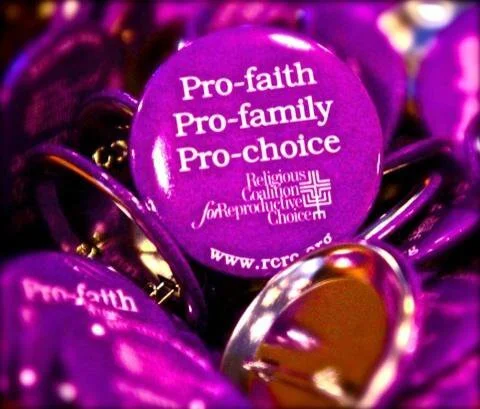
In 1967, two years before NARAL Pro-Choice America was founded, the 1,400-member Clergy Consultation Service formed to help women obtain abortions and fight legal barriers. After the high court legalized U.S. abortions in the 1973 Roe v. Wade decision currently at issue, the related Religious Coalition for Abortion Rights was founded to campaign for moral acceptance. (In 1994 it dropped the A-word and was renamed the Religious Coalition for Reproductive Choice or RCRC).

Founders included a significant chunk of "mainline" and liberal Protestantism, including the Episcopal Church, Presbyterian Church (U.S.A.) Mission Agency, United Church of Christ and several independent Protestant caucuses. The United Methodists' General Board of Church and Society hosted the founding, and the Methodist women's division also joined, but both later backed away. The Coalition also included major non-Orthodox Jewish organizations and the Unitarian Universalist Association (UUA).

In the new Court filings, abortion-rights law gets continued support from RCRC, UUA and Jewish organizations. But no Protestant denomination that favors abortion choice has joined to support Roe. Reporters should find out why they sidestepped this historic showdown. For example, have complex schism talks led to silence on the United Methodist left, as opposed to earlier debates (see YouTube video at the top of this post)?

The silence from "mainline" churches deprives the high court of in-depth moral thinking from pro-choice Christians that answers conservatives on issues that make abortion unusually difficult for public policy, among them: Does a genetically unique and developing human embryo or fetus have value? Why, or why not?


Please respect our Commenting Policy

Big question right now: What religious groups oppose vaccination, even during epidemics?

Big question right now: What religious groups oppose vaccination, even during epidemics?

THE QUESTION:

What religious groups oppose vaccination -- even during epidemics?

THE RELIGION GUY'S ANSWER:

Judges and public officials will be coping with the issue of vaccination mandates that President Joe Biden, states and employers are imposing to counter spread of the stubbornly contagious and virulent COVID-19 virus. This again raises the issue of religious-liberty claims for exemption from required vaccination.

Pastor Greg Locke of the independent Global Vision Bible Church in suburban Nashville has just been permanently banned from social media postings on Twitter after demanding that Christians shun vaccination (as well as preaching that Biden is a usurper and not a legitimately elected president).

Also, the Washington Post highlighted Pastor Jackson Lahmeyer of Tulsa, Oklahoma (who's running against devoutly evangelical U.S. Senator James Lankford in next year's Republican primary). Lahmeyer offers exemption letters for anyone who donates at least $1 to become an online member of his charismatic Sheridan Church. So far 30,000 supplicants have downloaded his exemption letter.

The president's new policy has already sparked a significant upswing in religious exemption requests. So, what are the facts on religious groups and opposition to vaccination?

A bit of history: Major religious objections arose with the first vaccination experiments in the American Colonies. But influential Congregationalist Cotton Mather championed scientific progress and defended smallpox experiments using adult volunteers. Eminent theologian Jonathan Edwards agreed and set an example as a vaccination volunteer when president of the school we know as Princeton University. He died as a result in 1758. Edward Jenner only achieved vaccination safety 38 years later.

Since then, official Christian or Jewish protests have generally been rare to non-existent as vaccinations are required to enter U.S. public schools, military service or particular jobs, or for foreign travel.


Please respect our Commenting Policy