Religious Liberty

Why mainstream newsrooms can't be bothered to cover USCCB church vandalism report

Why mainstream newsrooms can't be bothered to cover USCCB church vandalism report

Abortion debates continue to dominate American politics. A Texas law banning most abortions after six weeks of pregnancy went into effect just three weeks ago, something that resulted in widespread national news coverage, with many of the stories showing familiar media-bias patterns.

Despite the 1973 Supreme Court decision that made abortion legal, this law makes attaining an abortion in Texas among the most restrictive in the country after the U.S. Supreme Court ruled 5-4 on Sept. 2 not to block it. This unleashed debate and further political animus between Democrats and Republicans as arguments over abortion in this country now stretch into a fifth decade.

The fallout from all this may have increased animosity against the Catholic church. The church’s stand — ancient and modern — against abortion has placed it at the forefront of this cause, along with many other traditional Christian denominations and organizations.

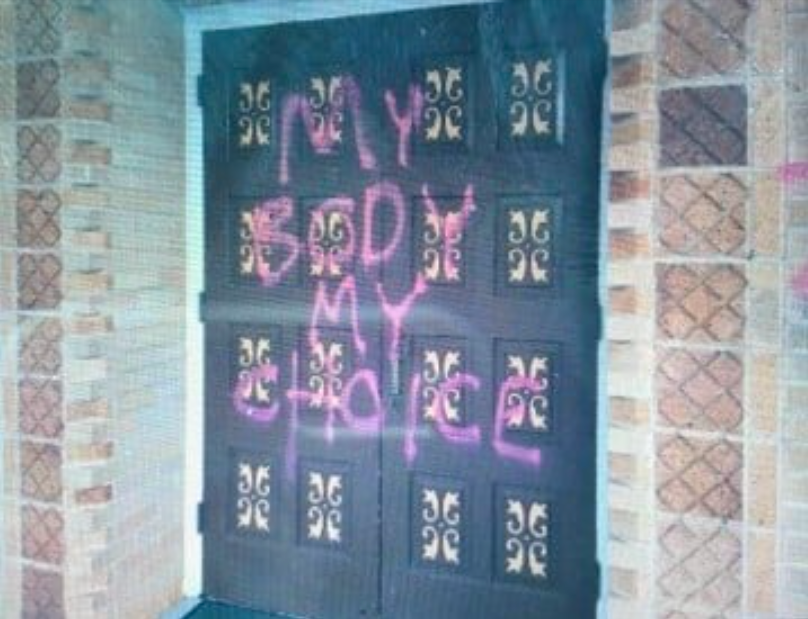
Some of this animosity has led to vandalism against U.S. churches. A Catholic church in Colorado was vandalized with graffiti showing support for legalized abortion days after the Supreme Court decision. This is how The Christian Post recently reported the story. This is long, but essential:

St. Louis Catholic Church, located in the Boulder suburb of Louisville, became the target of vandalism from abortion activists over the weekend. The doors to the church were spray-painted with the declaration “My body, My choice,” a common refrain among pro-choice activists. Church members discovered the graffiti when they gathered for worship on Sunday morning.

In addition to spraying the phrase “My body, my choice” on the church's doors, vandals targeted a marker on the property that read “Respect Life,” replacing the word “Life” with the phrase “Bodily Autonomy.” Additionally, the sign at the front of the church was defaced with the phrase “bans off our bodies.”

In a Facebook post on Monday, the Louisville Police Department noted that a surveillance camera recorded three individuals on the church property at 1:30 a.m. local time Sunday and asked the public for help with identifying them.

The Christian Post, as the name states, is a niche news source. The question here — once again — is why vandalism cases of this kind receive so little attention in the mainstream press.

Please respect our Commenting Policy

Plug-In: As COVID-19 vaccine wars rage, press focuses on religious-exemption claims

Plug-In: As COVID-19 vaccine wars rage, press focuses on religious-exemption claims

Back in March, I wrote a column about the joy and hope the COVID-19 vaccines had brought my family after more than a year of pandemic disruption.

I prayed that those skeptical of the vaccines eventually would recognize the benefits of protecting themselves — and their loved ones — from potential serious illness and death.

Yet here we are six months later, with coronavirus infections and deaths at “levels not seen since last winter” and religion often at the center of the vaccine war.

Colleen Long and Andrew DeMillo of The Associated Press report:

An estimated 2,600 Los Angeles Police Department employees are citing religious objections to try to get out of the required COVID-19 vaccination. In Washington state, thousands of state workers are seeking similar exemptions.

And in Arkansas, a hospital has been swamped with so many such requests from employees that it is apparently calling their bluff.

Religious objections, once used sparingly around the country to get exempted from various required vaccines, are becoming a much more widely used loophole against the COVID-19 shot.

And it is only likely to grow following President Joe Biden’s sweeping new vaccine mandates covering more than 100 million Americans, including executive branch employees and workers at businesses with more than 100 people on the payroll.

In a front-page report, New York Times religion writer Ruth Graham notes:

Major religious traditions, denominations and institutions are essentially unanimous in their support of the vaccines against Covid-19. But as more employers across the country begin requiring Covid vaccinations for workers, they are butting up against the nation’s sizable population of vaccine holdouts who nonetheless see their resistance in religious terms — or at least see an opportunity.


Please respect our Commenting Policy

Are we finally witnessing the long-anticipated (by journalists) evangelical crack-up? 

Are we finally witnessing the long-anticipated (by journalists) evangelical crack-up? 

Those impossible-to-ignore and hard-to-define white " evangelicals" have, for decades, been the largest and most dynamic sector in U.S. religion. Are we finally witnessing an evangelical crack-up as so long anticipated -- and desired -- by liberal critics?

That's a big theme for the media to affirm or deny.

To begin, The Religion Guy is well aware that millions of these conservative Protestants quietly attend weekly worship, join Bible and prayer groups, try to help those in need, fund national and foreign missions and are oblivious to discussions of this sort on the national level.

For years we've seen a telltale slide of membership and baptisms in the Southern Baptist Convention, that massive and stereotypical evangelical denomination. At the same time, it’s clear (follow the work of Ryan Burge for background) that many of those Southern Baptists have simply moved to independent, nondenominational evangelical megachurches of various kinds.

But more than numbers, analysts are pondering insults to cultural stature, which greatly affect any movement's legitimacy, respect, impact and appeal to potential converts, especially with younger adults.

The Scopes Trial to forbid teaching of Darwinian evolution nearly a century ago continues to shape perceptions of evangelicalism and its fundamentalist wing, especially due to the fictionalized 1955 play and 1960 movie "Inherit the Wind." No doubt ongoing evangelical enthusiasm for Donald Trump has a similar negative impact among his critics, but this is not merely a political story but involves evangelicalism's internal dynamics. The Trump era exacerbates divisions that already existed despite unity in belief.

Turn to former GetReligion writer Mark Kellner, who is already making his mark (pun intended) as the new "faith and family" reporter for the Washington Times. Here is an essential recent read: “After scandals, is evangelical Christianity's image damaged?"

The immediate cause behind the question was an odd little incident that spoke volumes, the sacking of Daniel Darling as spokesman for National Religious Broadcasters (NRB).


Please respect our Commenting Policy

This story has been hot for about 50 years: Religion do's and don'ts in public schools

This story has been hot for about 50 years: Religion do's and don'ts in public schools

THE QUESTION:

What are the do's and don'ts on religion in U.S. public schools?

THE RELIGION GUY'S ANSWER:

As U.S. public schools cope with in-person learning in the midst of another COVID-19 upsurge and argue about "critical race theory," let's remember some good news. Divisive past disputes about how schools handle religion have been substantially settled. Debates continue on certain church-and-state issues but most deal with religious schools and taxpayer funding, not public education.

There's widespread agreement on what federal court rulings require, and on what common sense commends in light of today's pluralistic student bodies. A remarkably broad alliance of groups has joined in a series of policy statements brokered by Senior Fellow Charles Haynes at the First Amendment Center. Click here to read the full texts for yourself or print them out.

The lists of those endorsing the policies vary somewhat but typically they involve all the relevant public school associations alongside major "mainline" and "evangelical" Protestant organizations; Reform, Orthodox and "communal" Jewish groups; religious liberty advocates; and the Council on Islamic Education. Though most lack official backing from the U.S. Catholic bishops' conference, no conflicts with church thinking have been raised.

Especially significant is "A Teacher’s Guide to Religion in Public Schools," issued in 2004. Others are "A Parent's Guide to Religion in the Public Schools," "The Equal Access Act: Questions and Answers," "Religion in the Public School Curriculum: Questions and Answers," "Religious Holidays in the Public Schools: Questions and Answers," "The Bible and Public Schools: A First Amendment Guide" and "Public Schools and Religious Communities: A First Amendment Guide."

The overriding agreed principle: "The First Amendment prohibits public-school teachers from either inculcating or inhibiting religion. Teachers must remain neutral concerning religion, neutral among religions and neutral between religion and non-religion."

Thus, schools are neither "religion-free zones" nor platforms for worship or evangelism.


Please respect our Commenting Policy

Thinking about fights over religious liberty and 'religious exemptions' from COVID vaccines

Thinking about fights over religious liberty and 'religious exemptions' from COVID vaccines

The Delta variant story keeps getting bigger and bigger, which means that debates between anti-vaccine activists and mainstream science and government leaders are getting hotter and hotter.

There are plenty of religion-news angles there, of course. There are plenty of articles to read about COVID-19, vaccines and fights in pews.

With that in mind, let’s connect several dots while on our way to this weekend’s “think piece” — which is a David French essay with this double-decker headline:

It’s Time to Stop Rationalizing and Enabling Evangelical Vaccine Rejection

There is no religious liberty interest in refusing the COVID vaccine.

Start here, with this passage near the end of my GetReligion post earlier this week that ran with this headline: “Was this a story? Why? Mississippi governor talks about heaven and Southern anti-vax trends.”

When thinking about religious liberty and those seeking exemptions from vaccine mandates, remember that — for decades — the U.S. Supreme Court has said that government can ask tough questions about religious beliefs and actions when they involve fraud, profit and clear threats to life and health. Watch for discussions of that third factor in these public-policy debates. …

The fact that there are bitter debates on this topic in conservative pews is a sign of DIVISION on the topic, not that Black and White believers are UNITED against vaccines and masks. The press coverage keeps implying unity here and that is the opposite of what the facts show.

Now, it is becoming clear that some religious leaders are going to test these religious-liberty arguments with employers and then in courts.


Please respect our Commenting Policy

Was this a story? Why? Mississippi governor talks about heaven and Southern anti-vax trends

Was this a story? Why? Mississippi governor talks about heaven and Southern anti-vax trends

Here’s a complex question that is worthy of serious research by journalists: Are people who believe in heaven less likely to feel the need to get vaccinated against COVID-19?

Now, lots of people believe in eternal life and the vast majority of them believe — no matter what their level of faith or practice — that they are headed straight to heaven when they die. Belief in hell? That’s another matter.

Ah. But who, according to most media stereotypes, are the folks who REALLY believe in heaven? In particular, what kind of person would let that belief affect their actions in the real world (which means issues of political policy and public health)?

Obviously, we’re talking about those dang White evangelical Protestants. Right?

That brings us to a recent headline at The Daily Memphian (“the primary daily online publication for intelligent, in-depth journalism in the Memphis community”) that caught the eye of some GetReligion readers. The emails I received made it clear that some people were mad about this story for different reasons. Hold that thought.

First, the headline: “Miss. Gov.: South’s response to COVID impacted by belief in ‘eternal life’.” Then, here is the overture:

Mississippi Gov. Tate Reeves believes religion has a lot to do with the region’s response to the COVID-19 pandemic.

During a … fundraiser at the Eads home of Shelby County Election Commission Chairman Brent Taylor, Reeves spoke to several dozen Republicans.

“I’m often asked by some of my friends on the other side of the aisle about COVID … and why does it seem like folks in Mississippi and maybe in the Mid-South are a little less scared, shall we say,” Reeves said.

“When you believe in eternal life — when you believe that living on this earth is but a blip on the screen, then you don’t have to be so scared of things,” he said, but added: “Now, God also tells us to take necessary precautions. And we all have opportunities and abilities to do that and we should all do that.


Please respect our Commenting Policy

Everything the media will cover about Afghanistan is bound up with a rigid form of Islam

Everything the media will cover about Afghanistan is bound up with a rigid form of Islam

Two weeks ago, the Religion Guy looked at the future of world Islam and the media after Afghanistan's Taliban takeover. Herewith a look backward with a bit of historical and cultural perspective for writers covering this turbulent and tormented land.

As University of Washington political scientist Anthony Gill commented in the Wall Street Journal, "Despite the seeming irrelevance of religion in the secular West, policy-makers and military strategists would do well to understand its power elsewhere in the world." In the case of Afghanistan, one good source for that is "Holy Wars: The Rise of Islamic Fundamentalism" (Routledge, 1989, reissued 2014) by British journalist Dilip Hiro, a native of Pakistan.

A big theme emerges: Anything and everything that has occurred and will occur is bound up with an especially rigid form of Islam that dominates Afghan culture. In rural villages across the countryside, where most live, mullahs with rudimentary schooling are part of the influential elite establishment.

Time and again over the past century, monarchs tried to tame the clergy and impose a somewhat flexible form of Islam only to be defeated by populist rancor. Among the issues: whether to educate girls, child marriage, modern dress vs. the veil and burqa, whether women can leave their houses without male chaperones or hold down jobs, women voting, alcohol prohibition, polygamy rules and whether to permit banks when the religion bans charging of interest.

Hiro writes that Afghanistan was "a landlocked society which clung to medieval Islam and tenaciously resisted modernization well into the last quarter of the 20th Century." The media have well and amply surveyed the following eruptions since a 1973 military coup abolished the monarchy.

Soviet troops invaded to prop up a Marxist regime and produced the militant Muslim movement (1979). U.S.-aided Mujahideen forces won Soviet withdrawal (1989). The Taliban emerged from the resulting confusion to impose harsh theocracy (1996). Western powers and Afghan allies expelled Taliban rulers for harboring the 9/11 plotters (2001). The Taliban rapidly regain power (August, 2021).


Please respect our Commenting Policy

When talking about vaccines, shame isn't going to change minds in many pews

When talking about vaccines, shame isn't going to change minds in many pews

Donald Trump had to know it was coming, even if -- to use a Bible Belt expression -- he was preaching to his choir.

"You know what? I believe totally in your freedoms," he said, at a rally in Cullman, Ala. "You got to do what you have to do, but I recommend: Take the vaccines. I did it -- it's good."

Videos of this August 21 event make it clear that quite a few people booed this request by the former president.

Truth is, the longer a health crisis lasts, the more pollsters will find that anti-vaccine citizens have "turned into true believers" who are rock-solid in their convictions, said political scientist Ryan Burge of Eastern Illinois University. He is co-founder of the Religion in Public website and a contributor to the GetReligion.org weblog I have led since 2004.

"At this point, the holdouts are the only people that (pollsters) have to talk to. … They've heard everything, and nothing is moving the needle for them," he said. "In fact, it seems like whatever you say to try to change their minds only makes it worse. These hardcore folks are digging in their heels all the more."

When exploring the most recent Data for Progress poll numbers, it's hard to nail down a religion factor in this drama. As summer began, 70% of non-evangelical Protestants had received at least one shot of COVID-19 vaccine -- but so had 62% of both evangelical Protestants and Catholics. As the author of a book entitled "The Nones: Where They Came From, Who They Are, and Where They Are Going," Burge found it significant that only 47% of the religiously unaffiliated reported receiving at least one shot.

"Religion may be a factor, for some people, but it's not the main thing" causing Americans to be reluctant, he said. "Age is clearly the No. 1 factor, even when you factor in politics. Young Republicans and independents are the same. …


Please respect our Commenting Policy

New podcast: Gray Lady prints some complex Ryan Burge insights on Democrats and religion

New podcast: Gray Lady prints some complex Ryan Burge insights on Democrats and religion

Something old, something new.

Something red, something blue.

We started with something new and something blue during this week’s “Crossroads” podcast (click here to tune that in). But, as you will see, the “something old” turned out to be blue, as well.

“Blue,” of course, refers to the liberal/progressive half of the starkly divided American political scene, which also reflects, of course, divisions on moral, social, cultural and religious issues.

Oceans of mass-media ink have been poured out in recent decades by journalists covering the Religious Right and its scary impact on the Republican Party. What about the religious left — no capital letters, of course — and its impact on the Democrats?

That isn’t an important story, of course. At the start of the podcast I quoted some numbers retrieved at mid-week from some Google searches. A basic search for “Religious Right” yielded 6.5 million hits and a Google News search found 77,500 items. Do the same thing for “religious left” and you get 196,000 in the first search and 3,680 in the news search. Amazing, that.

This brings us to a New York Times op-ed essay by the increasingly omnipresent (and that’s a good thing) political scientist Ryan Burge, who contributes charts and info here at GetReligion. The headline: “A More Secular America Is Not Just a Problem for Republicans.” Here’s an early thesis statement:

Today, scholars are finding that by almost any metric they use to measure religiosity, younger generations are much more secular than their parents or grandparents. In responses to survey questions, over 40 percent of the youngest Americans claim no religious affiliation, and just a quarter say they attend religious services weekly or more.

Americans have not come to terms with how this cultural shift will affect so many facets of society — and that’s no more apparent than when it comes to the future of the Republican and Democratic Parties.

The impact on the GOP is rather obvious. While conservative religious groups remain strong in America (evangelicals are not vanishing, for example), the number of religiously unaffiliated (“nones”) continues to rise and the vague middle of the religious spectrum continues to shrink. Meanwhile, conservatives face an increasingly “woke” corporate culture and fading support on the left for old-fashioned First Amendment liberalism (think “religious liberty” framed in scare quotes).

Things get interesting — especially in the context of the Times op-ed world — when Burge discusses complications now facing Democratic Party leaders.


Please respect our Commenting Policy