Religious Liberty

Here we go again: White House reaches out to Latino 'faith leaders'? Why not quote a few?

Here we go again: White House reaches out to Latino 'faith leaders'? Why not quote a few?

First, my apologies. Once again, I need to write about an issue that I have covered over and over here at GetReligion.

I mean, like this: “Why are Latinos veering into GOP? It's all about money, money, money (and zero faith).”

Then there was: “Concerning Hispanic evangelicals, secret Trump voters and white evangelical women in Georgia.

And also this: “New York Times listens to Latino evangelicals: 'Politically homeless' voters pushed toward Trump.”

Now, that third post did get to point readers to a passage in a New York Times story in which it appears that the reporter did pay attention to what a circle of Latino evangelicals had to say. For a brief moment, a window opened into a world that is larger than mere partisan politics:

When Pastor [Jose] Rivera looks at his congregation of 200 families he sees a microcosm of the Latino vote in the United States: how complex it is, and how each party’s attempt to solidify crucial support can fall short. There are not clear ideological lines here between liberals and conservatives. People care about immigration, but are equally concerned about religious liberty and abortion. …

To explain his own partisan affiliation, Mr. Rivera says he is “politically homeless.”

In that post, I noted that this sounded like words I have heard before, spoken by many frustrated Democrats in pews. To go further, I added:

That sounds just like the laments I have heard from all kinds of reluctant Trump voters — Catholic, Orthodox, evangelicals, etc. — who define themselves in terms of their religious convictions, more than loyalty to a political party. They feel stuck, but shoved toward the GOP because of an overwhelming sense of fear caused by Democrats (and mass media professionals) who now put “religious liberty” inside scare quotes.

So this brings me to a new headline at The New York Times: “Latino Voters Moved Toward Republicans. Now Biden Wants Them Back.” Yes, here we go again.

Please respect our Commenting Policy

Spot the religion test (again): What's at stake when politicos ask if nominees believe in God?

Spot the religion test (again): What's at stake when politicos ask if nominees believe in God?

This is one of those GetReligion topics that — alas — keep popping up every year or two. Here is the Deseret New headline on the latest case study for journalists to file in the growing “Spot the religion test” file: “Is it legal to ask nominees to federal office if they believe in God?”

There’s a reason that this keeps happening. Church-state conflicts, especially those involving Sexual Revolution doctrines, are among the hottest of America’s hot-button political issues. The First Amendment is, for different reasons, under assault from some camps on the political right and also from many illiberal voices on the left.

In terms of raw statistics, Democrats rely on a grassroots base that, with the exception of the Black Church, is increasingly made up of Nones, agnostics, atheists and religious liberals. Republicans seeking office cannot afford to ignore people in pews — period.

All of this leads us back to these words in Article 6 in the U.S. Constitution:

The Senators and Representatives … and the Members of the several State Legislatures, and all executive and judicial Officers, both of the United States and of the several States, shall be bound by Oath or Affirmation, to support this Constitution; but no religious Test shall ever be required as a Qualification to any Office or public Trust under the United States.

The headline on the Deseret News piece reads like an opinion essay, but this is actually a solid news feature that quotes a variety of voices active in debates about this church-state issue. Here is the overture:

The Constitution states that the government can’t create a religious test for public office. But does that mean confirmation hearings should include no mention of faith?

There are at least a few members of each party who think some religion questions are fair game.


Please respect our Commenting Policy

Journalists covering Canadian church arsons need to ask: Who's behind these attacks?

Journalists covering Canadian church arsons need to ask: Who's behind these attacks?

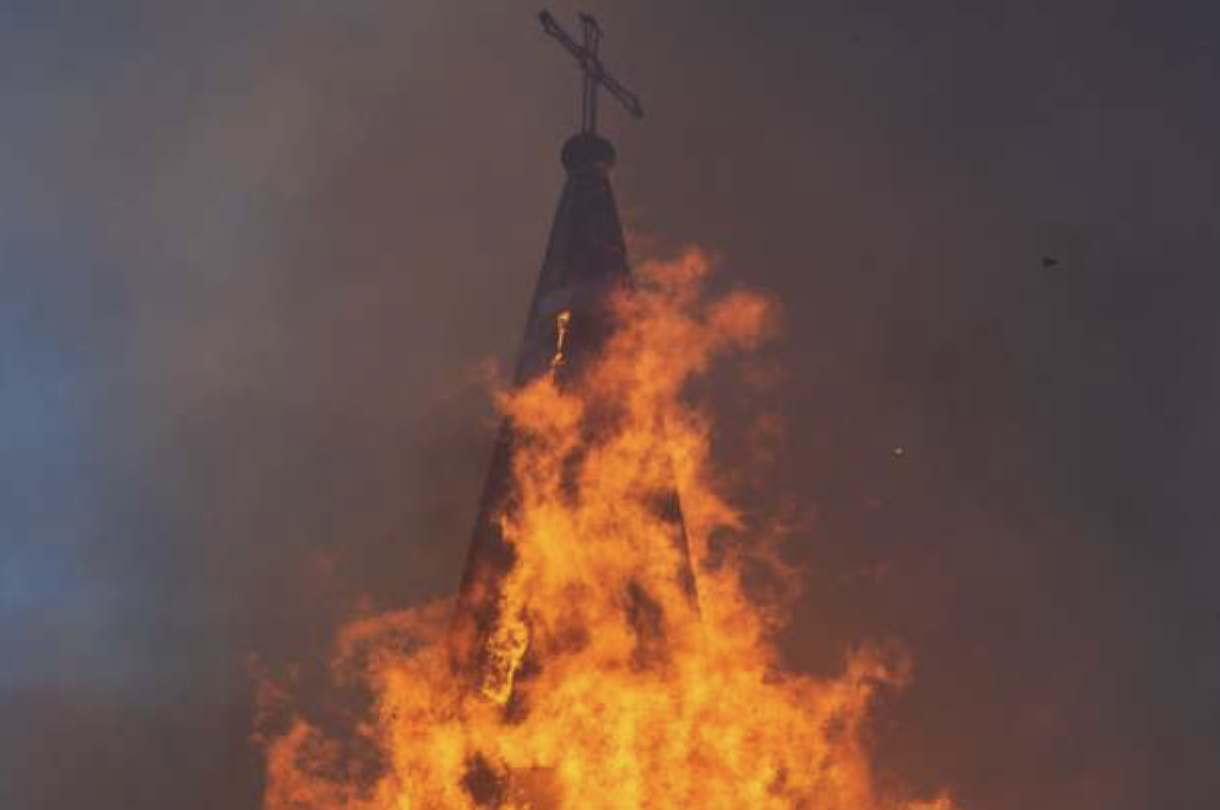
We’ve been here before, unfortunately. The “here” to which I am referring is a rash of suspicious church fires. We saw it pre-pandemic across France, during the COVID-19 outbreak in this country last summer and now in Canada just as the virus seemingly dissipates amid increased vaccinations.

In all, there have been fires at 10 Canadian churches — mostly Catholic ones — and multiple acts of vandalism this summer.

Why? That’s the question more mainstream journalists should be asking. So who not ask it?

This is how the Catholic news website Aleteia reported on the incidents in a July 9 report:

The incidents followed news that Native Canadians have used ground-penetrating radar in cemeteries on the grounds of former residential schools, which were part of a Canadian program to assimilate indigenous peoples. The existence of the cemeteries had been known, but the news this spring and summer has put the controversy over the residential schools back in the limelight.

Many of the schools, which stretched across Canada and were in operation from the mid-19th to the late-20th centuries, were run by Catholic religious orders. A truth and reconciliation commission several years ago detailed the ways children were forcibly removed from their families to be educated in European traditions at the schools, forbidden to use their native languages and forced to drop elements of their Native culture.

Prime Minister Justin Trudeau, who has called for Pope Francis to come to Canada to apologize for the Church’s role in the schools, said last week that he understands the anger behind the church burnings but said it was “not something we should be doing as Canadians.”

The way the indigenous people were treated is certainly a stain on Canada’s history and has been a widely reported news story, as it should be, in Canada as well as the United States. The vandalism churches have suffered stemming from that has been covered as well — but notably absent is any journalistic focus or investigation on who may be responsible for these acts and what motivates them.

Are these church burnings hate crimes, even acts of terrorism?


Please respect our Commenting Policy

Once again, U.S. Supreme Court chooses to punt on a major religious liberty case

Once again, U.S. Supreme Court chooses to punt on a major religious liberty case

Florist Barronelle Stutzman and Robert Ingersoll have shared many details from the 2013 conversation that changed their lives and, perhaps, trends in First Amendment law.

For nine years, Ingersoll was a loyal customer at Arlene's Flowers in Richland, Wash., and that included special work Stutzman did for Valentine's Day and anniversaries with his partner Curt Freed. Then, a year after the state legalized same-sex marriages, Ingersoll asked her to design the flower arrangements for his wedding.

Stutzman took his hand, Ingersoll recalled, and said: "You know I love you dearly. I think you are a wonderful person, but my religion doesn't allow me to do this."

In a written statement to the Christian Science Monitor, Ingersoll wrote: "While trying to remain composed, I was … flooded with emotions and disbelief of what just happened." He knew many Christians rejected gay marriage but was stunned to learn this was true for Stutzman.

As stated in recent U.S. Supreme Court documents: "Barronelle Stutzman is a Christian artist who imagines, designs and creates floral art. … She cannot take part in or create custom art that celebrates sacred ceremonies that violate her faith."

This legal drama appears to have ended with Stutzman's second trip to the high court and its July 2 refusal to review a Washington Supreme Court decision the drew a red line between a citizen's right to hold religious beliefs and the right to freely exercise these beliefs in public life. Supreme Court justices Clarence Thomas, Samuel Alito and Neil Gorsuch backed a review, but lacked a fourth vote.

"This was shocking" to religious conservatives "because Barronelle seemed to have so many favorable facts on her side," said Andrew T. Walker, who teaches ethics at Southern Baptist Theological Seminary.

Stutzman is a 76-year-old grandmother and great-grandmother who faces the loss of her small business and her retirement savings. She has employed gay staffers. She helped Ingersoll find another designer for his wedding flowers. In the progressive Northwest, her Southern Baptist faith clearly makes her part of a religious minority.

"Barronelle is a heretic because she has clashed with today's version of progressivism," said Walker.


Please respect our Commenting Policy

Lawsuits and scarce donors: Religious colleges could be facing tough years ahead

Lawsuits and scarce donors: Religious colleges could be facing tough years ahead

A narrowly-framed Supreme Court victory — the Fulton v. Philadelphia case — will allow Catholic Charities (at least for now) to preserve religious conscience and avoid placing foster children and children available for adoption with same-sex couples, despite the city's non-discrimination statute.

However, this does not settle the many similar legal disputes the media will be covering the next few years.

In particular, reporters will want to carefully monitor Hunter v. U.S. Department of Education, a potentially huge lawsuit filed in Oregon federal court March 29. This is a class action with 33 plaintiffs represented by Portland attorney Paul Southwick, director of the Religious Exemption Accountability Project or REAP (paul@paulsouthwick.com and 503-806-9517). Alliance Defending Freedom, a familiar participant in such matters, has filed a bid to defend the religious schools (media@adflegal.org or 480-444-0020). There are questions about the degree to which the current Justice Department will help in this defense.

The suit charges that LGBTQ students suffer "abuses and unsafe conditions" at "hundreds" of U.S. religious colleges with traditional doctrinal covenants so government should cut off their financial aid. Except for Brigham Young University and the Church of Jesus Christ of Latter-day Saints, REAP's targets are Protestant, led off by Oregon's George Fox University, a venerable Quaker campus attended by Herbert Hoover when it was a mere secondary school. George Fox's mission statement declares that "we desire the presence of Christ to be at the core of all we do."

Others include the likes of Azusa Pacific University, Baylor University, Bob Jones University, Dordt University, Eastern University, Fuller Theological Seminary, Liberty University, Messiah University, Moody Bible Institute, Seattle Pacific University, Union University and Westmont College. (Notably missing: Calvin, Gordon, Wheaton.)

Loss of aid for students would be a severe competitive blow in coming years when all colleges and especially private and religious ones expect to suffer declines in the student-age population and thus in applications, this on top of the institutional damage wrought by COVID-19. There are also prospective attacks on such schools' tax exemption and academic accreditation over sexuality. The status of athletic programs is also a hot-button issue.


Please respect our Commenting Policy

Examining Joe Biden the Catholic is the story, not just what the bishops are doing

Examining Joe Biden the Catholic is the story, not just what the bishops are doing

British singer Winston Marshall, the banjo player for Mumford & Sons, announced that he decided to leave the band. The move came months after he’d faced criticism over a tweet in which he praised journalist Andy Ngo on his recent book — “Unmasked” — about the roots and strategies of the political protest movement known as antifa.

Marshall wrote an op-ed last Thursday for Medium under the headline “Why I’m Leaving Mumford & Sons” is a commentary on the world we live in today.

This is the section of his essay that stood out most for me, in the context of how mainstream journalists are covering America’s Catholic president:

Though there’s nothing wrong with being conservative, when forced to politically label myself I flutter between “centrist,” “liberal” or the more honest “bit this, bit that.” Being labeled erroneously just goes to show how binary political discourse has become. I had criticized the “Left,” so I must be the “Right,” or so their logic goes.

Indeed, it is this “binary political discourse” that dominates our lives these days. It may be a result of social media — Marshall details how he was attacked for his initial tweet and later his apology — in a world where nameless and faceless trolls dictate the discourse.

This takes me to the ongoing fallout from the U.S. bishop’s vote to draft a document that addresses “Eucharistic coherence” continues to be debated. The proposal’s aim is to ultimately decide whether Catholic politicians, like President Joe Biden, should be denied Holy Communion.

The news coverage in secular media on this very complicated theological matter has been disappointing, sub-par even in some cases. It’s no surprise at a time when skilled religion reporters are as hard to spot as a unicorn on stories of this kind. Far too often, political desk reporters at major news organizations cover such religious/theological issues. Politics, after all, is what matters.


Please respect our Commenting Policy

How will this Supreme Court decide, or sidestep, pivotal religious liberty questions?

How will this Supreme Court decide, or sidestep, pivotal religious liberty questions?

The major U.S. Supreme Court ruling in Fulton v. Philadelphia (.pdf here) allows a Catholic agency to avoid placing foster-care children with same-sex couples. Importantly, the Catholics will place gay children and will place children with gay singles since there's no conscience crisis over defying the church's doctrines on marriage.

For decades there's been confusion and acrimony over the court's applications of the Constitution's ban on government "establishment of religion," but now disputes over the religious "free exercise" clause grab the spotlight. The Fulton ruling sidestepped the heart of this generation's conflagration between religious rights and LGBTQ+ rights and, thus, may even have added logs to the fire.

The justices backed the Catholic claim with what The Economist's headline correctly labeled "The 3-3-3 Court." The narrow technical grounds for the decision enabled the three liberals (Stephen Breyer, Elena Kagan, Sonia Maria Sotomayor) to make the ruling unanimous. The conservatives were split between three demanding a thorough overhaul of "free exercise" law (Justice Samuel Alito, in a vigorous 77 pages, joined by Neil Gorsuch and Clarence Thomas) and three unwilling to take the plunge at this time (Chief Justice John Roberts and the two newest members, Brett Kavanaugh and Amy Coney Barrett).

Similar caution apparently underlies the court's majority decision this week not to review transgender student Gavin Grimm's victory against his Virginia school over bathroom access.

Journalists should prepare for more years of extensive -- and expensive -- politicking and litigation before the Supreme Court defines -- or decides not to define -- how First Amendment guarantees apply in 21st Century culture.

For those on the religion beat, it is easy to see that this case has hardened the related conflict among major denominations.


Please respect our Commenting Policy

Newsy thinking about SCOTUS, sports images, religious liberty and the Sexual Revolution

Newsy thinking about SCOTUS, sports images, religious liberty and the Sexual Revolution

Wait, you mean there was another important religion story during the traffic jam of stories about the right vs. further right showdown at the Southern Baptist Convention and America’s Catholic bishops arguing about Holy Communion, the Catechism and liberal Catholic politicos?

Obviously, I noticed headlines such as this one in the Washington Post: “Supreme Court unanimously rules for Catholic group in Philadelphia foster-care dispute.”

The word “unanimous” is certainly important, in the fractured age in which we live. But look for the other crucial word in the overture on that story:

The Supreme Court ruled unanimously … that Philadelphia was wrong to end a Catholic group’s contract to provide foster-care services because the organization refused to work with same-sex couples.

It was the latest victory for religious organizations at the increasingly conservative court, and the second time it has ruled against governments trying to enforce an anti-discrimination law protecting LGBTQ rights against those claiming religious liberty.

But the opinion, written by Chief Justice John G. Roberts Jr., was narrow enough to draw the support of the court’s three liberals — and the consternation of its three most conservative members for not going further.

Obviously, the crucial word is “but.” This ruling encouraged some church-state conservatives, but also provided some hope for those who believe that the Sexual Revolution will, more often than not, trump the free exercise of religion.

So, it’s time for two think pieces that explore the degree to which this ruling was a win for religious liberty.

No surprise here: Religious liberty pro David French, of The Dispatch, was encouraged: “Four Things You Need to Know After a Huge Day at SCOTUS — ‘Good night, Employment Division v. Smith. Good work. Sleep well. I’ll most likely kill you in the morning​.’ “ Here is his reaction, at the level of SCOTUS personalities:


Please respect our Commenting Policy

Chicago Tribune's take on Moody Bible student lacks some tough, logical questions

Chicago Tribune's take on Moody Bible student lacks some tough, logical questions

One of the rules of journalism is to make clear why a reader should care what you’re writing about.

One way to make that happen is to choose a sympathetic figure. Personal stories are always easier to grasp than abstract concepts such as teachings, doctrines and beliefs. This principle has been used brilliantly by movements seeking to push modernist ideas, such as gay marriage. It’s one thing to oppose the idea; it’s another to oppose two human beings right in front of you.

Those of us who covered the Episcopal Church’s slide from an influential denomination of 3.6 million members into a fast-declining church of 1.8 million saw this principle used repeatedly in the 1990s and 2000s. Whenever the denomination wanted to push some novel sexual idea, it put forth stories of the courageous individuals who indulged in such practices. Such folks were easier to like than the seemingly stodgy types who were bent on keeping to the old ways.

All of which is why the Chicago Tribune chose a 24-year-old lesbian who was hounded by Moody Bible Institute administrators to be the face of a new lawsuit. An engaging dissident with a compelling story was far more interesting than the traditional institution she was fighting. The story begins:

Megan Steffen had completed all her college coursework at Moody Bible Institute and was at home with her parents in Michigan, waiting to graduate, when she got an email from the school, telling her an administrator needed to talk with her.

She agreed to a meeting via Zoom, where she learned that faculty members at the conservative Christian college had raised objections to her graduation.

Which was in 2020, by the way.

Then the two administrators on the Zoom call began asking questions, among them: Had Steffen ever had romantic or sexual relations with a woman? Had she ever dated men? Did she envision dating women in the future?


Please respect our Commenting Policy