
Pope Francis

Big setup, big letdown: New York Times on Luis Palau event

The New York Times did a promising advance for Luis Palau's CityFest, then let the follow-up slide. The newspaper used the occasion for an indepth on the growth of evangelical Christianity in New York, highlighting the role of immigrants. But the event coverage was pedestrian, paint-by-the-numbers, almost as if the Times had lost interest by then.

The 1,500-word advance has some strong virtues. It tells of the patient but exuberant preparations for the July 10 event. It provides a peek into the festive, exuberant Sunday worship of some of the churches. It tells how they serve immigrants on several levels: spiritual, social and cultural. And it quotes a variety of evangelicals: Haitian, Ecuadoran, Salvadoran, Trinidadian.

"The size of the festival belies the city’s secular reputation and speaks to the vibrant evangelical movement in New York," the Times says. At times it sounds almost affectionate for the main speaker, without injecting stereotypes about the religious right:


Nearly 900 of the 1,700 churches participating in the festival are Hispanic, organizers said. Latino leaders were the ones two years ago to invite Mr. Palau, an endearing, white-haired bilingual immigrant from Argentina who has built a reputation as the Hispanic Billy Graham, but African-American and Korean-American church leaders quickly got involved in the planning.
The six-hour event is expected to highlight the multidenominational and multiethnic flavor of evangelical Christianity in New York and its suburbs, drawing hundreds of churches whose members also hail from the Caribbean, Africa and Asia.
"What the Palau Festival has been able to do is catalyze a growing movement of Christian voices present in the city," said Gabriel Salguero, a pastor of a multiethnic church in Manhattan’s Chinatown and the president of the National Latino Evangelical Coalition. It represents, he added, a "coming-of-age of immigrant evangelicals" in New York.

While numbers aren't easy to come by, the newspaper does a decent job. It also gives some "whys" for the rise of evangelicalism:

Please respect our Commenting Policy

New York Times seeks political (as opposed to pastoral) content of Wedding at Cana

The Pope Francis guy is still traveling around down there in South America and, gosh dang it, he keeps preaching sermons. Isn't that unkind of him?

These sermons, of course, mix commentary about Catholic teachings and life in the public square -- as if the pope was arguing that faith and life are on the same level, as opposed to real life being on the ground floor in the created order, with religious truth claims either (a) locked in a private closet or (b) mysterious things that are stored, with God, in an attic above our heads (perhaps one without a pull-down ladder, even).

Once again, I am not arguing that journalists have to believe what the pope believes. I am not arguing that they need to produce sermon summaries or evangelistic pamphlets. I am saying that, in order to accurately cover him, journalists need to understand that this man is not delivering political stump speeches as he stands at pulpits next to altars at which he will celebrate the Mass.

Pope Francis is preaching. The faith elements are part of the content, not words that create an irrelevant frame for the real news, which by definition has to be about politics.

This conflicts, as I said the other day, with the "mainstream journalism Grand Unified Theory" stating that "no matter what the pope cites as his reasons for visiting a land or region, he is actually there for political reasons. He is there in an attempt to impact the lives of real people through political ideas or actions (as opposed to through sacraments, biblical truth, etc.)."

Now, to its credit, the New York Times team attempted, the other day, to cover a sermon while leaving some of the religious language intact. There is even a biblical reference in there! Here's the lede:


Please respect our Commenting Policy

Pope Francis travels to South America to talk climate change (and, maybe, Jesus)

Once again, the pope is travelling. This means that, once again, readers get to observe one of the iron-clad laws that govern religion-news coverage at work.

This chunk of the mainstream journalism Grand Unified Theory states that, no matter what the pope cites as his reasons for visiting a land or region, he is actually there for political reasons. He is there in an attempt to impact the lives of real people through political ideas or actions (as opposed to through sacraments, biblical truth, etc.) Then again, he might be there because of something that is going on in church politics. Reporters are allowed to consider that option.

In this case, Pope Francis is back home in South America where, in a welcoming ceremony at Ecuador’s Quito International airport. he offered the following reasons for this trip:

Pope Francis ... spoke to a delegation which included Ecuador’s president, Rafael Correa, government authorities, and his fellow bishops. The Pope told the delegation that his reason for coming to Ecuador was to be “a witness of God’s mercy and of faith in Jesus Christ.”

Wait. That isn't the reason for the journey quoted in your main news source?

Oh, right. That quote is from the Catholic News Agency report, which actually used a lede that combined both the sacred and the secular language from the Pope Francis arrival rite.


Please respect our Commenting Policy

The papal encyclical: Challenging coverage and advancing the story

The papal encyclical: Challenging coverage and advancing the story

Remember Joseph Stalin's nasty and dismissive line, one version of which goes, "The pope? How many divisions does he have?”? Or maybe he actually said, “How many divisions does the pope of Rome have?”

Hard to say. Both versions are floating around the Internet.

No matter. The implication is clear in both instances. The Vatican long ago lost a considerable portion of its worldly power that once allowed it to impose its will not only on the preponderance of Roman Catholics, but on much of non-Catholic humanity.

This should be obvious to GetReligion readers. Should you require evidence, however, the recent vote legalizing same-sex marriage in once staunchly traditional, Catholic Ireland should serve as a clincher.

The Vatican's diminished influence is also obvious in much of the general media's coverage of Pope Francis' environmental encyclical, Laudato Si -- notwithstanding all the headlines it generated. 

Francis emphasized the moral challenge he believes is key to slowing human-influenced climate change and to furthering a sustainable global environmental policy that fosters economic justice. His moral argument -- a harsh critique of rapacious capitalist practices and unbridled consumerism -- warned of the negative consequences of current policies for all the world, but, in particular, for the poor and powerless. 

But get past the lede of most renditions of the story -- most prominently in the follow up coverage -- and you find that the Vatican's message was not the dominate theme.


Please respect our Commenting Policy

Welcoming sinners? Welcoming doctrinal change? Return of the pope as Machiavelli theory

So the powers that be at the Vatican have released a crucial document -- a “instrumentum laboris” -- setting the table for this fall's much-anticipated gathering to hash out issues related to marriage and family life. The ever quotable blogger Rocco Palmo has called it the "fight card" for Rome's "Main Event of 2015."

So there.

As you would expect, that Palmo quote -- with many others from Vatican insiders and officials -- made it into the Religion News Service news feature about the document. Quite frankly, this piece does a decent job of quoting Catholics who yearn for doctrinal change, while also stressing that the document keeps repeating and affirming major chunks of the church's moral traditions that have stood for 2,000 or so.

It's not bad. It's not an editorial-page piece hidden under a news headline.

However, right at the top, the piece gently frames the whole debate -- as usual -- in a way that seems to pit Pope Francis against the basic doctrines of his church. Here's the top of this news feature. See if you can spot the key word that frames the piece (oh, right, while ignoring the art with this post).

VATICAN CITY (RNS) Vatican officials on Tuesday (June 23) released a document on family values -- a precursor to a major meeting in October -- that underscores the ongoing tension between Pope Francis’ desire for a more “welcoming” church and the need to hew to long-standing tradition and doctrine.


Please respect our Commenting Policy

Rare mid-week think piece: That communitarian Pope Francis encyclical said what?

I realize that it's rare for your GetReligionistas to serve up one of our "think pieces" in the middle of the week, but, frankly, I am still digging out from the move to East Tennessee and missed this handy little essay this past weekend. So here we go.

Has anyone else been amazed that so much of the coverage of the papal encyclical Laudato Si (full English text here) has (a) tried to turn it into a truly radical political document and (b) seemed to suggest, as usual, that Pope Francis is the first occupant of the Throne of St. Peter to wade into these troubled waters.

I mean, this document has all kinds of things in it, including -- for liberals, surely -- some highly troubling language in which the pope's communitarian and Catholic moral vision is applied to, let's say, abortion:

120. Since everything is interrelated, concern for the protection of nature is also incompatible with the justification of abortion. How can we genuinely teach the importance of concern for other vulnerable beings, however troublesome or inconvenient they may be, if we fail to protect a human embryo, even when its presence is uncomfortable and creates difficulties?

Or how about that passage that many are interpreting as a statement addressing life choices facing those who see themselves as transsexuals?


Please respect our Commenting Policy

That other papal statement: Here's your rare 250-word RNS report on a gay-rights issue

And now for something completely different. Let's take a glance at some mainstream news coverage of that other recent pronouncement by Pope Francis, the one that didn't get very much ink.

Why is that? Well, the problem is that the pope, in this case, warmly and publicly embraced a key element of Catholic moral theology linked to marriage and sexuality. This is not the sort of thing that ends up getting major play in major American newspapers.

What did the pope say? Speaking on issues linked to parenting, at a conference held by the Diocese of Rome, Francis noted the following while talking about the meaning of "communion," with a small "c":

… Being parents is based on the diversity of being male and female, as the Bible reminds us. This is the 'first' and most fundamental difference, constitutive of the human being. It is a wealth. Differences are wealth. …
"We men learn to recognise, through the female figures we encounter in life, the extraordinary beauty that women bear. And women follow a similar path, learning from male figures that the man is different and has his own way of feeling, understanding and living. And this communion in difference is very important also in the education of children”.

In the end, the pope issued a ringing affirmation of traditional marriage and the importance of children having both a mother and a father. In the current context, this is rather a rather shocking statement and worthy of coverage, even though it is basic, orthodox, 2,000 year-old Christian doctrine.

This is the kind of statement, in other words, that was granted a 250-word, bare-bones news report by the Religion News Service.


Please respect our Commenting Policy

Global warming: Media rush to interpret what pope says, even before he says it (Updated)

You may have heard of a spinning storm like Tropical Storm Bill -- but have you ever seen the spin before the storm?

You have if you’ve read much about Pope Francis' encyclical on the environment. It hasn't even come out yet -- it's scheduled to be released today -- but already, tongues are waggin' and tweets are twittering.

Laudato Sii, or "Praised Be," is supposed to balance reflections on science, economics and compassion for the poor surrounding climate change. But the message is already in danger of being drowned out by spin doctors, both liberal and conservative -- and anger over media that leaked a version of the document.

Among the cheerleaders is the Los Angeles Times' breathless advance piece. The story throws a bone to conservatives who think the encyclical could "roil the American presidential race by injecting religion into the already contentious politics of global warming." But all the direct quotes go to liberals who applaud what they think Francis is about to say (remember, the letter hasn't even come out yet!).

And the newspaper's own attitude is evident from this:

Viewed by some as a bold act by the pope to sway opinion on a controversial issue, the encyclical in many ways reflects a movement that has been growing for decades, sometimes on the margins, with some Catholic and Christian academics and individual church leaders and congregations increasingly making “creation care” a theological pursuit and a central ministry. In some cases, the approach has helped churches reconnect with people who felt Catholicism and other denominations had become too concerned with divisive cultural issues such as abortion and same-sex marriage. Many of those groups believe they have a formidable new ally.

Reuters chimes in, saying how "keenly awaited" has been the encyclical, which is "destined to become a signature document of his papacy."

Reuters puts Francis on the side of the angels, aka scientists:


Please respect our Commenting Policy

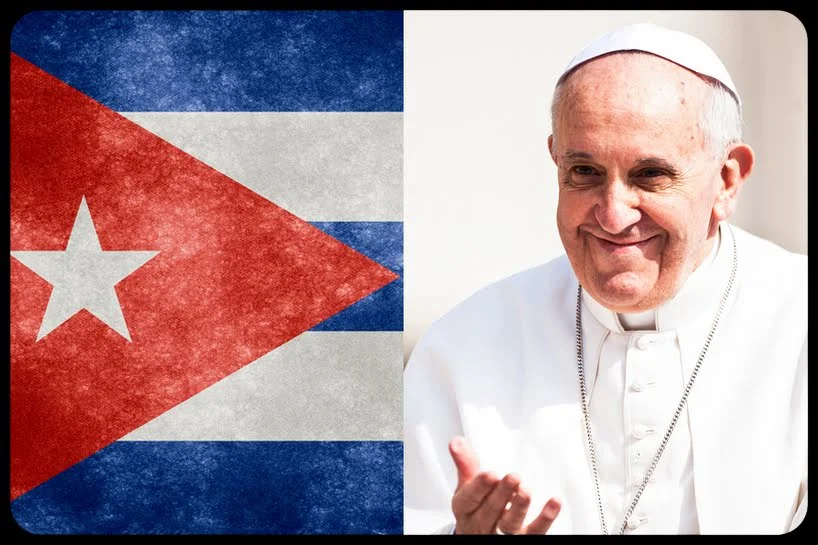
Religion in Cuba ahead of visit by Pope Francis: Think politics, politics, politics

Religion in Cuba ahead of visit by Pope Francis: Think politics, politics, politics

My fascination with Cuba began in my late teens when I discovered traditional Cuban dance music, which I much preferred to the bubble-gum rock that had supplanted the doo-wop sound, my first musical love. My friends and I -- middle class Jewish guys from New York City's outer boroughs -- referred to the music as "Latin;" today it's know as "salsa," a catch-all term that fails miserably, as did Latin, to do justice to the many musical forms that comprise the rhythmic complexity of the Cuban musical palate.

By the early 1960s, we were regulars on the New York Latin dance scene. One of our wider circle actually become one of salsa's biggest stars. That would be Larry Harlow, nicknamed El Judeo Maravilloso (the Marvelous Jew), who began life as Lawrence Ira Kahn. Go figure.

Our access to the music was greatly, if inadvertently, facilitated by Fidel Castro, who's revolutionary success in 1959 prompted many of Cuba's greatest musicians to flee to the U.S. for the artistic freedom that trumped any revolutionary zeal they harbored. 

I got to Cuba in 1998 to cover the visit of Pope John Paul II and I hope to return there later this year or next with three high school-era friends for a bucket-list musical tour of the island nation. In the meantime, I read all I can about contemporary Cuba, including this recent Washington Post piece that touted what was called a Cuban religious resurgence.

Here's a few graphs that convey the news feature's central point:


Please respect our Commenting Policy